Tight Trade-off Between Internal, Assisted, and External Entanglement
Pith reviewed 2026-05-10 05:12 UTC · model grok-4.3
The pith
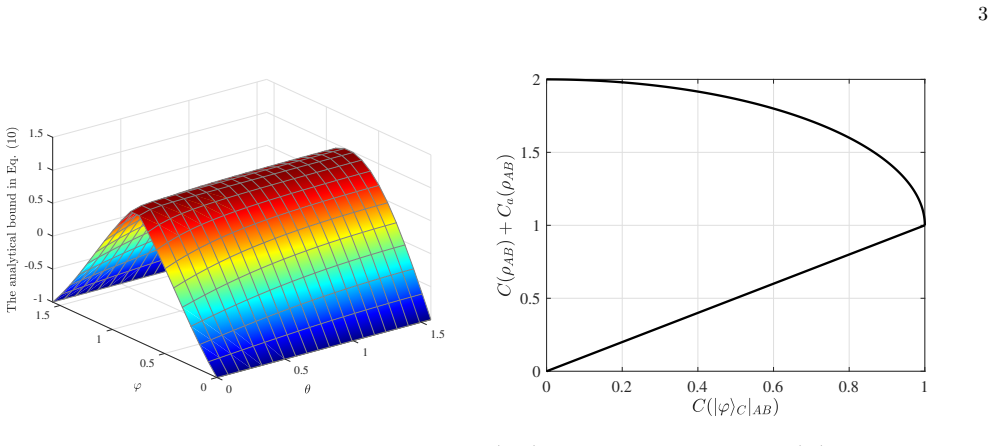
A monogamy relation tightly bounds the sum of concurrence and concurrence of assistance by entanglement with an external qubit for three-qubit pure states.
A machine-rendered reading of the paper's core claim, the machinery that carries it, and where it could break.
Core claim
The authors establish a tight and saturable monogamy relation for three-qubit pure states in which the sum of the concurrence between one pair of qubits and the concurrence of assistance between another pair is upper-bounded by a decreasing function of the entanglement between the remaining qubit and an external qubit; the bound is saturated for certain states and the inequality also holds in equivalent form when concurrence is replaced by negativity and its convex-roof extensions.
What carries the argument
The saturable monogamy inequality that trades the sum of concurrence and concurrence of assistance against the amount of external entanglement, with the upper bound decreasing strictly as external entanglement grows.
Load-bearing premise
The three-qubit states are pure and the standard properties of concurrence, concurrence of assistance, and negativity continue to hold when these measures are extended to mixed states via convex-roof constructions.
What would settle it
A pure three-qubit state in which the measured sum of concurrence and concurrence of assistance exceeds the value of the derived bound for the observed external entanglement would disprove the claimed relation.
Figures
read the original abstract
We derive a tight and saturable monogamy relation for three-qubit pure states that bounds the sum of concurrence and concurrence of assistance by the entanglement with an external qubit. The bound decreases strictly with increasing external entanglement, establishing a precise trade-off between internal and environment-induced entanglement. Equivalent formulations in terms of negativity and its convex-roof extensions follow. Our result provides a unified and quantitative constraint on entanglement distribution in open multipartite quantum systems.
Editorial analysis
A structured set of objections, weighed in public.
Referee Report
Summary. The manuscript derives a tight and saturable monogamy inequality for pure three-qubit states that upper-bounds the sum of concurrence C(ρ_AB) and concurrence of assistance C_a(ρ_AB) by a strictly decreasing function of the entanglement between the AB pair and an external qubit C. Equivalent formulations are given in terms of negativity and its convex-roof extensions. Equality cases are exhibited for W-class and GHZ-class states via explicit algebraic manipulation of the two-qubit reduced density matrix.
Significance. If the derivation holds, the result supplies a precise quantitative trade-off between internal (assisted) entanglement and external entanglement in open multipartite systems, extending standard monogamy relations with an explicit, saturable bound. The identification of equality cases for standard state classes and the provision of equivalent negativity forms are strengths that enhance applicability to entanglement distribution constraints.
minor comments (3)
- §2, Eq. (5): the definition of the external entanglement measure E_ext should explicitly state whether it is the concurrence or negativity of the reduced state ρ_{ABC} with respect to the AB bipartition, to avoid ambiguity with the internal measures.
- Figure 2: the plot of the bound versus external entanglement lacks error bars or sampling details for the numerical verification of tightness; adding these would strengthen the visual evidence.
- The introduction cites several monogamy papers but omits the original Coffman-Kundu-Wootters 2000 work on three-qubit concurrence monogamy; adding this reference would improve context.
Simulated Author's Rebuttal
We thank the referee for the positive assessment of our manuscript and the recommendation for minor revision. No specific major comments were provided in the report, so there are no technical points requiring rebuttal or clarification. We will address any minor editorial suggestions in the revised version.
Circularity Check
No significant circularity in the derivation
full rationale
The manuscript derives the tight monogamy relation via explicit algebraic manipulation of the two-qubit reduced density matrix for pure three-qubit states. Concurrence C and concurrence of assistance C_a are applied using their standard definitions and convex-roof extensions, leading to the bound through inequality chains that are verified to be tight for W-class and GHZ-class states. No steps reduce to self-definition, fitted inputs renamed as predictions, or load-bearing self-citations. The derivation is self-contained and independent of the target result.
Axiom & Free-Parameter Ledger
axioms (1)
- domain assumption Standard definitions and convex-roof extensions of concurrence and negativity for qubit systems
Reference graph
Works this paper leans on
- [1]
-
[2]
B. M. Terhal, Is entanglement monogamous? IBM J. Res. Dev . 48, 71 (2004)
work page 2004
-
[3]
M. Paw/suppress lowski, Security proof for cryptographic protocols based only on the monogamy of Bell’s inequality violatio ns, Phys. Rev. A 82, 032313 (2010)
work page 2010
-
[4]
A. Ac ´ ın, N. Gisin, and L. Masanes, From Bell’s theorem to secure quantum key distribution, Phys. Rev. Lett. 97, 120405 (2006)
work page 2006
-
[5]
M. Tomamichel, S. Fehr, J. Kaniewski, and S. Wehner, A mon ogamy-of-entanglement game with applications to device- independent quantum cryptography, New J. Phys. 15, 103002 (2013)
work page 2013
-
[6]
M. P. Seevinck, Monogamy of correlations versus monogam y of entanglement, Quantum Inf. Process. 9, 273 (2010)
work page 2010
-
[7]
X. Ma, B. Dakic, W. Naylor, A. Zeilinger, and P. Walther, Q uantum simulation of the wavefunction to probe frustrated Heisenberg spin systems, Nat. Phys. 7, 399 (2011)
work page 2011
-
[8]
E. Verlinde and H. Verlinde, Black hole entanglement and quantum error correction, J. High Energy Phys. 1310, 107 (2013)
work page 2013
-
[9]
T. J. Osborne and F. Verstraete, General monogamy inequa lity for bipartite qubit entanglement, Phys. Rev. Lett. 96, 220503 (2006)
work page 2006
-
[10]
Y. C. Ou and H. Fan, Monogamy inequality in terms of negat ivity for three-qubit states, Phys. Rev. A 75, 062308 (2007)
work page 2007
- [11]
-
[12]
Y. K. Bai, Y. F. Xu, and Z. D. Wang, General monogamy relat ion for the entanglement of formation in multiqubit systems , Phys. Rev. Lett. 113, 100503 (2014)
work page 2014
-
[13]
M. Koashi and A. Winter, Monogamy of entanglement and ot her correlations, Phys. Rev. A 69, 022309 (2004)
work page 2004
- [14]
-
[15]
C. Lancien, S. Di Martino, M. Huber, M. Piani, G. Adesso, and A. Winter, Should entanglement measures be monogamous or faithful? Phys. Rev. Lett. 117, 060501 (2016)
work page 2016
-
[16]
G. L. Giorgi, Monogamy properties of quantum and classi cal correlations, Phys. Rev. A 84, 054301 (2011)
work page 2011
-
[17]
Camalet, Monogamy inequality for entanglement and l ocal contextuality, Phys
S. Camalet, Monogamy inequality for entanglement and l ocal contextuality, Phys. Rev. A 95, 062329 (2017)
work page 2017
-
[18]
Camalet, Internal entanglement and external correl ations of any form limit each other, Phys
S. Camalet, Internal entanglement and external correl ations of any form limit each other, Phys. Rev. Lett. 121, 060504 (2018)
work page 2018
-
[19]
Camalet, Monogamy inequality for any local quantum r esource and entanglement, Phys
S. Camalet, Monogamy inequality for any local quantum r esource and entanglement, Phys. Rev. Lett. 119, 110503 (2017)
work page 2017
- [20]
- [21]
-
[22]
T. Laustsen, F. Verstraete, and S. J. van Enk, Local vs. j oint measurements for the entanglement of assistance, Quan tum Inf. Comput. 3, 64–83 (2003)
work page 2003
-
[23]
G. Vidal and R. F. Werner, Computable measure of entangl ement, Phys. Rev. A 65, 032314 (2002)
work page 2002
-
[24]
M. B. Plenio, Logarithmic negativity: A full entanglem ent monotone that is not convex, Phys. Rev. Lett. 95, 090503 (2005)
work page 2005
-
[25]
K. ˙Zyczkowski, P. Horodecki, A. Sanpera, and M. Lewenstein, Vo lume of the set of separable states, Phys. Rev. A 58, 883 (1998)
work page 1998
-
[26]
S. Lee, D. P. Chi, S. D. Oh, and J. Kim, Convex-roof extend ed negativity as an entanglement measure for bipartite quantum systems, Phys. Rev. A 68, 062304 (2003)
work page 2003
-
[27]
J. S. Kim, A. Das, and B. C. Sanders, Entanglement monoga my of multipartite higher-dimensional quantum systems usi ng convex-roof extended negativity, Phys. Rev. A 79, 012329 (2009)
work page 2009
-
[28]
A. Ac ´ ın, A. Andrianov, L. Costa, E. Jan´ e, J. I. Latorre, and R. Tarrach, Generalized Schmidt decomposition and cla ssifi- cation of three-qubit states, Phys. Rev. Lett. 85, 1560 (2000). Supplemental Material In this Supplemental Material we prove the main theorem of the Let ter. 5 Theorem.—For any three-qubit pure state |ψ ⟩ABC with ρAB = TrC (|ψ ⟩ABC...
work page 2000
-
[29]
(S9) Step 2: Maximization at fixed (λ 0,λ 3,λ 4)
+ (λ 2λ 3 +λ 1λ 4)2. (S9) Step 2: Maximization at fixed (λ 0,λ 3,λ 4). Fix (λ 0,λ 3,λ 4), so that r and s are fixed, and maximize Awc over (λ 1,λ 2) subject to λ 2 1 +λ 2 2 =s. Let u := (λ 1,λ 2)T. Then Awc =λ 2 0λ 2 4 +uTNu, N := ( λ 2 4 λ 3λ 4 λ 3λ 4 λ 2 3 +λ 2 0 ) . 6 The matrix N is positive semidefinite because Tr(N ) = λ 2 0 +λ 2 3 +λ 2 4 ≥ 0, det(N ) ...
discussion (0)
Sign in with ORCID, Apple, or X to comment. Anyone can read and Pith papers without signing in.