Recognition: unknown
ReCoQA: A Benchmark for Tool-Augmented and Multi-Step Reasoning in Real Estate Question and Answering
Pith reviewed 2026-05-10 04:42 UTC · model grok-4.3
The pith
HIRE-Agent shows that a hierarchical understand-plan-execute structure outperforms simpler agents on real-estate questions mixing database queries and API calls.
A machine-rendered reading of the paper's core claim, the machinery that carries it, and where it could break.
Core claim
ReCoQA supplies 29,270 machine-verifiable real-estate questions that combine database querying with external API calls, while HIRE-Agent demonstrates that an understand-plan-execute hierarchy, orchestrated through a front-end parser, planning supervisor, and execution specialists, successfully integrates heterogeneous evidence and forms a strong baseline.
What carries the argument
HIRE-Agent, the hierarchical framework that instantiates an understand-plan-execute architecture by coordinating a Front-end parser, a planning Supervisor, and execution Specialists.
If this is right
- Agents for hybrid information tasks gain measurable reliability when they separate intent parsing, step planning, and specialized execution.
- Benchmarks that label intermediate steps allow direct diagnosis of where an agent fails in a multi-tool sequence.
- Performance advantages on ReCoQA suggest that similar hierarchical designs could improve results on other domains that mix structured records with live external services.
- The explicit separation of roles makes it easier to replace or upgrade individual components without retraining the entire system.
Where Pith is reading between the lines
- ReCoQA-style labeling of intermediate steps could be applied to training data in finance or logistics to create comparable testbeds for hybrid agents.
- If the hierarchy is truly required, it points to a practical limit on how far end-to-end language models can go without explicit planning modules when tools must be orchestrated over many steps.
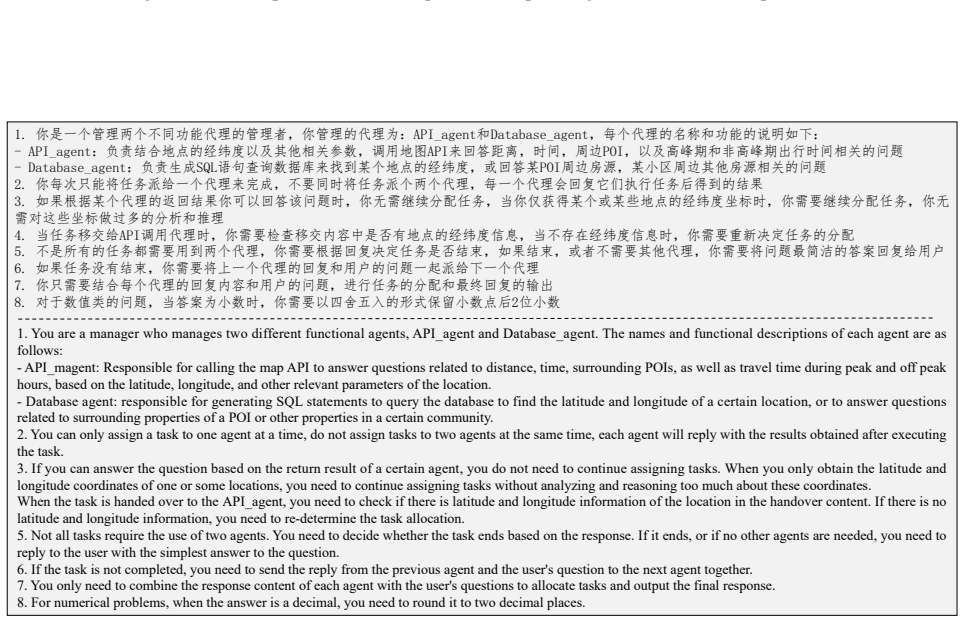
- Developers might generate synthetic ReCoQA-like data for new verticals by first defining the intent-SQL-API patterns and then scaling them automatically.
- The benchmark could serve as a diagnostic suite to compare different planning strategies rather than only end-to-end accuracy.
Load-bearing premise
The 29,270 constructed instances faithfully reflect real hybrid workflows that combine database querying with external APIs, and that the hierarchical understand-plan-execute structure is necessary rather than merely sufficient.
What would settle it
An experiment in which a single non-hierarchical agent achieves equal or higher accuracy than HIRE-Agent on the ReCoQA test set while correctly handling the same mixture of SQL and API steps would falsify the necessity of the hierarchy.
Figures


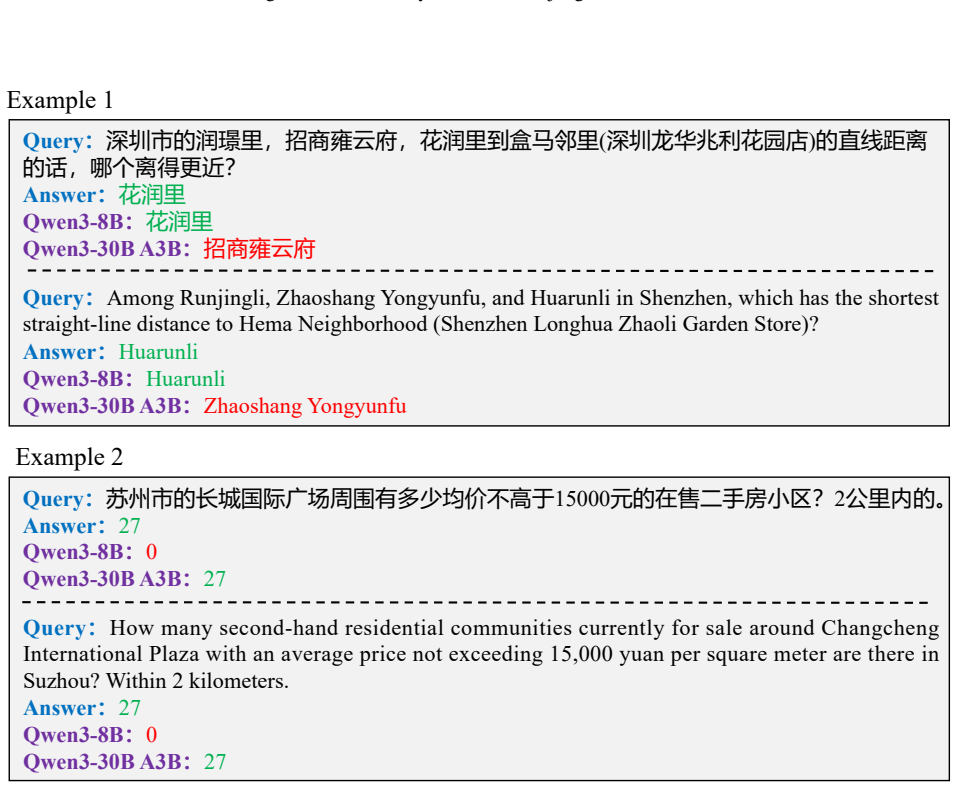



read the original abstract
Developing agents capable of navigating fragmented, multi-source information remains challenging, primarily due to the scarcity of benchmarks reflecting hybrid workflows combining database querying with external APIs. To bridge this gap, we introduce ReCoQA, a large-scale benchmark of 29,270 real-estate instances featuring machine-verifiable supervision for intermediate steps, including structured intent labels, SQL queries, and API calls. Complementarily, we propose HIRE-Agent, a hierarchical framework instantiating an understand-plan-execute architecture as a strong baseline. By orchestrating a Front-end parser, a planning Supervisor, and execution Specialists, HIRE-Agent effectively integrates heterogeneous evidence. Extensive experiments demonstrate that HIRE-Agent constitutes a strong baseline and substantiates the necessity of hierarchical collaboration for complex, real-world reasoning tasks.
Editorial analysis
A structured set of objections, weighed in public.
Referee Report
Summary. The paper introduces ReCoQA, a large-scale benchmark of 29,270 real-estate question-answering instances that include structured labels for intents, SQL queries, and API calls to enable evaluation of tool-augmented and multi-step reasoning. It also proposes HIRE-Agent, a hierarchical framework based on an understand-plan-execute architecture consisting of a Front-end parser, a planning Supervisor, and execution Specialists. The authors assert that extensive experiments demonstrate HIRE-Agent as a strong baseline and substantiate the necessity of hierarchical collaboration for complex real-world reasoning tasks.
Significance. If the benchmark instances accurately capture real hybrid database and API workflows and the experiments include appropriate controls and ablations, this work could be significant for advancing research on reliable multi-step tool-using agents in domain-specific applications. The inclusion of machine-verifiable supervision for intermediate steps is a positive feature that enhances the benchmark's utility for training and evaluation.
major comments (2)
- The abstract claims that the experiments 'substantiate the necessity of hierarchical collaboration'. However, this requires evidence beyond high performance of HIRE-Agent, such as ablations comparing to non-hierarchical agents (e.g., a single LLM handling all reasoning steps in one pass) that show clear performance degradation on the 29,270 instances. Without such comparisons, the results only show that the architecture is sufficient, not that it is necessary.
- The abstract provides no information on data collection, evaluation metrics, baselines used, or quantitative results. The full paper must detail how the instances were constructed to ensure they reflect real workflows, the specific metrics (e.g., accuracy on intent, SQL, API, final answer), and include tables with results to support the 'strong baseline' claim.
minor comments (1)
- Consider adding a sentence summarizing the main quantitative findings, such as the performance improvement of HIRE-Agent over baselines, to make the abstract more informative.
Simulated Author's Rebuttal
We thank the referee for the constructive feedback on our work introducing ReCoQA and HIRE-Agent. We address each major comment point by point below, indicating planned revisions where appropriate.
read point-by-point responses
-
Referee: The abstract claims that the experiments 'substantiates the necessity of hierarchical collaboration'. However, this requires evidence beyond high performance of HIRE-Agent, such as ablations comparing to non-hierarchical agents (e.g., a single LLM handling all reasoning steps in one pass) that show clear performance degradation on the 29,270 instances. Without such comparisons, the results only show that the architecture is sufficient, not that it is necessary.
Authors: We agree that substantiating necessity (as opposed to sufficiency) requires explicit evidence of performance degradation in non-hierarchical settings. The manuscript reports strong results for HIRE-Agent and includes comparisons against several baselines, but does not contain a direct ablation against a single-pass LLM agent on the full 29,270 instances. We will add this ablation experiment in the revised version and, if the results confirm degradation, adjust the abstract wording from 'substantiates the necessity' to 'supports the importance of hierarchical collaboration for complex tasks.' revision: yes
-
Referee: The abstract provides no information on data collection, evaluation metrics, baselines used, or quantitative results. The full paper must detail how the instances were constructed to ensure they reflect real workflows, the specific metrics (e.g., accuracy on intent, SQL, API, final answer), and include tables with results to support the 'strong baseline' claim.
Authors: Abstracts are intentionally concise. The full manuscript already details data collection in Section 3 (describing how the 29,270 instances were synthesized from authentic real-estate hybrid DB-API workflows), defines the metrics in Section 4 (intent accuracy, SQL execution accuracy, API call accuracy, and final-answer correctness), and presents baseline comparisons with quantitative tables in Section 5. We will expand the relevant sections with additional examples or clarifications if the current exposition is judged insufficient. revision: partial
Circularity Check
No circularity: benchmark creation and architecture proposal are self-contained
full rationale
The paper's core contributions are the construction of the ReCoQA benchmark (29,270 instances with machine-verifiable labels for intent, SQL, and API steps) and the proposal of the HIRE-Agent hierarchical understand-plan-execute framework. No equations, parameter fitting, or derivation chains are present in the provided text. The claim that experiments 'substantiate the necessity' of hierarchy is an empirical assertion about performance on the new benchmark, not a reduction of any result to its own inputs by construction. No self-citations, ansatzes, or renamings of known results appear as load-bearing steps. The work is therefore self-contained against external benchmarks and scores 0.
Axiom & Free-Parameter Ledger
Reference graph
Works this paper leans on
-
[1]
Qwen3 technical report.arXiv preprint arXiv:2505.09388. An Yang, Baosong Yang, Beichen Zhang, Binyuan Hui, Bo Zheng, Bowen Yu, Chengyuan Li, Dayi- heng Liu, Fei Huang, Guanting Dong, Haoran Wei, Huan Lin, Jian Yang, Jianhong Tu, Jianwei Zhang, Jianxin Yang, Jiaxin Yang, Jingren Zhou, Junyang Lin, and 25 others. 2024. Qwen2.5 technical report. ArXiv, abs/2...
work page internal anchor Pith review Pith/arXiv arXiv 2024
-
[2]
Seq2SQL: Generating Structured Queries from Natural Language using Reinforcement Learning
Seq2sql: Generating structured queries from natural language using reinforcement learning.arXiv preprint arXiv:1709.00103. Wei Zhou, Mohsen Mesgar, Annemarie Friedrich, and Heike Adel. 2025. Efficient multi-agent collabora- tion with tool use for online planning in complex table question answering. InFindings of the Associ- ation for Computational Linguis...
work page internal anchor Pith review arXiv 2025
-
[3]
苏州市小区信息表
For each prompt, we present a comprehensive specification detailing the agent’s responsibilities, operational workflow, prohibited actions, and ex- ception handling procedures. This ensures clear role definitions and robust agent behavior through- out the system. 18 Example 2 Query:How many shopping centers are there within 2 kilometers of Xinyi Jinyushan...
2013
-
[4]
你是一个管理两个不同功能代理的管理者,你管理的代理为:API_agent和Database_agent,每个代理的名称和功能的说明如下: - API_agent:负责结合地点的经纬度以及其他相关参数,调用地图API来回答距离,时间,周边POI,以及高峰期和非高峰期出行时间相关的问题 - Database_agent:负责生成SQL语句查询数据库来找到某个地点的经纬度,或回答某POI周边房源,某小区周边其他房源相关的问题
-
[5]
你每次只能将任务派给一个代理来完成,不要同时将任务派个两个代理,每一个代理会回复它们执行任务后得到的结果
-
[6]
如果根据某个代理的返回结果你可以回答该问题时,你无需继续分配任务,当你仅获得某个或某些地点的经纬度坐标时,你需要继续分配任务,你无 需对这些坐标做过多的分析和推理
-
[7]
当任务移交给API调用代理时,你需要检查移交内容中是否有地点的经纬度信息,当不存在经纬度信息时,你需要重新决定任务的分配
-
[8]
不是所有的任务都需要用到两个代理,你需要根据回复决定任务是否结束,如果结束,或者不需要其他代理,你需要将问题最简洁的答案回复给用户
-
[9]
如果任务没有结束,你需要将上一个代理的回复和用户的问题一起派给下一个代理
-
[10]
你只需要结合每个代理的回复内容和用户的问题,进行任务的分配和最终回复的输出
-
[11]
对于数值类的问题,当答案为小数时,你需要以四舍五入的形式保留小数点后2位小数
-
[12]
You are a manager who manages two different functional agents, API_agent and Database_agent. The names and functional descriptions of each agent are as follows: - API_magent: Responsible for calling the map API to answer questions related to distance, time, surrounding POIs, as well as travel time during peak and off peak hours, based on the latitude, lon...
-
[13]
You can only assign a task to one agent at a time, do not assign tasks to two agents at the same time, each agent will reply with the results obtained after executing the task
-
[14]
If you can answer the question based on the return result of a certain agent, you do not need to continue assigning tasks. When you only obtain the latitude and longitude coordinates of one or some locations, you need to continue assigning tasks without analyzing and reasoning too much about these coordinates. When the task is handed over to the API_agent...
-
[15]
You need to decide whether the task ends based on the response
Not all tasks require the use of two agents. You need to decide whether the task ends based on the response. If it ends, or if no other agents are needed, you need to reply to the user with the simplest answer to the question
-
[16]
If the task is not completed, you need to send the reply from the previous agent and the user's question to the next agent together
-
[17]
You only need to combine the response content of each agent with the user's questions to allocate tasks and output the final response
-
[18]
Figure 13: System Prompt for Supervisor Agent
For numerical problems, when the answer is a decimal, you need to round it to two decimal places. Figure 13: System Prompt for Supervisor Agent. 20 你是一个负责数据库SQL语句生成的代理,你的主要任务是根据用户的问题生成对应的查询语句,以下是你 工作的主要内容: - 你只需要对用户的问题进行查询语句的生成,无需回答用户的问题 - 对于最值类的问题,除非用户指定数量,否则你需要将最终的结果数量限制为1 - 你需要按照用户的要求对答案进行规范化输出,输出内容中不要包含除SQL语句外任何无关的内容 - 在生成的查询语句中,你需要根据用户的问题找到最相关的属性列的形成...
discussion (0)
Sign in with ORCID, Apple, or X to comment. Anyone can read and Pith papers without signing in.