Flow Shop Scheduling with Stochastic Reentry
Pith reviewed 2026-05-10 03:57 UTC · model grok-4.3
The pith
A reduction to parallel machine scheduling with arrivals preserves expected objective values in stochastic reentry flow shops.
A machine-rendered reading of the paper's core claim, the machinery that carries it, and where it could break.
Core claim
We reduce the stochastic reentry flow shop to a classical parallel machine scheduling problem augmented with machine arrivals. This reduction preserves expected objective values exactly for every policy. Consequently, structural results and performance guarantees from the auxiliary parallel-machine problem transfer directly to the reentrant flow shop. In particular, we prove optimality of priority policies for expected makespan and total completion time under geometric and monotone hazard rate distributions, and we obtain an approximation guarantee for total weighted completion time that depends only on the squared coefficient of variation.
What carries the argument
The exact reduction that maps each reentrant job into a sequence of machine arrivals on parallel machines while preserving expected objective values for every policy.
If this is right
- Priority policies are optimal for minimizing expected makespan when pass counts are geometrically distributed.
- Priority policies are optimal for minimizing expected total completion time under geometric or monotone hazard rate pass distributions.
- A simple priority policy achieves an approximation ratio for expected total weighted completion time that depends solely on the squared coefficient of variation of the pass-count distribution.
- These optimality and approximation results hold because the reduction preserves expectations for arbitrary policies.
Where Pith is reading between the lines
- If the reduction works for any policy, then simulation or dynamic programming algorithms developed for parallel machines with arrivals can be reused directly on reentrant instances.
- The approach may extend to other stochastic shop models such as job shops or open shops by constructing analogous arrival mappings.
- Testing the reduction on small deterministic instances where pass counts are fixed would verify that makespan values match exactly between the two models.
Load-bearing premise
The reduction to the parallel-machine problem with arrivals preserves expected objective values exactly for every policy.
What would settle it
Construct a small instance with two jobs, two machines, and a non-geometric pass distribution; compute the expected makespan under a given policy in the reentrant model and in the reduced parallel-machine model; any numerical difference would disprove the preservation claim.
Figures

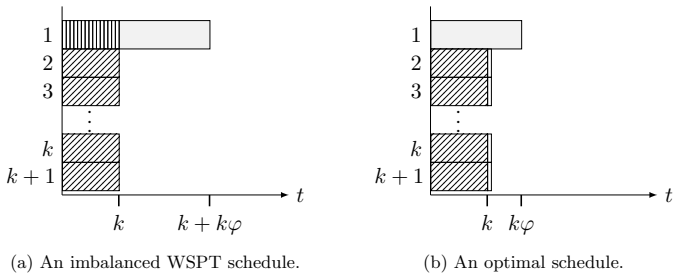


read the original abstract
We study flow shop scheduling with stochastic reentry, where jobs must complete multiple passes through the entire shop, and the number of passes that a job requires for completion is drawn from a discrete probability distribution. The goal is to find policies that minimize performance measures in expectation. Our main contribution is a reduction to a classical parallel machine scheduling problem augmented with machine arrivals. This reduction preserves expected objective values and enables transferring structural results and performance guarantees from the auxiliary problems to the reentrant flow shop setting. We demonstrate the usefulness of this reduction by proving the optimality of simple priority policies for minimizing the makespan and the total completion time in expectation under geometric and, more generally, monotone hazard rate distributions. For minimizing the total weighted completion time, we derive an approximation guarantee that depends only on the squared coefficient of variation of the underlying distributions for a simple priority policy. Our results constitute the first optimality and approximation guarantees for flow shops with stochastic reentry and demonstrate that established scheduling policies naturally extend to this setting through the proposed reduction.
Editorial analysis
A structured set of objections, weighed in public.
Referee Report
Summary. The paper studies flow shop scheduling with stochastic reentry, where the number of passes each job requires is drawn from a discrete probability distribution. The main contribution is a reduction to a classical parallel-machine scheduling problem augmented with machine arrivals; this reduction is asserted to preserve expected objective values for every policy. The authors use the reduction to prove optimality of simple priority policies for expected makespan and total completion time under geometric and monotone hazard rate distributions, and to obtain a squared-coefficient-of-variation approximation guarantee for expected total weighted completion time.
Significance. If the reduction is valid, the work supplies the first optimality and approximation guarantees for stochastic-reentry flow shops. By mapping the problem onto an auxiliary parallel-machine instance whose structural results transfer directly, the paper shows that classical priority policies extend to this setting without modification. The monotone-hazard-rate and CV-based results are concrete and falsifiable, strengthening the contribution.
major comments (1)
- [Main contribution (reduction)] The central claim (abstract and main contribution paragraph) is that the reduction to parallel-machine scheduling with arrivals preserves expected objective values exactly for every policy. This preservation is load-bearing for all subsequent optimality and approximation transfers. The explicit construction of the mapping and the proof that expectations are identical for arbitrary policies must be examined for any implicit independence or support assumptions on the reentry distribution that could invalidate the transfer.
minor comments (2)
- [Abstract] The abstract states optimality holds for geometric and, more generally, monotone hazard rate distributions; the precise definition of the monotone-hazard-rate class and whether it includes all distributions used in the approximation result should be stated explicitly in the introduction or preliminaries.
- [Preliminaries] Notation for policies, reentry random variables, and the auxiliary machine-arrival process should be introduced once in a dedicated preliminaries section and used consistently thereafter.
Simulated Author's Rebuttal
We thank the referee for their thoughtful review and for identifying the critical role of the reduction in our results. We provide a detailed response to the major comment below.
read point-by-point responses
-
Referee: The central claim (abstract and main contribution paragraph) is that the reduction to parallel-machine scheduling with arrivals preserves expected objective values exactly for every policy. This preservation is load-bearing for all subsequent optimality and approximation transfers. The explicit construction of the mapping and the proof that expectations are identical for arbitrary policies must be examined for any implicit independence or support assumptions on the reentry distribution that could invalidate the transfer.
Authors: We appreciate the referee's emphasis on verifying the foundational reduction. The explicit construction is detailed in Section 3, where each job's reentries are mapped to arrivals of new jobs on parallel machines, with the number of arrivals for each original job drawn from the given distribution. The proof that the expected objective value is identical for any policy in the original and auxiliary problems relies on the law of total expectation, applied recursively over the sequence of passes. This argument holds for any discrete probability distribution on the number of reentries (including those with infinite support) and assumes only the independence of processing times and reentry counts across jobs, which is standard in the model. There are no hidden assumptions on the support or independence that would invalidate the transfer. To address the referee's request for examination, we will expand the proof in the revision with an additional lemma explicitly stating the generality. revision: partial
Circularity Check
No significant circularity; reduction is an independent mapping
full rationale
The paper's load-bearing step is a reduction from stochastic reentrant flow shop to a parallel-machine problem with arrivals that exactly preserves expected objective values for every policy. This is presented as a direct equivalence (not a fit or redefinition), allowing transfer of known optimality and approximation results from the classical setting. No equations reduce the preservation claim or subsequent guarantees (optimality of priority policies under geometric/monotone hazard rates, or the C^2-based approximation) back to the original inputs by construction. No self-citations are load-bearing for uniqueness or ansatz, and no renaming of known empirical patterns occurs. The derivation chain is self-contained against external benchmarks in classical scheduling theory.
Axiom & Free-Parameter Ledger
axioms (1)
- domain assumption Number of passes for each job is drawn independently from a discrete probability distribution
Reference graph
Works this paper leans on
- [1]
-
[2]
European Journal of Operational Research , volume=
Flow shops with reentry: Reversibility properties and makespan optimal schedules , author=. European Journal of Operational Research , volume=. 2020 , publisher=
work page 2020
-
[3]
Journal of Scheduling , volume=
Flow shops with reentry: The total weighted completion time objective , author=. Journal of Scheduling , volume=. 2025 , publisher=
work page 2025
-
[4]
J\". Generalizing the. 35th Symposium on Theoretical Aspects of Computer Science (STACS 2018) , pages =. 2018 , volume =. doi:10.4230/LIPIcs.STACS.2018.43 , annote =
-
[5]
Kawaguchi, Tsuyoshi and Kyan, Seiki , journal=. Worst case bound of an. 1986 , publisher=
work page 1986
- [6]
-
[7]
Journal of Applied Probability , volume=
Scheduling tasks with exponential service times on parallel processors , author=. Journal of Applied Probability , volume=. 1979 , publisher=
work page 1979
-
[8]
Scheduling of re-entrant flow shops , journal =. 1983 , issn =. doi:10.1016/0272-6963(83)90004-9 , author =
-
[9]
Scheduling of stochastic tasks on two parallel processors , year =
Pinedo, Michael and Weiss, Gideon , journal =. Scheduling of stochastic tasks on two parallel processors , year =. doi:10.1002/nav.3800260314 , publisher =
-
[10]
Bruno, J. and Downey, P. and Frederickson, G. N. , title =. 1981 , issue_date =. doi:10.1145/322234.322242 , journal =
-
[11]
Gittins, J. C. , journal =. Multiserver scheduling of jobs with increasing completion rates , year =. doi:10.2307/3213196 , publisher =
-
[12]
Chang, Cheng-Shang and Nelson, Randolph and Pinedo, Michael , journal =. Scheduling two classes of exponential jobs on parallel processors: structural results and worst-case analysis , year =. doi:10.2307/1427684 , publisher =
-
[13]
Mathematics of Operations Research , title =. 1981 , issn =. doi:10.1287/moor.6.2.305 , publisher =
-
[14]
Weber, Richard R. , journal =. Scheduling jobs by stochastic processing requirements on parallel machines to minimize makespan or flowtime , year =. doi:10.2307/3213926 , publisher =
-
[15]
Approximation in stochastic scheduling: the power of
M\". Approximation in stochastic scheduling: the power of. 1999 , issue_date =. doi:10.1145/331524.331530 , journal =
-
[16]
On the optimality of static priority policies in stochastic scheduling on parallel machines , year =
Kämpke, Thomas , journal =. On the optimality of static priority policies in stochastic scheduling on parallel machines , year =. doi:10.2307/3214267 , publisher =
-
[17]
Minimizing makespan on an m-machine re-entrant flowshop , journal =. 2008 , issn =. doi:10.1016/j.cor.2006.09.028 , author =
-
[18]
Minimizing total completion time for re-entrant flow shop scheduling problems , journal =. 2011 , issn =. doi:10.1016/j.tcs.2011.08.030 , author =
-
[19]
Flow Shop Scheduling: Theoretical Results, Algorithms, and Applications , author=. 2012 , doi=
work page 2012
-
[20]
Middendorf, Martin and Timkovsky, Vadim G. , title =. Journal of Scheduling , volume =. doi:10.1002/jos.95 , year =
-
[21]
Complexity Results for Single-Machine Problems with Positive Finish-Start Time-Lags , author=. Computing , volume=. 1999 , publisher=
work page 1999
-
[22]
Identical parallel machines vs.\ unit-time shops and preemptions vs.\ chains in scheduling complexity , journal =. 2003 , issn =. doi:10.1016/S0377-2217(02)00767-1 , author =
-
[23]
Operations Research Letters , volume =
An alternative proof of the. Operations Research Letters , volume =. 2011 , issn =. doi:10.1016/j.orl.2011.06.007 , author =
-
[24]
Statistics & Probability Letters , volume=
A generalized geometric distribution and some of its properties , author=. Statistics & Probability Letters , volume=. 1983 , publisher=
work page 1983
-
[25]
Hall, W. J. and Wellner, Jon A. , title =. Proceedings of the International Symposium on Statistics and Related Topics (Ottawa, Ont., Canada) , pages =. 1981 , publisher =
work page 1981
-
[26]
and Dauzère-Pérès, Stéphane and Mason, Scott J
Mönch, Lars and Fowler, John W. and Dauzère-Pérès, Stéphane and Mason, Scott J. and Rose, Oliver , journal =. A survey of problems, solution techniques, and future challenges in scheduling semiconductor manufacturing operations , year =. doi:10.1007/s10951-010-0222-9 , publisher =
-
[27]
Journal of the Operational Research Society , volume =
S-W Choi and Y-D Kim , title =. Journal of the Operational Research Society , volume =. 2007 , publisher =
work page 2007
-
[28]
Pfund, Michele E. and Mason, Scott J. and Fowler, John W. Semiconductor Manufacturing Scheduling and Dispatching. Handbook of P roduction S cheduling. 2006
work page 2006
-
[29]
Mason, Scott J. and Fowler, John W. and Matthew Carlyle, W. , journal =. A modified shifting bottleneck heuristic for minimizing total weighted tardiness in complex job shops , year =. doi:10.1002/jos.102 , publisher =
discussion (0)
Sign in with ORCID, Apple, or X to comment. Anyone can read and Pith papers without signing in.