Recognition: unknown
DifFoundMAD: Foundation Models meet Differential Morphing Attack Detection
Pith reviewed 2026-05-10 05:27 UTC · model grok-4.3
The pith
DifFoundMAD adapts vision foundation model embeddings with lightweight fine-tuning to improve differential morphing attack detection over prior methods.
A machine-rendered reading of the paper's core claim, the machinery that carries it, and where it could break.
Core claim
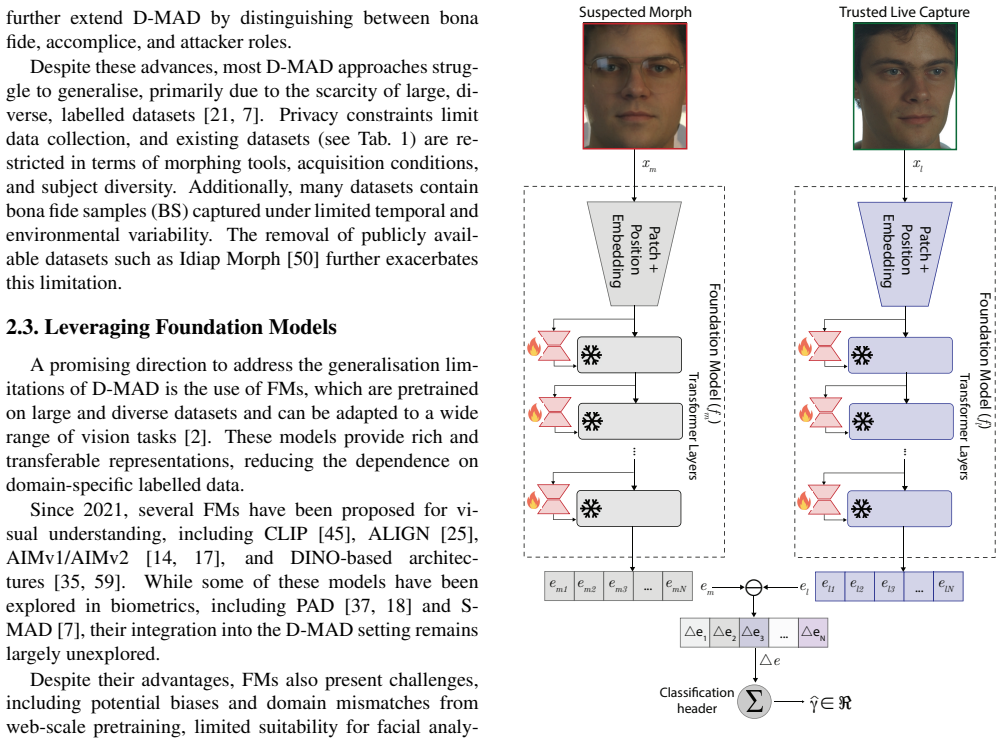
DifFoundMAD follows the standard differential paradigm but substitutes the representation space with embeddings from vision foundation models, achieving error-rate reductions from 6.16% to 2.17% at high-security thresholds through lightweight fine-tuning and class-balanced optimisation that preserves rich representational priors.
What carries the argument
The central mechanism is the substitution of conventional face recognition or handcrafted features with embeddings from vision foundation models inside the differential morphing attack detection pipeline, enabled by parameter-efficient fine-tuning.
Load-bearing premise
That embeddings from general vision foundation models contain the subtle discrepancies needed to distinguish morphs from live captures and that lightweight fine-tuning can reliably extract them across databases and capture conditions.
What would settle it
A fresh cross-database evaluation in which DifFoundMAD produces higher or equal error rates to existing state-of-the-art systems at the same high-security thresholds would falsify the claimed improvement.
Figures


read the original abstract
In this work, we introduce DifFoundMAD, a parameter-efficient D-MAD framework that exploits the generalisation capabilities of vision foundation models (FM) to capture discrepancies between suspected morphs and live capture images. In contrast to conventional D-MAD systems that rely on face recognition embeddings or handcrafted feature differences, DifFoundMAD follows the standard differential paradigm while replacing the underlying representation space with embeddings extracted from FMs. By combining lightweight finetuning with class-balanced optimisation, the proposed method updates only a small subset of parameters while preserving the rich representational priors of the underlying FMs. Extensive cross-database evaluations on standard D-MAD benchmarks demonstrate that DifFoundMAD achieves consistent improvements over state-of-the-art systems, particularly at the strict security levels required in operational deployments such as border control: The error rates reported in the current state-of-the-art were reduced from 6.16% to 2.17% for high-security levels using DifFoundMAD.
Editorial analysis
A structured set of objections, weighed in public.
Referee Report
Summary. The manuscript presents DifFoundMAD, a parameter-efficient differential morphing attack detection (D-MAD) framework that replaces conventional face recognition embeddings with those from vision foundation models (FMs). It applies lightweight fine-tuning combined with class-balanced optimization to update only a small parameter subset, and reports consistent improvements over state-of-the-art systems on cross-database benchmarks, including a reduction in error rates from 6.16% to 2.17% at high-security operating points relevant to border control.
Significance. If the cross-database performance gains hold under detailed scrutiny, the work would be significant for showing how foundation models can be adapted efficiently to fine-grained biometric forensic tasks. The emphasis on parameter efficiency and generalization across capture conditions addresses practical constraints in operational security systems.
major comments (2)
- [§4 (Experiments)] §4 (Experiments): The central performance claim of reducing error rates from 6.16% to 2.17% at high-security levels is load-bearing, yet the manuscript provides no definition of the precise operating point (e.g., fixed BPCER threshold for APCER measurement), no error bars, no mention of the number of independent runs, and no statistical significance tests. This prevents assessment of whether the reported improvement is robust or driven by particular database splits.
- [§3 (Method)] §3 (Method): The key assumption that lightweight fine-tuning of general FM embeddings reliably encodes subtle morph-specific low-level cues (texture blending, landmark shifts) across databases is not supported by any ablation (e.g., frozen vs. tuned backbone performance) or feature-level analysis. Without such evidence, it remains possible that the gains arise from high-level semantic adaptation rather than the required morph artifacts, undermining generalization at strict security thresholds.
minor comments (2)
- [Abstract] Abstract: The acronym D-MAD is introduced without expansion on first use; expand at first occurrence for clarity.
- [Introduction] Introduction: The comparison to prior SOTA error rates would benefit from explicit citation of the exact papers and tables being referenced for the 6.16% baseline.
Simulated Author's Rebuttal
We thank the referee for their insightful comments, which help improve the clarity and rigor of our work. We address the major comments point by point below. Where revisions are needed, we will incorporate them in the revised manuscript.
read point-by-point responses
-
Referee: [§4 (Experiments)] The central performance claim of reducing error rates from 6.16% to 2.17% at high-security levels is load-bearing, yet the manuscript provides no definition of the precise operating point (e.g., fixed BPCER threshold for APCER measurement), no error bars, no mention of the number of independent runs, and no statistical significance tests. This prevents assessment of whether the reported improvement is robust or driven by particular database splits.
Authors: We agree that explicitly defining the operating point is essential for reproducibility and assessment. In the revised version, we will clearly state that the high-security operating point refers to the APCER at a fixed BPCER of 0.1%, consistent with ISO/IEC standards for biometric performance evaluation in high-security scenarios. However, the original experiments were performed using a single training run per configuration due to the high computational cost of fine-tuning foundation models. Therefore, we cannot provide error bars or statistical significance tests without conducting additional independent runs, which we note as a limitation. We will emphasize the consistency of the observed improvements across all cross-database evaluations to support the robustness of the gains. revision: partial
-
Referee: [§3 (Method)] The key assumption that lightweight fine-tuning of general FM embeddings reliably encodes subtle morph-specific low-level cues (texture blending, landmark shifts) across databases is not supported by any ablation (e.g., frozen vs. tuned backbone performance) or feature-level analysis. Without such evidence, it remains possible that the gains arise from high-level semantic adaptation rather than the required morph artifacts, undermining generalization at strict security thresholds.
Authors: We appreciate this point and acknowledge that including an ablation study would provide stronger evidence for the role of fine-tuning in capturing morph-specific artifacts. In the revised manuscript, we will add an ablation comparing the performance of the frozen foundation model embeddings versus the lightly fine-tuned ones on the D-MAD task. This will demonstrate the contribution of the class-balanced fine-tuning to encoding the subtle discrepancies. Additionally, we will include a brief feature analysis, such as visualizing the difference maps or activation differences, to illustrate the focus on low-level cues like texture inconsistencies. revision: yes
- The lack of error bars, number of independent runs, and statistical significance tests for the reported performance metrics, as these were not computed in the original experimental setup.
Circularity Check
No circularity: empirical cross-database results rest on independent benchmarks
full rationale
The paper presents an empirical framework that replaces face-recognition embeddings with vision-foundation-model embeddings, applies lightweight fine-tuning under class-balanced optimisation, and reports measured error-rate reductions on standard D-MAD cross-database splits. No derivation, equation, or claim reduces by construction to its own inputs; performance figures are obtained from held-out test sets rather than from any fitted quantity defined in terms of the target metric. No self-citation is invoked as a load-bearing uniqueness theorem or ansatz, and the method does not rename a known result. The central claim therefore remains externally falsifiable against the cited benchmarks.
Axiom & Free-Parameter Ledger
Reference graph
Works this paper leans on
-
[1]
Accessed: Jan
Bologna Online Evaluation Platform (BOEP).https:// biolab.csr.unibo.it/fvcongoing/UI/Form/ boep.aspx, 2026. Accessed: Jan. 6, 2026
2026
-
[2]
Awais, M
M. Awais, M. Naseer, S. Khan, R. Anwer, H. Cholakkal, M. Shah, M. Yang, and F. Khan. Foundation models defining a new era in vision: a survey and outlook.IEEE Trans. on Pattern Analysis and Machine Intelligence (TPAMI), 2025
2025
-
[3]
Blasingame and C
Z. Blasingame and C. Liu. Fast-DiM: Towards fast diffusion morphs.IEEE Security & Privacy, 22(4):103–114, 2024
2024
-
[4]
Blasingame and C
Z. Blasingame and C. Liu. Greedy-DiM: Greedy algorithms for unreasonably effective face morphs. InProc. Intl. Joint Conference on Biometrics (IJCB), pages 1–11, 2024
2024
-
[5]
Blasingame and C
Z. Blasingame and C. Liu. Leveraging diffusion for strong and high quality face morphing attacks.IEEE Trans. on Biometrics, Behavior, and Identity Science (T-BIOM), 6(1):118–131, 2024
2024
-
[6]
Borghi, A
G. Borghi, A. Franco, N. D. Domenico, M. Ferrara, and D. Maltoni. V-MAD: Video-based morphing attack detec- tion in operational scenarios. InProc. Intl. Joint Conf. on Biometrics (IJCB), pages 1–10, 2024
2024
-
[7]
Caldeira, G
E. Caldeira, G. Guray, T. Chettaoui, M. Ivanovska, P. Peer, F. Boutros, V . Struc, and N. Damer. MADation: Face mor- phing attack detection with foundation models, 2025
2025
-
[8]
Damer, V
N. Damer, V . Boller, Y . Wainakh, F. Boutros, P. Terh ¨orst, A. Braun, and A. Kuijper. Detecting face morphing at- tacks by analyzing the directed distances of facial landmarks shifts. In T. Brox, A. Bruhn, and M. Fritz, editors,Pattern Recognition, pages 518–534, Cham, Switzerland, 2019
2019
-
[9]
Damer, S
N. Damer, S. Zienert, Y . Wainakh, A. Mosegu ´ı-Saladi´e, F. Kirchbuchner, and A. Kuijper. A multi-detector solution towards an accurate and generalized detection of face mor- phing attacks. InProc. Intl. Conf. Information Fusion (FU- SION), pages 1–8, 2019
2019
-
[10]
Dargaud, M
L. Dargaud, M. Ibsen, J. Tapia, and C. Busch. A princi- pal component analysis-based approach for single morphing attack detection. InProc. Winter Conf. on Applications of Computer Vision (WCACV), pages 683–692, 2023
2023
-
[11]
Debiasi, U
L. Debiasi, U. Scherhag, C. Rathgeb, A. Uhl, and C. Busch. PRNU variance analysis for morphed face image detection. InProc. of 9th Intl. Conf. on Biometrics: Theory, Applica- tions and Systems (BTAS 2018), 2018
2018
-
[12]
Domenico, G
N. Domenico, G. Borghi, A. Franco, and D. Maltoni. Com- bining identity features and artifact analysis for differential morphing attack detection. InProc. Intl. Conf. on Image Analysis and Processing (ICIAP), pages 100–111, 2023
2023
-
[13]
N. D. Domenico, G. Borghi, A. Franco, and D. Maltoni. Im- proving accomplice detection in the morphing attack.Ma- chine Intelligence Research, pages 1–15, 2025
2025
-
[14]
Scalable pre-training of large autoregressive image models.arXiv preprint arXiv:2401.08541, 2024
A. El-Nouby, M. Klein, S. Zhai, M. Bautista, A. Toshev, V . Shankar, J. Susskind, and A. Joulin. Scalable pre- training of large autoregressive image models.arXiv preprint arXiv:2401.08541, 2024
-
[15]
European Union. Regulation (eu) 2019/1157 of the european parliament and of the council of 20 june 2019 on strength- ening the security of identity cards of union citizens and of residence documents issued to union citizens and their fam- ily members exercising their right of free movement. Official Journal of the European Union, L 188, pp. 67-78, 2019. A...
2019
-
[16]
Ferrara, A
M. Ferrara, A. Franco, and D. Maltoni. Face demorphing. IEEE Trans. on Information Forensics and Security (TIFS), 13(4):1008–1017, 2018
2018
-
[17]
E. Fini, M. Shukor, X. Li, P. Dufter, M. Klein, D. Haldimann, S. Aitharaju, V . da Costa, L. B´ethune, Z. Gan, et al. Multi- modal autoregressive pre-training of large vision encoders. InProc. Intl. Conf. on Computer Vision and Pattern Recog- nition (CVPR), pages 9641–9654, 2025
2025
-
[18]
L. J. Gonzalez-Soler, J. Tapia, and C. Busch. Are foundation models all you need for zero-shot face presentation attack de- tection? InIEEE Intl. Conf. on Automatic Face and Gesture Recognition (FG), pages 1–10, 2025
2025
-
[19]
Grimmer and C
M. Grimmer and C. Busch. LADIMO: face morph genera- tion through biometric template inversion with latent diffu- sion. InProc. Intl. Joint Conf. on Biometrics (IJCB), pages 1–7, 2024
2024
-
[20]
E. Hu, Y . Shen, P. Wallis, Z. Allen-Zhu, Y . Li, S. Wang, L. Wang, W. Chen, et al. LoRa: Low-rank adaptation of large language models.Proc. Intl. Conf. on Learning Repre- sentations (ICLR), 1(2):3, 2022
2022
-
[21]
Ibsen, L
M. Ibsen, L. J. Gonzalez-Soler, C. Rathgeb, and C. Busch. TetraLoss: Improving the robustness of face recognition against morphing attacks. InIEEE Intl. Conf. on Automatic Face and Gesture Recognition (FG), pages 1–9, 2024
2024
-
[22]
Ibsen, L
M. Ibsen, L. J. Gonzalez-Soler, C. Rathgeb, P. Drozdowski, M. Gomez-Barrero, and C. Busch. Differential anomaly de- tection for facial images. InIEEE Intl. Workshop on Infor- mation Forensics and Security (WIFS), pages 1–6, 2021
2021
-
[23]
In- formation Technology – Methodologies to evaluate the resis- tance of biometric recognition systems to morphing attacks
ISO/IEC JTC1 SC37 Biometrics.ISO/IEC 20059:2025. In- formation Technology – Methodologies to evaluate the resis- tance of biometric recognition systems to morphing attacks. International Organization for Standardization, 2025
2025
-
[24]
M. Ivanovska, L. Todorov, N. Damer, D. Jain, P. Peer, and V .ˇStruc. SelfMAD: Enhancing generalization and robust- ness in morphing attack detection via self-supervised learn- ing.arXiv preprint arXiv:2504.05504, 2025
-
[25]
C. Jia, Y . Yang, Y . Xia, Y . Chen, Z. Parekh, H. Pham, Q. Le, Y . Sung, Z. Li, and T. Duerig. Scaling up visual and vision- language representation learning with noisy text supervision. InProc. Intl. Conf. on Machine Learning (ICML), pages 4904–4916, 2021
2021
-
[26]
Joshi, M
I. Joshi, M. Grimmer, C. Rathgeb, C. Busch, F. Bremond, and A. Dantcheva. Synthetic data in human analysis: A sur- vey.IEEE Trans. on Pattern Analysis and Machine Intelli- gence (PAMI), 46(7):4957–4976, 2024
2024
-
[27]
Kabbani, K
W. Kabbani, K. Raja, R. Ramachandra, and C. Busch. Sta- bleMorph: High-quality face morph generation with stable diffusion. InProc. Intl. Joint Conf. on Biometrics (IJCB), pages 1–10, 2025
2025
-
[28]
A rank stabilization scaling factor for fine-tuning with lora,
D. Kalajdzievski. A rank stabilization scaling factor for fine- tuning with lora.arXiv preprint arXiv:2312.03732, 2023
-
[29]
Karras, S
T. Karras, S. Laine, M. Aittala, J. Hellsten, J. Lehtinen, and T. Aila. Analyzing and improving the image quality of Style- GAN. InProc. Intl. Conf. on Computer Vision and Pattern Recognition (CVPR), pages 8110–8119, 2020
2020
-
[30]
Kessler, K
R. Kessler, K. Raja, J. Tapia, and C. Busch. Towards min- imizing efforts for morphing attacks—deep embeddings for morphing pair selection and improved morphing attack de- tection.Plos one, 19(5):e0304610, 2024
2024
-
[31]
Kirillov, E
A. Kirillov, E. Mintun, N. Ravi, H. Mao, C. Rolland, L. Gustafson, T. Xiao, S. Whitehead, A. Berg, W. Lo, et al. Segment anything. InProc. Intl. Conf. on Computer Vision (ICCV), pages 4015–4026, 2023
2023
-
[32]
T. Lin, P. Goyal, R. Girshick, K. He, and P. Doll´ar. Focal loss for dense object detection. InProc. Intl. Conf. on Computer Vision (ICCV), pages 2980–2988, 2017
2017
-
[33]
C. Liu, M. Ferrara, A. Franco, G. Borghi, and D. Zhong. Differential morphing attack detection via triplet-based met- ric learning and artifact extraction. InProc. Intl. Conf. of the Biometrics Special Interest Group (BIOSIG), pages 1–7, 2024
2024
-
[34]
M. Ngan, P. Grother, K. Hanaoka, and J. Kuo. Face analy- sis technology evaluation (FATE) part 4: MORPH - perfor- mance of automated face morph detection. 2025
2025
-
[35]
DINOv2: Learning Robust Visual Features without Supervision
M. Oquab, T. Darcet, T. Moutakanni, H. V o, M. Szafraniec, V . Khalidov, P. Fernandez, D. Haziza, F. Massa, A. El- Nouby, et al. DINOv2: Learning robust visual features with- out supervision.arXiv preprint arXiv:2304.07193, 2023
work page internal anchor Pith review Pith/arXiv arXiv 2023
-
[36]
Ortega-Delcampo, C
D. Ortega-Delcampo, C. Conde, D. Palacios-Alonso, and E. Cabello. Border control morphing attack detection with a convolutional neural network de-morphing approach.IEEE Access, 8:92301–92313, 2020
2020
-
[37]
Ozgur, E
G. Ozgur, E. Caldeira, T. Chettaoui, F. Boutros, R. Raghavendra, and N. Damer. FoundPAD: Founda- tion models reloaded for face presentation attack detection. InProc. Winter Conf. on Applications of Computer Vision (WCACV), pages 745–755, 2025
2025
-
[38]
Papavasileiou, A
E. Papavasileiou, A. Paraskevas, and J. Edmunds. egates in airports: A systematic literature review and future research directions.Journal of the Air Transport Research Society, page 100076, 2025
2025
-
[39]
Paszke, S
A. Paszke, S. Gross, F. Massa, A. Lerer, J. Bradbury, G. Chanan, T. Killeen, Z. Lin, N. Gimelshein, L. Antiga, A. Desmaison, A. Kopf, E. Yang, Z. DeVito, M. Raison, A. Tejani, S. Chilamkurthy, B. Steiner, L. Fang, J. Bai, and S. Chintala. PyTorch: An Imperative Style, High- Performance Deep Learning Library. InAdvances in Neural Information Processing Sys...
2019
- [40]
-
[41]
F. Peng, L. Zhang, and M. Long. FD-GAN: Face de- morphing generative adversarial network for restoring ac- complice’s facial image.IEEE Access, 7:75122–75131, 2019
2019
-
[42]
Phillips, P
J. Phillips, P. Flynn, T. Scruggs, K. Bowyer, J. Chang, K. Hoffman, J. Marques, J. Min, and W. Worek. Overview of the face recognition grand challenge. InProc. Intl. Conf. on Computer Vision and Pattern Recognition (CVPR), vol- ume 1, pages 947–954, 2005
2005
-
[43]
Phillips, H
J. Phillips, H. Wechsler, J. Huang, and P. Rauss. The feret database and evaluation procedure for face-recognition algo- rithms.Image and vision computing, 16(5):295–306, 1998
1998
-
[44]
Rachalwar, M
H. Rachalwar, M. Fang, N. Damer, and A. Das. Depth- guided robust face morphing attack detection. InProc. Intl. Joint Conf. on Biometrics (IJCB), pages 1–9, 2023
2023
-
[45]
Radford, J
A. Radford, J. Kim, C. Hallacy, A. Ramesh, G. Goh, S. Agar- wal, G. Sastry, A. Askell, P. Mishkin, J. Clark, et al. Learn- ing transferable visual models from natural language super- vision. InProc. Intl. Conf. on Machine Learning (ICML), pages 8748–8763, 2021
2021
-
[46]
Raghavendra, S
R. Raghavendra, S. Venkatesh, N. Damer, N. Vetrekar, and R. Gad. Multispectral imaging for differential face morphing attack detection: A preliminary study. InProc. Winter Conf. on Applications of Computer Vision (WCACV), pages 6185– 6193, 2024
2024
-
[47]
Raghavendra, S
R. Raghavendra, S. Venkatesh, K. Raja, and C. Busch. To- wards making morphing attack detection robust using hybrid scale-space colour texture features. InProc. Intl. Conf. on Identity, Security, and Behavior Analysis (ISBA), pages 1–8, 2019
2019
-
[48]
K. Raja, M. Ferrara, A. Franco, L. Spreeuwers, I. Batskos, F. D. Wit, M. Gomez-Barrero, U. Scherhag, D. Fischer, S. Venkatesh, et al. Morphing attack detection-database, evaluation platform, and benchmarking.IEEE Trans. on Information Forensics and Security (TIFS), 16:4336–4351, 2020
2020
-
[49]
Robledo-Moreno, G
M. Robledo-Moreno, G. Borghi, N. D. Domenico, A. Franco, K. Raja, and D. Maltoni. Towards federated learn- ing for morphing attack detection. InProc. Intl. Joint Conf. on Biometrics (IJCB), pages 1–10, 2024
2024
-
[50]
Sarkar, P
E. Sarkar, P. Korshunov, L. Colbois, and S. Marcel. Are GAN-based morphs threatening face recognition? InProc. Intl. Conf. on Acoustics, Speech and Signal Processing (ICASSP), pages 2959–2963, 2022
2022
-
[51]
Scherhag, D
U. Scherhag, D. Budhrani, M. Gomez-Barrero, and C. Busch. Detecting morphed face images using facial landmarks. InIntl. Conf. on Image and Signal Processing (ICISP), 2018
2018
-
[52]
Scherhag, L
U. Scherhag, L. Debiasi, C. Rathgeb, C. Busch, and A. Uhl. Detection of face morphing attacks based on PRNU analysis. IEEE Trans. on Biometrics, Behavior, and Identity Science (T-BIOM), 2019
2019
-
[53]
Scherhag, C
U. Scherhag, C. Rathgeb, and C. Busch. Morph deterction from single face image: A multi-algorithm fusion approach. InProc. Intl. Conf. on Biometric Engineering and Applica- tions (ICBEA), pages 6–12, 2018
2018
-
[54]
Scherhag, C
U. Scherhag, C. Rathgeb, J. Merkle, and C. Busch. Deep face representations for differential morphing attack detec- tion.IEEE Trans. on Information Forensics and Security (TIFS), 2020
2020
-
[55]
LAION-400M: Open Dataset of CLIP-Filtered 400 Million Image-Text Pairs
C. Schuhmann, R. Vencu, R. Beaumont, R. Kaczmarczyk, C. Mullis, A. Katta, T. Coombes, J. Jitsev, and A. Komat- suzaki. LAION-400M: Open dataset of clip-filtered 400 million image-text pairs.arXiv preprint arXiv:2111.02114, 2021
work page internal anchor Pith review arXiv 2021
-
[56]
Seibold, W
C. Seibold, W. Samek, A. Hilsmann, and P. Eisert. Detection of face morphing attacks by deep learning. InProc. Intl. Workshop on Digital Forensics and Watermarking, pages 107–120, 2017
2017
-
[57]
R. Shekhawat, H. Li, R. Raghavendra, and S. Venkatesh. Towards zero-shot differential morphing attack detection with multimodal large language models.arXiv preprint arXiv:2505.15332, 2025
-
[58]
Shukla and A
N. Shukla and A. Ross. Facial demorphing via identity pre- serving image decomposition. InProc. Intl. Joint Conf. on Biometrics (IJCB), pages 1–10, 2024
2024
-
[59]
O. Sim ´eoni, H. V o, M. Seitzer, F. Baldassarre, M. Oquab, C. Jose, V . Khalidov, M. Szafraniec, S. Yi, M. Ramamon- jisoa, et al. Dinov3.arXiv preprint arXiv:2508.10104, 2025
work page internal anchor Pith review Pith/arXiv arXiv 2025
-
[60]
Singh, K
J. Singh, K. Raja, R. Raghavendra, and C. Busch. Robust morph-detection at automated border control gate using deep decomposed 3D shape & diffuse reflectance. InProc. of the 15th Intl. Conf. on Signal Image Technology & Internet Based Systems (SITIS), November 2019
2019
-
[61]
Tapia, M
J. Tapia, M. Russo, and C. Busch. Generating automati- cally print/scan textures for morphing attack detection ap- plications.IEEE Access, 2025
2025
-
[62]
Tapia, D
J. Tapia, D. Schulz, and C. Busch. Single-morphing attack detection using few-shot learning and triplet-loss.Neuro- computing, page 130033, 2025
2025
-
[63]
Thomaz and G
C. Thomaz and G. Giraldi. A new ranking method for prin- cipal components analysis and its application to face image analysis.Image and vision computing, 28(6):902–913, 2010
2010
-
[64]
Venkatesh, R
S. Venkatesh, R. Raghavendra, K. Raja, L. Spreeuwers, R. Veldhuis, and C. Busch. Morphed face detection based on deep color residual noise. InProc. Intl. Conf. on Image Processing Theory, Tools and Applications (IPTA), pages 1– 6, 2019
2019
-
[65]
Venkatesh, R
S. Venkatesh, R. Raghavendra, K. Raja, L. Spreeuwers, R. Veldhuis, and C. Busch. Detecting morphed face attacks using residual noise from deep multi-scale context aggrega- tion network. InProc. Winter Conf. on Applications of Com- puter Vision (WCACV), pages 280–289, 2020
2020
-
[66]
Zhang, R
H. Zhang, R. Raghavendra, K. Raja, and C. Busch. Gener- alized single-image-based morphing attack detection using deep representations from vision transformer. InProc. Intl. Conf. on Computer Vision and Pattern Recognition (CVPR), pages 1510–1518, 2024
2024
-
[67]
Zhang, R
H. Zhang, R. Raghavendra, K. Raja, and C. Busch. Syn- Morph: Generating synthetic face morphing dataset with mated samples.IEEE Access, 2025
2025
-
[68]
Zhang, S
H. Zhang, S. Venkatesh, R. Raghavendra, K. Raja, N. Damer, and C. Busch. MIPGAN—generating strong and high qual- ity morphing attacks using identity prior driven GAN.IEEE Trans. on Biometrics, Behavior, and Identity Science (T- BIOM), 3(3):365–383, 2021
2021
-
[69]
Zhang, S
L. Zhang, S. Chen, M. Long, and J. Cai. Face de-morphing based on identity feature transfer.IET Image Processing, 19(1):e13324, 2025
2025
discussion (0)
Sign in with ORCID, Apple, or X to comment. Anyone can read and Pith papers without signing in.