pith. machine review for the scientific record. sign in

arxiv: 2604.17963 · v1 · submitted 2026-04-20 · 🌌 astro-ph.GA

Recognition: unknown

BEACON: JWST NIRCam Pure-parallel Imaging Survey. III. Constraints on the UV LF and the Clustering of z~7-14 Galaxies

Authors on Pith no claims yet

Pith reviewed 2026-05-10 04:23 UTC · model grok-4.3

classification 🌌 astro-ph.GA
keywords high-redshift galaxiesultraviolet luminosity functiongalaxy clusteringearly universedark matter haloscosmic variancegalaxy formation
0
0 comments X

The pith

Bright galaxies at redshifts 7 to 10 appear in overdense sky regions three times more often than average, implying they form inside the most massive dark matter halos.

A machine-rendered reading of the paper's core claim, the machinery that carries it, and where it could break.

This paper analyzes wide-area JWST imaging spread over dozens of separate fields to measure how many ultraviolet-bright galaxies existed between redshifts 7 and 14. The broad coverage averages over cosmic structure variations that limit narrower surveys. The derived luminosity functions match earlier models at redshifts near 7.5 and 10 but show lower counts than some recent photometric estimates at the brightest levels. The central result is that the brightest sources cluster together: fields containing them are far more likely to contain extra galaxies overall. This pattern indicates that ultraviolet-luminous galaxies at these epochs preferentially occupy the densest, most massive environments.

Core claim

Across 400 arcmin squared in 36 independent sightlines, 164 galaxy candidates are identified at 7 less than z less than 12, with 100 percent purity confirmed in 11 fields with public spectroscopy. The z approximately 7.5 and z approximately 10 ultraviolet luminosity functions align with pre-JWST models while lying below most prior photometric JWST results at z approximately 10. Bright galaxies with absolute magnitude brighter than -20.5 exhibit significant clustering, such that their host fields are approximately three times more likely to be overdense than the survey average. This implies these sources reside in the most massive halos, with inferred halo masses 0.9 dex lower at z~11 than at

What carries the argument

The ratio of overdensity probability in fields that contain bright ultraviolet sources versus the full survey area, which traces the preference of luminous galaxies for the highest-mass halos.

If this is right

  • The luminosity function measurements supply direct tests for theoretical models of early galaxy assembly.
  • Clustering statistics require updates to the assumed relation between ultraviolet luminosity and host halo mass at these redshifts.
  • The absence of robust sources beyond redshift 13 supplies upper bounds on the abundance of the brightest objects at those epochs.
  • Simulations must accommodate both a redshift-dependent halo mass shift and excess clustering strength relative to older luminosity-halo mass prescriptions.

Where Pith is reading between the lines

These are editorial extensions of the paper, not claims the author makes directly.

  • The observed clustering excess may indicate that some bright galaxies share the same halo rather than occupying separate massive halos.
  • Extending the same multi-field approach to other redshift windows could tighten constraints on how galaxy bias evolves over time.
  • Deeper follow-up spectroscopy on the brightest candidates would directly test whether the inferred halo masses continue to rise at still higher redshifts.
  • If confirmed, the results would push models to include stronger feedback or burstier star formation in the densest early environments.

Load-bearing premise

The dropout selection and photometric redshift assignments correctly identify all sources in the stated magnitude and redshift ranges with negligible contamination or bias.

What would settle it

A spectroscopic campaign that finds a substantial fraction of the bright candidates lie at redshifts below 7 or show spectral features inconsistent with the claimed distances.

Figures

Figures reproduced from arXiv: 2604.17963 by Abdurro'uf, Andrew J. Bunker, Benedetta Vulcani, Charlotte A. Mason, Claudia Scarlata, Guido Roberts-Borsani, Hakim Atek, Kimi C. Kreilgaard, Kosuke Takahashi, Larry D. Bradley, Marc Rafelski, Maru\v{s}a Brada\v{c}, Massimo Stiavelli, Matthew J. Hayes, Michele Trenti, Nicha Leethochawalit, Novan Saputra Haryana, Ryo A. Sutanto, Takahiro Morishita, Tommaso Treu, Vihang Mehta, Viola Gelli, Yechi Zhang, Zhaoran Liu.

Figure 1
Figure 1. Figure 1: Sky distribution of the 36 fields included in BEACON DR2 (orange circles), overlaid on a temperature map from the WMAP 7 yr data (N. Jarosik et al. 2011). We also show some JWST legacy fields (grey squares): COSMOS-Web (C. M. Casey et al. 2023), PRIMER-UDS (J. S. Dunlop et al. 2021), CEERS-EGS (S. L. Finkelstein et al. 2025), JADES-GOODS-South, and JADES-GOODS-North (D. J. Eisenstein et al. 2026). The symb… view at source ↗
Figure 2
Figure 2. Figure 2: Distribution of the 5σ limiting magnitude (depth) mea￾sured within a 0. ′′16 aperture radius in the F150W band, present for 35 of the 36 fields included in this study (BEACON DR2). The median depth of 27.9 AB mag across the 35 fields is marked with a dashed line. including an additional 55 pointings with fewer than 6 filters, and archival data. 3. HIGH REDSHIFT CANDIDATE SELECTION In this work, we focus on… view at source ↗
Figure 3
Figure 3. Figure 3: Histogram showing the absolute UV magnitudes for galaxy candidates in each of the three dropout selections. The UV magnitudes are measured as the average flux in the rest-frame 1450Å–1550Å wavelength range based on a power law fitted to the UV continuum sampled by the available NIRCam photometry for each source. We note that the F150W-dropout candidate is not in￾cluded in our final sample, as its non-detec… view at source ↗
Figure 4
Figure 4. Figure 4: Comparison between the photometric redshift, as esti￾mated from the EAZY SED fit and the spectroscopic redshift when available. The orange points represent the median of the EAZY red￾shift posterior, while the lower and upper errors indicate the 16th and 84th percentiles. The dashed line indicates the one-to-one rela￾tion, while the shaded region shows the ∆z < 0.5 margin. E. Curtis-Lake et al. 2023, for w… view at source ↗
Figure 5
Figure 5. Figure 5: Examples of our observed photometry and SED fitting results for two F090W-dropouts (purple) and two F115W-dropouts (blue). Black open diamonds show the observed photometry in each band with errors, where the uncertainty range on the wavelength axis is determined from the half power wavelengths of the passband, e.g. the wavelengths at which the transmission falls to 50% of its peak value. The coloured curve… view at source ↗
Figure 6
Figure 6. Figure 6: Example of the completeness matrix for each of the three dropout selections, as a function of the recovered magnitude, Mrecov, and the injected/intrinsic redshift, z. Shown are results of the completeness simulations for the field beacon 2304-6250, which is a typical BEACON DR2 field, with a F150W 5σ limiting magnitude of 27.94 AB mag (i.e. roughly the median of 27.9 mag for DR2). This field has been obser… view at source ↗
Figure 7
Figure 7. Figure 7: Binned UV LFs inferred from our F090W- (left panel), F115W- (middle panel), and F150W-dropout samples (right panel), The orange scatter points indicate the number density of galaxies in fixed MUV bins. The best-fit Schechter- and DPL parameterisations of the UV LF are displayed in, respectively, the solid and dashed coloured lines, while the shaded regions indicate the 68% and 95% confidence intervals of t… view at source ↗
Figure 8
Figure 8. Figure 8: The cosmic UV luminosity density, ρUV, resulting from integrating our best-fit Schechter function UV LFs down to MUV = −17 (coloured points). The errors on the luminosity density are estimated as the 16th and 84th percentiles of the ρUV-values. The redshift error corresponds to the 16th and 84th percentiles of the best-fit EAZY redshift for the galaxy candidates included in the given sample (i.e. F090W- or… view at source ↗
Figure 9
Figure 9. Figure 9: A comparison of the number densities measured from BEACON DR2 (orange scatter points) for, respectively, the F090W-dropouts (z ∼ 7.5), the F115W-dropouts (z ∼ 10), and the F150W-dropouts (z ∼ 14) with various theoretical models at similar redshifts (from left to right, z = 8, z = 10, and z = 14). We plot an analytical pre-JWST model by C. A. Mason et al. (2015a) (orange), implementing mass-dependent but re… view at source ↗
Figure 10
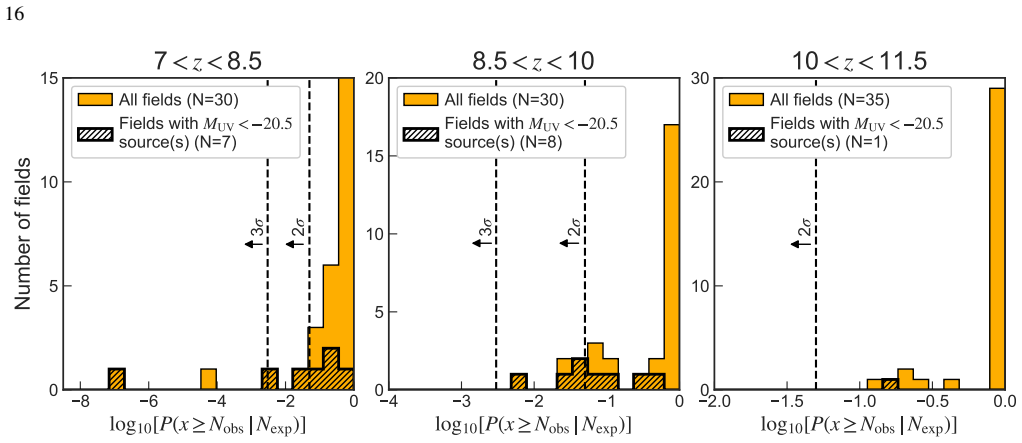
Figure 10. Figure 10: Distributions of the probability of observing Nobs sources or more in a field where Nexp sources are expected, measured for, respectively, all fields (orange) and fields hosting at least one bright MUV < −20.5 source (black, hatched), in three redshift bins: 7 < z < 8.5, 8.5 < z < 10, and 10 < z < 11.5 (left to right panel). The lower the value of P(N ≥ Nobs | Nexp), the more unlikely it is that we observ… view at source ↗
Figure 11
Figure 11. Figure 11: Relative overdensity probability, P(overdense | M > Mh)/P(overdense), as a function of halo mass threshold, Mh, based on 10,000 mock fields from the simu￾lation. This quantifies the excess probability of an overdensity (at the 3σ level) in a mock field, if it contains a halo more massive than Mh. Curves show the median result from 500 independent realisations, with shaded regions indicating the 68th perce… view at source ↗
read the original abstract

The James Webb Space Telescope (JWST) has extended the frontier of galaxy detection to redshifts z>11, finding a high abundance of UV-bright sources that challenge theoretical models. However, most current results come from just a few fields, introducing uncertainties due to cosmic variance. Here, we constrain z~7-14 UV luminosity functions (LFs) over ~400 arcmin^2 across 36 independent sightlines from DR2 of BEACON, a JWST pure-parallel NIRCam multi-band imaging survey. We identify 164 7<z<12 galaxy candidates: 150 F090W-, 14 F115W-, and no robust F150W-dropouts. Based on 11 pointings overlapping with public JWST spectroscopy, we observe 100% purity. Our z~7.5 UV LF agrees with previous bright-end measurements but yields lower number densities at $-21\leq M_\mathrm{UV}\leq-19$. At z~10, our measurements are lower than most photometric JWST results but match spectroscopic constraints, consistent with the high purity of our selection. The LFs at z~7.5 and z~10 are consistent with pre-JWST models, while our limits at z>13 do not rule out a possible excess. We measure significant clustering of bright ($M_\mathrm{UV}<-20.5$) galaxies at 7<z<10. Fields hosting such sources are approximately three times more likely to be overdense relative to the full survey, implying that UV-bright galaxies preferentially reside in the most massive halos at these redshifts. Comparing with semi-numerical simulations, we estimate that $M_{\mathrm{UV}} < -20.5$ galaxies inhabit halos ~0.9 dex less massive at z~11 than at z~7, consistent with a shift to higher star formation rates. However, their observed clustering exceeds predictions from pre-JWST luminosity-halo mass relations, suggesting these sources reside in more massive halos than previously modelled and/or multiple halo occupation.

Editorial analysis

A structured set of objections, weighed in public.

Desk editor's note, referee report, simulated authors' rebuttal, and a circularity audit. Tearing a paper down is the easy half of reading it; the pith above is the substance, this is the friction.

Referee Report

2 major / 2 minor

Summary. The paper reports results from the BEACON JWST pure-parallel NIRCam survey, identifying 164 galaxy candidates (150 F090W-dropouts, 14 F115W-dropouts) at 7<z<12 across 36 independent fields covering ~400 arcmin². It measures the UV luminosity function at z~7.5 (agreeing with prior bright-end results but lower densities at -21 ≤ M_UV ≤ -19) and z~10 (lower than most photometric JWST studies but matching spectroscopic constraints), with limits at z>13. The key result is significant clustering of bright (M_UV < -20.5) galaxies at 7<z<10, with fields hosting such sources ~3× more likely to be overdense, implying residence in the most massive halos; comparisons to semi-numerical simulations suggest these galaxies occupy halos ~0.9 dex less massive at z~11 than at z~7, with observed clustering exceeding pre-JWST luminosity-halo mass relation predictions.

Significance. If the purity and completeness hold, the multi-field approach provides valuable cosmic-variance-reduced constraints on the bright end of the high-z UV LF and the first direct clustering measurements for UV-bright sources at these redshifts. The halo-mass inference and tension with pre-JWST models could inform galaxy formation and reionization studies, particularly if the overdensity factor is robust. The 100% purity from spectroscopic overlaps and consistency with models are positive features, though the limited validation sample size tempers the strength of the claims.

major comments (2)
  1. [spectroscopic validation and sample selection] Spectroscopic validation section: The 100% purity claim rests on 11 overlapping pointings, but the manuscript does not specify the number or fraction of M_UV < -20.5 bright candidates included in these validated fields. Since the clustering result (fields with bright sources ~3× more overdense) is driven by this small bright subset of the 164 total candidates, any unvalidated bright sources could introduce low-z interlopers or redshift errors that bias the field-density comparison and halo-mass estimates.
  2. [clustering measurement and simulation comparison] Clustering analysis section: The overdensity likelihood factor of ~3 and the subsequent halo-mass inference (0.9 dex shift) rely on the assumption that bright candidates are correctly placed at 7<z<10 with no magnitude-dependent selection artifacts. Without a detailed completeness simulation or error budget for the bright-end selection function (as noted in the abstract's purity statement), it is unclear whether the excess clustering signal could arise from residual biases rather than true halo occupation differences.
minor comments (2)
  1. [LF results at z>13] The abstract states 'no robust F150W-dropouts' but does not quantify the upper limits or magnitude range for z>13 constraints; this should be clarified with explicit number densities or Poisson limits in the LF section.
  2. [sample selection] Notation for dropout selection (F090W-, F115W-dropouts) is clear in the abstract but the full criteria (e.g., color cuts, S/N thresholds) should be tabulated or explicitly referenced to allow reproduction.

Simulated Author's Rebuttal

2 responses · 0 unresolved

We thank the referee for their constructive and detailed comments on our manuscript. We have carefully considered each major point and provide point-by-point responses below, including revisions to the manuscript where appropriate to address the concerns raised.

read point-by-point responses
  1. Referee: [spectroscopic validation and sample selection] Spectroscopic validation section: The 100% purity claim rests on 11 overlapping pointings, but the manuscript does not specify the number or fraction of M_UV < -20.5 bright candidates included in these validated fields. Since the clustering result (fields with bright sources ~3× more overdense) is driven by this small bright subset of the 164 total candidates, any unvalidated bright sources could introduce low-z interlopers or redshift errors that bias the field-density comparison and halo-mass estimates.

    Authors: We thank the referee for highlighting this important detail regarding the spectroscopic validation of the bright-end sample. In the revised manuscript, we have expanded the spectroscopic validation section to include a breakdown of the validated candidates by UV magnitude. This addition specifies the number and fraction of M_UV < -20.5 bright candidates that fall within the 11 overlapping pointings with public spectroscopy. All bright candidates in these validated fields are confirmed at the expected redshifts (7 < z < 10) with no interlopers or redshift errors identified. We have also added a brief discussion explaining why the purity of the bright-end selection is particularly robust, given the higher signal-to-noise ratios for these sources. These changes directly address the potential for bias in the clustering and halo-mass results. revision: yes

  2. Referee: [clustering measurement and simulation comparison] Clustering analysis section: The overdensity likelihood factor of ~3 and the subsequent halo-mass inference (0.9 dex shift) rely on the assumption that bright candidates are correctly placed at 7<z<10 with no magnitude-dependent selection artifacts. Without a detailed completeness simulation or error budget for the bright-end selection function (as noted in the abstract's purity statement), it is unclear whether the excess clustering signal could arise from residual biases rather than true halo occupation differences.

    Authors: We agree with the referee that a more explicit treatment of the bright-end selection function strengthens the clustering analysis. In the revised manuscript, we have expanded the methods and clustering sections to include additional details from our completeness simulations, along with a quantitative error budget specifically for the bright-end (M_UV < -20.5) selection function. These simulations show that magnitude-dependent artifacts are minimal at the bright end, as the dropout criteria remain highly efficient and the contamination rate is low even before spectroscopic validation. We have also added a short discussion of how these results support that the observed overdensity factor of ~3 is not driven by selection biases. While we acknowledge that no simulation is perfect, the updated error budget and consistency with the spectroscopic subsample indicate that the halo-mass inference remains robust. revision: yes

Circularity Check

0 steps flagged

Direct counts and angular clustering measurements with no self-referential reduction to inputs

full rationale

The UV LFs are constructed from raw candidate counts (164 sources across 36 fields) binned by magnitude and redshift, while the clustering result follows from comparing the overdensity of fields containing M_UV < -20.5 sources against the survey-wide average. The 100% purity statement rests on an external spectroscopic overlap (11 pointings) rather than a fit to the same data. Simulation comparisons are used only for post-hoc halo-mass interpretation and do not feed back into the observed LF or clustering values. No equations redefine a derived quantity as an input, no fitted parameters are relabeled as predictions, and no load-bearing uniqueness claims rely on self-citations.

Axiom & Free-Parameter Ledger

0 free parameters · 2 axioms · 0 invented entities

The central claims rest on the accuracy of photometric redshift selection, the assumption that the 11 spectroscopic overlaps are representative of the full sample, and the mapping from observed clustering to halo mass via external simulations.

axioms (2)
  • domain assumption Photometric dropout criteria and color selections cleanly isolate galaxies at the stated redshifts with negligible low-redshift contamination.
    Invoked to claim 100% purity and to interpret the LF and clustering results.
  • domain assumption The angular clustering signal directly traces halo occupation without significant projection effects or redshift errors.
    Required to conclude that bright galaxies reside in the most massive halos.

pith-pipeline@v0.9.0 · 5822 in / 1470 out tokens · 41539 ms · 2026-05-10T04:23:00.625931+00:00 · methodology

discussion (0)

Sign in with ORCID, Apple, or X to comment. Anyone can read and Pith papers without signing in.

Forward citations

Cited by 2 Pith papers

Reviewed papers in the Pith corpus that reference this work. Sorted by Pith novelty score.

  1. Breaking the UV Luminosity Function Degeneracy:Self-Interacting Dark Matter Constraints from Reionization Topology

    astro-ph.CO 2026-04 unverdicted novelty 6.0

    21 cm reionization topology breaks the degeneracy between self-interacting dark matter and astrophysical parameters that limits UV luminosity function constraints, enabling robust SIDM limits of σ/m ≳ 1-2 cm²/g indepe...

  2. A structural degeneracy explains reionization tensions and limits dark matter constraints

    astro-ph.CO 2026-05 unverdicted novelty 5.0

    An algebraic degeneracy makes all reionization-history observables sensitive only to the product of escape fraction and star formation efficiency, explaining parameter tensions and limiting dark matter constraints fro...

Reference graph

Works this paper leans on

300 extracted references · 251 canonical work pages · cited by 2 Pith papers · 3 internal anchors

  1. [1]

    SAPPHIRES: Slitless Areal Pure-Parallel High-Redshift Emission Survey

  2. [2]

    A NIRCam Pure-Parallel Imaging Survey of Galaxies Across the Universe

  3. [3]

    arXiv e-prints , keywords =

    Ly Halo Properties and Dust in the Circumgalactic Medium of z 2 Star-forming Galaxies. arXiv e-prints , keywords =. doi:10.48550/arXiv.2405.13122 , archivePrefix =. 2405.13122 , primaryClass =

  4. [4]

    , keywords =

    Searching for Extremely Blue UV Continuum Slopes at z = 7-11 in JWST/NIRCam Imaging: Implications for Stellar Metallicity and Ionizing Photon Escape in Early Galaxies. , keywords =. doi:10.3847/1538-4357/aca522 , archivePrefix =. 2208.01610 , primaryClass =

  5. [5]

    W., Stark, D

    The UV continuum slopes of early star-forming galaxies in JADES. , keywords =. doi:10.1093/mnras/stae800 , archivePrefix =. 2307.08835 , primaryClass =

  6. [6]

    arXiv e-prints , keywords =

    Precisely Measuring the Cosmic Reionization History from IGM Damping Wings Towards Quasars. arXiv e-prints , keywords =. doi:10.48550/arXiv.2406.12070 , archivePrefix =. 2406.12070 , primaryClass =

  7. [7]

    , keywords =

    Rest-frame UV Colors for Faint Galaxies at z 9 16 with the JWST NGDEEP Survey. , keywords =. doi:10.3847/2041-8213/ad2de4 , archivePrefix =. 2311.04294 , primaryClass =

  8. [8]

    , keywords =

    Revisiting the gas kinematics in SSA22 Lyman- Blob 1 with radiative transfer modelling in a multiphase, clumpy medium. , keywords =. doi:10.1093/mnras/staa3951 , archivePrefix =. 2008.09130 , primaryClass =

  9. [9]

    , keywords =

    The JWST Advanced Deep Extragalactic Survey: Discovery of an Extreme Galaxy Overdensity at z = 5.4 with JWST/NIRCam in GOODS-S. , keywords =. doi:10.3847/1538-4357/ad0da7 , archivePrefix =. 2302.10217 , primaryClass =

  10. [10]

    , keywords =

    Ly Emission Line Profiles of Extreme [O III]- emitting Galaxies at z 2: Implications for Ly Visibility in the Reionization Era. , keywords =. doi:10.3847/1538-4357/ad5ae0 , archivePrefix =. 2404.06569 , primaryClass =

  11. [11]

    J., Johnson , B

    The JADES Origins Field: A New JWST Deep Field in the JADES Second NIRCam Data Release. arXiv e-prints , keywords =. doi:10.48550/arXiv.2310.12340 , archivePrefix =. 2310.12340 , primaryClass =

  12. [12]

    J., Willott, C., Alberts, S., et al

    Overview of the JWST Advanced Deep Extragalactic Survey (JADES). arXiv e-prints , keywords =. doi:10.48550/arXiv.2306.02465 , archivePrefix =. 2306.02465 , primaryClass =

  13. [13]

    E., et al

    The JWST UNCOVER Treasury Survey: Ultradeep NIRSpec and NIRCam Observations before the Epoch of Reionization. , keywords =. doi:10.3847/1538-4357/ad66cf , archivePrefix =. 2212.04026 , primaryClass =

  14. [14]

    , keywords =

    Crucial Factors for Ly Transmission in the Reionizing Intergalactic Medium: Infall Motion, H II Bubble Size, and Self-shielded Systems. , keywords =. doi:10.3847/1538-4357/ac2f4b , archivePrefix =. 2105.10770 , primaryClass =

  15. [15]

    Radiative Transfer in Ly Nebulae. I. Modeling a Continuous or Clumpy Spherical Halo with a Central Source. , keywords =. doi:10.3847/1538-4357/acac98 , archivePrefix =. 2212.09630 , primaryClass =

  16. [16]

    Pontzen and F

    Line transfer through clumpy, large-scale outflows: Ly absorption and haloes around star-forming galaxies. , keywords =. doi:10.1111/j.1365-2966.2012.21131.x , archivePrefix =. 1203.3803 , primaryClass =

  17. [17]

    arXiv e-prints , keywords =

    JADES: The star-formation and chemical enrichment history of a luminous galaxy at z -0.5ex 9.43 probed by ultra-deep JWST/NIRSpec spectroscopy. arXiv e-prints , keywords =. doi:10.48550/arXiv.2407.02575 , archivePrefix =. 2407.02575 , primaryClass =

  18. [18]

    , keywords =

    The Universe at z > 10: predictions for JWST from the UNIVERSEMACHINE DR1. , keywords =. doi:10.1093/mnras/staa3164 , archivePrefix =. 2007.04988 , primaryClass =

  19. [19]

    , keywords =

    Late-end reionization with ATON-HE: towards constraints from Ly emitters observed with JWST. , keywords =. doi:10.1093/mnras/stae1945 , archivePrefix =. 2404.06548 , primaryClass =

  20. [20]

    arXiv e-prints , keywords =

    JWST FRESCO: a comprehensive census of H +[OIII] emitters at 6.8<z<9.0 in the GOODS fields. arXiv e-prints , keywords =. doi:10.48550/arXiv.2405.05111 , archivePrefix =. 2405.05111 , primaryClass =

  21. [21]

    arXiv e-prints , keywords =

    Between the Extremes: A JWST Spectroscopic Benchmark for High Redshift Galaxies Using -0.5ex 500 Confirmed Sources at z 5. arXiv e-prints , keywords =. doi:10.48550/arXiv.2403.07103 , archivePrefix =. 2403.07103 , primaryClass =

  22. [22]

    , keywords =

    CEERS: Diversity of Ly Emitters during the Epoch of Reionization. , keywords =. doi:10.3847/1538-4357/ad3913 , archivePrefix =. 2304.05385 , primaryClass =

  23. [23]

    Hydrodynamic Response of the Intergalactic Medium to Reionization. II. Physical Characteristics and Dynamics of Ionizing Photon Sinks. , keywords =. doi:10.3847/1538-4357/ac2eb9 , archivePrefix =. 2108.04837 , primaryClass =

  24. [24]

    2006, PASJ, 58, 485, doi: 10.1093/pasj/58.3.485

    Implications for Cosmic Reionization from the Optical Afterglow Spectrum of the Gamma-Ray Burst 050904 at z = 6.3 ^ *. , keywords =. doi:10.1093/pasj/58.3.485 , archivePrefix =. astro-ph/0512154 , primaryClass =

  25. [25]

    , keywords =

    Lyman- transmission properties of the intergalactic medium in the CoDaII simulation. , keywords =. doi:10.1093/mnras/stab2762 , archivePrefix =. 2004.14496 , primaryClass =

  26. [26]

    , keywords =

    The characteristic shape of damping wings during reionization. , keywords =. doi:10.1093/mnrasl/slad171 , archivePrefix =. 2307.04797 , primaryClass =

  27. [27]

    , keywords =

    E-XQR-30: The evolution of Mg II, C II, and O I across 2 < z < 6. , keywords =. doi:10.1093/mnras/stae789 , archivePrefix =. 2403.10072 , primaryClass =

  28. [28]

    , keywords =

    Metal enrichment and evolution in four z > 6.5 quasar sightlines observed with JWST/NIRSpec. , keywords =. doi:10.1051/0004-6361/202347943 , archivePrefix =. 2309.06470 , primaryClass =

  29. [29]

    , keywords =

    Cosmic Reionization on Computers: Statistics, Physical Properties, and Environments of Lyman Limit Systems at z 6. , keywords =. doi:10.3847/1538-4357/ad2269 , archivePrefix =. 2212.07033 , primaryClass =

  30. [30]

    2023, ApJ, 956, 139, doi: 10.3847/1538-4357/acf376

    Redshift Evolution of Electron Density in the Interstellar Medium at z 0-9 Uncovered with JWST/NIRSpec Spectra and Line-spread Function Determinations. , keywords =. doi:10.3847/1538-4357/acf376 , archivePrefix =. 2301.06811 , primaryClass =

  31. [31]

    2016, MNRAS, 462, 1415, doi: 10.1093/mnras/stw1756

    Modelling and interpreting spectral energy distributions of galaxies with BEAGLE. , keywords =. doi:10.1093/mnras/stw1756 , archivePrefix =. 1603.03037 , primaryClass =

  32. [32]

    , year = 2009, month = sep, volume =

    The Hi Distribution of the Milky Way. , year = 2009, month = sep, volume =. doi:10.1146/annurev-astro-082708-101823 , adsurl =

  33. [33]

    Mirage or Miracle? Spectroscopic Confirmation of Remarkably Luminous Galaxies at z>10

  34. [34]

    The CANDELS-Area Prism Epoch of Reionization Survey (CAPERS)

  35. [35]

    arXiv e-prints , keywords =

    Possible Contamination of the Intergalactic Medium Damping Wing in ULAS J1342+0928 by Proximate Damped Ly Absorption. arXiv e-prints , keywords =. doi:10.48550/arXiv.2312.06747 , archivePrefix =. 2312.06747 , primaryClass =

  36. [36]

    , keywords =

    On the Escape of Ionizing Radiation from Starbursts. , keywords =. doi:10.1086/322475 , archivePrefix =. astro-ph/0105012 , primaryClass =

  37. [37]

    , keywords =

    Extreme Feedback and the Epoch of Reionization: Clues in the Local Universe. , keywords =. doi:10.1088/0004-637X/730/1/5 , archivePrefix =. 1101.4219 , primaryClass =

  38. [38]

    , keywords =

    Uncovering the physical origin of the prominent Lyman- emission and absorption in GS9422 at z = 5.943. , keywords =. doi:10.1051/0004-6361/202450375 , archivePrefix =. 2404.06543 , primaryClass =

  39. [39]

    , keywords =

    Radiation Hydrodynamics of Turbulent H II Regions in Molecular Clouds: A Physical Origin of LyC Leakage and the Associated Ly Spectra. , keywords =. doi:10.3847/1538-4357/abc2d9 , archivePrefix =. 1905.02480 , primaryClass =

  40. [40]

    , keywords =

    Searching for Emission Lines at z > 11: The Role of Damped Ly and Hints About the Escape of Ionizing Photons. , keywords =. doi:10.3847/1538-4357/ad8447 , archivePrefix =. 2404.04325 , primaryClass =

  41. [41]

    , keywords =

    Connecting the escape fraction of Lyman-alpha and Lyman-continuum photons in star-forming galaxies at z ≃ 4-5. , keywords =. doi:10.1093/mnras/stad3417 , archivePrefix =. 2306.03916 , primaryClass =

  42. [42]

    , keywords =

    Model-independent Insights into the Nature of the Ly Forest and the Distribution of Matter in the Universe. , keywords =. doi:10.1086/322421 , archivePrefix =. astro-ph/0104272 , primaryClass =

  43. [43]

    , keywords =

    A Physical Upper Limit on the H I Column Density of Gas Clouds. , keywords =. doi:10.1086/338106 , archivePrefix =. astro-ph/0109280 , primaryClass =

  44. [44]

    and Schaye, J

    The distribution of neutral hydrogen around high-redshift galaxies and quasars in the EAGLE simulation. , keywords =. doi:10.1093/mnras/stv1414 , archivePrefix =. 1503.05553 , primaryClass =

  45. [45]

    , keywords =

    Measuring the photoionization rate, neutral fraction, and mean free path of H I ionizing photons at 4.9 z 6.0 from a large sample of XShooter and ESI spectra. , keywords =. doi:10.1093/mnras/stad2566 , archivePrefix =. 2304.02038 , primaryClass =

  46. [46]

    , keywords =

    Constraints on the Evolution of the Ionizing Background and Ionizing Photon Mean Free Path at the End of Reionization. , keywords =. doi:10.3847/1538-4357/ad1d5d , archivePrefix =. 2312.08464 , primaryClass =

  47. [47]

    , keywords =

    The THESAN project: Connecting ionized bubble sizes to their local environments during the Epoch of Reionization. , keywords =. doi:10.1093/mnras/stae1325 , archivePrefix =. 2310.03783 , primaryClass =

  48. [48]

    arXiv e-prints , keywords =

    JWST NIRSpec spectroscopy of the triply-lensed z = 10.17 galaxy MACS0647 - JD. arXiv e-prints , keywords =. doi:10.48550/arXiv.2305.03042 , archivePrefix =. 2305.03042 , primaryClass =

  49. [49]

    , keywords =

    Ly Emission at z = 7 13: Clear Evolution of Ly Equivalent Width Indicating a Late Cosmic Reionization History. , keywords =. doi:10.3847/1538-4357/ad38c2 , archivePrefix =. 2312.06804 , primaryClass =

  50. [50]

    2023, PASP, 135, 048001, doi: 10.1088/1538-3873/acb293

    The Science Performance of JWST as Characterized in Commissioning. , keywords =. doi:10.1088/1538-3873/acb293 , archivePrefix =. 2207.05632 , primaryClass =

  51. [51]

    The Near-Infrared Spectrograph (NIRSpec) on the James Webb Space Telescope. I. Overview of the instrument and its capabilities. , keywords =. doi:10.1051/0004-6361/202142663 , archivePrefix =. 2202.03305 , primaryClass =

  52. [52]

    , keywords =

    Diffuse Ly haloes around galaxies at z = 2.2-6.6: implications for galaxy formation and cosmic reionization. , keywords =. doi:10.1093/mnras/stu825 , archivePrefix =. 1403.0732 , primaryClass =

  53. [53]

    , keywords =

    Life beyond 30: Probing the -20 < M _ UV < -17 Luminosity Function at 8 < z < 13 with the NIRCam Parallel Field of the MIRI Deep Survey. , keywords =. doi:10.3847/2041-8213/acd9d0 , archivePrefix =. 2302.02429 , primaryClass =

  54. [54]

    , keywords =

    Peering into cosmic reionization: Ly visibility evolution from galaxies at z = 4.5-8.5 with JWST. , keywords =. doi:10.1051/0004-6361/202449644 , archivePrefix =. 2402.11220 , primaryClass =

  55. [55]

    arXiv e-prints , keywords =

    Learning Reionization History from Quasars with Simulation-Based Inference. arXiv e-prints , keywords =. doi:10.48550/arXiv.2311.16238 , archivePrefix =. 2311.16238 , primaryClass =

  56. [56]

    E., Brammer , G

    The JWST-PRIMAL archival survey: A JWST/NIRSpec reference sample for the physical properties and Lyman- absorption and emission of 600 galaxies at z = 5.0 ‑ 13.4. , keywords =. doi:10.1051/0004-6361/202450243 , archivePrefix =. 2404.02211 , primaryClass =

  57. [57]

    , keywords =

    The Impact of Mass-dependent Stochasticity at Cosmic Dawn. , keywords =. doi:10.3847/1538-4357/ad7b36 , archivePrefix =. 2405.13108 , primaryClass =

  58. [58]

    , keywords =

    JADES: Carbon enrichment 350 Myr after the Big Bang. , keywords =. doi:10.1051/0004-6361/202348636 , archivePrefix =. 2311.09908 , primaryClass =

  59. [59]

    , keywords =

    A new model framework for circumgalactic Ly radiative transfer constrained by galaxy-Ly forest clustering. , keywords =. doi:10.1093/mnras/sty2214 , archivePrefix =. 1710.10053 , primaryClass =

  60. [60]

    , keywords =

    The H I covering fraction of Lyman Limit Systems in FIRE haloes. , keywords =. doi:10.1093/mnras/stae1738 , archivePrefix =. 2311.18000 , primaryClass =

  61. [61]

    , keywords =

    The origin of the characteristic shape and scatter of intergalactic damping wings during reionization. , keywords =. doi:10.1093/mnrasl/slae022 , archivePrefix =. 2308.11709 , primaryClass =

  62. [62]

    , keywords =

    JWST PRIMER: a new multifield determination of the evolving galaxy UV luminosity function at redshifts z ≃ 9 - 15. , keywords =. doi:10.1093/mnras/stae2037 , archivePrefix =. 2403.03171 , primaryClass =

  63. [63]

    J., Jones, G

    JADES: The production and escape of ionizing photons from faint Lyman-alpha emitters in the epoch of reionization. , keywords =. doi:10.1051/0004-6361/202347132 , archivePrefix =. 2306.04536 , primaryClass =

  64. [64]

    , year = 1996, volume =

    An analytic model for the spatial clustering of dark matter haloes. , keywords =. doi:10.1093/mnras/282.2.347 , archivePrefix =. astro-ph/9512127 , primaryClass =

  65. [65]

    Monthly Notices of the Royal Astronomical Society 373, 1195–1202

    Natural downsizing in hierarchical galaxy formation. , keywords =. doi:10.1111/j.1365-2966.2006.10918.x , archivePrefix =. astro-ph/0605045 , primaryClass =

  66. [66]

    The physical origin of the universal function

    The accretion history of dark matter haloes - I. The physical origin of the universal function. , keywords =. doi:10.1093/mnras/stv689 , archivePrefix =. 1409.5228 , primaryClass =

  67. [67]

    , keywords =

    The JADES Transient Survey: Discovery and Classification of Supernovae in the JADES Deep Field. , keywords =. doi:10.3847/1538-4357/ad8fab , archivePrefix =. 2406.05060 , primaryClass =

  68. [68]

    SPURS: Evidence for Clumpy Neutral Envelopes and Ionized IGM Surrounding Little Red Dots in Abell 2744 from Ultra-Deep Rest-UV Spectroscopy

    SPURS: Evidence for Clumpy Neutral Envelopes and Ionized IGM Surrounding Little Red Dots in Abell 2744 from Ultra-Deep Rest-UV Spectroscopy. arXiv e-prints , keywords =. doi:10.48550/arXiv.2604.03563 , archivePrefix =. 2604.03563 , primaryClass =

  69. [69]

    Endsley, D

    The Star-forming and Ionizing Properties of Dwarf z -0.5ex 6-9 Galaxies in JADES: Insights on Bursty Star Formation and Ionized Bubble Growth. arXiv e-prints , keywords =. doi:10.48550/arXiv.2306.05295 , archivePrefix =. 2306.05295 , primaryClass =

  70. [70]

    2023, ApJL, 944, L59, doi: 10.3847/2041-8213/aca1c4

    Metal-enriched Neutral Gas Reservoir around a Strongly Lensed Low-mass Galaxy at z = 4 Identified by JWST/NIRISS and VLT/MUSE. , keywords =. doi:10.3847/2041-8213/aca1c4 , archivePrefix =. 2209.03376 , primaryClass =

  71. [71]

    , keywords =

    Neutral CGM as damped Ly absorbers at high redshift. , keywords =. doi:10.1093/mnras/stab2240 , archivePrefix =. 2105.06489 , primaryClass =

  72. [72]

    , keywords =

    CGM ^ 2 I: The Extent of the Circumgalactic Medium Traced by Neutral Hydrogen. , keywords =. doi:10.3847/1538-4357/abea14 , archivePrefix =. 2008.08092 , primaryClass =

  73. [73]

    Efficient modeling of correlated noise. II. A flexible noise model with fast and scalable methods. , keywords =. doi:10.1051/0004-6361/201936906 , archivePrefix =. 2004.10678 , primaryClass =

  74. [74]

    , keywords =

    Subkiloparsec Imaging of Ly Emission in a Low-mass, Highly Ionized, Gravitationally Lensed Galaxy at z = 1.84. , keywords =. doi:10.3847/1538-4357/ab3daf , archivePrefix =. 1907.11733 , primaryClass =

  75. [75]

    , keywords =

    Ly -emitting galaxies as a probe of reionization: large-scale bubble morphology and small-scale absorbers. , keywords =. doi:10.1093/mnras/stw2193 , archivePrefix =. 1510.05647 , primaryClass =

  76. [76]

    , keywords =

    A stellar feedback origin for neutral hydrogen in high-redshift quasar-mass haloes. , keywords =. doi:10.1093/mnrasl/slw091 , archivePrefix =. 1601.07188 , primaryClass =

  77. [77]

    , keywords =

    Neutral hydrogen in galaxy haloes at the peak of the cosmic star formation history. , keywords =. doi:10.1093/mnras/stv336 , archivePrefix =. 1409.1919 , primaryClass =

  78. [78]

    , keywords =

    Virialization of the Inner CGM in the FIRE Simulations and Implications for Galaxy Disks, Star Formation, and Feedback. , keywords =. doi:10.3847/1538-4357/abd776 , archivePrefix =. 2006.13976 , primaryClass =

  79. [79]

    , keywords =

    The Gaseous Environment of High-z Galaxies: Precision Measurements of Neutral Hydrogen in the Circumgalactic Medium of z -0.5ex 2-3 Galaxies in the Keck Baryonic Structure Survey. , keywords =. doi:10.1088/0004-637X/750/1/67 , archivePrefix =. 1202.6055 , primaryClass =

  80. [80]

    2010, Monthly Notices of the Royal Astronomical Society, 408, 1181, doi: 10.1111/j.1365-2966.2010.17197.x

    The nature of proximate damped Lyman systems. , keywords =. doi:10.1111/j.1365-2966.2010.16780.x , archivePrefix =. 1004.2715 , primaryClass =

Showing first 80 references.