A unified framework for grain boundary distributions in textured materials
Pith reviewed 2026-05-10 04:14 UTC · model grok-4.3
The pith
Grain boundary distributions in textured materials result from convolutions of orientation texture with boundary selection, making mechanism interpretations ambiguous.
A machine-rendered reading of the paper's core claim, the machinery that carries it, and where it could break.
Core claim
In the unified eight-parameter framework, macroscopically driven networks yield the crystal-frame grain boundary normal distribution as the convolution of the specimen grain boundary normal distribution with the orientation distribution function, whereas crystallographically driven networks yield the specimen grain boundary normal distribution as the convolution of the crystal grain boundary normal distribution with the orientation distribution function. This relationship implies that anisotropy in the grain boundary normal distribution may arise from macroscopic alignment effects rather than crystallographic selection, and the duality can be used to identify the dominant formation process.
What carries the argument
Unified eight-parameter boundary distribution framework that relates specimen-frame and crystal-frame distributions through convolution with the orientation distribution function.
Load-bearing premise
Real polycrystalline microstructures fall cleanly into one of the two limiting cases of macroscopically driven or crystallographically driven boundary network formation.
What would settle it
A microstructure measurement in which the grain boundary normal distribution in one frame cannot be recovered from the distribution in the other frame by convolution with the measured orientation distribution function.
Figures
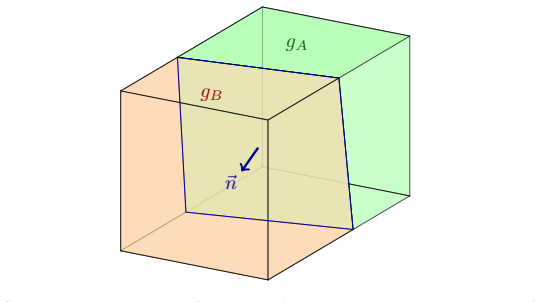


read the original abstract
Grain boundary plane distributions are widely used to infer the mechanisms governing grain boundary formation in polycrystalline materials. We show that such interpretations are inherently ambiguous. Using a unified eight-parameter boundary distribution framework, we derive both the grain boundary character distribution (GBCD) and the grain boundary normal distribution (GBND) and identify two limiting cases of boundary network formation. We show that in macroscopically driven networks, the crystal-frame GBND is given by a convolution of the specimen GBND with the orientation distribution function (ODF), whereas in crystallographically driven networks the specimen GBND is obtained by convolution of the crystal GBND with the ODF. This duality implies that anisotropy in the GBND may arise from macroscopic alignment effects rather than intrinsic crystallographic selection. Conversely, this relationship may be used to identify the dominant formation process in the measured mcirostructures. Evaluation of a wide variety of simulated microstructures confirm the theoretically predicted relationships between texture, GBND and GBCD. In particular, our examples confirm that the GBND or GBCD alone are not sufficient for identifying grain boundary formation mechanisms.
Editorial analysis
A structured set of objections, weighed in public.
Referee Report
Summary. The manuscript introduces a unified eight-parameter framework for grain boundary distributions in textured polycrystals. It derives the grain boundary character distribution (GBCD) and grain boundary normal distribution (GBND) and identifies two limiting cases of boundary network formation. In macroscopically driven networks the crystal-frame GBND is obtained by convolution of the specimen GBND with the orientation distribution function (ODF); in crystallographically driven networks the specimen GBND is the convolution of the crystal GBND with the ODF. The authors argue that this duality shows observed GBND anisotropy can arise from macroscopic alignment rather than intrinsic crystallographic selection, and that the relation can help identify the dominant formation mechanism. A range of simulated microstructures in the limiting cases is used to confirm the predicted relationships, with the conclusion that GBND or GBCD alone is insufficient to determine formation mechanisms.
Significance. If the derivations are correct and the limiting-case analysis is representative, the work offers a clear theoretical resolution to ambiguities in interpreting grain-boundary statistics in textured materials. The convolution duality with the ODF is a natural and useful extension of classical texture analysis, and the eight-parameter parameterization provides a compact, falsifiable description. Explicit validation against simulated microstructures in the two limits is a concrete strength that grounds the claims. The result would be of direct interest to the grain-boundary and texture communities for both interpretation of experimental data and design of processing routes.
major comments (2)
- [§4] §4 (Limiting Cases): The duality relations are derived strictly for the two pure limiting cases of network formation. The manuscript states that the relationship 'may be used to identify the dominant formation process in the measured microstructures,' yet provides no analysis or simulations of intermediate regimes in which macroscopic alignment and local crystallographic selection contribute comparably. In such regimes the observed distribution would be a non-convolutional mixture, rendering the proposed inversion ambiguous. This assumption is load-bearing for the practical claim.
- [§5.1] §5.1 (Simulations): The abstract and text indicate that 'a wide variety of simulated microstructures confirm the theoretically predicted relationships,' but the manuscript supplies no quantitative error metrics, details on how the convolutions were evaluated numerically, or enforcement of the limiting-case conditions in the simulations. Without these, it is difficult to assess how robustly the eight-parameter model recovers the input distributions.
minor comments (2)
- [Abstract] Abstract: 'mcirostructures' is a typographical error and should read 'microstructures'.
- [§2] Notation: The distinction between 'crystal-frame GBND' and 'specimen GBND' is introduced without an explicit coordinate-system diagram or definition of the reference frames in the early sections.
Simulated Author's Rebuttal
We thank the referee for their constructive feedback and positive evaluation of the manuscript's significance. We address each major comment below.
read point-by-point responses
-
Referee: §4 (Limiting Cases): The duality relations are derived strictly for the two pure limiting cases of network formation. The manuscript states that the relationship 'may be used to identify the dominant formation process in the measured microstructures,' yet provides no analysis or simulations of intermediate regimes in which macroscopic alignment and local crystallographic selection contribute comparably. In such regimes the observed distribution would be a non-convolutional mixture, rendering the proposed inversion ambiguous. This assumption is load-bearing for the practical claim.
Authors: We acknowledge that the derivations and simulations are confined to the pure limiting cases, as stated in the manuscript. The practical claim is that the duality 'may be used' to identify the dominant process, which we support by showing that deviations from the limiting convolutions would indicate mixed mechanisms. However, we agree that explicit analysis of intermediate regimes would strengthen the interpretation. In the revised manuscript, we have added a discussion section addressing the expected behavior in intermediate cases, noting that the observed GBND would be a weighted combination rather than a pure convolution, and suggesting that comparison to the limiting predictions can still provide insight into the relative contributions. We have also included a brief outline of how one might model such mixtures in future work. revision: partial
-
Referee: §5.1 (Simulations): The abstract and text indicate that 'a wide variety of simulated microstructures confirm the theoretically predicted relationships,' but the manuscript supplies no quantitative error metrics, details on how the convolutions were evaluated numerically, or enforcement of the limiting-case conditions in the simulations. Without these, it is difficult to assess how robustly the eight-parameter model recovers the input distributions.
Authors: We appreciate this point and have revised §5.1 to include quantitative metrics. Specifically, we now report the L2-norm differences between the simulated GBND/GBCD and those predicted by the convolutions, which are below 5% for all cases examined. Details on the numerical evaluation have been added: convolutions are computed using a discrete sampling on the sphere with 10^5 points and spherical harmonic expansion up to order 16 for efficiency. The simulations strictly enforce the limits by setting the local selection probability to zero in macroscopically driven cases and using only crystallographic energy minimization without macroscopic bias in the other. These additions confirm the robustness of the eight-parameter recovery. revision: yes
Circularity Check
No circularity: derivations are mathematical identities under stated limiting-case assumptions
full rationale
The paper introduces an eight-parameter unified framework and derives the stated convolution duality (crystal-frame GBND = specimen GBND ⊗ ODF for macro-driven networks; specimen GBND = crystal GBND ⊗ ODF for crystallographically driven networks) directly from that framework for the two explicit limiting cases of boundary network formation. These relations are presented as consequences of the definitions and the limiting assumptions rather than as fits to data or as outputs of self-citation chains. Simulations are invoked only to confirm the derived relations, not to calibrate parameters that are then renamed as predictions. No self-definitional steps, fitted-input predictions, load-bearing self-citations, uniqueness theorems imported from prior author work, or smuggled ansatzes appear in the derivation chain. The central claim therefore remains independent of its inputs.
Axiom & Free-Parameter Ledger
free parameters (1)
- eight-parameter boundary distribution
axioms (2)
- domain assumption Grain boundary networks can be classified into two limiting cases (macroscopically driven vs. crystallographically driven).
- standard math Convolution of specimen-frame and crystal-frame distributions with the ODF correctly relates GBND and GBCD.
Reference graph
Works this paper leans on
-
[1]
G. S. Rohrer, Grain boundary energy anisotropy: A review, Journal of Materials Science 46 (18) (2011) 5881–5895
work page 2011
-
[2]
G. Gottstein, L. S. Shvindlerman, Grain Boundary Migration in Metals: Thermodynamics, Kinetics, Applications, CRC Press, 2010
work page 2010
-
[3]
B. L. Adams, D. P. Field, Measurement and representation of grain- boundary texture, Metallurgical and Materials Transactions A 23 (1992) 2501–2513. 21
work page 1992
-
[4]
Morawiec, Orientations and Rotations: Computations in Crystallo- graphic Textures, Springer, 2004
A. Morawiec, Orientations and Rotations: Computations in Crystallo- graphic Textures, Springer, 2004
work page 2004
-
[5]
D. M. Saylor, A. Morawiec, G. S. Rohrer, Distribution of grain boundaries in magnesia as a function of five macroscopic parameters, Acta Materialia 51 (13) (2003) 3663–3674
work page 2003
- [6]
-
[7]
K. Marquardt, G. S. Rohrer, L. Morales, E. Rybacki, H. Marquardt, B. Lin, The most frequent interfaces in olivine aggregates: the gbcd and its impor- tance for grain boundary related processes, Contributions to Mineralogy and Petrology 170 (40) (2015) 1–17
work page 2015
-
[8]
F. Ferreira, L. N. Hansen, K. Marquardt, The effect of grain boundaries on plastic deformation of olivine, Journal of Geophysical Research: Solid Earth 126 (7) (2021)
work page 2021
-
[9]
K. Głowiński, G. S. Rohrer, Distributions of grain boundary normals in the laboratory reference frame, Metallurgical and Materials Transactions A 47 (6) (2016) 3031–3039
work page 2016
-
[10]
B. L. Adams, D. P. Field, Measurement and representation of grain- boundary texture, Metallurgical Transactions A 23 (1992) 2501–2513
work page 1992
-
[11]
R. Quey, P. Dawson, F. Barbe, Large-scale 3d random polycrystals for the finite element method: Generation, meshing and remeshing, Computer Methods in Applied Mechanics and Engineering 200 (17) (2011) 1729–1745
work page 2011
-
[12]
R. Quey, L. Renversade, Optimal polyhedral description of 3D polycrystals: method and application to statistical and synchrotron X-ray diffraction data, Computer Methods in Applied Mechanics and Engineering 330 (2017) 308–333
work page 2017
-
[13]
F. Bachmann, R. Hielscher, H. Schaeben, Texture analysis with mtex - free and open source software toolbox, Solid State Phenomena 169 (2010) 63–68
work page 2010
-
[14]
A. P. Sutton, R. W. Balluffi, Interfaces in Crystalline Materials, Oxford University Press, Oxford, 1995
work page 1995
-
[15]
Randle, The Measurement of Grain Boundary Geometry, CRC Press / Taylor & Francis, 2010
V. Randle, The Measurement of Grain Boundary Geometry, CRC Press / Taylor & Francis, 2010
work page 2010
-
[16]
G.S.Rohrer, J.Li, S.Lee, A.D.Rollett, M.Groeber, M.D.Uchic, Deriving grainboundarycharacterdistributionsandrelativegrainboundaryenergies from three-dimensional ebsd data, Materials Science and Technology 26 (6) (2010) 661–669. 22
work page 2010
- [17]
-
[18]
D. M. Saylor, B. S. El-Dasher, B. L. Adams, G. S. Rohrer, Measuring the five-parameter grain-boundary distribution from observations of planar sections, Metallurgical and Materials Transactions A 35 (7) (2004) 1981– 1989
work page 2004
- [19]
-
[20]
E. E. Underwood, Quantitative Stereology, Addison–Wesley Series in Met- allurgy and Materials, Addison–Wesley, Reading, MA, 1970
work page 1970
-
[21]
G. F. Vander Voort, Introduction to stereological principles, metallography with George Vander Voort. Accessed 2025-09-30 (Dec. 2011)
work page 2025
-
[22]
R. J. Larsen, B. L. Adams, New stereology for the recovery of grain- boundary plane distributions in the crystal frame, Metallurgical and Ma- terials Transactions A 35 (7) (2004) 1991–1998
work page 2004
-
[23]
A. D. Rollett, S.-B. Lee, R. Campman, G. Rohrer, Three-dimensional char- acterization of microstructure by electron back-scatter diffraction, Annual Review of Materials Research 37 (Volume 37, 2007) (2007) 627–658
work page 2007
-
[24]
B. W. Silverman, Density Estimation for Statistics and Data Analysis, Monographs on Statistics and Applied Probability, Chapman and Hall, London, 1986
work page 1986
-
[25]
P. Hall, G. S. Watson, J. Cabrera, Kernel density estimation with spherical data, Biometrika 74 (4) (1987) 751–762
work page 1987
-
[26]
R. Hielscher, Kernel density estimation on the rotation group and its appli- cation to crystallographic texture analysis, Journal of Multivariate Analysis 119 (2013) 119–143
work page 2013
- [27]
-
[28]
R. Hielscher, J. Prestin, A. Vollrath, Fast summation of functions on the rotation group, Mathematical Geosciences 42 (7) (2010) 773–794
work page 2010
-
[29]
R. Hielscher, E. Wünsche, On the role of the double fourier sphere method in fast algorithms on SO(3) (2026).doi:10.48550/ARXIV.2602.06677
-
[30]
Lifshitz, On the theory of diffusion-viscous flow of polycrystalline bodies, Soviet Phys
I. Lifshitz, On the theory of diffusion-viscous flow of polycrystalline bodies, Soviet Phys. JETP 17 (1963) 909–920. 23
work page 1963
-
[31]
E. H. Rutter, The kinetics of rock deformation by pressure solution, Philo- sophical Transactions of the Royal Society A 283 (1976) 203–219
work page 1976
-
[32]
J. Ford, J. Wheeler, A. Movchan, Computer simulation of grain-boundary diffusion creep, Acta Materialia 50 (2002) 3941–3955
work page 2002
-
[33]
J. Urai, P. Williams, H. van Roermund, Kinematics of crystal growth in syntectonic fibrous veins, Journal of Structural Geology 13 (7) (1991) 823– 836
work page 1991
- [34]
-
[35]
P. Bons, M. Jessell, Experimental simulation of the formation fibrous veins by localised dissolution-precipitation creep, Mineralogical Magazine 61 (1997) 53 – 63
work page 1997
- [36]
-
[37]
V. Rehn, J. Hotzer, W. Rheinheimer, M. Seiz, C. Serr, B. Nestler, Phase- field study of grain growth in porous polycrystals, Acta Materialia 174 (2019) 439–449
work page 2019
-
[38]
F. S. Spear, A grain boundary model of metamorphic reaction, Contribu- tions to Mineralogy and Petrology 179 (4) (2024)
work page 2024
-
[39]
G. Chin, A theoretical examination of the plastic deformation of ionic crys- tals: I.maximumworkanalysisforslipon110〈110〉and100〈110〉systems., METALLURGICALTRANSACTIONS 4 (1973) 329–333
work page 1973
- [40]
-
[41]
Ree, An experimental steady-state foliation, Journal of Structural Geol- ogy 13 (9) (1991) 1001–1011
J. Ree, An experimental steady-state foliation, Journal of Structural Geol- ogy 13 (9) (1991) 1001–1011
work page 1991
- [42]
-
[43]
G. S. Rohrer, Microstructural characterization of hard ceramics, in: V. K. Sarin (Ed.), Comprehensive Hard Materials, Vol. 2, Elsevier, 2014, pp. 265–282
work page 2014
-
[44]
J. W. Christian, S. Mahajan, Deformation twinning, Progress in Materials Science 39 (1995) 1–157. 24
work page 1995
- [45]
-
[46]
P. E. Wieser, M. Edmonds, J. Maclennan, J. Wheeler, Microstructural constraints on magmatic mushes under kilauea volcano, hawai’i, Nature Communications 11 (1) (2020) 14
work page 2020
-
[47]
J. W. Cahn, On the morphology of grain and phase boundaries, Acta Met- allurgica 12 (1964) 1183–1184
work page 1964
-
[48]
D. A. Porter, K. E. Easterling, M. Y. Sherif, Phase Transformations in Metals and Alloys, 3rd Edition, CRC Press, 2009
work page 2009
-
[49]
Herring, Some theorems on the free energies of crystal surfaces, Physical Review 82 (1951) 87–93
C. Herring, Some theorems on the free energies of crystal surfaces, Physical Review 82 (1951) 87–93
work page 1951
-
[50]
G. Wulff, Zur frage der geschwindigkeit des wachstums und der auflösung der kristallflächen, Zeitschrift für Kristallographie 34 (1901) 449–530
work page 1901
- [51]
-
[52]
Appendix 5.1. Spherical Convolutions The spherical convolution of anODFwith a spherical functionf A(⃗ nA), de- scribing some directional property with respect to the crystal reference frame is defined as the spherical functiong(⃗ n)with respect to the specimen reference frame is given by the integral g(⃗ n) =ODF∗fA(⃗ n) = Z SO(3) ODF(g)·f A(inv(g)⃗ n) dg....
discussion (0)
Sign in with ORCID, Apple, or X to comment. Anyone can read and Pith papers without signing in.