Decoherence in Waveguide Quantum Electrodynamics using Matrix Product States
Pith reviewed 2026-05-10 05:24 UTC · model grok-4.3
The pith
Density matrix matrix product states incorporate decoherence into waveguide quantum electrodynamics simulations.
A machine-rendered reading of the paper's core claim, the machinery that carries it, and where it could break.
Core claim
We present a matrix product state (MPS) method for including decoherence processes in calculations involving waveguide quantum electrodynamics (waveguide QED) using density matrices. The approach is based on collision quantum optics, where the many-body state of the waveguide is represented as discrete time bins, which are efficiently represented using an MPS chain. Our method is a generalization of previous MPS methods, and we demonstrate how one can efficiently expand to density matrices, allowing for the inclusion of various loss processes in the form of Lindblad terms in the Liouvillian superoperator responsible for the relevant dissipation dynamics.
What carries the argument
Collision quantum optics discretization of the waveguide into discrete time bins represented as an MPS chain for the density matrix, augmented by Lindblad superoperators in the Liouvillian to capture dissipation.
If this is right
- Pure dephasing modifies the emission and feedback dynamics of a two-level system in a semi-infinite waveguide in quantifiable ways.
- Off-chip radiative decay produces qualitatively different signatures from pure dephasing in the scattered light.
- Scattering of few-photon Fock pulses off an emitter can be tracked while including realistic decoherence.
- Interactions between two spatially separated emitters with propagation delays become tractable under Lindblad loss.
Where Pith is reading between the lines
- The same MPS density-matrix construction could be applied to more complex multi-emitter networks or chiral waveguides.
- Experimental groups could use the method to predict how controlled dephasing alters measured photon statistics before running hardware tests.
- The technique suggests a route to embed other open-system master equations into tensor-network descriptions of one-dimensional quantum optics.
Load-bearing premise
The discrete time-bin collision model of the waveguide continues to represent continuous-time dynamics accurately once the state is promoted from a wave function to a density matrix.
What would settle it
Exact comparison of computed single-photon scattering spectra or second-order correlation functions for a two-level emitter with known analytic Lindblad solutions at a chosen dephasing rate; large deviations would falsify the numerical method.
Figures




read the original abstract
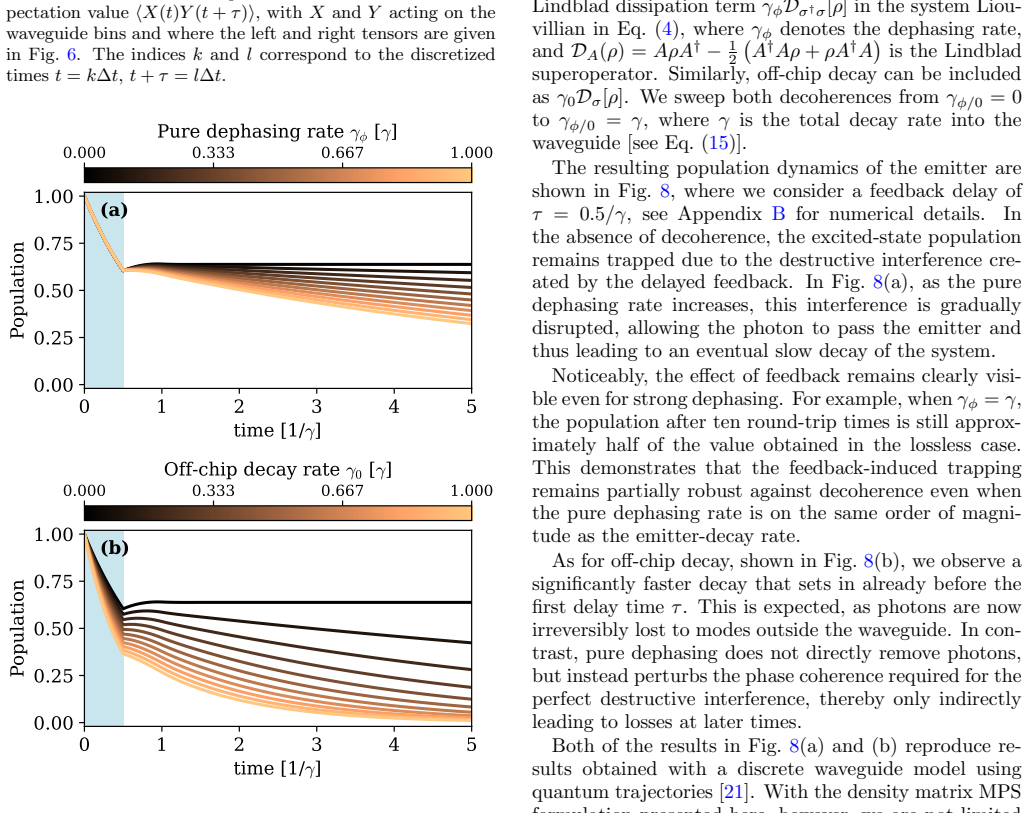
We present a matrix product state (MPS) method for including decoherence processes in calculations involving waveguide quantum electrodynamics (waveguide QED) using density matrices. The approach is based on collision quantum optics, where the many-body state of the waveguide is represented as discrete time bins, which are efficiently represented using an MPS chain. Our method is a generalization of previous MPS methods, and we demonstrate how one can efficiently expand to density matrices, allowing for the inclusion of various loss processes in the form of Lindblad terms in the Liouvillian superoperator responsible for the relevant dissipation dynamics. As an application of the theory, we study various waveguide QED systems and the influence of emitter pure dephasing (which is one of the most important processes in real systems) on the light-matter interactions, including a two-level system (TLS) in a semi-infinite waveguide with time-delayed feedback, two spatially separated TLSs with finite delays, and finally the scattering of few-photon Fock pulses on a TLS. In addition to emitter pure dephasing, we also show how to include off-chip radiative decay, and show how it differs qualitatively from pure dephasing.
Editorial analysis
A structured set of objections, weighed in public.
Referee Report
Summary. The paper presents a matrix product state (MPS) method for including decoherence in waveguide quantum electrodynamics calculations using density matrices. It generalizes collision quantum optics by discretizing the waveguide into time bins represented as an MPS chain and extends the formalism to vectorized density matrices to incorporate Lindblad superoperators for processes such as emitter pure dephasing and off-chip radiative decay. Applications are shown for a TLS with time-delayed feedback in a semi-infinite waveguide, two spatially separated TLSs with finite delays, and few-photon Fock pulse scattering on a TLS, with emphasis on qualitative differences between pure dephasing and radiative loss.
Significance. If the discretization and MPS representation remain accurate when extended to open systems, the work supplies a practical tensor-network tool for modeling realistic decoherence in waveguide QED, an area where such effects are experimentally relevant. Credit is given for the explicit generalization of prior MPS collision models to density matrices with Lindblad terms and for the demonstration that different loss mechanisms produce distinguishable signatures in the studied observables.
major comments (1)
- [Applications section] Applications section (TLS feedback, two-emitter, and few-photon scattering examples): No explicit convergence study with respect to time-bin width Δt is reported for the density-matrix simulations that include Lindblad operators. The collision-model discretization approximates continuous-time dynamics only in the Δt → 0 limit with fixed physical rates; without refinement data or error bounds on key observables (e.g., transmission, photon correlations, or steady-state populations), it is unclear whether the reported qualitative distinctions between pure dephasing and off-chip decay survive the continuum limit or arise from finite binning.
minor comments (2)
- [Method] The description of the vectorized MPS representation and the precise mapping of Lindblad terms onto the superoperator could be accompanied by an explicit equation or small schematic to improve reproducibility.
- [Introduction] A short comparison in the introduction to alternative approaches (quantum trajectories, direct integration of the master equation, or other tensor-network methods for open systems) would better situate the computational advantages claimed for the MPS collision model.
Simulated Author's Rebuttal
We thank the referee for their careful reading of the manuscript and for highlighting the importance of verifying the continuum limit in our density-matrix simulations. We address the major comment below.
read point-by-point responses
-
Referee: [Applications section] Applications section (TLS feedback, two-emitter, and few-photon scattering examples): No explicit convergence study with respect to time-bin width Δt is reported for the density-matrix simulations that include Lindblad operators. The collision-model discretization approximates continuous-time dynamics only in the Δt → 0 limit with fixed physical rates; without refinement data or error bounds on key observables (e.g., transmission, photon correlations, or steady-state populations), it is unclear whether the reported qualitative distinctions between pure dephasing and off-chip decay survive the continuum limit or arise from finite binning.
Authors: We agree that an explicit demonstration of convergence with respect to the time-bin width Δt is necessary to rigorously establish that the reported qualitative differences between pure dephasing and off-chip radiative decay are not discretization artifacts. In the revised manuscript we will add a dedicated subsection (or appendix) presenting convergence data for the key observables in each application example. Specifically, we will show how transmission, second-order correlation functions, and steady-state populations approach their Δt → 0 values for successively smaller bin widths while keeping the physical rates fixed, thereby confirming that the distinctions survive the continuum limit. revision: yes
Circularity Check
No circularity: generalization of established collision-model MPS to density matrices with Lindblad terms
full rationale
The paper presents a generalization of prior MPS techniques from collision quantum optics to open-system density matrices via vectorization and Lindblad superoperators. The core construction (time-bin discretization of the waveguide, MPS representation of the chain, and addition of local dissipators) is taken from established literature and extended without re-deriving the discretization from the target observables or fitting parameters to the results being computed. No step equates a claimed prediction to a fitted input by construction, nor does any uniqueness theorem or ansatz reduce to a self-citation chain whose validity is presupposed. The derivation chain remains self-contained against external benchmarks of the underlying collision model and tensor-network methods.
Axiom & Free-Parameter Ledger
axioms (2)
- domain assumption The continuous waveguide dynamics can be accurately discretized into a chain of discrete time bins that interact sequentially with the emitters.
- standard math Decoherence processes can be captured by Lindblad terms in the Liouvillian superoperator acting on the density matrix.
Reference graph
Works this paper leans on
-
[1]
One-photon state For the one-photon pulse, the bond dimension of the pure-state MPS isχ= 2, and the corresponding density- matrix MPS therefore has a bond space of dimension 16 χ2 = 4, spanned by the pairs: (0,0),(0,1),(1,0),(1,1).(A3) Here, the first index refers to the ket chain and the second to the bra chain, indicating whether the excitation has been...
-
[2]
Chirality of nanophotonic waveguide with embedded quantum emitter for unidirectional spin transfer,
R. J. Coles, D. M. Price, J. E. Dixon, B. Royall, E. Clarke, P. Kok, M. S. Skolnick, A. M. Fox, and M. N. Makhonin, “Chirality of nanophotonic waveguide with embedded quantum emitter for unidirectional spin transfer,” Nature Communications7(2016)
work page 2016
-
[3]
Coherent nonlinear optics of quantum emitters in nanophotonic waveguides,
Pierre T¨ urschmann, Hanna Le Jeannic, Signe F. Simon- sen, Harald R. Haakh, Stephan G¨ otzinger, Vahid San- doghdar, Peter Lodahl, and Nir Rotenberg, “Coherent nonlinear optics of quantum emitters in nanophotonic waveguides,” Nanophotonics8, 1641–1657 (2018)
work page 2018
-
[4]
Nanowire-based sources of non-classical light,
Dan Dalacu, Philip J Poole, and Robin L Williams, “Nanowire-based sources of non-classical light,” Nan- otechnology30, 232001 (2019)
work page 2019
-
[5]
Hanna Le Jeannic, Tom´ as Ramos, Signe F. Simonsen, 17 Tommaso Pregnolato, Zhe Liu, R¨ udiger Schott, An- dreas D. Wieck, Arne Ludwig, Nir Rotenberg, Juan Jos´ e Garc´ ıa-Ripoll, and Peter Lodahl, “Experimental Recon- struction of the Few-Photon Nonlinear Scattering Matrix from a Single Quantum Dot in a Nanophotonic Waveg- uide,” Physical Review Letters12...
work page 2021
-
[6]
Dynamical photon- photon interaction mediated by a quantum emitter,
Hanna Le Jeannic, Alexey Tiranov, Jacques Carolan, Tom´ as Ramos, Ying Wang, Martin Hayhurst Appel, Sven Scholz, Andreas D. Wieck, Arne Ludwig, Nir Roten- berg, Leonardo Midolo, Juan Jos´ e Garc´ ıa-Ripoll, An- ders S. Sørensen, and Peter Lodahl, “Dynamical photon- photon interaction mediated by a quantum emitter,” Na- ture Physics18, 1191–1195 (2022)
work page 2022
-
[7]
Hamidreza Siampour, Christopher O’Rourke, Alistair J. Brash, Maxim N. Makhonin, Ren´ e Dost, Dominic J. Hal- lett, Edmund Clarke, Pallavi K. Patil, Maurice S. Skol- nick, and A. Mark Fox, “Observation of large sponta- neous emission rate enhancement of quantum dots in a broken-symmetry slow-light waveguide,” npj Quantum Information9(2023)
work page 2023
-
[8]
The Accessibility and Inaccessibility of Urban Public Charging Stations
Tarun Patel, Matteo Pennacchietti, Sayan Gangopad- hyay, Dan Dalacu, Philip Poole, Stephen Hughes, and Michael Reimer, “Single photon reflection from a quan- tum dot in a waveguide,” (2026), 10.21203/rs.3.rs- 8979997/v1
-
[9]
Probing the quantum vacuum with an artificial atom in front of a mirror,
I.-C. Hoi, A. F. Kockum, L. Tornberg, A. Pourkabirian, G. Johansson, P. Delsing, and C. M. Wilson, “Probing the quantum vacuum with an artificial atom in front of a mirror,” Nature Physics11, 1045–1049 (2015)
work page 2015
-
[10]
Cavity quantum electrodynamics with atom-like mir- rors,
Mohammad Mirhosseini, Eunjong Kim, Xueyue Zhang, Alp Sipahigil, Paul B. Dieterle, Andrew J. Keller, Ana Asenjo-Garcia, Darrick E. Chang, and Oskar Painter, “Cavity quantum electrodynamics with atom-like mir- rors,” Nature569, 692–697 (2019)
work page 2019
-
[11]
Vinicius S. Ferreira, Gihwan Kim, Andreas Butler, Hannes Pichler, and Oskar Painter, “Deterministic gen- eration of multidimensional photonic cluster states with a single quantum emitter,” Nature Physics20, 865–870 (2024)
work page 2024
-
[12]
Bidirectional multiphoton commu- nication between remote superconducting nodes,
Joel Grebel, Haoxiong Yan, Ming-Han Chou, Gustav An- dersson, Christopher R. Conner, Yash J. Joshi, Jacob M. Miller, Rhys G. Povey, Hong Qiao, Xuntao Wu, and Andrew N. Cleland, “Bidirectional multiphoton commu- nication between remote superconducting nodes,” Phys- ical Review Letters132(2024)
work page 2024
-
[13]
Group Delay Controlled by the Decoherence of a Single Artificial Atom,
Y.-T. Cheng, K.-M. Hsieh, B.-Y. Wu, Z.Q. Niu, F. Aziz, Y.-H. Huang, P.Y. Wen, K.-T. Lin, Y.-H. Lin, J.C. Chen, A.F. Kockum, G.-D. Lin, Z.-R. Lin, Y. Lu, and I.-C. Hoi, “Group Delay Controlled by the Decoherence of a Single Artificial Atom,” Physical Review Letters135, 073601 (2025)
work page 2025
-
[14]
Non-Markovian dynamics of a supercon- ducting qubit in a phononic bandgap,
Mutasem Odeh, Kadircan Godeneli, Eric Li, Rohin Tan- girala, Haoxin Zhou, Xueyue Zhang, Zi-Huai Zhang, and Alp Sipahigil, “Non-Markovian dynamics of a supercon- ducting qubit in a phononic bandgap,” Nature Physics 21, 406–411 (2025)
work page 2025
-
[15]
Res- onance fluorescence of an artificial atom with a time- delayed coherent feedback,
Ching-Yeh Chen, Gavin Crowder, Zheng-Qi Niu, Ping Yi Wen, Yen-Hsiang Lin, Jeng-Chung Chen, Zhi-Rong Lin, Franco Nori, Stephen Hughes, and Io-Chun Hoi, “Res- onance fluorescence of an artificial atom with a time- delayed coherent feedback,” (2026), arXiv:2603.28004
-
[16]
Photonic Circuits with Time Delays and Quantum Feedback,
Hannes Pichler and Peter Zoller, “Photonic Circuits with Time Delays and Quantum Feedback,” Physical Review Letters116, 093601 (2016)
work page 2016
-
[17]
Universal photonic quantum com- putation via time-delayed feedback,
Hannes Pichler, Soonwon Choi, Peter Zoller, and Mikhail D. Lukin, “Universal photonic quantum com- putation via time-delayed feedback,” Proceedings of the National Academy of Sciences114, 11362–11367 (2017)
work page 2017
-
[18]
Tommaso Caneva, Marco T Manzoni, Tao Shi, James S Douglas, J Ignacio Cirac, and Darrick E Chang, “Quan- tum dynamics of propagating photons with strong in- teractions: a generalized input–output formalism,” New Journal of Physics17, 113001 (2015)
work page 2015
-
[19]
The SLH framework for modeling quantum input- output networks,
Joshua Combes, Joseph Kerckhoff, and Mohan Sarovar, “The SLH framework for modeling quantum input- output networks,” Advances in Physics: X2, 784–888 (2017)
work page 2017
-
[20]
Sofia Arranz Regidor and Stephen Hughes, “Probing dressed states and quantum nonlinearities in a strongly coupled three-qubit waveguide system under optical pumping,” Phys. Rev. A108, 033719 (2023)
work page 2023
-
[21]
Time-Delayed Quantum Feedback Control,
Arne L. Grimsmo, “Time-Delayed Quantum Feedback Control,” Physical Review Letters115, 060402 (2015)
work page 2015
-
[22]
Sofia Arranz Regidor, Gavin Crowder, Howard Carmichael, and Stephen Hughes, “Modeling quan- tum light-matter interactions in waveguide QED with retardation, nonlinear interactions, and a time-delayed feedback: Matrix product states versus a space- discretized waveguide model,” Physical Review Research 3, 023030 (2021)
work page 2021
-
[23]
Sofia Arranz Regidor and Stephen Hughes, “Cavitylike strong coupling in macroscopic waveguide QED using three coupled qubits in the deep non-Markovian regime,” Physical Review A104, L031701 (2021)
work page 2021
-
[24]
Oliver Kaestle, Regina Finsterhoelzl, Andreas Knorr, and Alexander Carmele, “Continuous and time-discrete non-markovian system-reservoir interactions: Dissipative coherent quantum feedback in Liouville space,” Phys. Rev. Res.3, 023168 (2021)
work page 2021
-
[25]
Continuous co- herent quantum feedback with time delays: Tensor net- work solution,
Kseniia Vodenkova and Hannes Pichler, “Continuous co- herent quantum feedback with time delays: Tensor net- work solution,” Physical Review X14(2024)
work page 2024
-
[26]
Sofia Arranz Regidor, Franco Nori, and Stephen Hughes, “Theory of multiqubit superradiance in a waveguide in the presence of finite delay times and two quantum exci- tations,” Physical Review A112, 063702 (2025)
work page 2025
-
[27]
Sofia Arranz Regidor, Andreas Knorr, and Stephen Hughes, “Theory and simulations of few-photon Fock state pulses strongly interacting with a single qubit in a waveguide: Exact population dynamics and time- dependent spectra,” Physical Review Research7, 023295 (2025)
work page 2025
-
[28]
Collision model for non-Markovian quan- tum trajectories,
S. J. Whalen, “Collision model for non-Markovian quan- tum trajectories,” Physical Review A100, 052113 (2019)
work page 2019
-
[29]
Gavin Crowder, Lora Ramunno, and Stephen Hughes, “Quantum trajectory theory and simulations of nonlin- ear spectra and multiphoton effects in waveguide-QED systems with a time-delayed coherent feedback,” Phys. Rev. A106, 013714 (2022)
work page 2022
-
[30]
Gavin Crowder, Lora Ramunno, and Stephen Hughes, “Improving on-demand single-photon-source coherence and indistinguishability through a time-delayed coherent feedback,” Phys. Rev. A110, L031703 (2024)
work page 2024
-
[31]
J Dubail, “Entanglement scaling of operators: a confor- mal field theory approach, with a glimpse of simulability of long-time dynamics in 1 + 1d,” Journal of Physics A: Mathematical and Theoretical50, 234001 (2017). 18
work page 2017
-
[32]
Rise and Fall, and Slow Rise Again, of Operator Entanglement under Dephasing,
D. Wellnitz, G. Preisser, V. Alba, J. Dubail, and J. Schachenmayer, “Rise and Fall, and Slow Rise Again, of Operator Entanglement under Dephasing,” Physical Review Letters129, 170401 (2022)
work page 2022
-
[33]
Collision models in quantum op- tics,
Francesco Ciccarello, “Collision models in quantum op- tics,” Quantum Measurements and Quantum Metrology 4(2017)
work page 2017
-
[34]
Matias Bundgaard-Nielsen, Dirk Englund, Mikkel Heuck, and Stefan Krastanov, “WaveguideQED.jl: An Efficient Framework for Simulating Non-Markovian Waveguide Quantum Electrodynamics,” Quantum9, 1710 (2025)
work page 2025
-
[35]
Heinz-Peter Breuer and Francesco Petruccione,The The- ory of Open Quantum Systems(Oxford University Pres- sOxford, 2007)
work page 2007
-
[36]
Matrix product density operators: Simulation of finite- temperature and dissipative systems,
F. Verstraete, J. J. Garc´ ıa-Ripoll, and J. I. Cirac, “Matrix product density operators: Simulation of finite- temperature and dissipative systems,” Physical Review Letters93(2004)
work page 2004
-
[37]
J´ erˆ ome Houdayer and Gr´ egoire Misguich, “Tensormixed- states: a Julia library for simulating pure and mixed quantum states using matrix product states,” (2025), arXiv:2505.11377 [quant-ph]
work page internal anchor Pith review arXiv 2025
-
[38]
Operational markov condition for quantum processes,
Felix A. Pollock, C´ esar Rodr´ ıguez-Rosario, Thomas Frauenheim, Mauro Paternostro, and Kavan Modi, “Operational markov condition for quantum processes,” Phys. Rev. Lett.120, 040405 (2018)
work page 2018
-
[39]
Efficient non-Markovian quantum dy- namics using time-evolving matrix product operators,
A. Strathearn, P. Kirton, D. Kilda, J. Keeling, and B. W. Lovett, “Efficient non-Markovian quantum dy- namics using time-evolving matrix product operators,” Nature Communications9, 3322 (2018)
work page 2018
-
[40]
Mathias R. Jørgensen and Felix A. Pollock, “Exploit- ing the causal tensor network structure of quantum pro- cesses to efficiently simulate non-markovian path inte- grals,” Physical Review Letters123(2019)
work page 2019
-
[41]
Moritz Cygorek and Erik M. Gauger, “ACE: A general- purpose non-Markovian open quantum systems simula- tion toolkit based on process tensors,” The Journal of Chemical Physics161(2024)
work page 2024
-
[42]
Sublinear Scaling in Non- Markovian Open Quantum Systems Simulations,
Moritz Cygorek, Jonathan Keeling, Brendon W. Lovett, and Erik M. Gauger, “Sublinear Scaling in Non- Markovian Open Quantum Systems Simulations,” Phys- ical Review X14, 011010 (2024)
work page 2024
-
[43]
Single pho- ton delayed feedback: A way to stabilize intrinsic quan- tum cavity electrodynamics,
Alexander Carmele, Julia Kabuss, Franz Schulze, Stephan Reitzenstein, and Andreas Knorr, “Single pho- ton delayed feedback: A way to stabilize intrinsic quan- tum cavity electrodynamics,” Physical Review Letters 110(2013)
work page 2013
-
[44]
Resonant dipole-dipole interaction in the pres- ence of dispersing and absorbing surroundings,
Ho Trung Dung, Ludwig Kn¨ oll, and Dirk-Gunnar Welsch, “Resonant dipole-dipole interaction in the pres- ence of dispersing and absorbing surroundings,” Phys. Rev. A66, 063810 (2002)
work page 2002
-
[45]
Gerasimos Angelatos and Stephen Hughes, “Entangle- ment dynamics and mollow nonuplets between two cou- pled quantum dots in a nanowire photonic-crystal sys- tem,” Phys. Rev. A91, 051803 (2015)
work page 2015
-
[46]
Michael A. Nielsen and Isaac L. Chuang,Quantum Com- putation and Quantum Information(Cambridge Univer- sity Press, 2010)
work page 2010
-
[47]
Computable measure of entanglement,
G. Vidal and R. F. Werner, “Computable measure of entanglement,” Physical Review A65, 032314 (2002)
work page 2002
-
[48]
Entanglement of Formation of an Arbitrary State of Two Qubits,
William K. Wootters, “Entanglement of Formation of an Arbitrary State of Two Qubits,” Physical Review Letters 80, 2245–2248 (1998)
work page 1998
-
[49]
Delay-induced spontaneous dark-state gener- ation from two distant excited atoms,
W. Alvarez-Giron, P. Solano, K. Sinha, and P. Barberis- Blostein, “Delay-induced spontaneous dark-state gener- ation from two distant excited atoms,” Phys. Rev. Res. 6, 023213 (2024)
work page 2024
-
[50]
Non-unitarity maximizing unraveling of open quantum dynamics,
Ruben Daraban, Fabrizio Salas-Ram´ ırez, and Johannes Schachenmayer, “Non-unitarity maximizing unraveling of open quantum dynamics,” SciPost Physics18, 048 (2025)
work page 2025
-
[51]
Kisa Barkemeyer, Andreas Knorr, and Alexander Carmele, “Strongly entangled system-reservoir dynamics with multiphoton pulses beyond the two-excitation limit: Exciting the atom-photon bound state,” Physical Review A103, 033704 (2021)
work page 2021
-
[52]
Finite au- tomata for caching in matrix product algorithms,
Gregory M. Crosswhite and Dave Bacon, “Finite au- tomata for caching in matrix product algorithms,” Phys- ical Review A78(2008)
work page 2008
-
[53]
Sofia Arranz Regidor, Matthew Kozma, and Stephen Hughes, “Quantum dynamics of few-photon pulsed waveguide-QED with a single artificial atom: frequency- dependent scattering theory and time-dependent matrix product states,” (2026), arXiv:2603.16628 [quant-ph]
-
[54]
Open Quantum System Dynamics from Infinite Ten- sor Network Contraction,
Valentin Link, Hong-Hao Tu, and Walter T. Strunz, “Open Quantum System Dynamics from Infinite Ten- sor Network Contraction,” Physical Review Letters132, 200403 (2024)
work page 2024
-
[55]
Decoherence-free interaction between giant atoms in waveguide quantum electrodynamics,
Anton Frisk Kockum, G¨ oran Johansson, and Franco Nori, “Decoherence-free interaction between giant atoms in waveguide quantum electrodynamics,” Phys. Rev. Lett.120, 140404 (2018)
work page 2018
-
[56]
Sofia Arranz Regidor, Matthew Kozma, and Stephen Hughes, “QwaveMPS: An efficient open-source Python package for simulating non-Markovian waveguide-QED using matrix product states,” e-print: arXiv:2602.15826 (2026), arXiv:2602.15826
discussion (0)
Sign in with ORCID, Apple, or X to comment. Anyone can read and Pith papers without signing in.