Recognition: unknown
Hamiltonian dynamics from pure dissipation
Pith reviewed 2026-05-10 05:07 UTC · model grok-4.3
The pith
Pure dissipation can approximate Hamiltonian dynamics to arbitrary precision with quadratic time cost.
A machine-rendered reading of the paper's core claim, the machinery that carries it, and where it could break.
Core claim
Bounded-norm dissipative generators can approximate Hamiltonian dynamics within ε error in diamond norm using O(t²/ε) evolution time in a GKSL representation with zero explicit Hamiltonian but nontraceless jump operators. For time-independent dynamics this O(t²/ε) scaling is necessary and optimal from a geometric perspective that captures the fundamental decoherence cost for catching up with Hamiltonian speed.
What carries the argument
Zero-Hamiltonian GKSL generator with non-traceless jump operators, which encodes effective unitary evolution purely through dissipative channels.
If this is right
- Purely dissipative dynamics are BQP-complete even before reaching approximate equilibrium.
- A Zeno-adjacent state-independent freezing effect appears in these generators.
- No super-quadratic fast-forwarding is possible for a class of purely dissipative dynamics.
- Lindbladian simulation cost can be lowered by changing the gauge representation.
Where Pith is reading between the lines
- The geometric lower bound may supply a general limit on how efficiently any dissipative process can reproduce coherent evolution.
- Similar constructions could be tested on small qubit devices by comparing the output of engineered jump operators against ideal unitary circuits.
- Gauge freedom in the Lindblad form might be exploited to simplify experimental implementations of quantum gates using only dissipation.
Load-bearing premise
That any target Hamiltonian dynamics admits an equivalent representation as a bounded-norm pure-dissipative generator using non-traceless jump operators in the GKSL form.
What would settle it
An explicit Hamiltonian and time t for which every bounded-norm zero-Hamiltonian Lindblad generator requires strictly more than order t²/ε total evolution time to reach diamond-norm error below ε.
Figures
read the original abstract
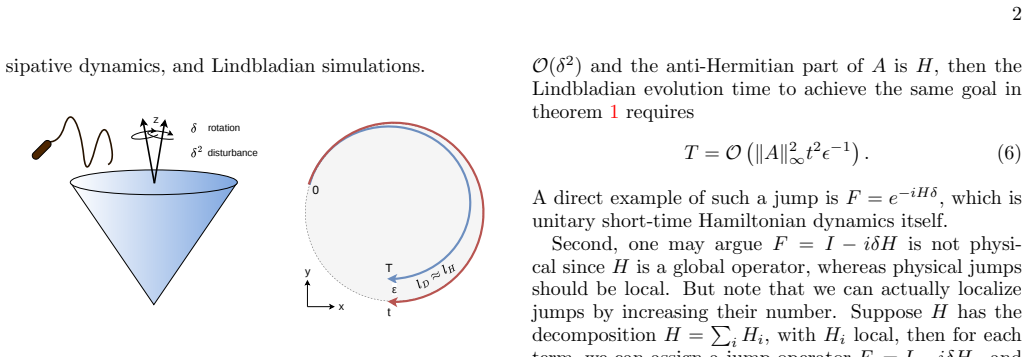
The fundamental difference between closed and open quantum dynamics lies in their environmental interaction: closed systems are perfectly isolated and evolve reversibly under unitary Hamiltonian dynamics, whereas open systems continuously couple to an external bath, resulting in irreversible dissipation and information loss. In this work, we show internal Hamiltonian dynamics can be "faked`` via external pure dissipation, i.e., Lindbladians without a coherent Hamiltonian part. More concretely, we show that, in a GKSL representation with zero explicit Hamiltonian term but nontraceless jump operators, bounded-norm dissipative generators can approximate Hamiltonian dynamics within $\epsilon$ error in diamond norm using $\mathcal{O}(t^2/\epsilon)$ evolution time. We further prove that for time-independent dynamics this $\mathcal{O}(t^2/\epsilon)$ scaling is in the worst case, necessary and optimal from a geometric perspective, which captures the fundamental decoherence cost for catching up with the speed of Hamiltonian dynamics. Our construction leads to various implications, including the BQP-completeness of purely dissipative dynamics even before reaching approximate equilibrium, a Zeno-adjacent state-independent freezing effect, the no super-quadratic fast-forwarding theorem of a class of purely dissipative dynamics, and reducing Lindbladian simulation cost via gauge changing.
Editorial analysis
A structured set of objections, weighed in public.
Referee Report
Summary. The manuscript claims that Hamiltonian dynamics can be approximated by purely dissipative Lindbladian evolution (GKSL form with explicit Hamiltonian term set to zero but non-traceless jump operators). Bounded-norm dissipative generators achieve diamond-norm error at most ε after total evolution time O(t²/ε). For time-independent target dynamics the scaling is necessary and optimal by a geometric argument on quantum channels. The work derives implications including BQP-completeness of dissipative dynamics prior to equilibrium, a Zeno-adjacent freezing phenomenon, a no-super-quadratic fast-forwarding theorem for a class of dissipative systems, and reduced Lindbladian simulation cost via gauge change.
Significance. If the central claims hold, the result supplies a concrete bridge between coherent and open-system dynamics by showing that pure dissipation can simulate unitary evolution with quadratic time overhead while remaining inside a fixed-norm ball of generators. The geometric optimality lower bound and the listed complexity and simulation consequences would be of broad interest to quantum information and open-systems theory. The absence of free parameters in the scaling and the falsifiable geometric optimality statement are positive features.
major comments (3)
- [Main construction / Theorem on approximation] Main construction (Theorem on approximation, likely §3–4): the claim that the jump operators L_k can be chosen with norms bounded independently of both t and ε must be supported by an explicit operator-norm bound. The non-traceless condition alone does not automatically guarantee ||L_k|| = O(1); if the construction encodes the rotation speed inside the jump operators, the stated O(t²/ε) scaling would no longer describe a bounded-generator regime.
- [Geometric optimality argument] Geometric optimality argument (section on lower bound): the distance measure on the space of channels and the precise reduction to the time-independent case must be stated explicitly. It is not yet clear whether the lower bound Ω(t²/ε) follows from the diamond norm or from a different metric, and whether the argument applies uniformly when the target Hamiltonian is time-independent.
- [Error analysis / proof of main theorem] Error analysis: the abstract states explicit approximation bounds, yet the manuscript must supply the full diamond-norm error derivation, including how the total evolution time is partitioned and how the non-traceless Lindbladian is integrated to obtain the stated O(t²/ε) dependence.
minor comments (2)
- [Introduction] Notation: the precise definition of 'pure dissipation' (zero coherent Hamiltonian but non-traceless jumps) should be stated once in the introduction with the standard GKSL form written explicitly.
- [Implications section] The BQP-completeness and fast-forwarding implications would benefit from a short proof sketch or reduction reference so that readers can assess the scope without consulting external works.
Simulated Author's Rebuttal
We thank the referee for the thorough and constructive report. The comments correctly identify places where explicit bounds, metric definitions, and full derivations should be added for clarity. We address each major comment below and will revise the manuscript to incorporate the requested details.
read point-by-point responses
-
Referee: Main construction / Theorem on approximation: the claim that the jump operators L_k can be chosen with norms bounded independently of both t and ε must be supported by an explicit operator-norm bound. The non-traceless condition alone does not automatically guarantee ||L_k|| = O(1); if the construction encodes the rotation speed inside the jump operators, the stated O(t²/ε) scaling would no longer describe a bounded-generator regime.
Authors: We agree that an explicit bound is necessary. In the construction the jump operators are chosen of the form L_k = c (V_k - I) where V_k are fixed unitaries independent of t and ε and the prefactor c is a fixed constant (e.g., c=1). Consequently ||L_k|| ≤ 2 for all k, uniformly in t and ε. The non-traceless property is used only to generate the effective coherent rotation from the dissipative part; it does not inflate the norm. We will insert a short lemma stating and proving ||L_k|| ≤ 2 together with the explicit choice of the operators, thereby confirming that the generators remain bounded while the total evolution time scales as O(t²/ε). revision: yes
-
Referee: Geometric optimality argument (section on lower bound): the distance measure on the space of channels and the precise reduction to the time-independent case must be stated explicitly. It is not yet clear whether the lower bound Ω(t²/ε) follows from the diamond norm or from a different metric, and whether the argument applies uniformly when the target Hamiltonian is time-independent.
Authors: The lower bound is derived in the diamond norm. We will add an explicit paragraph stating that the metric is the diamond-norm distance d_◇(Φ,Ψ) between quantum channels and that the geometric argument considers the shortest path length in the manifold of channels generated by bounded-norm Lindbladians (with zero Hamiltonian term). The reduction is performed for a fixed, time-independent target Hamiltonian H; the target channel is therefore the time-independent unitary channel U_t = exp(-iHt). The argument shows that any such dissipative channel requires total time Ω(t²/ε) to reach d_◇ ≤ ε. We will also note that the same geometric obstruction does not apply to time-dependent targets, consistent with the manuscript's focus. revision: yes
-
Referee: Error analysis: the abstract states explicit approximation bounds, yet the manuscript must supply the full diamond-norm error derivation, including how the total evolution time is partitioned and how the non-traceless Lindbladian is integrated to obtain the stated O(t²/ε) dependence.
Authors: We will supply the complete proof. The revised manuscript will contain a dedicated subsection (or appendix) that (i) partitions the total evolution interval [0,T] with T = O(t²/ε) into N = O(t/√ε) segments of length δ = O(√(ε/t)), (ii) solves the Lindblad equation explicitly for each segment using the non-traceless jump operators, (iii) bounds the diamond-norm distance between the resulting channel and the ideal unitary segment by O(δ² + δ³), and (iv) sums the local errors via the triangle inequality for the diamond norm to obtain the global bound ε. All constants will be tracked explicitly so that the O(t²/ε) scaling is transparent. revision: yes
Circularity Check
No significant circularity; derivation self-contained
full rationale
The central construction approximates Hamiltonian evolution via pure Lindbladians (H=0 in GKSL form) with non-traceless jump operators, achieving diamond-norm error ε in O(t²/ε) total time. The optimality claim for time-independent cases rests on a geometric argument about distances in the space of quantum channels, which is presented as an independent lower-bound analysis rather than a fit or redefinition of the upper-bound construction. No equations or steps in the abstract reduce the claimed scaling or bounded-norm premise to a self-defined quantity, fitted parameter, or self-citation chain. The bounded-norm condition on the generators is an explicit premise of the construction and is not shown to be forced by the target Hamiltonian itself.
Axiom & Free-Parameter Ledger
axioms (2)
- standard math The Lindblad master equation (GKSL form) is the correct generator for Markovian open quantum dynamics
- standard math Diamond norm is the appropriate distance for comparing quantum channels
Reference graph
Works this paper leans on
-
[1]
We refer to App
(9) Then LD,δ = δLH + O(δ2) (10) in diamond norm. We refer to App. C for the detailed proof. But note that our proof boils down to showing that Eq. (9) im- plies constraints on how the family of smooth Lindbla- dians LD,δ must behave at different orders of δ. An in- teresting remark here is that while shifting the Hamil- tonian (adding identity) is trivia...
-
[2]
Purely dissipative dynamics is BQP-complete.— A direct implication of our result is that purely dissipa- tive dynamics is BQP-complete [31] beyond the fixed point. Since Hamiltonian dynamics is BQP-complete, theorem 1 indicates the purely dissipative Lindbladian is BQP-hard, which combining with the fact that Lind- bladian can be efficiently simulated by ...
-
[3]
A novel Zeno-adjacent freezing mechanism. Quan- tum Zeno effect [35] states that strong and frequent measurements (or jump operators with large norms in the language of Lindbladian) can sometimes freeze the system’s evolution. The mechanism of the traditional Zeno effect is to construct strong dissipators LD[ρ] =P i FiρF † i − 1 2 {ρ, F † i Fi} , which is...
-
[4]
No super-quadratic fast forwarding for a class of Lindbladians.—A central result in Hamiltonian simula- tion is the no fast-forwarding theorem [37, 38], which states that there exist no universal (meaning for any H) Hamiltonian simulation algorithms that can simulate t- time Hamiltonian dynamics within a constant precision ϵ = 1/4 using sublinear costs in...
-
[5]
For H and Fi in eq
Reducing Lindbladian simulation cost via gauge changing.—One way to understand theorem 1 is via the gauge freedom of Lindbladians. For H and Fi in eq. (1), we can do a gauge transform [3] while keeping the Liou- villian operator and therefore, the dynamics unchanged Jump: Fi → F ′ i = X j UijFj + ciI, (20) Hamiltonian: H → H ′ = − i 2 X i c∗ i F ′ i − ciF...
-
[6]
Gorini, A
V. Gorini, A. Kossakowski, and E. C. G. Sudarshan, Completely positive dynamical semigroups of n-level sys- tems, Journal of Mathematical Physics 17, 821 (1976)
1976
-
[7]
Lindblad, On the generators of quantum dynamical semigroups, Communications in mathematical physics 48, 119 (1976)
G. Lindblad, On the generators of quantum dynamical semigroups, Communications in mathematical physics 48, 119 (1976)
1976
-
[8]
Breuer and F
H.-P. Breuer and F. Petruccione, The theory of open quantum systems (OUP Oxford, 2002)
2002
-
[9]
C.-F. Chen, M. Kastoryano, F. G. Brand˜ ao, and A. Gily´ en, Efficient quantum thermal simulation, Nature 646, 561 (2025)
2025
-
[10]
Rouz´ e, D
C. Rouz´ e, D. Stilck Fran¸ ca, and´A. M. Alhambra, Op- timal quantum algorithm for gibbs state preparation, Physical Review Letters 136, 060601 (2026)
2026
-
[11]
Chen, H.-Y
C.-F. Chen, H.-Y. Huang, J. Preskill, and L. Zhou, Lo- cal minima in quantum systems, in Proceedings of the 56th Annual ACM Symposium on Theory of Computing (2024) pp. 1323–1330
2024
- [12]
-
[13]
Ding, C.-F
Z. Ding, C.-F. Chen, and L. Lin, Single-ancilla ground state preparation via lindbladians, Physical Review Re- search 6, 033147 (2024)
2024
-
[14]
Y. Zhan, Z. Ding, J. Huhn, J. Gray, J. Preskill, G. K.-L. Chan, and L. Lin, Rapid quantum ground state prepa- ration via dissipative dynamics, Physical Review X 16, 011004 (2026)
2026
-
[15]
Shang, N
Z.-X. Shang, N. Guo, D. An, and Q. Zhao, Designing a nearly optimal quantum algorithm for linear differential equations via lindbladians, Physical Review Letters 135, 120604 (2025)
2025
-
[16]
Z. Chen, Y. Lu, H. Wang, Y. Liu, and T. Li, Quantum langevin dynamics for optimization, Communications in Mathematical Physics 406, 52 (2025)
2025
- [17]
-
[18]
M. A. Nielsen and I. L. Chuang, Quantum computation and quantum information (Cambridge university press, 2010)
2010
-
[19]
Hayden and J
P. Hayden and J. Sorce, A canonical hamiltonian for open quantum systems, Journal of Physics A: Mathematical and Theoretical 55, 225302 (2022)
2022
- [20]
-
[21]
A. Y. Kitaev, A. Shen, and M. N. Vyalyi, Classical and quantum computation, 47 (American Mathematical Soc., 2002)
2002
-
[22]
L. C. Evans, Partial differential equations, Vol. 19 (Amer- ican mathematical society, 2022)
2022
-
[23]
P. M. Harrington, E. J. Mueller, and K. W. Murch, Engi- neered dissipation for quantum information science, Na- ture Reviews Physics 4, 660 (2022)
2022
-
[24]
Kliesch, T
M. Kliesch, T. Barthel, C. Gogolin, M. Kastoryano, and J. Eisert, Dissipative quantum church-turing theorem, Physical review letters 107, 120501 (2011)
2011
- [25]
-
[26]
R. Cleve and C. Wang, Efficient quantum algo- rithms for simulating lindblad evolution, arXiv preprint arXiv:1612.09512 (2016)
- [27]
-
[28]
W. Yu, X. Li, Q. Zhao, and X. Yuan, Lindbladian simu- lation with logarithmic precision scaling via two ancillas, Physical Review Letters 135, 160602 (2025)
2025
- [29]
-
[30]
Z. Ding, X. Li, and L. Lin, Simulating open quantum systems using hamiltonian simulations, PRX quantum 5, 020332 (2024)
2024
-
[31]
Pocrnic, D
M. Pocrnic, D. Segal, and N. Wiebe, Quantum simula- tion of lindbladian dynamics via repeated interactions, Journal of Physics A: Mathematical and Theoretical 58, 305302 (2025)
2025
- [32]
-
[33]
M. M. Taddei, B. M. Escher, L. Davidovich, and R. L. 6 de Matos Filho, Quantum speed limit for physical pro- cesses, Physical review letters 110, 050402 (2013)
2013
-
[34]
D. P. Pires, M. Cianciaruso, L. C. C´ eleri, G. Adesso, and D. O. Soares-Pinto, Generalized geometric quantum speed limits, Physical Review X 6, 021031 (2016)
2016
-
[35]
Deffner and S
S. Deffner and S. Campbell, Quantum speed limits: from heisenberg’s uncertainty principle to optimal quantum control, Journal of Physics A: Mathematical and The- oretical 50, 453001 (2017)
2017
-
[36]
Bernstein and U
E. Bernstein and U. Vazirani, Quantum complexity the- ory, in Proceedings of the twenty-fifth annual ACM sym- posium on Theory of computing (1993) pp. 11–20
1993
-
[37]
Verstraete, M
F. Verstraete, M. M. Wolf, and J. Ignacio Cirac, Quan- tum computation and quantum-state engineering driven by dissipation, Nature physics 5, 633 (2009)
2009
-
[38]
Rouz´ e, D
C. Rouz´ e, D. S. Fran¸ ca, and´A. M. Alhambra, Efficient thermalization and universal quantum computing with quantum gibbs samplers, in Proceedings of the 57th An- nual ACM Symposium on Theory of Computing (2025) pp. 1488–1495
2025
-
[39]
M. J. Kastoryano, M. M. Wolf, and J. Eisert, Pre- cisely timing dissipative quantum information process- ing, Physical review letters 110, 110501 (2013)
2013
-
[40]
W. M. Itano, D. J. Heinzen, J. J. Bollinger, and D. J. Wineland, Quantum zeno effect, Physical Review A 41, 2295 (1990)
1990
-
[41]
Facchi and S
P. Facchi and S. Pascazio, Quantum zeno subspaces, Physical review letters 89, 080401 (2002)
2002
-
[42]
D. W. Berry, G. Ahokas, R. Cleve, and B. C. Sanders, Ef- ficient quantum algorithms for simulating sparse hamil- tonians, Communications in Mathematical Physics 270, 359 (2007)
2007
-
[43]
Atia and D
Y. Atia and D. Aharonov, Fast-forwarding of hamilto- nians and exponentially precise measurements, Nature communications 8, 1572 (2017)
2017
-
[44]
Farhi, J
E. Farhi, J. Goldstone, S. Gutmann, and M. Sipser, Limit on the speed of quantum computation in determining parity, Physical Review Letters 81, 5442 (1998)
1998
- [45]
- [46]
-
[47]
Zanardi and L
P. Zanardi and L. Campos Venuti, Coherent quantum dy- namics in steady-state manifolds of strongly dissipative systems, Physical review letters 113, 240406 (2014)
2014
-
[48]
Zanardi and L
P. Zanardi and L. Campos Venuti, Geometry, robustness, and emerging unitarity in dissipation-projected dynam- ics, Physical Review A 91, 052324 (2015)
2015
-
[49]
V. V. Albert, B. Bradlyn, M. Fraas, and L. Jiang, Ge- ometry and response of lindbladians, Physical Review X 6, 041031 (2016)
2016
-
[50]
Kempe, A
J. Kempe, A. Kitaev, and O. Regev, The complexity of the local hamiltonian problem, Siam journal on comput- ing 35, 1070 (2006)
2006
-
[51]
Roger and R
H. Roger and R. J. Charles, Topics in matrix analysis (1994). Appendix A: Proof of theorem 1 and related results On F = I − δA: To avoid ambiguity, in the following, we will use ∥ · ∥∞ to represent the spectral norm ∥ · ∥ in the main text. When we set the jump operator to be F = I − δA with A = G + iH, we have F ρF † = (I − δ(G + iH))ρ(I − δ(G − iH)) = ρ ...
1994
-
[52]
In particular, the first-order term is uniquely fixed by H
(C2) Then LD,δ = δLH + O(δ2) (C3) in diamond norm. In particular, the first-order term is uniquely fixed by H. Equivalently, if eLD,δ is another smooth purely dissipative family satisfying (C2) for the same Hamiltonian H, then LD,δ − eLD,δ = O(δ2). (C4) Moreover, assume that for some fixed m one can choose jump operators smoothly so that LD,δ(ρ) = mX j=1 ...
discussion (0)
Sign in with ORCID, Apple, or X to comment. Anyone can read and Pith papers without signing in.