Recognition: unknown
Physics-Informed Neural Networks for Biological 2D{+}t Reaction-Diffusion Systems
Pith reviewed 2026-05-10 05:14 UTC · model grok-4.3
The pith
A neural framework learns closed-form reaction-diffusion equations for 2D+t biological systems like lung cancer cell growth from microscopy data.
A machine-rendered reading of the paper's core claim, the machinery that carries it, and where it could break.
Core claim
The authors demonstrate that BINNs can be extended to 2D+t reaction-diffusion systems inside a PINN framework that combines data preprocessing, BINN-based equation learning, and symbolic regression post-processing, successfully recovering governing models for lung cancer cell population dynamics from experimental time-lapse microscopy observations.
What carries the argument
Biologically-informed neural networks that preserve the known reaction-diffusion differential operator structure while learning constitutive terms through trainable neural subnetworks, enforced by soft residual penalties and followed by symbolic regression for closed-form discovery.
Load-bearing premise
The reaction-diffusion differential operator structure is an appropriate model for the biological system and the data plus soft residual penalties are sufficient for the neural subnetworks to accurately identify the constitutive terms.
What would settle it
If the equations discovered from the lung cancer cell videos produce population dynamics that fail to match held-out experimental observations or known validated models of cell growth, the claim of successful recovery would be disproved.
Figures


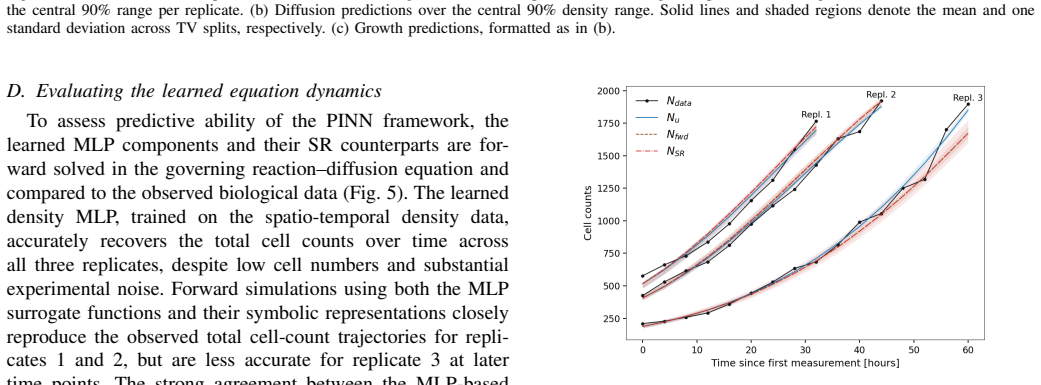


read the original abstract
Physics-informed neural networks (PINNs) provide a powerful framework for learning governing equations of dynamical systems from data. Biologically-informed neural networks (BINNs) are a variant of PINNs that preserve the known differential operator structure (e.g., reaction-diffusion) while learning constitutive terms via trainable neural subnetworks, enforced through soft residual penalties. Existing BINN studies are limited to $1\mathrm{D}{+}t$ reaction-diffusion systems and focus on forward prediction, using the governing partial differential equation as a regulariser rather than an explicit identification target. Here, we extend BINNs to $2\mathrm{D}{+}t$ systems within a PINN framework that combines data preprocessing, BINN-based equation learning, and symbolic regression post-processing for closed-form equation discovery. We demonstrate the framework's real-world applicability by learning the governing equations of lung cancer cell population dynamics from time-lapse microscopy data, recovering $2\mathrm{D}{+}t$ reaction-diffusion models from experimental observations. The proposed framework is readily applicable to other spatio-temporal systems, providing a practical and interpretable tool for fast analytic equation discovery from data.
Editorial analysis
A structured set of objections, weighed in public.
Referee Report
Summary. The paper extends Biologically-Informed Neural Networks (BINNs) from 1D+t to 2D+t reaction-diffusion systems within a PINN framework. It integrates data preprocessing, neural subnetworks to learn constitutive terms under soft residual penalties that preserve the known differential operator structure, and symbolic regression post-processing to obtain closed-form equations. The central demonstration is the recovery of interpretable 2D+t reaction-diffusion models for lung cancer cell population dynamics from time-lapse microscopy data.
Significance. If the empirical recovery holds with adequate validation, the work supplies a practical, interpretable pipeline for analytic equation discovery in spatio-temporal biological systems. It moves BINN methods beyond forward prediction and 1D settings toward real experimental data, with potential applicability to other reaction-diffusion problems where the operator structure is known a priori.
major comments (2)
- [§4.3, §5.2] §4.3 and §5.2: The recovery of the governing equations from experimental data is presented primarily through visual agreement and post-processed symbolic forms, but no quantitative metrics (e.g., residual norms, parameter recovery error on held-out data, or comparison to synthetic benchmarks) are reported for the 2D+t case. This weakens the claim that the neural subnetworks accurately identify the constitutive terms under the soft penalties.
- [§3.1, Eq. (5)–(7)] §3.1, Eq. (5)–(7): The BINN loss combines data fidelity with soft residual penalties whose weighting factors are free hyperparameters. The manuscript does not include an ablation or sensitivity analysis showing that the recovered symbolic equations remain stable across reasonable choices of these weights, which is load-bearing for the identification claim.
minor comments (3)
- [Abstract, §1] The abstract and introduction would benefit from a concise statement of the quantitative validation metrics used in the experimental section.
- [§2, §3] Notation for the 2D+t spatial-temporal coordinates and the neural subnetwork outputs should be introduced once and used consistently across equations and figures.
- [§5] Figure captions for the microscopy results should explicitly state the time interval and spatial resolution of the input data.
Simulated Author's Rebuttal
We thank the referee for the constructive review and the recommendation of minor revision. The comments identify key opportunities to strengthen the empirical validation of the equation recovery pipeline. We address each major comment below and will revise the manuscript accordingly.
read point-by-point responses
-
Referee: [§4.3, §5.2] §4.3 and §5.2: The recovery of the governing equations from experimental data is presented primarily through visual agreement and post-processed symbolic forms, but no quantitative metrics (e.g., residual norms, parameter recovery error on held-out data, or comparison to synthetic benchmarks) are reported for the 2D+t case. This weakens the claim that the neural subnetworks accurately identify the constitutive terms under the soft penalties.
Authors: We agree that quantitative metrics are needed to more rigorously support the identification claims. In the revised manuscript we will add (i) residual norm evaluations on held-out experimental frames, (ii) parameter recovery error statistics obtained by applying the same pipeline to synthetic 2D+t data generated from known reaction-diffusion models, and (iii) cross-validation error across multiple data splits. These additions will be placed in §4.3 and §5.2 alongside the existing visual and symbolic results. revision: yes
-
Referee: [§3.1, Eq. (5)–(7)] §3.1, Eq. (5)–(7): The BINN loss combines data fidelity with soft residual penalties whose weighting factors are free hyperparameters. The manuscript does not include an ablation or sensitivity analysis showing that the recovered symbolic equations remain stable across reasonable choices of these weights, which is load-bearing for the identification claim.
Authors: We acknowledge that stability with respect to the loss-weighting hyperparameters is essential for the reliability of the identification procedure. In the revised manuscript we will include an ablation study in §3.1 that systematically varies the relative weights of the data-fidelity and residual-penalty terms over a representative range (e.g., 0.1–10) and demonstrates that the downstream symbolic regression yields consistent equation structures and parameter values. The results will be summarized in a new table or figure. revision: yes
Circularity Check
No significant circularity
full rationale
The paper extends existing BINN methods to 2D+t systems by assuming the reaction-diffusion differential operator structure as known, using neural subnetworks to learn constitutive terms enforced by soft residual penalties, and applying symbolic regression post-processing to recover closed-form expressions from data. The central claim is an application to lung cancer cell microscopy data for model recovery. No derivation step reduces a claimed prediction or result to its own inputs by construction, and no load-bearing uniqueness or ansatz is imported via self-citation. The chain is self-contained with independent content from the data and standard PINN regularization.
Axiom & Free-Parameter Ledger
free parameters (1)
- BINN loss weighting factors
axioms (1)
- domain assumption The system obeys a reaction-diffusion PDE with known differential operator structure.
Reference graph
Works this paper leans on
-
[1]
L. J. S. Allen,An Introduction to Mathematical Biology. Upper Saddle River, NJ: Pearson/Prentice Hall, 2007
2007
-
[2]
Cornish-Bowden,Fundamentals of Enzyme Kinetics
A. Cornish-Bowden,Fundamentals of Enzyme Kinetics. London: Butterworth-Heinemann, 2014
2014
-
[3]
Brauer, C
F. Brauer, C. Castillo-Chavez, and Z. Feng,Mathematical Models in Epidemiology, ser. Texts in Applied Mathematics. New York, NY: Springer New York, 2019
2019
-
[4]
Longitudinal single-cell multiomic atlas of high-risk neuroblastoma reveals chemotherapy-induced tumor microenvironment rewiring,
W. Yu, R. Biyik-Sit, Y . Uzun, C.-H. Chen, A. Thadi, J. H. Sussman, M. Pang, C.-Y . Wu, L. D. Grossmann, P. Gao, D. W. Wu, A. Yousey, M. Zhang, C. S. Turn, Z. Zhang, S. Bandyopadhyay, J. Huang, T. Patel, C. Chen, D. Martinez, L. F. Surrey, M. D. Hogarty, K. Bernt, N. R. Zhang, J. M. Maris, and K. Tan, “Longitudinal single-cell multiomic atlas of high-risk...
2025
-
[5]
Label-free evaluation of mouse embryo quality using time-lapse bright field and optical coherence microscopy,
F. Wang, S. Hao, K. Park, A. Ahmady, and C. Zhou, “Label-free evaluation of mouse embryo quality using time-lapse bright field and optical coherence microscopy,”Commun. Biol, vol. 8, no. 1, p. 612, Apr. 2025
2025
-
[6]
Wearable continuous diffusion-based skin gas analysis,
D. Clausen, M. Farley, A. Little, K. Kasper, J. Moreno, L. Limesand, and P. Gutruf, “Wearable continuous diffusion-based skin gas analysis,” Nat. Commun., vol. 16, no. 1, p. 4343, May 2025
2025
-
[7]
Wearable microfluidic biosensors with haptic feedback for continuous monitoring of hydration biomarkers in workers,
J. C. Spinelli, B. J. Suleski, D. E. Wright, J. L. Grow, G. R. Fagans, M. J. Buckley, D. S. Yang, K. Yang, S. M. Beil, J. C. Wallace, T. S. DiZoglio, J. B. Model, S. Love, D. E. Macintosh, A. P. Scarth, M. T. Marrapode, C. Serviente, R. Avila, B. K. Alahmad, M. A. Busa, J. A. Wright, W. Li, D. J. Casa, J. A. Rogers, S. P. Lee, R. Ghaffari, and A. J. Arany...
2025
-
[8]
Time-series sewage metagenomics distinguishes seasonal, human-derived and environmental microbial communities potentially allowing source-attributed surveil- lance,
´A. Becsei, A. Fuschi, S. Otani, R. Kant, I. Weinstein, P. Alba, J. St ´eger, D. Visontai, C. Brinch, M. De Graaf, C. M. E. Schapendonk, A. Battisti, A. De Cesare, C. Oliveri, F. Troja, T. Sironen, O. Vapalahti, F. Pasquali, K. B ´anyai, M. Mak ´o, P. Pollner, A. Merlotti, M. Koopmans, I. Csabai, D. Remondini, F. M. Aarestrup, and P. Munk, “Time-series se...
2024
-
[9]
Discovering causal relations and equations from data,
G. Camps-Valls, A. Gerhardus, U. Ninad, G. Varando, G. Martius, E. Balaguer-Ballester, R. Vinuesa, E. Diaz, L. Zanna, and J. Runge, “Discovering causal relations and equations from data,”Phys. Rep., vol. 1044, pp. 1–68, Dec. 2023
2023
-
[10]
Mechanistic models versus machine learning, a fight worth fighting for the biological community?
R. E. Baker, J.-M. Pe ˜na, J. Jayamohan, and A. J ´erusalem, “Mechanistic models versus machine learning, a fight worth fighting for the biological community?”Biol. Lett., vol. 14, no. 5, p. 20170660, May 2018
2018
-
[11]
Weak SINDy: Galerkin-Based Data- Driven Model Selection,
D. A. Messenger and D. M. Bortz, “Weak SINDy: Galerkin-Based Data- Driven Model Selection,”Multiscale Model. Simul., vol. 19, no. 3, pp. 1474–1497, Jan. 2021
2021
-
[12]
Weak SINDy for partial differential equations,
——, “Weak SINDy for partial differential equations,”J. Comput. Phys., vol. 443, p. 110525, Oct. 2021
2021
-
[13]
Discovering governing equations from data by sparse identification of nonlinear dynamical systems,
S. L. Brunton, J. L. Proctor, and J. N. Kutz, “Discovering governing equations from data by sparse identification of nonlinear dynamical systems,”Proc. Natl. Acad. Sci. U.S.A., vol. 113, no. 15, pp. 3932–3937, Apr. 2016
2016
-
[14]
Data-driven discovery of partial differential equations,
S. H. Rudy, S. L. Brunton, J. L. Proctor, and J. N. Kutz, “Data-driven discovery of partial differential equations,”Sci. Adv., vol. 3, no. 4, p. e1602614, Apr. 2017
2017
-
[15]
Sparse dynamical system identification with simultaneous structural parameters and initial condition estimation,
B. Wei, “Sparse dynamical system identification with simultaneous structural parameters and initial condition estimation,”Chaos Soliton Fract., vol. 165, p. 112866, Dec. 2022
2022
-
[16]
Rapid Bayesian identification of sparse nonlinear dynamics from scarce and noisy data,
L. Fung, U. Fasel, and M. Juniper, “Rapid Bayesian identification of sparse nonlinear dynamics from scarce and noisy data,”Proc. R. Soc. Math. Phys. Eng. Sci., vol. 481, no. 2307, p. 20240200, Feb. 2025
2025
-
[17]
Data-driven discovery of coordinates and governing equations,
K. Champion, B. Lusch, J. N. Kutz, and S. L. Brunton, “Data-driven discovery of coordinates and governing equations,”Proc. Natl. Acad. Sci. U.S.A, vol. 116, no. 45, pp. 22 445–22 451, Nov. 2019
2019
-
[18]
Physics-informed learning of governing equations from scarce data,
Z. Chen, Y . Liu, and H. Sun, “Physics-informed learning of governing equations from scarce data,”Nat. Commun., vol. 12, no. 1, p. 6136, Oct. 2021
2021
-
[19]
PDE-LEARN: Using deep learning to discover partial differential equations from noisy, limited data,
R. Stephany and C. Earls, “PDE-LEARN: Using deep learning to discover partial differential equations from noisy, limited data,”Neural Netw., vol. 174, p. 106242, Jun. 2024
2024
-
[20]
M. L. Gao, J. N. Kutz, and B. Font, “Mesh-free sparse identification of nonlinear dynamics,” 2025, arXiv:2505.16058. [Online]. Available: https://arxiv.org/abs/2505.16058
-
[21]
Physics-informed neural networks: A deep learning framework for solving forward and inverse problems involving nonlinear partial differential equations,
M. Raissi, P. Perdikaris, and G. E. Karniadakis, “Physics-informed neural networks: A deep learning framework for solving forward and inverse problems involving nonlinear partial differential equations,”J. Comput. Phys., vol. 378, pp. 686–707, Feb. 2019
2019
-
[22]
B-PINNs: Bayesian physics- informed neural networks for forward and inverse PDE problems with noisy data,
L. Yang, X. Meng, and G. E. Karniadakis, “B-PINNs: Bayesian physics- informed neural networks for forward and inverse PDE problems with noisy data,”J. Comput. Phys., vol. 425, p. 109913, Jan. 2021
2021
-
[23]
Extended Physics-Informed Neural Networks (XPINNs): A Generalized Space-Time Domain De- composition Based Deep Learning Framework for Nonlinear Partial Differential Equations,
A. D. Jagtap and G. Em Karniadakis, “Extended Physics-Informed Neural Networks (XPINNs): A Generalized Space-Time Domain De- composition Based Deep Learning Framework for Nonlinear Partial Differential Equations,”Commun. Comput. Phys., vol. 28, no. 5, pp. 2002–2041, Jun. 2020
2002
-
[24]
Multi-resolution partial differential equations preserved learning framework for spa- tiotemporal dynamics,
X.-Y . Liu, M. Zhu, L. Lu, H. Sun, and J.-X. Wang, “Multi-resolution partial differential equations preserved learning framework for spa- tiotemporal dynamics,”Commun. Phys., vol. 7, no. 1, p. 31, Jan. 2024
2024
-
[25]
Physics-Informed Neural Operator for Learning Partial Differential Equations,
Z. Li, H. Zheng, N. Kovachki, D. Jin, H. Chen, B. Liu, K. Azizzade- nesheli, and A. Anandkumar, “Physics-Informed Neural Operator for Learning Partial Differential Equations,”JDS, vol. 1, no. 3, pp. 1–27, Sep. 2024
2024
-
[26]
Universal physics-informed neural networks: Symbolic differential operator discovery with sparse data,
L. Podina, B. Eastman, and M. Kohandel, “Universal physics-informed neural networks: Symbolic differential operator discovery with sparse data,” inProceedings of the 40th International Conference on Machine Learning, ser. Proceedings of Machine Learning Research, A. Krause, E. Brunskill, K. Cho, B. Engelhardt, S. Sabato, and J. Scarlett, Eds., vol. 202. P...
2023
-
[27]
C. Rackauckas, Y . Ma, J. Martensen, C. Warner, K. Zubov, R. Supekar, D. Skinner, A. Ramadhan, and A. Edelman, “Universal Differential Equations for Scientific Machine Learning,” 2020, arXiv:2001.04385. [Online]. Available: https://arxiv.org/abs/2001.04385
-
[28]
Neu- ral ordinary differential equations,
R. T. Q. Chen, Y . Rubanova, J. Bettencourt, and D. K. Duvenaud, “Neu- ral ordinary differential equations,” inAdvances in Neural Information Processing Systems, S. Bengio, H. Wallach, H. Larochelle, K. Grauman, N. Cesa-Bianchi, and R. Garnett, Eds., vol. 31. Curran Associates, Inc., 2018
2018
-
[29]
Biologically-informed neural networks guide mechanistic modeling from sparse experimental data,
J. H. Lagergren, J. T. Nardini, R. E. Baker, M. J. Simpson, and K. B. Flores, “Biologically-informed neural networks guide mechanistic modeling from sparse experimental data,”PLoS Comput. Biol., vol. 16, no. 12, p. e1008462, Dec. 2020
2020
-
[30]
Hyperparameter Selection in Biologically-Informed Neural Networks,
W. Laveryet al., “Hyperparameter Selection in Biologically-Informed Neural Networks,” 2026, preprint, to appear
2026
-
[31]
Learning partial differential equations for biological transport models from noisy spatio-temporal data,
J. H. Lagergren, J. T. Nardini, G. Michael Lavigne, E. M. Rutter, and K. B. Flores, “Learning partial differential equations for biological transport models from noisy spatio-temporal data,”Proc. R. Soc. Math. Phys. Eng. Sci., vol. 476, no. 2234, p. 20190800, Feb. 2020
2020
-
[32]
Interpretable Machine Learning for Science with PySR and SymbolicRegression.jl
M. Cranmer, “Interpretable Machine Learning for Science with PySR and SymbolicRegression.jl,” 2023, arXiv:2305.01582. [Online]. Available: https://arxiv.org/abs/2305.01582 APPENDIXA All candidate expressions obtained from the tenPySRruns across all replicates are provided in Table IV. The counts in each replicate column sum to 10. The expression with the ...
work page internal anchor Pith review arXiv 2023
discussion (0)
Sign in with ORCID, Apple, or X to comment. Anyone can read and Pith papers without signing in.