Recognition: 2 theorem links
· Lean TheoremHELIX: Verified compilation of cyber-physical control systems to LLVM IR
Pith reviewed 2026-05-14 22:08 UTC · model grok-4.3
The pith
HELIX generates verified LLVM IR code from high-level mathematical models of cyber-physical systems by applying algebraic transformations with formal semantic preservation.
A machine-rendered reading of the paper's core claim, the machinery that carries it, and where it could break.
Core claim
HELIX shows that vector and matrix computations in cyber-physical systems can be formalized in an operator language whose semantics-preserving term rewriting rules, combined with sparse vector abstraction for partial computations, enable verified algebraic transformations that turn high-level mathematical specifications into optimized LLVM IR while guaranteeing semantic equivalence throughout the process.
What carries the argument
Operator language with semantics-preserving term rewriting rules and sparse vector abstraction that formalizes algebraic transformations of vector and matrix computations into optimized dataflow for parallel processing.
If this is right
- High-level mathematical models of cyber-physical systems can be transformed into architecture-specific efficient code while retaining formal correctness proofs.
- Sparse vector representations allow algebraic proofs of parallel decomposition properties that improve performance on vectorized or parallel hardware.
- The multi-layered verification approach in Coq, including term rewriting and translation validation, scales to full systems from math down to LLVM IR.
- Application-specific numerical analysis can be integrated into the verified pipeline without breaking semantic guarantees.
Where Pith is reading between the lines
- The same operator-language approach could be applied to other numerical domains such as signal processing or optimization problems that involve similar matrix transformations.
- Extending the rewriting rules to include additional hardware-specific optimizations might reduce the need for manual tuning while keeping verification intact.
- Adapting the system to generate code for new target architectures would require only extending the final translation step, provided the intermediate semantics remain unchanged.
Load-bearing premise
The operator language semantics and term rewriting rules correctly capture and preserve the meaning of the original vector and matrix computations in the cyber-physical system.
What would settle it
Execute the LLVM IR generated by HELIX from the robot system example on the same inputs used in the high-level mathematical formulation and observe whether the outputs match exactly.
Figures




read the original abstract
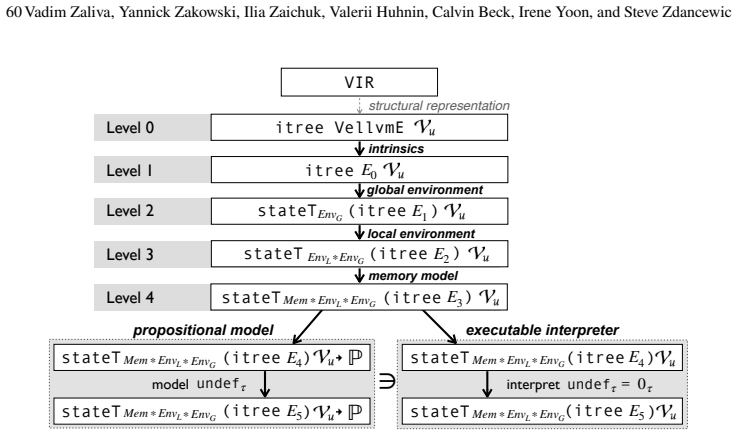
This paper presents the design of HELIX, an end-to-end verified code generation system with a focus on the intersection of high-performance and high-assurance numerical computing. The code generation can be fine-tuned to generate efficient code for a broad set of computer architectures while providing formal guarantees of the correctness of such generated code. Using a real-life example of a cyber-physical robot system, this paper demonstrates how, by using HELIX, one can start from a high-level mathematical formulation of the problem, apply a series of algebraic transformations that target intermediate languages, and generate an efficient imperative implementation. This is done while formally verifying semantic preservation from the original formulation down to LLVM IR. The method we used for high-performance code compilation is the algebraic transformation of vector and matrix computations into a dataflow optimised for parallel or vectorised processing on target hardware. The abstraction used to formalise and verify this technique is an operator language and accompanying semantics-preserving term rewriting. We use sparse vector abstraction to represent partial computations, enabling us to use algebraic reasoning to prove parallel decomposition properties. HELIX's verification infrastructure comprises multiple intermediate languages and verification approaches, all implemented in the Coq proof assistant. In particular, it uses verified term rewriting, translation validation, metaprogramming, verified compilation, layered monadic interpreters; it also supports application-specific uses of (verified) numerical analysis as we demonstrate via the running example.
Editorial analysis
A structured set of objections, weighed in public.
Referee Report
Summary. The paper introduces HELIX, an end-to-end verified compilation framework implemented in Coq for generating efficient LLVM IR code from high-level mathematical descriptions of cyber-physical control systems. It employs an operator language with term-rewriting rules based on sparse vector abstractions to perform algebraic optimizations for parallel and vectorized execution, using a robot control system as a running example to demonstrate semantic preservation from the original formulation through intermediate languages to LLVM IR via verified transformations, metaprogramming, and translation validation.
Significance. If the formal guarantees hold as claimed, this work would represent a significant advance in verified high-performance computing for safety-critical cyber-physical systems. By combining algebraic reasoning over sparse computations with a multi-layered Coq verification infrastructure, it offers a practical path from mathematical models to optimized machine code with machine-checked correctness proofs, addressing a key gap in high-assurance numerical software development.
major comments (2)
- The central claim that the operator language semantics and term-rewriting rules correctly capture and preserve meaning for sparse partial evaluations (including interactions with matrix multiplications) is load-bearing for the entire verification chain, yet the manuscript provides no proof sketches, confluence/termination arguments, or explicit handling of floating-point associativity assumptions for the patterns arising in the robot control example.
- § on verification infrastructure: while the paper lists verified term rewriting, translation validation, metaprogramming, and layered monadic interpreters, no specific theorem statements or coverage arguments are given showing that all algebraic transformations and sparse decompositions are accounted for in the Coq development.
minor comments (1)
- The abstract would be strengthened by briefly indicating the scale of the robot control example (e.g., matrix dimensions or number of transformations) to help readers gauge the practicality of the approach.
Simulated Author's Rebuttal
We thank the referee for their constructive comments, which help clarify the presentation of our formal results. We address each major comment below, indicating planned revisions to strengthen the manuscript while preserving its core contributions.
read point-by-point responses
-
Referee: The central claim that the operator language semantics and term-rewriting rules correctly capture and preserve meaning for sparse partial evaluations (including interactions with matrix multiplications) is load-bearing for the entire verification chain, yet the manuscript provides no proof sketches, confluence/termination arguments, or explicit handling of floating-point associativity assumptions for the patterns arising in the robot control example.
Authors: We acknowledge that the manuscript does not include explicit proof sketches, confluence/termination arguments, or a dedicated discussion of floating-point associativity assumptions. The full semantic preservation proofs for the operator language, term-rewriting rules, and sparse vector abstractions (including matrix interactions) are formalized in the accompanying Coq development. In the revised manuscript we will add a new subsection with proof sketches for the key theorems, a brief argument for termination and confluence based on the well-founded ordering induced by the sparse representation, and an explicit statement of the floating-point assumptions used in the robot control example (commutativity of addition and multiplication under the verified error bounds). revision: yes
-
Referee: § on verification infrastructure: while the paper lists verified term rewriting, translation validation, metaprogramming, and layered monadic interpreters, no specific theorem statements or coverage arguments are given showing that all algebraic transformations and sparse decompositions are accounted for in the Coq development.
Authors: We agree that the manuscript would benefit from more explicit theorem statements and coverage arguments. The Coq development contains machine-checked theorems establishing semantic preservation for each layer (term rewriting, translation validation, and monadic interpretation) and for every algebraic transformation and sparse decomposition appearing in the running example. In the revision we will insert a dedicated paragraph listing the principal theorems (e.g., Theorem 4.2: Preservation of sparse partial evaluation; Theorem 5.1: End-to-end LLVM IR correctness) together with a short coverage argument explaining how the layered infrastructure accounts for all transformations used in the robot controller. revision: yes
Circularity Check
No circularity: verification rests on Coq definitions and external LLVM semantics
full rationale
The derivation chain is self-contained because the operator language, term-rewriting rules, and semantic-preservation proofs are implemented and machine-checked inside Coq; the final translation to LLVM IR is validated against an external, independently defined LLVM semantics rather than being derived from the paper's own outputs or prior self-citations. No step reduces a claimed prediction or uniqueness result to a fitted parameter or to an unverified self-citation; the algebraic transformations are justified by explicit Coq proofs of preservation, not by renaming or smuggling ansatzes.
Axiom & Free-Parameter Ledger
axioms (1)
- domain assumption The operator language semantics accurately capture the computations in cyber-physical systems and the term rewriting preserves those semantics.
Lean theorems connected to this paper
-
IndisputableMonolith/Cost/FunctionalEquation.leanwashburn_uniqueness_aczel unclear?
unclearRelation between the paper passage and the cited Recognition theorem.
The abstraction used to formalise and verify this technique is an operator language and accompanying semantics-preserving term rewriting. We use sparse vector abstraction to represent partial computations, enabling us to use algebraic reasoning to prove parallel decomposition properties.
-
IndisputableMonolith/Foundation/AbsoluteFloorClosure.leanabsolute_floor_iff_bare_distinguishability unclear?
unclearRelation between the paper passage and the cited Recognition theorem.
HELIX’s verification infrastructure comprises multiple intermediate languages and verification approaches, all implemented in the Coq proof assistant.
What do these tags mean?
- matches
- The paper's claim is directly supported by a theorem in the formal canon.
- supports
- The theorem supports part of the paper's argument, but the paper may add assumptions or extra steps.
- extends
- The paper goes beyond the formal theorem; the theorem is a base layer rather than the whole result.
- uses
- The paper appears to rely on the theorem as machinery.
- contradicts
- The paper's claim conflicts with a theorem or certificate in the canon.
- unclear
- Pith found a possible connection, but the passage is too broad, indirect, or ambiguous to say the theorem truly supports the claim.
Reference graph
Works this paper leans on
-
[1]
Abhishek Anand, Andrew Appel, Greg Morrisett, Zoe Paraskevopoulou, Randy Pollack, Olivier Savary Belanger, Matthieu Sozeau, and Matthew Weaver. 2017. CertiCoq: A verified compiler for Coq. InThe Third International Workshop on Coq for Programming Languages (CoqPL)
work page 2017
-
[2]
Abhishek Anand and Ross A. Knepper. 2015. ROSCoq: Robots Powered by Constructive Reals. InInteractive Theorem Proving - 6th International Conference, ITP 2015, Nanjing, China, August 24-27, 2015, Proceedings (Lecture Notes in Computer Science, Vol. 9236), Christian Urban and Xingyuan Zhang (Eds.). Springer, 34–50. doi:10.1007/978-3-319-22102-1 3
-
[3]
Andrew W. Appel. 2011. Verified Software Toolchain. InProgramming Languages and Systems, Gilles Barthe (Ed.). Springer Berlin Heidelberg, Berlin, Heidelberg, 1–17. doi:10.1007/978-3-642-19718-5 1
-
[4]
Andrew W Appel, Lennart Beringer, Adam Chlipala, Benjamin C Pierce, Zhong Shao, Stephanie Weirich, and Steve Zdancewic. 2017. Position paper: the science of deep specification.Philosophical Transactions of the Royal Society A: Mathematical, Physical and Engineering Sciences375, 2104 (2017), 20160331
work page 2017
-
[5]
Calvin Beck, Irene Yoon, Hanxi Chen, Yannick Zakowski, and Steve Zdancewic. 2024. A Two-Phase Infinite/Finite Low-Level Memory Model.Proc. ACM Program. Lang.ICFP (aug 2024). doi:10.1145/3674652
-
[6]
Nick Benton. 2004. Simple Relational Correctness Proofs for Static Analyses and Program Transformations. SIGPLAN Not.39, 1 (Jan. 2004), 14–25. doi:10.1145/982962.964003
-
[7]
Lennart Beringer, Adam Petcher, Katherine Q. Ye, and Andrew W. Appel. 2015. Verified Correctness and Security of OpenSSL HMAC. InProceedings of the 24th USENIX Conference on Security Symposium (Washington, D.C.)(SEC’15). USENIX Association, USA, 207–221. HELIX: Verified compilation of cyber-physical control systems to LLVM IR 117
work page 2015
-
[8]
Lennart Beringer, Gordon Stewart, Robert Dockins, and Andrew W. Appel. 2014. Verified Compilation for Shared-Memory C. InESOP (LNCS, Vol. 8410). 107–127. doi:10.1007/978-3-642-54833-8 7
-
[9]
Michael Blair, Sally Obenski, and Paula Bridickas. 1992. Patriot Missile Defense: Software Problem Led to System Failure at Dhahran, Saudi Arabia
work page 1992
-
[10]
Fr´ed´eric Blanqui and Adam Koprowski. 2011. CoLoR: a Coq library on well-founded rewrite relations and its application to the automated verification of termination certificates.Mathematical Structures in Computer Science21, 4 (2011), 827–859
work page 2011
-
[11]
Rose Bohrer, Yong Kiam Tan, Stefan Mitsch, Magnus O. Myreen, and Andr´e Platzer. 2018. VeriPhy: verified controller executables from verified cyber-physical system models. InProceedings of the 39th ACM SIGPLAN Conference on Programming Language Design and Implementation, PLDI 2018, Philadelphia, PA, USA, June 18-22, 2018, Jeffrey S. Foster and Dan Grossma...
-
[12]
Sylvie Boldo, Jean-Christophe Filliˆatre, and Guillaume Melquiond. 2009. Combining Coq and Gappa for certifying floating-point programs. InInternational Conference on Intelligent Computer Mathematics. Springer, 59–74
work page 2009
-
[13]
Sylvie Boldo and Guillaume Melquiond. 2011. Flocq: A unified library for proving floating-point algorithms in Coq. InComputer Arithmetic (ARITH), 2011 20th IEEE Symposium on. IEEE, 243–252
work page 2011
-
[14]
Peter Borovansk` y, Claude Kirchner, H´elene Kirchner, Pierre-Etienne Moreau, and Christophe Ringeissen
-
[15]
An overview of ELAN.Electronic Notes in Theoretical Computer Science15 (1998), 55–70
work page 1998
-
[16]
Timothy Bourke, L´elio Brun, and Marc Pouzet. 2020. Mechanized Semantics and Verified Compilation for a Dataflow Synchronous Language with Reset. InProceedings of the 47th ACM SIGPLAN Symposium on Principles of Programming Languages(New Orleans, LA, USA), Vol. 4. Association for Computing Machinery. doi:10.1145/3371112
-
[17]
Patrick J. Brinich. 2020.Formal Verification of Spiral Generated Code. Master’s thesis. Drexel University
work page 2020
-
[18]
Venanzio Capretta. 2005. General recursion via coinductive types.Log. Methods Comput. Sci.1, 2 (2005). doi:10.2168/LMCS-1(2:1)2005
-
[19]
2012.A gentle introduction to type classes and relations in Coq
Pierre Cast ´eran and Matthieu Sozeau. 2012.A gentle introduction to type classes and relations in Coq. Technical Report. Technical Report hal-00702455, version 1
work page 2012
-
[20]
Nicolas Chappe, Paul He, Ludovic Henrio, Yannick Zakowski, and Steve Zdancewic. 2023. Choice Trees: Representing Nondeterministic, Recursive, and Impure Programs in Coq.Proc. ACM Program. Lang.7, POPL (2023), 1770–1800. doi:10.1145/3571254
-
[21]
Nicolas Chappe, Paul He, Ludovic Henrio, Yannick Zakowski, and Steve Zdancewic. 2023. Choice Trees: Representing Nondeterministic, Recursive, and Impure Programs in Coq.Proceedings of the ACM on Programming Languages7, POPL (2023)
work page 2023
-
[22]
Robert N Charette. 2009. This car runs on code.IEEE spectrum46, 3 (2009), 3
work page 2009
-
[23]
2017.Formal reasoning about programs
Adam Chlipala. 2017.Formal reasoning about programs. http://adam.chlipala.net/frap
work page 2017
-
[24]
Minki Cho, Youngju Song, Dongjae Lee, Lennard G¨aher, and Derek Dreyer. 2023. Stuttering for Free.Proc. ACM Program. Lang.7, OOPSLA2 (2023), 1677–1704. doi:10.1145/3622857
-
[25]
2012.Comparing Floating Point Numbers
Bruce Dawson. 2012.Comparing Floating Point Numbers. https://randomascii.wordpress.com/2012/02/25/ comparing-floating-point-numbers-2012-edition/
work page 2012
-
[26]
Florent De Dinechin, Christoph Quirin Lauter, and Guillaume Melquiond. 2008. Certifying floating-point implementations using Gappa.arXiv preprint arXiv:0801.0523(2008)
work page internal anchor Pith review Pith/arXiv arXiv 2008
-
[27]
Ankush Desai, Tommaso Dreossi, and Sanjit A. Seshia. 2017. Combining Model Checking and Runtime Verification for Safe Robotics. InRuntime Verification - 17th International Conference, RV 2017, Seattle, WA, USA, September 13-16, 2017, Proceedings (Lecture Notes in Computer Science, Vol. 10548), Shuvendu K. Lahiri and Giles Reger (Eds.). Springer, 172–189. ...
-
[28]
2004.The Coq proof assistant reference manual
The Coq development team. 2004.The Coq proof assistant reference manual. LogiCal Project. http://coq.inria.fr Version 8.0
work page 2004
-
[29]
Christof Ebert and Capers Jones. 2009. Embedded Software: Facts, Figures, and Future.Computer42, 4 (April 2009), 42–52. doi:10.1109/MC.2009.118
- [30]
-
[31]
Dieter Fox, Wolfram Burgard, and Sebastian Thrun. 1997. The dynamic window approach to collision avoidance.IEEE Robotics & Automation Magazine4, 1 (1997), 23–33. 118 Vadim Zaliva, Yannick Zakowski, Ilia Zaichuk, Valerii Huhnin, Calvin Beck, Irene Yoon, and Steve Zdancewic
work page 1997
-
[32]
Franz Franchetti, Fr´ed´eric de Mesmay, Daniel McFarlin, and Markus P¨ uschel. 2009. Operator Language: A Program Generation Framework for Fast Kernels. InIFIP Working Conference on Domain Specific Languages (DSL WC) (Lecture Notes in Computer Science, Vol. 5658). Springer, 385–410
work page 2009
-
[33]
F. Franchetti, T. M. Low, S. Mitsch, J. P. Mendoza, L. Gui, A. Phaosawasdi, D. Padua, S. Kar, J. M. F. Moura, M. Franusich, J. Johnson, A. Platzer, and M. M. Veloso. 2017. High-Assurance SPIRAL: End-to-End Guarantees for Robot and Car Control.IEEE Control Systems37, 2 (April 2017), 82–103. doi:10.1109/MCS.2016.2643244
-
[34]
From High Level Specification to High Performance Code
Franz Franchetti, Tze-Meng Low, Thom Popovici, Richard Veras, Daniele G. Spampinato, Jeremy Johnson, Markus P¨ uschel, James C. Hoe, and Jos´e M. F. Moura. 2018. SPIRAL: Extreme Performance Portability. Proceedings of the IEEE, special issue on “From High Level Specification to High Performance Code”106, 11 (2018)
work page 2018
-
[35]
Franz Franchetti and Markus P¨ uschel. 2009. Generating High-Performance Pruned FFT Implementations. In International Conference on Acoustics, Speech, and Signal Processing (ICASSP). 549–552
work page 2009
-
[36]
Franz Franchetti, Markus P¨ uschel, Jos´e M. F. Moura, and Christoph W. Ueberhuber. 2002. Short Vector SIMD Code Generation for DSP Algorithms. InHigh Performance Extreme Computing (HPEC)
work page 2002
-
[37]
Franz Franchetti, Yevgen Voronenko, and Markus P¨ uschel. 2005. Formal Loop Merging for Signal Transforms. InProceedings of the 2005 ACM SIGPLAN Conference on Programming Language Design and Implementation (Chicago, IL, USA)(PLDI ’05). ACM, New York, NY, USA, 315–326. doi:10.1145/1065010.1065048
-
[38]
Nathan Fulton, Stefan Mitsch, Jan-David Quesel, Marcus V¨olp, and Andr´e Platzer. 2015. KeYmaera X: An axiomatic tactical theorem prover for hybrid systems. InInternational Conference on Automated Deduction. Springer, 527–538
work page 2015
-
[39]
Ronghui Gu, J´er´emie Koenig, Tahina Ramananandro, Zhong Shao, Xiongnan (Newman) Wu, Shu-Chun Weng, Haozhong Zhang, and Yu Guo. 2015. Deep Specifications and Certified Abstraction Layers. InProceedings of the 42nd Annual ACM SIGPLAN-SIGACT Symposium on Principles of Programming Languages(Mumbai, India)(POPL ’15). ACM, New York, NY, USA, 595–608. doi:10.11...
-
[40]
Bastian Hagedorn, Johannes Lenfers, Thomas Kundefinedhler, Xueying Qin, Sergei Gorlatch, and Michel Steuwer. 2020. Achieving High-Performance the Functional Way: A Functional Pearl on Expressing High- Performance Optimizations as Rewrite Strategies.Proc. ACM Program. Lang.4, ICFP, Article 92 (Aug. 2020), 29 pages. doi:10.1145/3408974
-
[41]
Hanru Jiang, Hongjin Liang, Siyang Xiao, Junpeng Zha, and Xinyu Feng. 2019. Towards certified separate compilation for concurrent programs. InPLDI. 111–125. doi:10.1145/3314221.3314595
- [42]
-
[43]
Rudolph Emil Kalman. 1960. A new approach to linear filtering and prediction problems. (1960)
work page 1960
-
[44]
Jeehoon Kang, Chung-Kil Hur, William Mansky, Dmitri Garbuzov, Steve Zdancewic, and Viktor Vafeiadis
-
[45]
A Formal C Memory Model Supporting Integer-Pointer Casts. InProceedings of the 36th ACM SIGPLAN Conference on Programming Language Design and Implementation(Portland, OR, USA)(PLDI ’15). Association for Computing Machinery, New York, NY, USA, 326–335. doi:10.1145/2737924.2738005
-
[46]
Jeehoon Kang, Yoonseung Kim, Youngju Song, Juneyoung Lee, Sanghoon Park, Mark Dongyeon Shin, Yonghyun Kim, Sungkeun Cho, Joonwon Choi, Chung-Kil Hur, and Kwangkeun Yi. 2018. Crellvm: Verified Credible Compilation for LLVM. InProceedings of the 39th ACM SIGPLAN Conference on Programming Language Design and Implementation(Philadelphia, PA, USA)(PLDI 2018). ...
-
[47]
Nicolas Koh, Yao Li, Yishuai Li, Li-yao Xia, Lennart Beringer, Wolf Honor´e, William Mansky, Benjamin C. Pierce, and Steve Zdancewic. 2019. From C to Interaction Trees: Specifying, Verifying, and Testing a Networked Server. InProceedings of the 8th ACM SIGPLAN International Conference on Certified Programs and Proofs (Cascais, Portugal)(CPP 2019). ACM, Ne...
-
[48]
Ramana Kumar, Magnus O Myreen, Michael Norrish, and Scott Owens. 2014. CakeML: a verified implemen- tation of ML.ACM SIGPLAN Notices49, 1 (2014), 179–191
work page 2014
-
[50]
Xavier Leroy. 2009. Formal verification of a realistic compiler.Commun. ACM52, 7 (2009), 107–115. doi:10.1145/1538788.1538814
-
[51]
Appel, Sandrine Blazy, and Gordon Stewart
Xavier Leroy, Andrew W. Appel, Sandrine Blazy, and Gordon Stewart. 2012.The CompCert Memory Model, Version 2. Research Report RR-7987. INRIA. 26 pages. https://hal.inria.fr/hal-00703441 HELIX: Verified compilation of cyber-physical control systems to LLVM IR 119
work page 2012
-
[53]
Bell, Adam Chlipala, Benjamin C
Mohsen Lesani, Li-yao Xia, Anders Kaseorg, Christian J. Bell, Adam Chlipala, Benjamin C. Pierce, and Steve Zdancewic. 2022. C4: verified transactional objects.Proc. ACM Program. Lang.6, OOPSLA (2022), 1–31. doi:10.1145/3527324
-
[54]
Liyi Li and Elsa Gunter. 2020. K-LLVM: A Relatively Complete Semantics of LLVM IR. In34rd European Conference on Object-Oriented Programming, ECOOP 2020, Berlin, Germany. doi:10.4230/LIPIcs.ECOOP. 2020.7
-
[55]
Lopes, Juneyoung Lee, Chung-Kil Hur, Zhengyang Liu, and John Regehr
Nuno P. Lopes, Juneyoung Lee, Chung-Kil Hur, Zhengyang Liu, and John Regehr. 2021. Alive2: Bounded Translation Validation for LLVM. InProceedings of the 42nd ACM SIGPLAN International Conference on Programming Language Design and Implementation(Virtual, Canada)(PLDI 2021). Association for Computing Machinery, New York, NY, USA, 65–79. doi:10.1145/3453483.3454030
-
[56]
Tze-Meng Low and Franz Franchetti. 2017. High Assurance Code Generation for Cyber-Physical Systems. In IEEE International Symposium on High Assurance Systems Engineering (HASE)
work page 2017
-
[57]
Vicente Macian, Jose Manuel Lujan, Carlos Guardiola, and Pedro Yuste. 2006. DFT-based controller for fuel injection unevenness correction in turbocharged diesel engines.IEEE transactions on control systems technology14, 5 (2006), 819–827
work page 2006
-
[58]
Gregory Malecha. 2017. Speeding Up Proofs with Computational Reflection. https://gmalecha.github.io/ reflections/2017/speeding-up-proofs-with-computational-reflection. Accessed: 2020-09-01
work page 2017
-
[59]
Gregory Malecha et al . 2012. ExtLib Coq library. https://github.com/coq-ext-lib/coq-ext-lib. Accessed: 2020-08-18
work page 2012
-
[60]
Gregory Malecha, Daniel Ricketts, Mario M. Alvarez, and Sorin Lerner. 2016. Towards foundational verification of cyber-physical systems. In2016 Science of Security for Cyber-Physical Systems Workshop, SOSCYPS@CPSWeek 2016, Vienna, Austria, April 11, 2016. IEEE Computer Society, 1–5. doi:10.1109/ SOSCYPS.2016.7580000
-
[61]
William Mansky, Andrew W. Appel, and Aleksey Nogin. 2017. A Verified Messaging System.Proc. ACM Program. Lang.1, OOPSLA, Article 87 (oct 2017), 28 pages. doi:10.1145/3133911
-
[62]
Mariano Moscato, Laura Titolo, Aaron Dutle, and C´esar A Munoz. 2017. Automatic estimation of verified floating-point round-off errors via static analysis. InComputer Safety, Reliability, and Security: 36th Inter- national Conference, SAFECOMP 2017, Trento, Italy, September 13-15, 2017, Proceedings 36. Springer, 213–229
work page 2017
-
[63]
Yiannis N Moschovakis. 1989. A mathematical modeling of pure, recursive algorithms. InInternational Symposium on Logical Foundations of Computer Science. Springer, 208–229
work page 1989
-
[64]
Jos´e M. F. Moura, Jeremy Johnson, Robert W. Johnson, David Padua, Viktor K. Prasanna, Markus P¨ uschel, Bryan Singer, Manuela Veloso, and Jianxin Xiong. 2001. Generating Platform-Adapted DSP Libraries using SPIRAL. InHigh Performance Extreme Computing (HPEC)
work page 2001
-
[65]
Scott Owens, Magnus O Myreen, Ramana Kumar, and Yong Kiam Tan. 2016. Functional big-step semantics. InEuropean Symposium on Programming. Springer, 589–615
work page 2016
-
[66]
Amir Pnueli, Michael Siegel, and Eli Singerman. 1998. Translation validation. InTools and Algorithms for the Construction and Analysis of Systems: 4th International Conference, TACAS’98 Held as Part of the Joint European Conferences on Theory and Practice of Software, ETAPS’98 Lisbon, Portugal, March 28–April 4, 1998 Proceedings 4. Springer, 151–166
work page 1998
-
[67]
M. P¨ uschel, J. M. F. Moura, J. R. Johnson, D. Padua, M. M. Veloso, B. W. Singer, Jianxin Xiong, F. Franchetti, A. Gacic, Y. Voronenko, K. Chen, R. W. Johnson, and N. Rizzolo. 2005. SPIRAL: Code Generation for DSP Transforms.Proc. IEEE93, 2 (Feb 2005), 232–275. doi:10.1109/JPROC.2004.840306
-
[68]
John C. Reynolds. 1972. Definitional Interpreters for Higher-Order Programming Languages. InProceedings of the ACM Annual Conference - Volume 2(Boston, Massachusetts, USA)(ACM ’72). Association for Computing Machinery, New York, NY, USA, 717–740. doi:10.1145/800194.805852
-
[69]
Michael Sammler, Simon Spies, Youngju Song, Emanuele D’Osualdo, Robbert Krebbers, Deepak Garg, and Derek Dreyer. 2023. DimSum: A Decentralized Approach to Multi-Language Semantics and Verification. Proc. ACM Program. Lang.7, POPL, Article 27 (jan 2023), 31 pages. doi:10.1145/3571220
-
[70]
Jaroslav ˇSevˇc´ık, Viktor Vafeiadis, Francesco Zappa Nardelli, Suresh Jagannathan, and Peter Sewell. 2013. CompCertTSO: A Verified Compiler for Relaxed-Memory Concurrency.J. ACM60, 3 (2013), 22. doi:10. 120 Vadim Zaliva, Yannick Zakowski, Ilia Zaichuk, Valerii Huhnin, Calvin Beck, Irene Yoon, and Steve Zdancewic 1145/2487241.2487248
-
[71]
Lucas Silver, Paul He, Ethan Cecchetti, Andrew K. Hirsch, and Steve Zdancewic. 2023b. Semantics for Noninterference with Interaction Trees. InProceedings of the 37th Annual European Conference on Object-Oriented Programming (ECOOP 2023)
work page 2023
-
[72]
Lucas Silver, Eddy Westbrook, Matthew Yacavone, and Ryan Scott. 2023a. Interaction Tree Specifications: A Framework for Specifying Recursive, Effectful Computations That Supports Auto-Active Verification. In37th European Conference on Object-Oriented Programming (ECOOP 2023) (Leibniz International Proceedings in Informatics (LIPIcs), Vol. 263), Karim Ali ...
-
[73]
Lucas Silver and Steve Zdancewic. 2021. Dijkstra Monads Forever: Termination-Sensitive Specifications for Interaction Trees.Proc. ACM Program. Lang.5, POPL, Article 26 (Jan. 2021), 28 pages. doi:10.1145/3434307
-
[74]
Alexey Solovyev, Marek S Baranowski, Ian Briggs, Charles Jacobsen, Zvonimir Rakamari ´c, and Ganesh Gopalakrishnan. 2018. Rigorous estimation of floating-point round-off errors with symbolic taylor expansions. ACM Transactions on Programming Languages and Systems (TOPLAS)41, 1 (2018), 1–39
work page 2018
-
[75]
Youngju Song, Minki Cho, Dongjoo Kim, Yonghyun Kim, Jeehoon Kang, and Chung-Kil Hur. 2019. CompCertM: CompCert with C-Assembly Linking and Lightweight Modular Verification.Proc. ACM Program. Lang.4, POPL, Article 23 (Dec. 2019), 31 pages. doi:10.1145/3371091
-
[76]
Youngju Song, Minki Cho, Dongjae Lee, Chung-Kil Hur, Michael Sammler, and Derek Dreyer. 2023. Conditional Contextual Refinement.Proc. ACM Program. Lang.7, POPL (2023), 1121–1151. doi:10.1145/ 3571232
work page 2023
-
[77]
Youngju Song, Minki Cho, Dongjae Lee, Chung-Kil Hur, Michael Sammler, and Derek Dreyer. 2023. Conditional Contextual Refinement.Proc. ACM Program. Lang.7, POPL, Article 39 (jan 2023), 31 pages. doi:10.1145/3571232
-
[78]
Matthieu Sozeau. 2010. A new look at generalized rewriting in type theory.Journal of Formalized Reasoning (2010), 1–12
work page 2010
-
[79]
Matthieu Sozeau, Abhishek Anand, Simon Boulier, Cyril Cohen, Yannick Forster, Fabian Kunze, Gregory Malecha, Nicolas Tabareau, and Th ´eo Winterhalter. 2020. The MetaCoq Project.Journal of Automated Reasoning(2020), 1–53
work page 2020
-
[80]
Bas Spitters and Eelis Van der Weegen. 2011. Type classes for mathematics in type theory.Mathematical Structures in Computer Science21, 4 (2011), 795–825
work page 2011
-
[81]
Michel Steuwer, Christian Fensch, Sam Lindley, and Christophe Dubach. 2015. Generating Performance Portable Code Using Rewrite Rules: From High-Level Functional Expressions to High-Performance OpenCL Code.SIGPLAN Not.50, 9 (Aug. 2015), 205–217. doi:10.1145/2858949.2784754
-
[82]
The GAP Group 2020.GAP – Groups, Algorithms, and Programming, Version 4.11.0. The GAP Group. https://www.gap-system.org
work page 2020
discussion (0)
Sign in with ORCID, Apple, or X to comment. Anyone can read and Pith papers without signing in.