Input Visualizations to Track Health Data by Older Adults with Multiple Chronic Conditions
Pith reviewed 2026-05-10 03:33 UTC · model grok-4.3
The pith
Older adults with multiple chronic conditions personalize physical tokens to track health data in ways that support ongoing reflection and daily integration.
A machine-rendered reading of the paper's core claim, the machinery that carries it, and where it could break.
Core claim
Through interview and diary studies, older adults living with multiple chronic conditions inputted health data using physical tokens over two weeks. They adapted strategies and personalized physical input visualizations to align with their individual needs. Participants integrated these visualizations into daily routines and leveraged tangible markers to reflect on patterns and behaviors, while enjoying the process of tracking and focusing on personal expression and meaningful reflection.
What carries the argument
Physical input visualizations using rearrangeable tangible tokens for entering and viewing health data, allowing immediate visual feedback and personalization.
If this is right
- Health data collection becomes integrated into daily routines rather than a separate later review task.
- Tangible markers enable immediate reflection on patterns and behaviors during the act of recording.
- Personalization of token arrangements supports diverse individual needs, expression, and enjoyment.
- The tracking process shifts focus from accumulation to meaningful personal reflection.
- Design considerations can guide creation of physical token systems for older adults with multiple chronic conditions.
Where Pith is reading between the lines
- Similar physical token systems might help other groups who find digital tools impersonal or hard to maintain.
- Longer deployments could reveal whether token-based reflection leads to sustained behavior changes.
- Combining physical tokens with optional digital logging might amplify pattern recognition without losing tangibility.
- The approach could extend to non-health data such as mood, activity, or medication adherence for broader personalization.
Load-bearing premise
A two-week period with physical tokens is long enough for participants to develop and report stable personalization strategies and reflection practices that would hold in longer everyday use.
What would settle it
A follow-up observation six months later to determine whether participants continue using and arranging the same personalized token setups for reflection without study prompting.
Figures
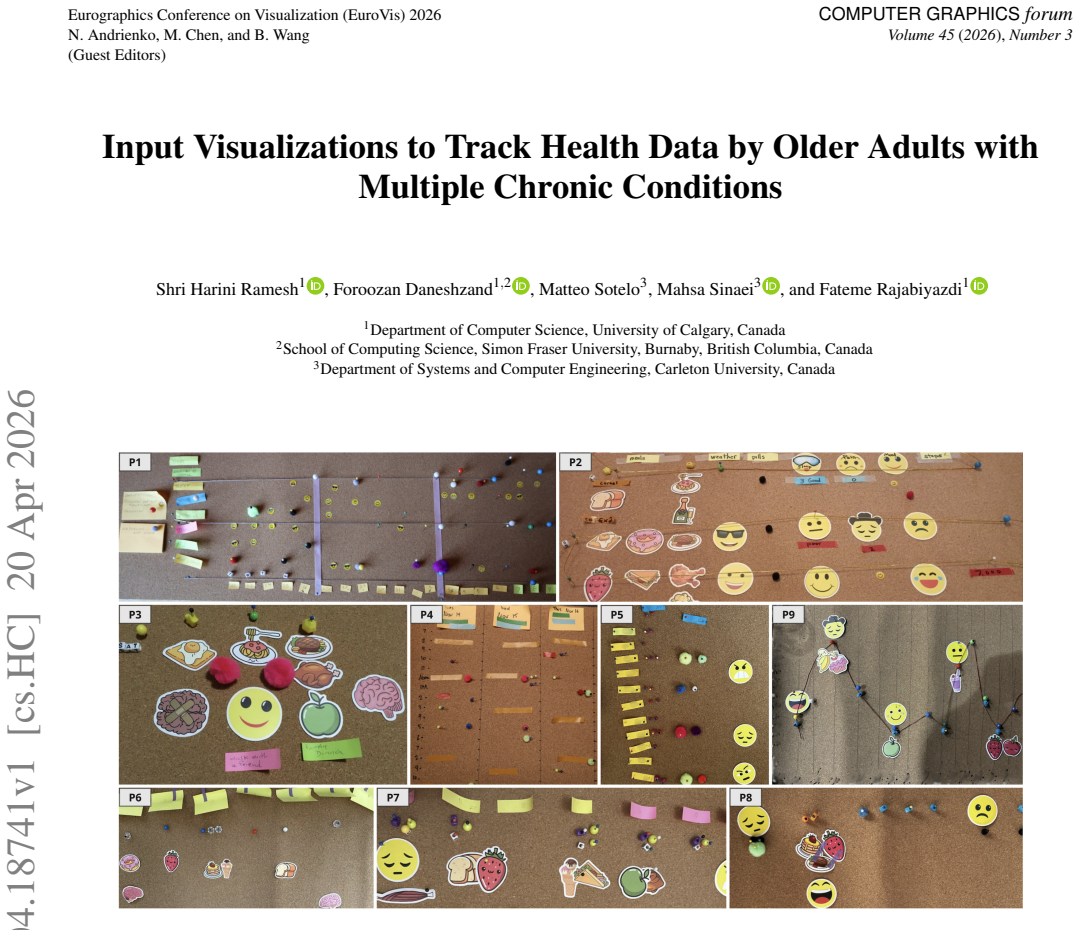


read the original abstract
Older adults living with multiple chronic conditions (MCC) can considerably benefit from collecting and reflecting on their health data. Many older adults collect their health data using various approaches, such as digital tools or handwritten notebooks. However, in these approaches, the act of collecting data does not itself yield insights; sensemaking and reflection happen only if individuals later review their accumulated records. The daily process of data collection thus offers limited opportunity for individuals to actively engage with their data or find the process personally meaningful and enjoyable. Personal data input visualizations using physical tokens offer a promising solution that can help individuals recognize evolving patterns while collecting data and discover meaningful insights more serendipitously and engagingly. Yet, there is a limited understanding of whether and how older adults living with MCC might adopt physical input visualizations to collect data and reflect on their health, and how the tangible, expressive, and personalizable nature of this process supports their sensemaking and reflection. In this paper, we present the results of our interview and diary studies in which older adults living with MCC inputted health data using physical tokens over two weeks. Our findings highlight the diverse and unique needs of older adults for tracking personal health data, illustrating how they adapt strategies and personalize physical input visualizations to align with their individual needs. We demonstrate how older adults integrated input visualizations into daily routines and leveraged tangible markers to reflect on patterns and behaviors, while enjoying the process of tracking and focusing on personal expression and meaningful reflection. Finally, we provide design considerations for supporting older adults with MCC when inputting health data through physical tokens.
Editorial analysis
A structured set of objections, weighed in public.
Referee Report
Summary. The paper reports findings from interview and two-week diary studies in which older adults with multiple chronic conditions (MCC) collected health data using physical input visualizations (tokens). It claims that participants exhibited diverse needs, adapted and personalized the tokens to fit individual routines and preferences, integrated the visualizations into daily life, used tangible markers for serendipitous reflection on patterns and behaviors, and found the process enjoyable and personally meaningful, ultimately yielding design considerations for supporting such users with physical data input.
Significance. If the empirical findings hold, the work contributes to personal informatics and health HCI by shifting focus from post-collection review to in-the-moment sensemaking and engagement through tangible, expressive, and personalizable input methods. It provides concrete examples of how older adults with MCC adapt physical tokens for reflection and routine integration, offering actionable design considerations that could inform more accessible and enjoyable health-tracking tools. The study design (interviews plus diary) is a standard strength for surfacing user adaptations in this domain.
major comments (2)
- [Methods] Methods section: The manuscript provides no participant count, recruitment details, inclusion/exclusion criteria, interview protocol, diary instructions, or qualitative analysis method (e.g., whether thematic analysis, grounded theory, or another approach was used, and how inter-rater reliability or bias was addressed). These omissions are load-bearing because the central claims about diverse needs, personalization strategies, routine integration, and meaningful reflection rest entirely on the robustness of the reported participant behaviors and self-reports.
- [Findings and Discussion] Diary study description (throughout Findings and Discussion): The two-week duration is presented as sufficient to observe stable adaptation, personalization, and reflection practices, yet no longitudinal follow-up or discussion of novelty/Hawthorne effects is provided. This undercuts the leap from observed short-term behaviors to design considerations for everyday, long-term use by older adults with MCC.
minor comments (2)
- [Abstract] Abstract and Introduction: The abstract states findings without any methodological qualifiers (e.g., 'in a two-week study with N=...'), which makes the claims appear more general than the study scope supports.
- [Introduction] Terminology: 'Input visualizations' and 'physical tokens' are used interchangeably without an early, explicit definition or diagram showing the token set and mapping to health metrics.
Simulated Author's Rebuttal
We thank the referee for the constructive and detailed feedback, which highlights important areas for strengthening the manuscript. We address each major comment below and will revise the paper to improve clarity and rigor.
read point-by-point responses
-
Referee: [Methods] Methods section: The manuscript provides no participant count, recruitment details, inclusion/exclusion criteria, interview protocol, diary instructions, or qualitative analysis method (e.g., whether thematic analysis, grounded theory, or another approach was used, and how inter-rater reliability or bias was addressed). These omissions are load-bearing because the central claims about diverse needs, personalization strategies, routine integration, and meaningful reflection rest entirely on the robustness of the reported participant behaviors and self-reports.
Authors: We agree that these details are essential and were omitted from the original manuscript. In the revised version, we will expand the Methods section to report the participant count and demographics, recruitment strategy and channels, inclusion and exclusion criteria, the semi-structured interview protocol, the specific instructions and materials provided for the two-week diary study, and the qualitative analysis process (thematic analysis with two independent coders who met regularly to discuss and resolve coding discrepancies). revision: yes
-
Referee: [Findings and Discussion] Diary study description (throughout Findings and Discussion): The two-week duration is presented as sufficient to observe stable adaptation, personalization, and reflection practices, yet no longitudinal follow-up or discussion of novelty/Hawthorne effects is provided. This undercuts the leap from observed short-term behaviors to design considerations for everyday, long-term use by older adults with MCC.
Authors: We acknowledge the limitation of the two-week timeframe and the absence of longitudinal data or explicit discussion of novelty and Hawthorne effects. The study was intended as an initial exploration of adoption and adaptation rather than a claim of long-term stability. In the revision, we will add a dedicated Limitations subsection that discusses the short duration, potential novelty effects on engagement, and observer effects, while reframing the design considerations as preliminary insights derived from short-term use that require future longitudinal validation. revision: partial
Circularity Check
No circularity: qualitative empirical study with no derivations or fitted parameters
full rationale
This is a qualitative HCI study reporting interview and two-week diary findings on older adults' use of physical tokens for health data tracking. The central claims derive directly from participant observations, self-reports, and thematic analysis rather than any equations, parameter fits, predictions, or self-citation chains. No load-bearing step reduces by construction to its own inputs; the two-week duration is noted as a limitation in the skeptic analysis but does not create circularity in the reported results. The derivation chain is self-contained against external benchmarks of empirical data collection.
Axiom & Free-Parameter Ledger
axioms (1)
- domain assumption Older adults living with MCC can considerably benefit from collecting and reflecting on their health data.
Reference graph
Works this paper leans on
-
[1]
J. M. Buhmann and D. W. Fellner and M. Held and J. Ketterer and J. Puzicha , TITLE =. 1998 , PAGES =. doi:10.1111/1467-8659.00269 , NOTE =
-
[2]
and Helmberg, Christoph , TITLE =
Fellner, Dieter W. and Helmberg, Christoph , TITLE =. 1993 , PAGES =
1993
-
[3]
L. Kobbelt and M. Stamminger and H.-P. Seidel , title =. doi:10.1111/1467-8659.16.3conferenceissue.36 , note =
-
[4]
Lafortune and Sing-Choong Foo and Kenneth E
Eric P. Lafortune and Sing-Choong Foo and Kenneth E. Torrance and Donald P. Greenberg , title =. Proc. SIGGRAPH '97 , volume = 31, pages =
-
[5]
and Bruzzese, Tommy and Romanos, Alyssa B
Abtahi, Parastoo and Ding, Victoria and Yang, Anna C. and Bruzzese, Tommy and Romanos, Alyssa B. and Murnane, Elizabeth L. and Follmer, Sean and Landay, James A. , title =. 2020 , issue_date =. doi:10.1145/3432236 , journal =
-
[6]
Samavati , title =
Lynn Moorman, Hessam Djavaherpour, Katayoon Etemad and Faramarz F. Samavati , title =. Journal of Geography , volume =. 2021 , publisher =
2021
-
[7]
Proceedings of the 2023 ACM Designing Interactive Systems Conference , pages =
Li, Jiatong and Suzuki, Ryo and Nakagaki, Ken , title =. Proceedings of the 2023 ACM Designing Interactive Systems Conference , pages =. 2023 , isbn =. doi:10.1145/3563657.3596037 , abstract =
-
[8]
Touretzky, David S. , title =. 2014 , issue_date =. doi:10.1145/2684721.2684732 , journal =
-
[9]
Horn, Michael S. and Jacob, Robert J. K. , title =. Proceedings of the 1st International Conference on Tangible and Embedded Interaction , pages =. 2007 , isbn =. doi:10.1145/1226969.1227003 , abstract =
-
[10]
Pantano and Eleonora Bilotta , title =
Francesca Bertacchini, Pietro S. Pantano and Eleonora Bilotta , title =. International Journal of Design Creativity and Innovation , volume =. 2024 , publisher =
2024
-
[11]
The Visual Computer , year =
Multi-scale physicalization of polar heritage at risk in the western Canadian Arctic , author =. The Visual Computer , year =
-
[12]
Friedenberger, Tamara and Hurtienne, J\". Size Doesn’t Matter? Down-Scaling a Data Physicalization Does Not Measurably Change Viewers’ Mediated Social Interactions , year =. Proceedings of the Nineteenth International Conference on Tangible, Embedded, and Embodied Interaction , articleno =. doi:10.1145/3689050.3704947 , abstract =
-
[13]
2016 , isbn =
Dear Data , author =. 2016 , isbn =
2016
-
[14]
2020 , KEYWORDS =
Rajabiyazdi, Fateme and Perin, Charles and Oehlberg, Lora and Carpendale, Sheelagh , URL =. 2020 , KEYWORDS =
2020
-
[15]
IEEE Computer Graphics and Applications , title=
Rajabiyazdi, Fateme and Perin, Charles and Oehlberg, Lora and Carpendale, Sheelagh , doi =. IEEE Computer Graphics and Applications , title=. 2021 , volume=
2021
-
[16]
Bringing Data to Life: Community Data Physicalization , author =
-
[17]
Chandrasekaran, Ranganathan and Katthula, Vipanchi and Moustakas, Evangelos. Patterns of Use and Key Predictors for the Use of Wearable Health Care Devices by US Adults: Insights from a National Survey. J Med Internet Res. 2020. doi:10.2196/22443
-
[18]
Zaman, Sojib Bin and Khan, Raihan Kabir and Evans, Roger G and Thrift, Amanda G and Maddison, Ralph and Islam, Sheikh Mohammed Shariful. Exploring Barriers to and Enablers of the Adoption of Information and Communication Technology for the Care of Older Adults With Chronic Diseases: Scoping Review. JMIR Aging. 2022. doi:10.2196/25251
-
[19]
Jean, Beth and Choe, Eun Kyoung , title =
Oh, Chi Young and Luo, Yuhan and St. Jean, Beth and Choe, Eun Kyoung , title =. Proc. ACM Hum.-Comput. Interact. , month = apr, articleno =. 2022 , issue_date =. doi:10.1145/3512954 , abstract =
-
[20]
Ancker, Jessica S and Witteman, Holly O and Hafeez, Baria and Provencher, Thierry and Van de Graaf, Mary and Wei, Esther. ``You Get Reminded You're a Sick Person'': Personal Data Tracking and Patients With Multiple Chronic Conditions. J Med Internet Res. 2015. doi:10.2196/jmir.4209
-
[21]
Kim, Ben and Ghasemi, Peyman and Stolee, Paul and Lee, Joon. Clinicians and Older Adults' Perceptions of the Utility of Patient-Generated Health Data in Caring for Older Adults: Exploratory Mixed Methods Study. JMIR Aging. 2021. doi:10.2196/29788
-
[22]
Data Badges: Making an Academic Profile Through a DIY Wearable Physicalization , year=
Panagiotidou, Georgia and Görücü, Sinem and Vande Moere, Andrew , journal=. Data Badges: Making an Academic Profile Through a DIY Wearable Physicalization , year=
-
[23]
Stegers, Brigitte and Sauv\'. Ecorbis: A Data Sculpture of Environmental Behavior in the Home Context , year =. Proceedings of the 2022 ACM Designing Interactive Systems Conference , pages =. doi:10.1145/3532106.3533508 , abstract =
-
[24]
LOOP: Exploring Physicalization of Activity Tracking Data , year =
Sauv\'. LOOP: Exploring Physicalization of Activity Tracking Data , year =. doi:10.1145/3419249.3420109 , booktitle =
-
[25]
Laina: Dynamic Data Physicalization for Slow Exercising Feedback , year =
Menheere, Daphne and Hartingsveldt, Evianne and Birkeb. Laina: Dynamic Data Physicalization for Slow Exercising Feedback , year =. doi:10.1145/3461778.3462041 , booktitle =
-
[26]
Khot, Rohit Ashok and Hjorth, Larissa and Mueller, Florian 'Floyd' , title =. 2014 , isbn =. doi:10.1145/2556288.2557144 , booktitle =
-
[27]
Activity Sculptures: Exploring the Impact of Physical Visualizations on Running Activity , year=
Stusak, Simon and Tabard, Aurélien and Sauka, Franziska and Khot, Rohit Ashok and Butz, Andreas , journal=. Activity Sculptures: Exploring the Impact of Physical Visualizations on Running Activity , year=
-
[28]
Thudt, Alice and Hinrichs, Uta and Huron, Samuel and Carpendale, Sheelagh , title =. 2018 , isbn =. doi:10.1145/3173574.3173728 , booktitle =
-
[29]
Brombacher, Hans and Van Koningsbruggen, Rosa and Vos, Steven and Houben, Steven , title =. 2024 , isbn =. doi:10.1145/3623509.3633378 , booktitle =
-
[30]
Wijers, Jelle and Brombacher, Hans and Houben, Steven , title =. Proceedings of the Eighteenth International Conference on Tangible, Embedded, and Embodied Interaction , articleno =. 2024 , isbn =. doi:10.1145/3623509.3635252 , abstract =
-
[31]
Proceedings of the 2016 CHI Conference on Human Factors in Computing Systems , pages =
Houben, Steven and Golsteijn, Connie and Gallacher, Sarah and Johnson, Rose and Bakker, Saskia and Marquardt, Nicolai and Capra, Licia and Rogers, Yvonne , title =. Proceedings of the 2016 CHI Conference on Human Factors in Computing Systems , pages =. 2016 , isbn =. doi:10.1145/2858036.2858059 , abstract =
-
[32]
and Fekete, Jean-Daniel , title =
Swaminathan, Saiganesh and Shi, Conglei and Jansen, Yvonne and Dragicevic, Pierre and Oehlberg, Lora A. and Fekete, Jean-Daniel , title =. Proceedings of the SIGCHI Conference on Human Factors in Computing Systems , pages =. 2014 , isbn =. doi:10.1145/2556288.2557310 , abstract =
-
[33]
2021 , DOI =
Dragicevic, Pierre and Jansen, Yvonne and Vande Moere, Andrew , BOOKTITLE =. 2021 , DOI =
2021
-
[34]
Constructing Visual Representations: Investigating the Use of Tangible Tokens , year=
Huron, Samuel and Jansen, Yvonne and Carpendale, Sheelagh , journal=. Constructing Visual Representations: Investigating the Use of Tangible Tokens , year=
-
[35]
Opportunities and Challenges for Data Physicalization , year =
Jansen, Yvonne and Dragicevic, Pierre and Isenberg, Petra and Alexander, Jason and Karnik, Abhijit and Kildal, Johan and Subramanian, Sriram and Hornb. Opportunities and Challenges for Data Physicalization , year =. Proceedings of the 33rd Annual ACM Conference on Human Factors in Computing Systems , pages =. doi:10.1145/2702123.2702180 , abstract =
-
[36]
2014 , publisher=
Basics of qualitative research: Techniques and procedures for developing grounded theory , author=. 2014 , publisher=
2014
-
[37]
Purposeful sampling for qualitative data collection and analysis in mixed method implementation research , author=. Administration and policy in mental health and mental health services research , volume=. 2015 , publisher=. doi:https://doi.org/10.1007/s10488-013-0528-y , pages=
-
[38]
Carter, Scott and Mankoff, Jennifer , title =. 2005 , isbn =. doi:10.1145/1054972.1055098 , booktitle =
-
[39]
BMC medical research methodology , volume=
A qualitative approach to guide choices for designing a diary study , author=. BMC medical research methodology , volume=. 2018 , doi=
2018
-
[40]
Huron, Samuel and Carpendale, Sheelagh and Thudt, Alice and Tang, Anthony and Mauerer, Michael , title =. 2014 , isbn =. doi:10.1145/2598510.2598566 , booktitle =
-
[41]
Jenny Ploeg and Marie-Lee Yous and Kimberly Fraser and Sinéad Dufour and Lisa Garland Baird and Sharon Kaasalainen and Carrie McAiney and Maureen Markle-Reid , title =. BMC Geriatrics , year =. doi:10.1186/s12877-019-1345-2 , issn =
-
[42]
Quarterly Journal of Experimental Psychology , volume =
Alexander LM Siegel and Rachel S Graup and Alan D Castel , title =. Quarterly Journal of Experimental Psychology , volume =. 2020 , doi =
2020
-
[43]
Information Delivery Methods and their Association with Older Adults Memory and Comprehension , volume =
Imamura, Yukio and Murakami, Yuki and Kimura, Yoshihide and Maeda, Osamu and Tsujii, Masanori and Konishi, Kei and Nakano, Tomoko and Nagai, Yoriko and Mitani, Satoko , year =. Information Delivery Methods and their Association with Older Adults Memory and Comprehension , volume =. Journal of Aging Science , doi =
-
[44]
Zhu and Amy Aloysi and Corbett A
Clara Li and Judith Neugroschl and Carolyn W. Zhu and Amy Aloysi and Corbett A. Schimming and Dongming Cai and Hillel Grossman and Jane Martin and Margaret Sewell and Maria Loizos and Xiaoyi Zeng and Mary Sano , title =. Journal of Alzheimer’s Disease , volume =. 2021 , doi =
2021
-
[45]
and Ouellet, Jennifer A
Ouellet, Gregory M. and Ouellet, Jennifer A. and Tinetti, Mary E. , title =. JAMA Network Open , volume =. 2024 , month =
2024
-
[46]
Katherine S. McGilton and Shirin Vellani and Lily Yeung and Jawad Chishtie and Elana Commisso and Jenny Ploeg and Melissa K. Andrew and Ana Patricia Ayala and Mikaela Gray and Debra Morgan and Amanda Froehlich Chow and Edna Parrott and Doug Stephens and Lori Hale and Margaret Keatings and Jennifer Walker and Walter P. Wodchis and Veronique Dubé and Janet ...
-
[47]
Yu, Jingxin and Ayobi, Amid and Marshall, Paul and O'Kane, Aisling Ann , title =. 2025 , isbn =. doi:10.1145/3689050.3704944 , booktitle =
-
[48]
Polhemus, Ashley and Simblett, Sara and Dawe-Lane, Erin and Gilpin, Gina and Elliott, Benjamin and Jilka, Sagar and Novak, Jan and Nica, Raluca Ileana and Temesi, Gergely and Wykes, Til. Health Tracking via Mobile Apps for Depression Self-management: Qualitative Content Analysis of User Reviews. JMIR Hum Factors. 2022. doi:10.2196/40133
-
[49]
2014 , address =
Tamara Munzner , title =. 2014 , address =
2014
-
[50]
Mukhlid Alshammari and Jed Duff and Michelle Guilhermino , title =. BMC Nursing , year =. doi:10.1186/s12912-019-0385-4 , issn =
-
[51]
Luo, Yuhan and Oh, Chi Young and Jean, Beth St and Choe, Eun Kyoung. Interrelationships Between Patients' Data Tracking Practices, Data Sharing Practices, and Health Literacy: Onsite Survey Study. J Med Internet Res. 2020. doi:10.2196/18937
-
[52]
Karyda, Maria and Mekler, Elisa D and Lucero, Andr\'. Data Agents: Promoting Reflection through Meaningful Representations of Personal Data in Everyday Life , year =. doi:10.1145/3411764.3445112 , booktitle =
-
[53]
Sauv\'. Physicalization from Theory to Practice: Exploring Contemporary Challenges for Physicalization Design , year =. doi:10.1145/3656156.3658381 , booktitle =
-
[54]
Sauv\'. Physecology: A Conceptual Framework to Describe Data Physicalizations in their Real-World Context , year =. doi:10.1145/3505590 , journal =
-
[55]
Liapis, Alexandros and Katsanos, Christos and Xenos, Michalis and Orphanoudakis, Theofanis , title =. 2019 , isbn =. doi:10.1145/3290607.3312995 , booktitle =
-
[56]
Sauv\'. Econundrum: Visualizing the Climate Impact of Dietary Choice through a Shared Data Sculpture , year =. doi:10.1145/3357236.3395509 , booktitle =
-
[57]
Brombacher, Hans and Nikolov, Vasil and Vos, Steven and Houben, Steven , title =. 2023 , isbn =. doi:10.1145/3544549.3585866 , booktitle =
-
[58]
: Design patterns for data comics
Ledo, David and Houben, Steven and Vermeulen, Jo and Marquardt, Nicolai and Oehlberg, Lora and Greenberg, Saul , title =. 2018 , isbn =. doi:10.1145/3173574.3173610 , booktitle =
-
[59]
2011 , howpublished =
Jose Duarte , title =. 2011 , howpublished =
2011
-
[60]
Pittarello, Fabio and Semenzato, Manuel , title =. 2024 , isbn =. doi:10.1145/3656650.3656682 , booktitle =
-
[61]
ProtoBricks: A Research Toolkit for Tangible Prototyping & Data Physicalization , year =
Dominiak, Julia and Walczak, Anna and Stefanidi, Evropi and Adamkiewicz, Krzysztof and Grudzie\'. ProtoBricks: A Research Toolkit for Tangible Prototyping & Data Physicalization , year =. doi:10.1145/3643834.3661573 , booktitle =
-
[62]
Lim, Catherine Y. and Berry, Andrew B.L. and Hartzler, Andrea L. and Hirsch, Tad and Carrell, David S. and Bermet, Zo\". Facilitating Self-reflection about Values and Self-care Among Individuals with Chronic Conditions , year =. doi:10.1145/3290605.3300885 , booktitle =
-
[63]
Morais, Luiz and Panagiotidou, Georgia and Hayes, Sarah and Losev, Tatiana and Noonan, Rebecca and Hinrichs, Uta , title =. 2024 , isbn =. doi:10.1145/3613904.3642248 , booktitle =
-
[64]
Aging Clinical and Experimental Research , year =
CJ Liu and D Marie and A Fredrick and J Bertram and K Utley and EE Fess , title =. Aging Clinical and Experimental Research , year =. doi:10.1007/s40520-016-0628-0 , pmid =
-
[65]
Age and Grip Strength Predict Hand Dexterity in Adults , year =. PLOS ONE , publisher =. doi:10.1371/journal.pone.0117598 , author =
-
[66]
Understanding How Older Adults Comprehend COVID-19 Interactive Visualizations via Think-Aloud Protocol , doi =
Mingming Fan and Yiwen Wang and Yuning Xie and Franklin Mingzhe Li and Chunyang Chen , journal=. Understanding How Older Adults Comprehend COVID-19 Interactive Visualizations via Think-Aloud Protocol , doi =. 2022 , volume=
2022
-
[67]
Cleveland and Robert McGill , journal =
William S. Cleveland and Robert McGill , journal =. Graphical Perception: The Visual Decoding of Quantitative Information on Graphical Displays of Data , urldate =
-
[68]
Singhal, Samarth and Neustaedter, Carman and Odom, William and Bartram, Lyn and Heshmat, Yasamin , title =. 2018 , isbn =. doi:10.1145/3173574.3173753 , booktitle =
-
[69]
Personal Visualization and Personal Visual Analytics , year=
Huang, Dandan and Tory, Melanie and Adriel Aseniero, Bon and Bartram, Lyn and Bateman, Scott and Carpendale, Sheelagh and Tang, Anthony and Woodbury, Robert , journal=. Personal Visualization and Personal Visual Analytics , year=
-
[70]
Diagnosing blood pressure with Acoustic Sonification singing bowls , journal =. 2016 , note =. doi:https://doi.org/10.1016/j.ijhcs.2015.08.007 , author =
-
[71]
Lee, Kyung-Ryong and Ju, Somi and Dzhoroev, Temirlan and Goh, Geonil and Lee, Moon-Hwan and Park, Young-Woo , title =. 2020 , isbn =. doi:10.1145/3357236.3395439 , booktitle =
-
[72]
Weng, Shitong and Gohumpu, Jennifer and Zhao, Cuina and Bao, Yanchi and Zhang, Biyong and Xue, Mengru , title =. 2024 , isbn =. doi:10.1007/978-3-031-74353-5_36 , booktitle =
-
[73]
and Kaji, Amy H
Schwarze, Margaret L. and Kaji, Amy H. and Ghaferi, Amir A. , title =. JAMA Surgery , volume =. 2020 , month =
2020
-
[74]
Introduction to qualitative researchinput , author=
-
[75]
Baumer, Eric P.S. , title =. 2015 , isbn =. doi:10.1145/2702123.2702234 , booktitle =
-
[76]
Li, Ian and Dey, Anind K. and Forlizzi, Jodi , title =. 2011 , isbn =. doi:10.1145/2030112.2030166 , booktitle =
-
[77]
Krekhov, Andrey and Emmerich, Katharina and Fuchs, Johannes and Krueger, Jens Harald , title =. Proceedings of the 2022 CHI Conference on Human Factors in Computing Systems , articleno =. 2022 , isbn =. doi:10.1145/3491102.3517661 , abstract =
-
[78]
The Data-Wink Ratio: Emoji Encoder for Generating Semantically-Resonant Unit Charts , year=
Brehmer, Matthew and Setlur, Vidya and Zoe and Correll, Michael , booktitle=. The Data-Wink Ratio: Emoji Encoder for Generating Semantically-Resonant Unit Charts , year=
-
[79]
2017 , journal =
Axios , title =. 2017 , journal =
2017
-
[80]
and Nagel, T
Huron, S. and Nagel, T. and Oehlberg, L. and Willett, W. , editor =. Making with Data: Physical Design and Craft in a Data-Driven World , edition =. 2022 , publisher =
2022
discussion (0)
Sign in with ORCID, Apple, or X to comment. Anyone can read and Pith papers without signing in.