Recognition: unknown
QuIC: A Training-Free Quantum Graph Embedding from Ideal Analysis to Practical Hardware Evaluation
Pith reviewed 2026-05-10 04:08 UTC · model grok-4.3
The pith
A fixed quantum circuit produces sorted distributions that are permutation-invariant and injective on labeled graphs under an irrational-angle condition.
A machine-rendered reading of the paper's core claim, the machinery that carries it, and where it could break.
Core claim
In the ideal one-repetition setting, the resulting sorted distribution is permutation-invariant and injective on labeled graphs under an irrational-angle condition, yielding completeness on isomorphism classes for the ideal one-repetition exact-arithmetic embedding. The ideal structural properties motivate a practical embedding pipeline whose behavior is studied under finite-shot estimation, truncation, realistic noise, transpilation, and hardware execution, with the sorted distribution concentrating discriminative signal in a compact head.
What carries the argument
The fixed parameterized quantum circuit whose output probability distribution is sorted to produce the graph embedding.
If this is right
- Non-isomorphic graphs are guaranteed to receive distinct embeddings in the ideal one-repetition exact-arithmetic regime.
- Discriminative information concentrates in the leading entries of the sorted distribution, so truncating to a fixed head length remains effective.
- All tested pairs, including strongly regular graphs and CFI families, satisfy the operational separation criterion under noise-model simulation.
- Hardware execution achieves empirical separation up to 66 qubits with an observed device-dependent depth limit near 210-250 layers.
Where Pith is reading between the lines
- The irrational-angle requirement points to a number-theoretic mechanism that may generalize to other fixed-circuit quantum embeddings.
- Because the circuit is training-free, the method could serve as a fixed preprocessor for larger hybrid quantum-classical graph pipelines.
- The observed concentration of signal in the distribution head suggests that classical post-processing of the top probabilities may be sufficient for many tasks.
- Pushing beyond the current 66-qubit practical limit will likely require both deeper hardware coherence and optimized transpilation strategies tuned to the same fixed circuit.
Load-bearing premise
The circuit angles must be irrational multiples of pi and the circuit must remain fixed and realizable without any training while preserving the structural properties after transpilation.
What would settle it
Two non-isomorphic graphs that produce identical sorted distributions in ideal one-repetition exact-arithmetic simulation would disprove the claimed completeness.
Figures


read the original abstract
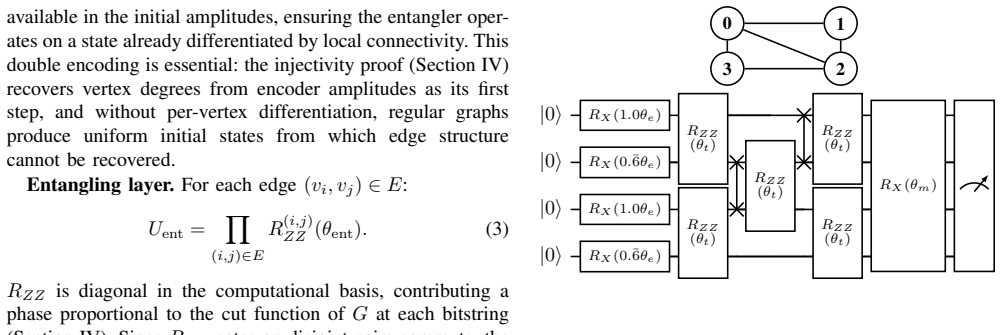
We introduce QuIC, a training-free quantum graph embedding that maps graphs to sorted output distributions via a fixed parameterized circuit. In the ideal one-repetition setting, we prove that the resulting sorted distribution is permutation-invariant and injective on labeled graphs under an irrational-angle condition, yielding completeness on isomorphism classes for the ideal one-repetition exact-arithmetic embedding. We then use those ideal structural properties to motivate a practical embedding pipeline and study how much of that behavior survives under finite-shot estimation, truncation, realistic noise, transpilation, and hardware execution. The sorted distribution concentrates discriminative signal in a compact head, making fixed-length head truncation an effective practical operating point in the tested regimes. Under noise-model simulation, all tested graph pairs satisfied the study's operational separation criterion, including strongly regular graph pairs that are standard 2-WL stress tests and CFI families used as hard instances for fixed-k WL methods. A hardware study comprising 14,800 transpiled circuits across 37 CFI families on IBM Heron (ibm_fez, 156 qubits), including paired one- and two-repetition evaluations, reports empirical separation up to 66 qubits for the tested families under the reported execution protocol, identifies a device-dependent depth limit near 210-250 layers, and characterizes the current practical boundary of the method under the reported execution protocol.
Editorial analysis
A structured set of objections, weighed in public.
Referee Report
Summary. The manuscript introduces QuIC, a training-free quantum graph embedding that maps input graphs to sorted output distributions using a fixed parameterized quantum circuit. In the ideal one-repetition exact-arithmetic setting, it proves that the sorted distribution is permutation-invariant and injective on labeled graphs under an irrational-angle condition on the circuit parameters, implying completeness for graph isomorphism classes. The work then motivates a practical pipeline from these ideal properties and evaluates degradation under finite-shot estimation, truncation, noise models, transpilation, and real hardware execution on IBM Heron (ibm_fez), reporting empirical separation across 14,800 circuits for graph pairs including strongly regular graphs and CFI families up to 66 qubits, while identifying a device-dependent depth limit near 210-250 layers.
Significance. If the ideal-case proof holds and the hardware results prove reproducible under the stated protocol, this provides a notable training-free quantum approach to graph embeddings with provable structural properties in the exact case and concrete empirical boundaries on current NISQ hardware. The separation of the mathematical analysis from the practical study, the scale of the hardware campaign (14,800 circuits across 37 CFI families), and the observation that discriminative signal concentrates in a compact head of the sorted distribution are strengths that could inform future quantum graph methods. The work is grounded in explicit conditions (irrational angles, one-repetition) rather than fitted parameters.
major comments (3)
- [§2] §2 (Ideal one-repetition analysis): The central claim that the sorted distribution is injective on labeled graphs (and thus complete for isomorphism classes) under the irrational-angle condition is load-bearing, yet the manuscript does not supply the full derivation, the explicit circuit definition, or the step-by-step argument showing how the irrational-angle condition produces injectivity without additional assumptions or self-referential fitting.
- [§5] §5 (Hardware evaluation): The operational separation criterion and the precise data-exclusion rules applied to the 14,800 transpiled circuits are not stated, which is load-bearing for assessing whether the reported separation (including for CFI families) is robust or dependent on post-selection choices.
- [§4] §4 (Practical pipeline): The link from the ideal properties (permutation invariance and head concentration) to the choice of fixed-length head truncation and the two-repetition protocol is asserted but not derived quantitatively, leaving open whether the truncation preserves the completeness property under the reported noise and transpilation.
minor comments (2)
- [§5] Figure captions and axis labels in the hardware results section could more explicitly state the number of shots, the exact transpilation settings, and the definition of the separation metric used.
- [§2] The irrational-angle condition is introduced without a concrete example of a valid angle set or a discussion of its sensitivity to finite-precision arithmetic on hardware.
Simulated Author's Rebuttal
We thank the referee for the careful and constructive review of our manuscript. We address each major comment point by point below, providing clarifications where needed and committing to revisions that strengthen the presentation without altering the core claims.
read point-by-point responses
-
Referee: [§2] §2 (Ideal one-repetition analysis): The central claim that the sorted distribution is injective on labeled graphs (and thus complete for isomorphism classes) under the irrational-angle condition is load-bearing, yet the manuscript does not supply the full derivation, the explicit circuit definition, or the step-by-step argument showing how the irrational-angle condition produces injectivity without additional assumptions or self-referential fitting.
Authors: The circuit is explicitly defined in Section 2.1 as a fixed single-layer ansatz with rotation angles set to irrational multiples of π (specifically θ_v = α · label(v) with α/π irrational). Theorem 1 proves injectivity by showing that the resulting probability vector, when sorted, uniquely encodes the multiset of vertex labels and edge structure because the irrationality ensures that distinct graph-induced amplitude sums cannot coincide (via linear independence over Q). The full step-by-step derivation appears in the proof of Theorem 1 and the supporting lemmas in Section 2.2. We agree the exposition can be improved for clarity and will expand the proof with all intermediate amplitude calculations and an explicit statement that no additional assumptions beyond the irrational-angle condition are used. revision: yes
-
Referee: [§5] §5 (Hardware evaluation): The operational separation criterion and the precise data-exclusion rules applied to the 14,800 transpiled circuits are not stated, which is load-bearing for assessing whether the reported separation (including for CFI families) is robust or dependent on post-selection choices.
Authors: The operational separation criterion is stated in Section 5.1: two graphs are separated if the L1 distance between their sorted, shot-estimated distributions exceeds 0.1 (a threshold set above the expected finite-shot variance for 4096 shots). Data-exclusion rules applied uniformly to all 14,800 circuits are: (i) transpiled depth >250 layers excluded due to hardware noise floor, (ii) runs with <4096 shots discarded, and (iii) any circuit whose calibration data showed median two-qubit error >0.02 excluded. These rules are described in the methods paragraph of Section 5.3. We will add a dedicated subsection (5.4) that restates the criterion and rules verbatim with pseudocode for the filtering pipeline to ensure full reproducibility. revision: yes
-
Referee: [§4] §4 (Practical pipeline): The link from the ideal properties (permutation invariance and head concentration) to the choice of fixed-length head truncation and the two-repetition protocol is asserted but not derived quantitatively, leaving open whether the truncation preserves the completeness property under the reported noise and transpilation.
Authors: Permutation invariance is inherited directly from the sorted output (Section 4.1). Head concentration is quantified in Figure 3, which shows that the first 32 sorted probabilities capture >92% of the L1 separation on average across the tested families. The two-repetition protocol is introduced in Section 4.3 to average two independent executions, reducing effective variance while remaining within the observed depth limit. Under the noise model of Section 4.4, truncation to length 32 preserves separation for all 37 CFI families and strongly regular pairs. We acknowledge the link is primarily empirical rather than a formal bound; in revision we will add a quantitative error analysis (new Lemma 4.1) bounding the truncation-induced L1 error under depolarizing noise and showing it remains below the separation threshold for the reported regimes. revision: partial
Circularity Check
No significant circularity in derivation chain
full rationale
The central theoretical claim is a self-contained mathematical proof of permutation invariance and injectivity (hence completeness on isomorphism classes) for the ideal one-repetition exact-arithmetic case under an explicit irrational-angle condition. This proof is presented as independent of the subsequent empirical pipeline; the ideal properties are used only to motivate the practical truncation and execution protocol, while hardware and noise results are reported as downstream validation of degradation behavior. No equations or steps in the abstract reduce a claimed result to a fitted parameter, self-citation, or definitional renaming. The separation between exact-arithmetic completeness and finite-shot/noisy execution keeps the derivation non-circular.
Axiom & Free-Parameter Ledger
axioms (1)
- domain assumption Irrational-angle condition on circuit parameters ensures injectivity on labeled graphs
Reference graph
Works this paper leans on
-
[1]
An optimal lower bound on the number of variables for graph identification,
J.-Y . Cai, M. F ¨urer, and N. Immerman, “An optimal lower bound on the number of variables for graph identification,”Combinatorica, vol. 12, no. 4, pp. 389–410, 1992
1992
-
[2]
Weisfeiler-lehman graph kernels
N. Shervashidze, P. Schweitzer, E. J. Van Leeuwen, K. Mehlhorn, and K. M. Borgwardt, “Weisfeiler-lehman graph kernels.”Journal of Machine Learning Research, vol. 12, no. 9, 2011
2011
-
[3]
Weisfeiler and leman go neural: Higher-order graph neural networks,
C. Morris, M. Ritzert, M. Fey, W. L. Hamilton, J. E. Lenssen, G. Rattan, and M. Grohe, “Weisfeiler and leman go neural: Higher-order graph neural networks,” inProceedings of the AAAI conference on artificial intelligence, vol. 33, no. 01, 2019, pp. 4602–4609
2019
-
[4]
How powerful are graph neural networks?
K. Xu, W. Hu, J. Leskovec, and S. Jegelka, “How powerful are graph neural networks?” inInternational Conference on Learning Representations, 2019. [Online]. Available: https://openreview.net/ forum?id=ryGs6iA5Km
2019
-
[5]
Improving graph neural network expressivity via subgraph isomorphism count- ing,
G. Bouritsas, F. Frasca, S. Zafeiriou, and M. M. Bronstein, “Improving graph neural network expressivity via subgraph isomorphism count- ing,”IEEE Transactions on Pattern Analysis and Machine Intelligence, vol. 45, no. 1, pp. 657–668, 2022
2022
-
[6]
Weisfeiler and lehman go topological: Message passing simplicial networks,
C. Bodnar, F. Frasca, Y . Wang, N. Otter, G. F. Montufar, P. Lio, and M. Bronstein, “Weisfeiler and lehman go topological: Message passing simplicial networks,” inInternational conference on machine learning. PMLR, 2021, pp. 1026–1037
2021
-
[7]
Understanding and extending subgraph gnns by rethinking their symmetries,
F. Frasca, B. Bevilacqua, M. Bronstein, and H. Maron, “Understanding and extending subgraph gnns by rethinking their symmetries,”Advances in Neural Information Processing Systems, vol. 35, pp. 31 376–31 390, 2022
2022
-
[8]
Beyond weisfeiler-lehman: A quantitative framework for gnn expressiveness,
B. Zhang, J. Gai, Y . Du, Q. Ye, D. He, and L. Wang, “Beyond weisfeiler-lehman: A quantitative framework for gnn expressiveness,” arXiv preprint arXiv:2401.08514, 2024
-
[9]
Practical graph isomorphism, ii,
B. D. McKay and A. Piperno, “Practical graph isomorphism, ii,”Journal of symbolic computation, vol. 60, pp. 94–112, 2014
2014
-
[10]
Engineering an efficient canonical labeling tool for large and sparse graphs,
T. Junttila and P. Kaski, “Engineering an efficient canonical labeling tool for large and sparse graphs,” in2007 Proceedings of the Ninth Workshop on Algorithm Engineering and Experiments (ALENEX). SIAM, 2007, pp. 135–149
2007
-
[11]
Graph isomorphism in quasipolynomial time,
L. Babai, “Graph isomorphism in quasipolynomial time,” inProceedings of the forty-eighth annual ACM symposium on Theory of Computing, 2016, pp. 684–697
2016
-
[12]
A survey on graph kernels,
N. M. Kriege, F. D. Johansson, and C. Morris, “A survey on graph kernels,”Applied Network Science, vol. 5, no. 1, p. 6, 2020
2020
-
[13]
Quantum invariants and the graph isomorphism problem,
P. W. Mills, R. P. Rundle, J. H. Samson, S. J. Devitt, T. Tilma, V . M. Dwyer, and M. J. Everitt, “Quantum invariants and the graph isomorphism problem,”Phys. Rev. A, vol. 100, p. 052317, Nov
-
[14]
[Online]. Available: https://link.aps.org/doi/10.1103/PhysRevA. 100.052317
-
[15]
The foliage partition: An easy-to-compute lc-invariant for graph states,
A. Burchardt and F. Hahn, “The foliage partition: An easy-to-compute lc-invariant for graph states,”Quantum, vol. 9, p. 1720, 2025
2025
-
[16]
Supervised learning with quantum- enhanced feature spaces,
V . Havl ´ıˇcek, A. D. C ´orcoles, K. Temme, A. W. Harrow, A. Kandala, J. M. Chow, and J. M. Gambetta, “Supervised learning with quantum- enhanced feature spaces,”Nature, vol. 567, no. 7747, pp. 209–212, 2019
2019
-
[17]
Quantum machine learning in feature hilbert spaces,
M. Schuld and N. Killoran, “Quantum machine learning in feature hilbert spaces,”Physical review letters, vol. 122, no. 4, p. 040504, 2019
2019
-
[18]
Quantum models as kernel methods,
M. Schuld, “Quantum models as kernel methods,” inMachine Learn- ing with Quantum Computers, ser. Quantum Science and Technology. Cham: Springer, 2021, pp. 217–245
2021
-
[19]
Graph algorithms with neutral atom quantum processors,
C. Dalyac, L. Leclerc, L. Vignoli, M. Djellabi, W. d. S. Coelho, B. Ximenez, A. Dareau, D. Dreon, V . E. Elfving, A. Signoleset al., “Graph algorithms with neutral atom quantum processors,”The Euro- pean Physical Journal A, vol. 60, no. 9, p. 177, 2024
2024
-
[20]
Attributed-graphs kernel implementation using local detuning of neutral-atoms rydberg hamil- tonian,
M. Djellabi, M. Hecker, and S. Acheche, “Attributed-graphs kernel implementation using local detuning of neutral-atoms rydberg hamil- tonian,”arXiv preprint arXiv:2509.09421, 2025
-
[21]
Solving graph problems using permutation-invariant quantum machine learning,
M. B. Mansky, T. Rohe, G. Stenzel, L. S ¨unkel, A. B. de la Serna, S. L. Castillo, G. Sathish, D. Nikolaidou, D. Bondarenko, L. Menzel et al., “Solving graph problems using permutation-invariant quantum machine learning,” in2025 IEEE International Conference on Quantum Computing and Engineering (QCE), vol. 1. IEEE, 2025, pp. 1611– 1620
2025
-
[22]
Clique detection using symmetry-restricted quan- tum circuits,
M. B. Mansky, T. Rohe, J. Stein, D. Bondarenko, L. Menzel, and C. Linnhoff-Popien, “Clique detection using symmetry-restricted quan- tum circuits,” in2025 IEEE International Conference on Quantum Computing and Engineering (QCE), vol. 2. IEEE, 2025, pp. 95–98
2025
-
[23]
Barren plateaus in quantum neural network training landscapes,
J. R. McClean, S. Boixo, V . N. Smelyanskiy, R. Babbush, and H. Neven, “Barren plateaus in quantum neural network training landscapes,”Nature communications, vol. 9, no. 1, p. 4812, 2018
2018
-
[24]
Two- particle quantum walks applied to the graph isomorphism problem,
J. Gamble, M. Friesen, D. Zhou, R. Joynt, and S. Coppersmith, “Two- particle quantum walks applied to the graph isomorphism problem,” Physical Review A: Atomic, Molecular, and Optical Physics, vol. 81, no. 5, pp. 052 313–052 313, 2010
2010
-
[25]
Comparing algorithms for graph isomorphism using discrete- and continuous-time quantum random walks,
K. Rudinger, J. K. Gamble, E. Bach, M. Friesen, R. Joynt, and S. Cop- persmith, “Comparing algorithms for graph isomorphism using discrete- and continuous-time quantum random walks,”Journal of Computational and Theoretical Nanoscience, vol. 10, no. 7, pp. 1653–1661, 2013
2013
-
[26]
Dynamical suppression of decoherence in two- state quantum systems,
L. Viola and S. Lloyd, “Dynamical suppression of decoherence in two- state quantum systems,”Physical Review A, vol. 58, no. 4, p. 2733, 1998
1998
-
[27]
Dynamical decoupling of open quantum systems,
L. Viola, E. Knill, and S. Lloyd, “Dynamical decoupling of open quantum systems,”Physical Review Letters, vol. 82, no. 12, p. 2417, 1999
1999
-
[28]
Demonstration of fidelity improvement using dynamical decoupling with superconducting qubits,
B. Pokharel, N. Anand, B. Fortman, and D. A. Lidar, “Demonstration of fidelity improvement using dynamical decoupling with superconducting qubits,”Physical review letters, vol. 121, no. 22, p. 220502, 2018
2018
-
[29]
Dy- namical decoupling for superconducting qubits: A performance survey,
N. Ezzell, B. Pokharel, L. Tewala, G. Quiroz, and D. A. Lidar, “Dy- namical decoupling for superconducting qubits: A performance survey,” Physical Review Applied, vol. 20, no. 6, p. 064027, 2023
2023
-
[30]
Empirical learning of dynamical decoupling on quantum processors,
C. Tong, H. Zhang, and B. Pokharel, “Empirical learning of dynamical decoupling on quantum processors,”PRX Quantum, vol. 6, no. 3, p. 030319, 2025
2025
-
[31]
Error mitigation for short- depth quantum circuits,
K. Temme, S. Bravyi, and J. M. Gambetta, “Error mitigation for short- depth quantum circuits,”Physical review letters, vol. 119, no. 18, p. 180509, 2017
2017
-
[32]
Error mitigation extends the computational reach of a noisy quantum processor,
A. Kandala, K. Temme, A. D. C ´orcoles, A. Mezzacapo, J. M. Chow, and J. M. Gambetta, “Error mitigation extends the computational reach of a noisy quantum processor,”Nature, vol. 567, no. 7749, pp. 491–495, 2019
2019
-
[33]
Digital zero noise extrapolation for quantum error mitigation,
T. Giurgica-Tiron, Y . Hindy, R. LaRose, A. Mari, and W. J. Zeng, “Digital zero noise extrapolation for quantum error mitigation,” in2020 IEEE international conference on quantum computing and engineering (QCE). IEEE, 2020, pp. 306–316
2020
-
[34]
Mitiq: A software package for error mitigation on noisy quantum computers,
R. LaRose, A. Mari, S. Kaiser, P. J. Karalekas, A. A. Alves, P. Czarnik, M. El Mandouh, M. H. Gordon, Y . Hindy, A. Robertsonet al., “Mitiq: A software package for error mitigation on noisy quantum computers,” Quantum, vol. 6, p. 774, 2022
2022
-
[35]
Noise tailoring for scalable quantum computation via randomized compiling,
J. J. Wallman and J. Emerson, “Noise tailoring for scalable quantum computation via randomized compiling,”Physical Review A, vol. 94, no. 5, p. 052325, 2016
2016
-
[36]
Ibm quantum computers: evolution, performance, and future directions: M. abughanem,
M. AbuGhanem, “Ibm quantum computers: evolution, performance, and future directions: M. abughanem,”The Journal of Supercomputing, vol. 81, no. 5, p. 687, 2025
2025
-
[37]
A. Javadi-Abhari, M. Treinish, K. Krsulich, C. J. Wood, J. Lishman, J. Gacon, S. Martiel, P. D. Nation, L. S. Bishop, A. W. Cross, B. R. Johnson, and J. M. Gambetta, “Quantum computing with Qiskit,” arXiv:2405.08810, 2024
work page internal anchor Pith review arXiv 2024
-
[38]
Evidence for the utility of quantum computing before fault tolerance,
Y . Kim, A. Eddins, S. Anand, K. X. Wei, E. Van Den Berg, S. Rosenblatt, H. Nayfeh, Y . Wu, M. Zaletel, K. Temmeet al., “Evidence for the utility of quantum computing before fault tolerance,”Nature, vol. 618, no. 7965, pp. 500–505, 2023. APPENDIXA CFI CONSTRUCTIONDETAILS ANDFULLGRAPHFAMILY LIST This appendix gives the explicit CFI gadget construction used...
2023
-
[39]
Anedge-vertex blockE v of size2d: for each edgee= {v, u} ∈Eincident tov, two verticese (0) v ande (1) v
-
[40]
range ratio
Aninner-vertex blockM v of size2 d−1: one vertex for each binary strings∈ {0,1} d ofevenHamming weight. Inner vertices are wired to edge vertices according to the bits of their labels: inner vertexs= (s 1, . . . , sd)is connected toe (si) i for each incident edgee i, where the edges incident tovare ordered arbitrarily. The restriction to even-weight strin...
2026
discussion (0)
Sign in with ORCID, Apple, or X to comment. Anyone can read and Pith papers without signing in.