An Implicit Compact-Kernel Material Point Method for Computational Solid Mechanics
Pith reviewed 2026-05-10 02:37 UTC · model grok-4.3
The pith
Implicit compact-kernel MPM combines compact support with the smoothness needed for stable large-deformation solid mechanics
A machine-rendered reading of the paper's core claim, the machinery that carries it, and where it could break.
Core claim
The authors present an implicit CK-MPM and demonstrate through the benchmarks that it retains the advantages of compact support while preserving the smoothness required for robust large-deformation simulation. Compared with linear MPM it reduces cell-crossing-induced stress noise and excessive numerical dissipation; compared with quadratic B-spline MPM it improves contact locality and reduces artificial contact gaps and early-contact artifacts while maintaining comparable overall smoothness and accuracy. These results indicate that CK-MPM provides a viable implicit MPM framework for computational mechanics.
What carries the argument
The compact kernel formulated inside an implicit time-stepping scheme that governs particle-to-grid and grid-to-particle transfers
If this is right
- Implicit CK-MPM reduces cell-crossing-induced stress noise and excessive numerical dissipation relative to linear MPM.
- Implicit CK-MPM improves contact locality and reduces artificial contact gaps and early-contact artifacts relative to quadratic B-spline MPM.
- Implicit CK-MPM maintains comparable overall smoothness and accuracy for large-deformation cases.
- CK-MPM supplies a workable implicit framework for computational solid mechanics simulations.
Where Pith is reading between the lines
- The formulation could be tested on frictional or multi-body contact problems to check whether the locality gains persist under more complex interaction rules.
- Lower diffusion might permit coarser background grids in practice, producing computational savings once the kernel is fixed.
- The same compact kernel could be inserted into other implicit integrators or coupled with different constitutive models without changing the core transfer logic.
Load-bearing premise
The compact kernel can be placed inside an implicit time-stepping scheme without introducing new instabilities or demanding extra stabilization parameters that would erase the reported gains in locality and reduced diffusion.
What would settle it
A set of the same benchmark runs in which implicit CK-MPM either develops instabilities that require new stabilization parameters or fails to show the stated reductions in cell-crossing noise and contact artifacts would disprove the central claim.
Figures




read the original abstract
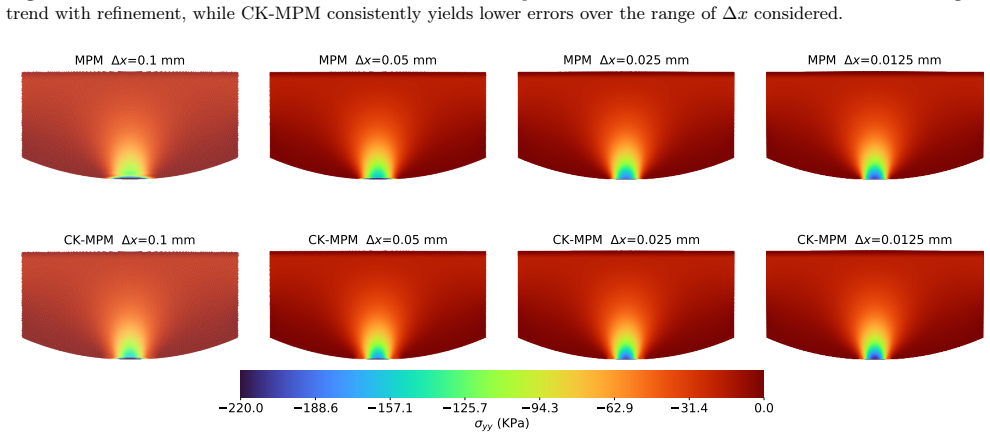
The numerical performance of the material point method (MPM) is strongly governed by the particle-grid kernel, which controls the trade-off among smoothness, locality, numerical diffusion, contact accuracy, and computational cost. Although wide-support smooth kernels can effectively suppress cell-crossing instability, they often introduce increased numerical diffusion, artificial contact gaps, and higher transfer cost. In contrast, the suitability of compact-kernel designs for implicit computational solid mechanics remains unclear. In this work, we develop an implicit formulation of the Compact-Kernel Material Point Method (CK-MPM) and assess its performance through benchmark problems in linear and nonlinear solid mechanics, including cantilever bending, Hertzian contact, narrow-clearance free fall, and colliding hyperelastic rings. The results show that implicit CK-MPM retains the advantages of compact support while preserving the smoothness required for robust large-deformation simulation. Compared with linear MPM, it reduces cell-crossing-induced stress noise and excessive numerical dissipation; compared with quadratic B-spline MPM, it improves contact locality and reduces artificial contact gaps and early-contact artifacts while maintaining comparable overall smoothness and accuracy. These results indicate that CK-MPM provides a viable implicit MPM framework for computational mechanics.
Editorial analysis
A structured set of objections, weighed in public.
Referee Report
Summary. The manuscript develops an implicit time-stepping formulation of the Compact-Kernel Material Point Method (CK-MPM) for computational solid mechanics. It claims that this approach preserves the locality and reduced numerical diffusion of compact-support kernels while retaining the smoothness needed for stable large-deformation simulations. Through benchmarks including cantilever bending, Hertzian contact, narrow-clearance free fall, and colliding hyperelastic rings, the work reports reduced cell-crossing stress noise relative to linear MPM and improved contact locality with fewer artificial gaps relative to quadratic B-spline MPM, without introducing new stabilization parameters.
Significance. If the central claims hold, the implicit CK-MPM offers a practical advance by resolving the smoothness-locality trade-off in MPM kernels for implicit solid-mechanics simulations. The benchmarks provide concrete evidence that compact kernels can be embedded in Newton-based time integrators while maintaining robustness, which could reduce computational cost and improve accuracy in contact-dominated or large-strain problems. The parameter-free nature of the kernel design is a notable strength.
major comments (2)
- [Results section] Results section (Hertzian contact and colliding rings benchmarks): the reported reductions in artificial contact gaps and early-contact artifacts are described qualitatively. Quantitative metrics such as contact-force error norms, measured gap distances relative to analytical solutions, or L2 displacement errors with grid refinement would be required to substantiate the superiority over quadratic B-spline MPM and to confirm that the implicit residual evaluation preserves locality without introducing new artifacts.
- [Section 3] Section 3 (implicit formulation): the construction of the tangent Jacobian and residual for the compact kernel is central to the claim that no additional stabilization is needed. A brief analysis of Newton iteration counts, matrix conditioning, or solver convergence behavior across the deformation regimes would directly address whether the limited kernel support alters stability or requires implicit-specific adjustments that could offset the reported gains.
minor comments (2)
- [Figures] Figure captions and legends should explicitly label all compared methods (linear MPM, quadratic B-spline, CK-MPM) and indicate whether results are at the same time step or deformation level.
- [Introduction] The abstract and introduction would benefit from a short statement of the specific compact kernel function (e.g., its support radius and polynomial degree) to allow immediate comparison with existing literature.
Simulated Author's Rebuttal
We thank the referee for the constructive review and the recommendation of minor revision. We address each major comment below and outline the revisions we will make to strengthen the quantitative support for our claims.
read point-by-point responses
-
Referee: [Results section] Results section (Hertzian contact and colliding rings benchmarks): the reported reductions in artificial contact gaps and early-contact artifacts are described qualitatively. Quantitative metrics such as contact-force error norms, measured gap distances relative to analytical solutions, or L2 displacement errors with grid refinement would be required to substantiate the superiority over quadratic B-spline MPM and to confirm that the implicit residual evaluation preserves locality without introducing new artifacts.
Authors: We agree that the current presentation of contact improvements is primarily qualitative. In the revised manuscript we will add quantitative metrics to the Hertzian contact and colliding rings benchmarks, including L2 displacement error norms under successive grid refinement, measured gap distances relative to the analytical Hertz solution, and contact-force error norms. These additions will enable direct, quantitative comparison with quadratic B-spline MPM and will confirm that the implicit residual evaluation preserves locality without new artifacts. revision: yes
-
Referee: [Section 3] Section 3 (implicit formulation): the construction of the tangent Jacobian and residual for the compact kernel is central to the claim that no additional stabilization is needed. A brief analysis of Newton iteration counts, matrix conditioning, or solver convergence behavior across the deformation regimes would directly address whether the limited kernel support alters stability or requires implicit-specific adjustments that could offset the reported gains.
Authors: The tangent Jacobian and residual are assembled directly from the compact kernel without auxiliary stabilization, following the standard Newton-Raphson procedure described in Section 3. To address the referee’s request, we will insert a concise convergence study (Newton iteration counts and solver residual histories) for the cantilever, Hertzian, and ring-collision benchmarks. This will show that the limited support does not degrade conditioning or require implicit-specific adjustments beyond those already present in the formulation. revision: yes
Circularity Check
No significant circularity detected; derivation is self-contained
full rationale
The paper introduces an implicit formulation of CK-MPM and supports its claims through direct numerical benchmarks (cantilever bending, Hertzian contact, narrow-clearance free fall, colliding rings) that compare against linear MPM and quadratic B-spline MPM. No load-bearing step reduces by construction to a fitted parameter, self-citation chain, or renamed input; the central performance assertions rest on independent simulation outcomes rather than tautological definitions or prior author results invoked as uniqueness theorems. The method development and validation chain remains externally falsifiable via the reported benchmark suite.
Axiom & Free-Parameter Ledger
Reference graph
Works this paper leans on
-
[1]
ACM Transactions on Graphics (TOG) , volume=
Ck-mpm: A compact-kernel material point method , author=. ACM Transactions on Graphics (TOG) , volume=. 2025 , publisher=
work page 2025
-
[2]
ACM Transactions on Graphics (TOG) , volume=
Physical validation of simulators in Computer Graphics: A new framework dedicated to slender elastic structures and frictional contact , author=. ACM Transactions on Graphics (TOG) , volume=. 2021 , publisher=
work page 2021
-
[3]
ACM SIGGRAPH 2023 Conference Proceedings , pages=
Multi-layer thick shells , author=. ACM SIGGRAPH 2023 Conference Proceedings , pages=
work page 2023
- [4]
-
[5]
L. The heavy elastica , author=. The London, Edinburgh, and Dublin Philosophical Magazine and Journal of Science , volume=. 1934 , publisher=
work page 1934
-
[6]
The Quarterly Journal of Mechanics and Applied Mathematics , volume=
Bending of a beam or wide strip , author=. The Quarterly Journal of Mechanics and Applied Mathematics , volume=. 1992 , publisher=
work page 1992
-
[7]
Advances in applied mechanics , volume=
Material point method after 25 years: Theory, implementation, and applications , author=. Advances in applied mechanics , volume=. 2020 , publisher=
work page 2020
-
[8]
Computer Modeling in Engineering & Sciences , volume=
The generalized interpolation material point method , author=. Computer Modeling in Engineering & Sciences , volume=. 2004 , publisher=
work page 2004
-
[9]
Computer methods in applied mechanics and engineering , volume=
The material-point method for granular materials , author=. Computer methods in applied mechanics and engineering , volume=. 2000 , publisher=
work page 2000
-
[10]
Computer methods in applied mechanics and engineering , volume=
The material point method in large strain engineering problems , author=. Computer methods in applied mechanics and engineering , volume=. 2004 , publisher=
work page 2004
-
[11]
Intrusion rheology in grains and other flowable materials , author=. Nature materials , volume=. 2016 , publisher=
work page 2016
-
[12]
Journal of Fluid Mechanics , volume=
A general fluid--sediment mixture model and constitutive theory validated in many flow regimes , author=. Journal of Fluid Mechanics , volume=. 2019 , publisher=
work page 2019
-
[13]
Acm siggraph 2016 courses , pages=
The material point method for simulating continuum materials , author=. Acm siggraph 2016 courses , pages=
work page 2016
-
[14]
International journal of impact engineering , volume=
Comparison study of MPM and SPH in modeling hypervelocity impact problems , author=. International journal of impact engineering , volume=. 2009 , publisher=
work page 2009
-
[15]
ACM transactions on graphics , year=
Incremental potential contact: intersection-and inversion-free, large-deformation dynamics , author=. ACM transactions on graphics , year=
-
[16]
Codimensional incremental potential contact
Codimensional incremental potential contact , author=. arXiv preprint arXiv:2012.04457 , year=
-
[17]
ACM Transactions on Graphics (TOG) , volume=
Anisompm: Animating anisotropic damage mechanics , author=. ACM Transactions on Graphics (TOG) , volume=. 2020 , publisher=
work page 2020
-
[18]
ACM Transactions on Graphics (TOG) , volume=
CD-MPM: continuum damage material point methods for dynamic fracture animation , author=. ACM Transactions on Graphics (TOG) , volume=. 2019 , publisher=
work page 2019
-
[19]
International Journal for Numerical and Analytical Methods in Geomechanics , volume=
Evaluation of material point method for use in geotechnics , author=. International Journal for Numerical and Analytical Methods in Geomechanics , volume=. 2015 , publisher=
work page 2015
-
[20]
International Journal for Numerical Methods in Engineering , volume=
A hybrid material-point spheropolygon-element method for solid and granular material interaction , author=. International Journal for Numerical Methods in Engineering , volume=. 2020 , publisher=
work page 2020
-
[21]
Hybrid continuum--discrete simulation of granular impact dynamics , author=. Acta Geotechnica , volume=. 2022 , publisher=
work page 2022
-
[22]
Computers and Geotechnics , volume=
Coupled material point and level set methods for simulating soils interacting with rigid objects with complex geometry , author=. Computers and Geotechnics , volume=. 2023 , publisher=
work page 2023
-
[23]
Computer Methods in Applied Mechanics and Engineering , volume=
A barrier method for frictional contact on embedded interfaces , author=. Computer Methods in Applied Mechanics and Engineering , volume=. 2022 , publisher=
work page 2022
-
[24]
Computers and Geotechnics , volume=
Impact and erosion dynamics of inclusion-enriched dry granular flows on rigid barriers with basal clearance: Numerical insights from hybrid MP-DEM simulations , author=. Computers and Geotechnics , volume=. 2024 , publisher=
work page 2024
-
[25]
Journal of Geophysical Research: Earth Surface , volume=
Erosion and transport of dry soil bed by collisional granular flow: Insights from a combined experimental--numerical investigation , author=. Journal of Geophysical Research: Earth Surface , volume=. 2023 , publisher=
work page 2023
-
[26]
Computers and Geotechnics , volume=
Revealing the role of forests in the mobility of geophysical flows , author=. Computers and Geotechnics , volume=. 2023 , publisher=
work page 2023
-
[27]
International Journal for Numerical Methods in Engineering , volume=
An explicit phase field material point method for modeling dynamic fracture problems , author=. International Journal for Numerical Methods in Engineering , volume=. 2023 , publisher=
work page 2023
-
[28]
Journal of Computational Physics , volume=
An angular momentum conserving affine-particle-in-cell method , author=. Journal of Computational Physics , volume=. 2017 , publisher=
work page 2017
-
[29]
International Journal for numerical methods in Engineering , volume=
A convected particle domain interpolation technique to extend applicability of the material point method for problems involving massive deformations , author=. International Journal for numerical methods in Engineering , volume=. 2011 , publisher=
work page 2011
-
[30]
International Journal for numerical methods in Engineering , volume=
Second-order convected particle domain interpolation (CPDI2) with enrichment for weak discontinuities at material interfaces , author=. International Journal for numerical methods in Engineering , volume=. 2013 , publisher=
work page 2013
-
[31]
ACM Transactions on Graphics (TOG) , volume=
A moving least squares material point method with displacement discontinuity and two-way rigid body coupling , author=. ACM Transactions on Graphics (TOG) , volume=. 2018 , publisher=
work page 2018
-
[32]
Computer Methods in Applied Mechanics and Engineering , volume=
DEM-enriched contact approach for material point method , author=. Computer Methods in Applied Mechanics and Engineering , volume=. 2023 , publisher=
work page 2023
-
[33]
International Journal for numerical methods in engineering , volume=
Enhancement of the material point method using B-spline basis functions , author=. International Journal for numerical methods in engineering , volume=. 2018 , publisher=
work page 2018
-
[34]
International Journal for Numerical Methods in Engineering , volume=
Extended B-spline-based implicit material point method , author=. International Journal for Numerical Methods in Engineering , volume=. 2021 , publisher=
work page 2021
-
[35]
Computational Mechanics , volume=
A contact method for B-spline material point method with application in impact and penetration problems , author=. Computational Mechanics , volume=. 2024 , publisher=
work page 2024
-
[36]
International Journal for Numerical Methods in Engineering , volume=
Validating High-Performance Multi-GPU MPM for Debris-Fluid-Structure Interaction , author=. International Journal for Numerical Methods in Engineering , volume=. 2025 , publisher=
work page 2025
-
[37]
Computational Particle Mechanics , volume=
Nitsche-based material point method for large deformation frictional contact problems , author=. Computational Particle Mechanics , volume=. 2025 , publisher=
work page 2025
-
[38]
Computer methods in applied mechanics and engineering , volume=
ILS-MPM: An implicit level-set-based material point method for frictional particulate contact mechanics of deformable particles , author=. Computer methods in applied mechanics and engineering , volume=. 2020 , publisher=
work page 2020
-
[39]
Computer Methods in Applied Mechanics and Engineering , volume=
A mortar segment-to-segment frictional contact approach in material point method , author=. Computer Methods in Applied Mechanics and Engineering , volume=. 2024 , publisher=
work page 2024
-
[40]
Computers & Structures , volume=
B-spline based boundary conditions in the material point method , author=. Computers & Structures , volume=. 2019 , publisher=
work page 2019
-
[41]
International Journal for Numerical Methods in Engineering , volume=
An Extended B-Spline-Based Material Point Method for Contact Problems , author=. International Journal for Numerical Methods in Engineering , volume=. 2025 , publisher=
work page 2025
-
[42]
Computer Methods in Applied Mechanics and Engineering , volume=
DP-MPM: Domain partitioning material point method for evolving multi-body thermal--mechanical contacts during dynamic fracture and fragmentation , author=. Computer Methods in Applied Mechanics and Engineering , volume=. 2021 , publisher=
work page 2021
-
[43]
Proceedings of the Institution of Mechanical Engineers , volume=
One hundred years of Hertz contact , author=. Proceedings of the Institution of Mechanical Engineers , volume=. 1982 , publisher=
work page 1982
-
[44]
International Journal for Numerical Methods in Engineering , volume=
Field-gradient partitioning for fracture and frictional contact in the material point method , author=. International Journal for Numerical Methods in Engineering , volume=. 2017 , publisher=
work page 2017
-
[45]
Computer physics communications , volume=
Application of a particle-in-cell method to solid mechanics , author=. Computer physics communications , volume=. 1995 , publisher=
work page 1995
-
[46]
International journal for numerical methods in engineering , volume=
Analysis and reduction of quadrature errors in the material point method (MPM) , author=. International journal for numerical methods in engineering , volume=. 2008 , publisher=
work page 2008
-
[47]
IEEE transactions on visualization and computer graphics , volume=
Optimization integrator for large time steps , author=. IEEE transactions on visualization and computer graphics , volume=. 2015 , publisher=
work page 2015
-
[48]
ACM Transactions on Graphics (TOG) , volume=
Hierarchical optimization time integration for cfl-rate mpm stepping , author=. ACM Transactions on Graphics (TOG) , volume=. 2020 , publisher=
work page 2020
-
[49]
International Journal for numerical methods in engineering , volume=
Variational integrators and the Newmark algorithm for conservative and dissipative mechanical systems , author=. International Journal for numerical methods in engineering , volume=. 2000 , publisher=
work page 2000
- [50]
-
[51]
ACM Transactions on Graphics (TOG) , volume=
VR-Doh: Hands-on 3D Modeling in Virtual Reality , author=. ACM Transactions on Graphics (TOG) , volume=. 2025 , publisher=
work page 2025
-
[52]
ACM SIGGRAPH 2024 Conference Papers , pages=
A dynamic duo of finite elements and material points , author=. ACM SIGGRAPH 2024 Conference Papers , pages=
work page 2024
-
[53]
Computational Mechanics , volume=
Unstructured moving least squares material point methods: a stable kernel approach with continuous gradient reconstruction on general unstructured tessellations , author=. Computational Mechanics , volume=. 2025 , publisher=
work page 2025
-
[54]
International Journal for Numerical and Analytical Methods in Geomechanics , volume=
Mapped material point method for large deformation problems with sharp gradients and its application to soil-structure interactions , author=. International Journal for Numerical and Analytical Methods in Geomechanics , volume=. 2024 , publisher=
work page 2024
-
[55]
International Journal for Numerical Methods in Engineering , volume=
Lagrangian--Eulerian multidensity topology optimization with the material point method , author=. International Journal for Numerical Methods in Engineering , volume=. 2021 , publisher=
work page 2021
-
[56]
SIGGRAPH Asia 2023 Conference Papers , pages=
Neural stress fields for reduced-order elastoplasticity and fracture , author=. SIGGRAPH Asia 2023 Conference Papers , pages=
work page 2023
-
[57]
ACM Transactions on Graphics (TOG) , volume=
A massively parallel and scalable multi-GPU material point method , author=. ACM Transactions on Graphics (TOG) , volume=. 2020 , publisher=
work page 2020
-
[58]
ACM Transactions on Graphics (TOG) , volume=
Energetically consistent inelasticity for optimization time integration , author=. ACM Transactions on Graphics (TOG) , volume=. 2022 , publisher=
work page 2022
discussion (0)
Sign in with ORCID, Apple, or X to comment. Anyone can read and Pith papers without signing in.