Recognition: unknown
On-demand generation of all four Bell states using a single PPKTP entangled photon source
Pith reviewed 2026-05-10 03:30 UTC · model grok-4.3
The pith
Translating a PPKTP crystal inside a Sagnac interferometer generates any of the four Bell states on demand.
A machine-rendered reading of the paper's core claim, the machinery that carries it, and where it could break.
Core claim
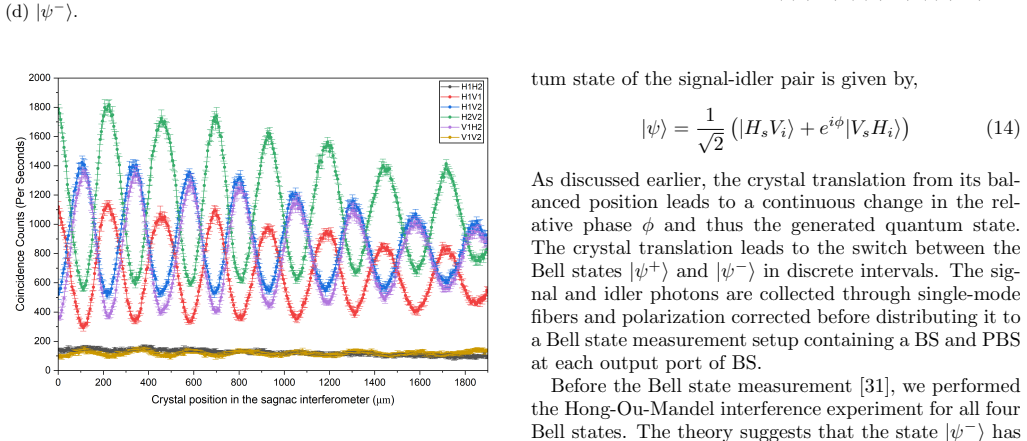
By translating the PPKTP crystal from the balanced position, the source repeatedly toggles between |φ+⟩ and |φ−⟩ at 122 ± 14 μm intervals, and a half-wave plate in the idler arm transitions to |ψ±⟩ states, allowing on-demand generation of all four Bell states with high fidelity.
What carries the argument
The controlled motorized translation of the nonlinear crystal in the polarization Sagnac interferometer that adjusts the phase for state switching.
Load-bearing premise
That moving the crystal changes only the relative phase between polarization components without degrading the entanglement or brightness within the usable range.
What would settle it
If quantum state tomography after crystal translation shows fidelity below 0.9 or fails to violate the CHSH inequality for the expected Bell state, the on-demand generation would be falsified.
Figures




read the original abstract
We present a compact, automated, high-brightness entangled photon source capable of generating all four Bell states with high fidelity. The system utilizes a type-0 quasi-phase-matched PPKTP crystal embedded within a polarization Sagnac interferometer. We introduce a switching scheme based on the controlled, motorized translation of the nonlinear crystal. This device is capable of generating any one of the Bell states on-demand. Experimentally, we demonstrate that translating the crystal from the interferometer's balanced position repeatedly toggles the state between $|\phi^+ \rangle$ and $|\phi^- \rangle$ (as well as $|\psi^+ \rangle$ and $|\psi^- \rangle$) at regular intervals of $122 \pm 14 ~\mu m$. Subsequently, a half-wave plate (HWP) in the idler arm transitions between the quantum states $|\phi^{\pm}\rangle$ and $|\psi^{\pm}\rangle$. While the non-collinear geometry imposes an upper limit on the translation range as verified via EMCCD imaging, the source however, displays very little change of intensity in the operational window. State purity and entanglement are certified through quantum state tomography (QST), visibility measurements, Bell state measurements (BSM), and CHSH inequality violations, confirming that the source is robust and provides a repeatable, high-fidelity output.
Editorial analysis
A structured set of objections, weighed in public.
Referee Report
Summary. The manuscript presents an experimental entangled-photon source based on a type-0 PPKTP crystal inside a polarization Sagnac interferometer. Motorized translation of the crystal toggles the output between |φ⁺⟩ and |φ⁻⟩ (and likewise for the |ψ⟩ manifold) at intervals of 122 ± 14 μm; insertion of a half-wave plate in the idler arm then switches between the φ and ψ manifolds. The authors claim that all four Bell states are generated on demand with high fidelity, certified by quantum state tomography, visibility measurements, Bell-state measurements, and CHSH inequality violations, while intensity remains stable over the accessible translation range despite the non-collinear geometry.
Significance. If the fidelity remains high across the full translation range, the scheme supplies a compact, automated, single-source method for on-demand selection of any Bell state. This would simplify many quantum-information protocols that require rapid switching among the four states. The experimental approach is strengthened by the use of multiple independent verification techniques (QST, visibility, BSM, CHSH) and by the demonstration of motorized control.
major comments (2)
- [Results section (crystal-translation data)] Results section (crystal-translation data): the central on-demand claim requires explicit evidence that two-photon visibility and reconstructed fidelity remain high at the extremes of the translation range. Intensity stability and EMCCD confirmation that beams remain within apertures do not by themselves guarantee preserved mode overlap; a shift of the SPDC emission point in the non-collinear geometry can alter relative path lengths and angles, introducing partial which-path information without a large drop in count rate. Plots or tables of fidelity or visibility versus crystal position (with error bars) are therefore needed to substantiate the claim.
- [Abstract and Results] Abstract and Results: the reported period of 122 ± 14 μm carries a sizable uncertainty; the manuscript should quantify how this uncertainty affects the repeatability of state selection and whether the operational window can be reliably centered on the high-fidelity points.
minor comments (2)
- [Abstract] The abstract states that intensity shows 'very little change' but supplies no numerical bound (e.g., percentage variation over the 122 μm interval); a quantitative statement would improve clarity.
- [Experimental setup] The non-collinear geometry is said to impose an upper limit on translation range; the manuscript should state the measured limit in micrometers and confirm that all reported data lie inside it.
Simulated Author's Rebuttal
We thank the referee for the constructive and detailed report, which highlights both the potential of our source and areas where additional evidence would strengthen the claims. We address each major comment below and have revised the manuscript accordingly.
read point-by-point responses
-
Referee: [Results section (crystal-translation data)] Results section (crystal-translation data): the central on-demand claim requires explicit evidence that two-photon visibility and reconstructed fidelity remain high at the extremes of the translation range. Intensity stability and EMCCD confirmation that beams remain within apertures do not by themselves guarantee preserved mode overlap; a shift of the SPDC emission point in the non-collinear geometry can alter relative path lengths and angles, introducing partial which-path information without a large drop in count rate. Plots or tables of fidelity or visibility versus crystal position (with error bars) are therefore needed to substantiate the claim.
Authors: We agree that intensity stability and EMCCD imaging alone do not fully exclude subtle degradation in mode overlap or introduction of which-path information at the translation extremes. In the revised manuscript we will add plots (with error bars) of two-photon visibility and reconstructed Bell-state fidelity versus crystal position across the full accessible range. These data will be presented in the Results section to directly confirm that fidelity remains high at the operational extremes. revision: yes
-
Referee: [Abstract and Results] Abstract and Results: the reported period of 122 ± 14 μm carries a sizable uncertainty; the manuscript should quantify how this uncertainty affects the repeatability of state selection and whether the operational window can be reliably centered on the high-fidelity points.
Authors: The reported uncertainty reflects the standard deviation obtained from repeated measurements of the toggling period. In the revised version we will add a quantitative discussion (in both Abstract and Results) showing that the high-fidelity windows are substantially wider than this uncertainty and that the motorized stage’s sub-micron positioning precision allows reliable centering on the desired points. This analysis demonstrates that the uncertainty does not compromise repeatable on-demand selection. revision: yes
Circularity Check
No circularity: pure experimental demonstration
full rationale
The manuscript reports an experimental apparatus and direct measurements: motorized crystal translation toggles between |φ±⟩ and |ψ±⟩ pairs at observed intervals of 122 ± 14 μm, with a subsequent HWP switching between φ and ψ families. All claims rest on raw count rates, EMCCD imaging, QST reconstructions, visibility data, BSM outcomes, and CHSH violations obtained from the physical setup. No equations, fitted parameters, or self-citations are invoked to derive or predict the observed toggling periods or fidelities; the reported intervals and state purities are measured outputs, not quantities forced by construction from any input model. The work is therefore self-contained against external benchmarks and contains no load-bearing theoretical step that reduces to its own premises.
Axiom & Free-Parameter Ledger
free parameters (1)
- crystal translation step size
axioms (2)
- domain assumption Type-0 quasi-phase-matching in PPKTP produces polarization-entangled photon pairs
- domain assumption Sagnac interferometer geometry preserves the required phase relations for Bell-state generation
Reference graph
Works this paper leans on
-
[1]
C. H. Bennett, G. Brassard, C. Cr´ epeau, R. Jozsa, A. Peres, and W. K. Wootters, Teleporting an unknown quantum state via dual classical and einstein-podolsky- 11 rosen channels, Phys. Rev. Lett.70, 1895 (1993)
1993
-
[2]
A. K. Ekert, Quantum cryptography based on bell’s the- orem, Phys. Rev. Lett.67, 661 (1991)
1991
-
[3]
M. A. Nielsen and I. L. Chuang,Quantum Computa- tion and Quantum Information: 10th Anniversary Edi- tion(Cambridge University Press, 2010)
2010
-
[5]
J.-W. Pan, D. Bouwmeester, H. Weinfurter, and A. Zeilinger, Experimental entanglement swapping: En- tangling photons that never interacted, Phys. Rev. Lett. 80, 3891 (1998)
1998
-
[6]
H.-K. Lo, M. Curty, and B. Qi, Measurement-device- independent quantum key distribution, Phys. Rev. Lett. 108, 130503 (2012)
2012
-
[7]
Y. H. Shih and C. O. Alley, New type of einstein- podolsky-rosen-bohm experiment using pairs of light quanta produced by optical parametric down conversion, Phys. Rev. Lett.61, 2921 (1988)
1988
-
[8]
Anwar, C
A. Anwar, C. Perumangatt, F. Steinlechner, T. Jen- newein, and A. Ling, Entangled photon-pair sources based on three-wave mixing in bulk crystals, Review of Scientific Instruments92, 041101 (2021)
2021
-
[9]
K. Guo, E. N. Christensen, J. B. Christensen, J. G. Koe- foed, D. Bacco, Y. Ding, H. Ou, and K. Rottwitt, High coincidence-to-accidental ratio continuous-wave photon- pair generation in a grating-coupled silicon strip waveg- uide, Applied Physics Express10, 062801 (2017)
2017
-
[10]
P. G. Kwiat, K. Mattle, H. Weinfurter, A. Zeilinger, A. V. Sergienko, and Y. Shih, New high-intensity source of polarization-entangled photon pairs, Phys. Rev. Lett. 75, 4337 (1995)
1995
-
[11]
P. G. Kwiat, E. Waks, A. G. White, I. Appelbaum, and P. H. Eberhard, Ultrabright source of polarization- entangled photons, Phys. Rev. A60, R773 (1999)
1999
-
[12]
Fiorentino, S
M. Fiorentino, S. M. Spillane, R. G. Beausoleil, T. D. Roberts, P. Battle, and M. W. Munro, Spontaneous para- metric down-conversion in periodically poled ktp waveg- uides and bulk crystals, Opt. Express15, 7479 (2007)
2007
-
[13]
K¨ onig and F
F. K¨ onig and F. N. C. Wong, Extended phase matching of second-harmonic generation in periodically poled ktiopo4 with zero group-velocity mismatch, Applied Physics Let- ters84, 1644 (2004)
2004
-
[14]
A. S. Perna, E. Ortega, M. Gr¨ afe, and F. Steinlechner, Visible-wavelength polarization-entangled photon source for quantum communication and imaging, Appl. Phys. Lett.120, 074001 (2022)
2022
-
[15]
Rangarajan, M
R. Rangarajan, M. Goggin, and P. G. Kwiat, Optimizing type-i polarization-entangled photons, Opt. Express17, 18920 (2009)
2009
-
[16]
M. V. Jabir and G. K. Samanta, Robust, high bright- ness, degenerate entangled photon source at room tem- perature, Sci. Rep.7, 12613 (2017)
2017
-
[17]
Szlachetka, K
J. Szlachetka, K. Joarder, and P. Kolenderski, Ultra- bright source of non-degenerate polarization-entangled photon pairs based on off-the-shelf polarization optics, Appl. Phys. Lett.123, 144001 (2023)
2023
-
[18]
Tanzilli, W
S. Tanzilli, W. Tittel, H. D. Riedmatten, H. Zbinden, M. D. P. Baldi, D. Ostrowsky, and N. Gisin, Ppln waveg- uide for quantum communication, The European Physi- cal Journal D - Atomic, Molecular, Optical and Plasma Physics18, 155 (2002)
2002
-
[19]
T. Kim, M. Fiorentino, and F. N. C. Wong, Phase-stable source of polarization-entangled photons using a polar- ization sagnac interferometer, Phys. Rev. A73, 012316 (2006)
2006
-
[20]
Guo and K
S. Guo and K. Shang, High-flux, high-visibility entangled photon source obtained with a non-collinear type-ii PP- KTP crystal pumped by a broadband continuous-wave diode laser, Opt. Commun.545, 129586 (2023)
2023
-
[21]
K. Park, J. Lee, D.-G. Im, D. Kim, and Y. S. Ihn, Ultrabright fiber-coupled polarization-entangled photon source with spectral brightness surpassing 2.0 mhz mw−1 nm−1, Adv. Photonics Res.6, 2500024 (2025)
2025
-
[22]
Cai, W.-H
N. Cai, W.-H. Cai, S. Wang, F. Li, R. Shimizu, and R.-B. Jin, Broadband-laser-diode pumped periodically poled potassium titanyl phosphate-sagnac polarization- entangled photon source, J. Opt. Soc. Am. B39, 77 (2022)
2022
-
[23]
R.-B. Jin, R. Shimizu, K. Wakui, H. Benichi, and M. Sasaki, Widely tunable high-quality photon-pair source at telecom wavelengths using a sagnac interfer- ometer, Opt. Express22, 11498 (2014)
2014
-
[24]
Gisin and H
N. Gisin and H. Bechmann-Pasquinucci, Bell inequality, bell states and maximally entangled states for n qubits, Phys. Lett. A246, 1 (1998)
1998
-
[25]
H. Kim, O. Kwon, and H. S. Moon, Pulsed sagnac source of polarization-entangled photon pairs in telecommunica- tion band, Sci. Rep.9, 5031 (2019)
2019
-
[26]
Sundar, M
S. Sundar, M. V. Jabir, and D. Razansky, Variable bell states in a polarization-entangled photon source, J. Opt. Soc. Am. B42, 1764 (2025)
2025
-
[27]
Mishra and R
S. Mishra and R. P. Singh, Transformation of bell states using linear optics, Phys. Open18, 100199 (2024)
2024
-
[28]
Bell state measurements in quantum optics: a review of recent progress and open challenges
L. Bianchi, C. Marconi, and D. Bacco, Bell state mea- surements in quantum optics: a review of recent progress and open challenges, arXiv preprint arXiv:2509.18756 10.48550/arXiv.2509.18756 (2025)
work page internal anchor Pith review Pith/arXiv arXiv doi:10.48550/arxiv.2509.18756 2025
-
[29]
Simone, Bayerbach, J
D’Aurelio, E. Simone, Bayerbach, J. Matthias, Barz, and Stefanie, Boosted quantum teleportation, npj Quantum Information11, 37 (2025)
2025
-
[30]
Y.-H. Kim, S. P. Kulik, and Y. Shih, Quantum telepor- tation of a polarization state with a complete bell state measurement, Phys. Rev. Lett.86, 1370 (2001)
2001
-
[31]
Weinfurter, Experimental Bell-State Analysis, EPL 25, 559 (1994)
H. Weinfurter, Experimental Bell-State Analysis, EPL 25, 559 (1994)
1994
-
[32]
C. K. Hong, Z. Y. Ou, and L. Mandel, Measurement of subpicosecond time intervals between two photons by in- terference, Phys. Rev. Lett.59, 2044 (1987)
2044
-
[33]
Pan, Z.-B
J.-W. Pan, Z.-B. Chen, C.-Y. Lu, H. Weinfurter, A. Zeilinger, and M. ˙Zukowski, Multiphoton entangle- ment and interferometry, Rev. Mod. Phys.84, 777 (2012)
2012
-
[34]
Z.-Y. J. Ou,Multi-Photon Quantum Interference (Springer, New York, 2007) Chap. 4, Sec. 4.1
2007
-
[35]
D. F. V. James, P. G. Kwiat, W. J. Munro, and A. G. White, Measurement of qubits, Phys. Rev. A64, 052312 (2001)
2001
discussion (0)
Sign in with ORCID, Apple, or X to comment. Anyone can read and Pith papers without signing in.