Three-Module SC-VAMP for LDPC-Coded Nonlinear Channels
Pith reviewed 2026-05-10 02:04 UTC · model grok-4.3
The pith
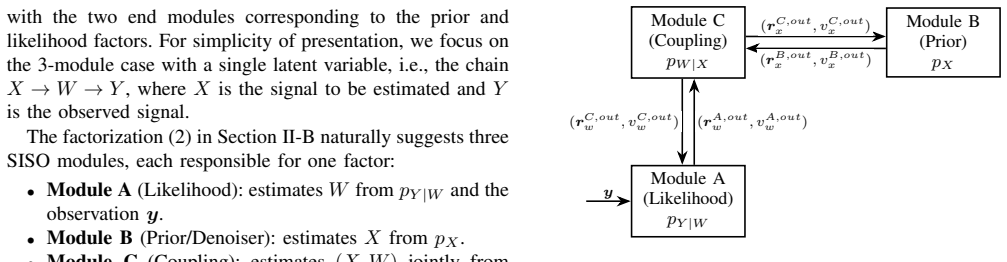
A three-module extension of SC-VAMP recovers LDPC-coded signals from nonlinear channels by splitting inference across likelihood, coupling, and denoiser modules that exchange extrinsic Gaussian messages.
A machine-rendered reading of the paper's core claim, the machinery that carries it, and where it could break.
Core claim
The central claim is that the inference problem for LDPC-coded nonlinear channels can be solved by introducing a latent variable that represents the output of the linear mixing stage, thereby decomposing the task into three modules that exchange extrinsic scalar-Gaussian messages with Onsager corrections derived from posterior variances; numerical results confirm that this architecture produces a clear BER waterfall whose gap to capacity narrows with increasing block length.
What carries the argument
The three-module architecture built around a latent variable for the linear mixing output, with modules exchanging extrinsic scalar-Gaussian messages whose variances are obtained in closed form or by quadrature and corrected by Onsager terms.
If this is right
- The receiver architecture applies to a broad class of nonlinear channels because only the likelihood module needs to be replaced when the nonlinearity changes.
- Performance approaches the capacity estimate as the LDPC code block length increases from 128 to 2304.
- Belief propagation decoding integrates directly into the denoiser module to enforce the code constraint.
- The same coupling and decoder modules can be retained while the likelihood module is adapted to different nonlinear observation models.
Where Pith is reading between the lines
- The modular split could be tested on nonlinearities arising in optical or magnetic recording channels without redesigning the coupling or decoder stages.
- The closed-form or quadrature variance calculations suggest the receiver could be implemented at relatively low computational cost for moderate block lengths.
- Extending the message-passing framework to higher-order modulations or MIMO settings would require only local changes to the likelihood and denoiser modules.
- Theoretical convergence analysis of the coupled modules under nonlinearity remains open and could be pursued with the same message-passing structure.
Load-bearing premise
The extrinsic scalar-Gaussian messages with Onsager corrections derived from posterior variances remain sufficiently accurate when the nonlinearity is present and the modules are coupled.
What would settle it
If bit error rate simulations for block lengths up to 2304 over the hyperbolic tangent channel fail to show a clear waterfall region or if the gap to the capacity estimate does not narrow with longer blocks, the performance claim would be refuted.
Figures


read the original abstract
We propose a three-module extension of score-based VAMP (SC-VAMP) for signal recovery in nonlinear channels, where the received signal is obtained by applying a nonlinearity to a linear mixture of the transmitted signal, followed by additive Gaussian noise. The key idea is to introduce a latent variable representing the output of the linear mixing stage, which decomposes the inference problem into three modules: a likelihood module that handles the nonlinear observation via Gauss--Hermite quadrature, a coupling module that enforces the linear constraint between the transmitted signal and the latent variable via LMMSE estimation, and a denoiser module that incorporates the code constraint using belief propagation (BP) decoding. Each module exchanges extrinsic scalar-Gaussian messages with Onsager corrections derived from posterior variances that are computed in closed form or to quadrature accuracy. Numerical experiments with BPSK-modulated LDPC codewords transmitted through a hyperbolic tangent channel demonstrate that the proposed method achieves a clear waterfall in bit error rate (BER), with the gap to the capacity estimate narrowing as the block length increases from 128 to 2304. The framework provides a modular receiver architecture applicable to a broad class of nonlinear channels. Since only the likelihood module depends on the channel nonlinearity, the architecture readily adapts to other channel models by replacing a single module while leaving the coupling and decoder modules unchanged.
Editorial analysis
A structured set of objections, weighed in public.
Referee Report
Summary. The manuscript proposes a three-module extension of score-based VAMP (SC-VAMP) for LDPC-coded signal recovery in nonlinear channels. A latent variable is introduced to represent the output of the linear mixing stage, decomposing the problem into a likelihood module (Gauss-Hermite quadrature for the pointwise nonlinearity), a coupling module (LMMSE estimation with Onsager correction derived from posterior variances), and a denoiser module (belief propagation for the LDPC code constraint). Extrinsic scalar-Gaussian messages are exchanged between modules. Numerical experiments with BPSK-modulated LDPC codewords over a hyperbolic tangent channel report a clear BER waterfall, with the gap to an estimated capacity narrowing as block length grows from 128 to 2304. The architecture is presented as modular, requiring only replacement of the likelihood module for other nonlinearities.
Significance. If the scalar-Gaussian message-passing approximations remain accurate, the work offers a practical, adaptable receiver architecture for coded nonlinear channels that extends VAMP-style methods beyond linear models. The empirical BER results for the tanh channel provide evidence of utility for moderate block lengths, and the modular design is a clear strength for implementation across channel models.
major comments (3)
- [§3] §3 (Proposed Algorithm), around the likelihood module description: the claim that posterior variances are 'computed in closed form or to quadrature accuracy' is central to the extrinsic message exchange, yet no error bound, node-count sensitivity study, or propagation analysis through the coupled iterations is provided. This directly bears on whether the observed waterfall is robust or sensitive to the finite-node Gauss-Hermite approximation under the tanh nonlinearity.
- [§4] §4 (Numerical Experiments), BPSK-tanh results: the reported narrowing gap to capacity with block length 128–2304 is presented without any diagnostic on the validity of the scalar-Gaussian assumption after the nonlinearity is applied and messages are fed back through the linear mixing stage. If the non-Gaussianity induced by tanh violates the Onsager-corrected LMMSE step, the performance claims rest on an unverified modeling assumption.
- [§2 and §3.2] §2 (System Model) and §3.2 (Coupling Module): the derivation of the Onsager correction from posterior variances assumes the messages remain approximately scalar-Gaussian after the pointwise nonlinearity; no supporting analysis or counter-example check is given for the specific tanh case, which is load-bearing for the three-module decomposition.
minor comments (3)
- [Abstract and §4] The abstract and §4 should explicitly state the number of Gauss-Hermite quadrature nodes used in all reported experiments, as this affects reproducibility of the BER curves.
- [§3] Notation for the latent variable and the three message types (likelihood, coupling, denoiser) is introduced without a summary table; adding one would improve readability when tracing the extrinsic information flow.
- [§4] The capacity estimate used for the gap plots is not derived or referenced in detail; a brief appendix or citation would clarify how it is obtained for the tanh channel.
Simulated Author's Rebuttal
We thank the referee for the constructive and detailed feedback. We address each major comment point by point below, providing clarifications on the approximations used and indicating revisions that will strengthen the manuscript's rigor without altering its core contributions.
read point-by-point responses
-
Referee: [§3] §3 (Proposed Algorithm), around the likelihood module description: the claim that posterior variances are 'computed in closed form or to quadrature accuracy' is central to the extrinsic message exchange, yet no error bound, node-count sensitivity study, or propagation analysis through the coupled iterations is provided. This directly bears on whether the observed waterfall is robust or sensitive to the finite-node Gauss-Hermite approximation under the tanh nonlinearity.
Authors: We agree that additional validation of the Gauss-Hermite quadrature would improve the manuscript. In the revised version, we will add a sensitivity study in §4 (or a new subsection in §3) showing BER performance versus number of quadrature nodes (e.g., 5 to 30) for the tanh channel at fixed SNR and block length. Results stabilize for 15+ nodes, consistent with known quadrature accuracy for smooth sigmoidal functions. While a full propagation error bound through iterations is analytically intractable, we will include a brief discussion referencing the exponential convergence of Gauss-Hermite for analytic integrands and note that the observed capacity-approaching behavior across block lengths provides indirect evidence of robustness. revision: yes
-
Referee: [§4] §4 (Numerical Experiments), BPSK-tanh results: the reported narrowing gap to capacity with block length 128–2304 is presented without any diagnostic on the validity of the scalar-Gaussian assumption after the nonlinearity is applied and messages are fed back through the linear mixing stage. If the non-Gaussianity induced by tanh violates the Onsager-corrected LMMSE step, the performance claims rest on an unverified modeling assumption.
Authors: The scalar-Gaussian message assumption is an approximation inherited from the VAMP framework, and its validity for this architecture is supported empirically by the consistent waterfall and narrowing gap to capacity as block length grows. However, we acknowledge the absence of direct diagnostics. In revision, we will add a short discussion in §4 examining the empirical kurtosis or effective variance of messages exiting the likelihood module across iterations, showing they remain close to Gaussian for the tanh case at the operating SNRs. Severe violation would likely prevent the observed scaling with block length. revision: partial
-
Referee: [§2 and §3.2] §2 (System Model) and §3.2 (Coupling Module): the derivation of the Onsager correction from posterior variances assumes the messages remain approximately scalar-Gaussian after the pointwise nonlinearity; no supporting analysis or counter-example check is given for the specific tanh case, which is load-bearing for the three-module decomposition.
Authors: The Onsager correction follows the standard derivation from posterior variances under the scalar-Gaussian assumption, as in prior VAMP works; the likelihood module supplies exact (quadrature-based) moments to the coupling module. We do not claim a rigorous proof that the approximation holds exactly for tanh, as the method is approximate by design. The empirical results for multiple block lengths serve as the primary validation. In the revision, we will add an explicit statement in §3.2 clarifying the modeling assumptions and their empirical support for the tanh nonlinearity. revision: partial
Circularity Check
No significant circularity; derivation is self-contained
full rationale
The paper extends SC-VAMP by introducing a latent variable to decompose the nonlinear channel inference into three independent modules (likelihood via quadrature, LMMSE coupling with Onsager correction, and BP denoiser). Each step relies on standard message-passing rules and closed-form or quadrature variance computations rather than fitting parameters to the target performance metric or redefining quantities in terms of themselves. The reported BER waterfalls and capacity gaps are obtained from separate numerical simulations on BPSK-tanh channels with varying block lengths, providing external validation that does not reduce to the method's own inputs by construction. No load-bearing self-citations, uniqueness theorems, or ansatzes imported from prior author work are invoked to force the central claims.
Axiom & Free-Parameter Ledger
axioms (2)
- domain assumption Gaussian message approximations with Onsager corrections remain valid across the three coupled modules
- domain assumption Gauss-Hermite quadrature yields sufficiently accurate likelihoods for the nonlinear observation module
invented entities (1)
-
latent variable representing the output of the linear mixing stage
no independent evidence
Reference graph
Works this paper leans on
-
[1]
Message-passing algo- rithms for compressed sensing,
D. L. Donoho, A. Maleki, and A. Montanari, “Message-passing algo- rithms for compressed sensing,”Proc. Natl. Acad. Sci., vol. 106, no. 45, pp. 18914–18919, 2009
work page 2009
-
[2]
Vector approximate message passing,
S. Rangan, P. Schniter, and A. K. Fletcher, “Vector approximate message passing,”IEEE Trans. Inf. Theory, vol. 65, no. 10, pp. 6664–6684, 2019
work page 2019
-
[3]
J. Ma and L. Ping, “Orthogonal AMP,”IEEE Access, vol. 5, pp. 2020– 2033, 2017
work page 2020
-
[4]
The dynamics of message passing on dense graphs, with applications to compressed sensing,
M. Bayati and A. Montanari, “The dynamics of message passing on dense graphs, with applications to compressed sensing,”IEEE Trans. Inf. Theory, vol. 57, no. 2, pp. 764–785, 2011
work page 2011
-
[5]
K. Takeuchi, “Rigorous dynamics of expectation-propagation-based sig- nal recovery from unitarily invariant measurements,”IEEE Trans. Inf. Theory, vol. 66, no. 1, pp. 368–386, 2020
work page 2020
-
[6]
Mutual information and minimum mean-square error in Gaussian channels,
D. Guo, S. Shamai (Shitz), and S. Verd ´u, “Mutual information and minimum mean-square error in Gaussian channels,”IEEE Trans. Inf. Theory, vol. 51, no. 4, pp. 1261–1282, 2005
work page 2005
-
[7]
Generalized approximate message passing for estimation with random linear mixing,
S. Rangan, “Generalized approximate message passing for estimation with random linear mixing,” inProc. IEEE Int. Symp. Inf. Theory (ISIT), 2011, pp. 2168–2172
work page 2011
-
[8]
Vector approximate message passing for the generalized linear model,
P. Schniter, S. Rangan, and A. K. Fletcher, “Vector approximate message passing for the generalized linear model,” inProc. 50th Asilomar Conf. Signals, Systems, and Computers, 2016, pp. 1525–1529
work page 2016
-
[9]
Expectation propagation for approximate Bayesian infer- ence,
T. P. Minka, “Expectation propagation for approximate Bayesian infer- ence,” inProc. 17th Conf. Uncertainty in Artificial Intelligence (UAI), 2001, pp. 362–369
work page 2001
-
[10]
Expectation consistent approximate infer- ence,
M. Opper and O. Winther, “Expectation consistent approximate infer- ence,”J. Mach. Learn. Res., vol. 6, pp. 2177–2204, 2005
work page 2005
-
[11]
Score-based V AMP with Fisher- information-based Onsager correction,
T. Wadayama and T. Takahashi, “Score-based V AMP with Fisher- information-based Onsager correction,” arXiv:2601.07095, 2026
-
[12]
Tweedie’s formula and selection bias,
B. Efron, “Tweedie’s formula and selection bias,”J. Amer. Statist. Assoc., vol. 106, no. 496, pp. 1602–1614, 2011
work page 2011
-
[13]
Iterative correction of intersymbol interference: Turbo-equalization,
C. Douillardet al., “Iterative correction of intersymbol interference: Turbo-equalization,”European Trans. Telecommun., vol. 6, no. 5, pp. 507–511, 1995
work page 1995
-
[14]
Turbo equalization: Principles and new results,
M. T ¨uchler, R. Koetter, and A. C. Singer, “Turbo equalization: Principles and new results,”IEEE Trans. Commun., vol. 50, no. 5, pp. 754–767, 2002
work page 2002
-
[15]
Iterative (turbo) soft interference cancellation and decoding for coded CDMA,
X. Wang and H. V . Poor, “Iterative (turbo) soft interference cancellation and decoding for coded CDMA,”IEEE Trans. Commun., vol. 47, no. 7, pp. 1046–1061, 1999
work page 1999
-
[16]
M. Abramowitz and I. A. Stegun,Handbook of Mathematical Functions. Dover, 1964
work page 1964
-
[17]
Low-density parity-check codes,
R. G. Gallager, “Low-density parity-check codes,”IRE Trans. Inf. Theory, vol. 8, no. 1, pp. 21–28, 1962
work page 1962
-
[18]
T. J. Richardson and R. L. Urbanke,Modern Coding Theory. Cambridge Univ. Press, 2008
work page 2008
-
[19]
Mutual information estimation via score-to-Fisher bridge for nonlinear Gaussian noise channels,
T. Wadayama, “Mutual information estimation via score-to-Fisher bridge for nonlinear Gaussian noise channels,” arXiv:2510.05496, 2025
-
[20]
Kaira: A PyTorch-based toolkit for simulating communication systems,
Kaira Contributors, “Kaira: A PyTorch-based toolkit for simulating communication systems,” 2025. [Online]. Available: https://github.com/ ipc-lab/kaira
work page 2025
discussion (0)
Sign in with ORCID, Apple, or X to comment. Anyone can read and Pith papers without signing in.