Recognition: unknown
Noise Reduction for Universal Hybrid Oscillator-Qubit Quantum Computation
Pith reviewed 2026-05-10 02:50 UTC · model grok-4.3
The pith
An ancilla qubit added to a GKP code reduces Gaussian displacement noise from sigma to order sigma squared for any hybrid CV-DV gate.
A machine-rendered reading of the paper's core claim, the machinery that carries it, and where it could break.
Core claim
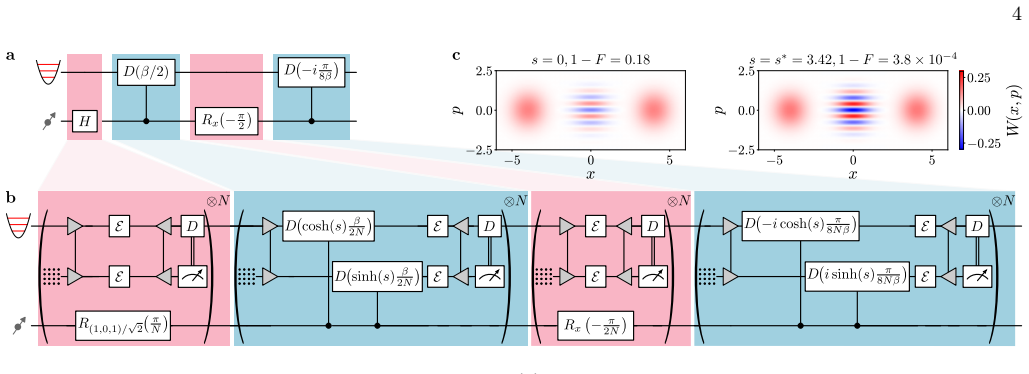
By introducing an ancilla qubit into a GKP-stabilizer code, Gaussian displacement noise is reduced from standard deviation sigma to tilde O(sigma squared) for the full universal set of CV-DV gates, including non-Gaussian operations. The scheme is shown to lower noise and raise fidelity when preparing non-Gaussian cat and Fock states.
What carries the argument
An ancilla qubit embedded in the GKP-stabilizer code that extends noise suppression to non-Gaussian gates by correcting displacements after such operations.
If this is right
- Noise reduction now applies to the entire universal CV-DV gate set rather than only Gaussian gates.
- Preparation of non-Gaussian states such as cat and Fock states reaches higher fidelity under the reduced noise.
- Hybrid architectures gain a practical route to lower overall error rates when combining CV and DV error correction.
- The quadratic noise scaling holds after arbitrary sequences of Gaussian and non-Gaussian gates.
Where Pith is reading between the lines
- Hybrid processors could reach useful sizes at lower physical error rates if the quadratic improvement compounds across many gates.
- The ancilla technique might extend to other bosonic codes that currently support only Gaussian operations.
- Small-scale experiments on superconducting or optical platforms could directly test whether real-device noise follows the predicted O(sigma squared) scaling after non-Gaussian gates.
Load-bearing premise
The ancilla qubit integrates into the GKP code without introducing new noise and the overall noise remains purely Gaussian displacement noise even after non-Gaussian operations.
What would settle it
Apply a non-Gaussian gate such as a controlled-phase gate to a GKP-encoded state using the ancilla, then measure the output noise standard deviation as a function of input sigma; if the scaling is not quadratic, the reduction claim is false.
Figures



read the original abstract
Hybrid continuous-variable--discrete-variable (CV--DV) architectures process quantum information in bosonic modes and qubits, but noise limits their performance. To reduce the noise, existing DV error correction must be complemented by CV noise reduction. Existing CV noise-reduction schemes -- such as GKP-stabilizer codes -- can reduce CV noise, but only for Gaussian gates. Therefore, no current noise-reduction scheme can correct arbitrary CV--DV gates, including non-Gaussian ones. Here, we develop noise reduction for a universal CV--DV gate set, making it applicable to arbitrary CV--DV gates. We do so by introducing an ancilla qubit into a GKP-stabilizer code, allowing us to reduce the standard deviation of Gaussian displacement noise from $\sigma$ to $\tilde O(\sigma^2)$. To demonstrate the scheme, we show that it significantly reduces noise and improves fidelity in the preparation of non-Gaussian cat and Fock states.
Editorial analysis
A structured set of objections, weighed in public.
Referee Report
Summary. The manuscript proposes incorporating an ancilla qubit into a GKP-stabilizer code to enable noise reduction for a universal set of hybrid CV-DV gates. It claims this reduces the standard deviation of Gaussian displacement noise from σ to ãO(σ²) and demonstrates the approach via improved fidelity and noise reduction in preparing non-Gaussian cat and Fock states.
Significance. If the O(σ²) reduction extends rigorously to arbitrary non-Gaussian CV-DV operations, the result would meaningfully advance hybrid quantum computation by providing CV error correction beyond Gaussian gates. The ancilla-augmented GKP construction offers a concrete route to universality with reduced noise, and the state-preparation results supply initial empirical support.
major comments (2)
- [Abstract and state-preparation demonstration] Abstract and demonstration section: the central claim of applicability to arbitrary CV-DV gates (including non-Gaussian ones such as cubic-phase or SNAP) is not supported by explicit noise propagation through the full gate set. The provided results are limited to cat/Fock state preparation; no derivation or simulation shows that non-Gaussian unitaries map input displacement errors to output errors that remain purely Gaussian and correctable at quadratic order by the same stabilizers.
- [Ancilla-augmented GKP code construction] Section on ancilla integration: the scheme relies on the assumption that the ancilla qubit couples to the oscillator without introducing new noise channels or converting displacement noise into quadrature-dependent or non-Gaussian components. No error analysis or BCH-expansion argument is given to confirm that this holds after non-Gaussian gates, which generically produce higher-order terms outside the GKP correctable set.
minor comments (2)
- [Abstract] The notation ãO(σ²) appears without a precise definition or expansion; clarify whether it denotes a specific leading-order term or an approximate scaling.
- [Numerical results] Figure captions and text should explicitly state the noise model parameters (e.g., value of σ) and the number of Monte Carlo samples used for fidelity estimates to allow reproducibility.
Simulated Author's Rebuttal
We thank the referee for their thorough review and valuable feedback on our manuscript. We address each major comment below.
read point-by-point responses
-
Referee: [Abstract and state-preparation demonstration] Abstract and demonstration section: the central claim of applicability to arbitrary CV-DV gates (including non-Gaussian ones such as cubic-phase or SNAP) is not supported by explicit noise propagation through the full gate set. The provided results are limited to cat/Fock state preparation; no derivation or simulation shows that non-Gaussian unitaries map input displacement errors to output errors that remain purely Gaussian and correctable at quadratic order by the same stabilizers.
Authors: We agree that our explicit demonstrations are confined to cat and Fock state preparation. These preparations inherently involve non-Gaussian operations, providing some support for the claim. However, we have not performed explicit noise propagation simulations for the complete universal gate set, such as cubic-phase gates or SNAP gates. In the revised manuscript, we clarify that the ancilla-augmented GKP code is applied post-gate to reduce the leading-order Gaussian displacement noise to O(σ²), assuming the gate acts on the noisy state without altering the error type at lowest order. We have added this explanation and adjusted the abstract to better reflect the demonstrated scope while outlining the general applicability. revision: partial
-
Referee: [Ancilla-augmented GKP code construction] Section on ancilla integration: the scheme relies on the assumption that the ancilla qubit couples to the oscillator without introducing new noise channels or converting displacement noise into quadrature-dependent or non-Gaussian components. No error analysis or BCH-expansion argument is given to confirm that this holds after non-Gaussian gates, which generically produce higher-order terms outside the GKP correctable set.
Authors: The construction assumes ideal coupling between the ancilla qubit and the oscillator, consistent with standard hybrid quantum computing proposals. The noise reduction targets Gaussian displacement errors after the gate application. We acknowledge that a detailed BCH-expansion analysis for the composition of non-Gaussian gates with the correction is absent from the manuscript. Such an analysis would be necessary to rigorously confirm the absence of higher-order non-Gaussian errors. We have revised the section on ancilla integration to explicitly list the assumptions made and to indicate that extending the error analysis to arbitrary gates is an important open question. revision: yes
Circularity Check
No circularity: scheme derives noise reduction from explicit ancilla-augmented GKP construction
full rationale
The paper's central claim is an explicit construction that augments a GKP stabilizer code with an ancilla qubit to extend noise reduction to non-Gaussian CV-DV gates, yielding the stated O(σ²) scaling for displacement noise. No load-bearing step reduces by definition or by fitting to its own output: the reduction is obtained from the stabilizer measurements and error propagation analysis on the augmented code, demonstrated on cat and Fock state preparation. No self-citation chain, ansatz smuggling, or renaming of known results is invoked to force the result; the derivation remains independent of the target scaling and is not tautological.
Axiom & Free-Parameter Ledger
axioms (2)
- domain assumption Noise on CV modes is purely Gaussian displacement noise.
- ad hoc to paper The ancilla qubit can be prepared, controlled, and measured without introducing additional errors.
Reference graph
Works this paper leans on
-
[1]
U. L. Andersen, J. S. Neergaard-Nielsen, P. van Loock, and A. Furusawa, Hybrid discrete- and continuous- variable quantum information, Nat. Phys.11, 713 (2015)
2015
-
[2]
Y. Liu, S. Singh, K. C. Smith, E. Crane, J. M. Martyn, A. Eickbusch, A. Schuckert, R. D. Li, J. Sinanan-Singh, M. B. Soley, T. Tsunoda, I. L. Chuang, N. Wiebe, and S. M. Girvin, Hybrid oscillator-qubit quantum processors: Instruction set architectures, abstract machine models, and applications, PRX Quantum7, 010201 (2026)
2026
- [3]
-
[4]
Y. Liu, J. M. Martyn, J. Sinanan-Singh, K. C. Smith, S. M. Girvin, and I. L. Chuang, Toward mixed analog-digital quantum signal processing: Quantum AD/DA conversion and the Fourier transform, IEEE Trans. Signal Process. 73, 3641 (2025)
2025
-
[5]
Hybrid oscillator-qubit quantum processors: Simulating fermions, bosons, and gauge fields,
E. Crane, K. C. Smith, T. Tomesh, A. Eickbusch, J. M. Martyn, S. Kühn, L. Funcke, M. A. DeMarco, I. L. Chuang, and N. Wiebe, Hybrid oscillator-qubit quan- tum processors: Simulating fermions, bosons, and gauge fields (2024), arXiv:2409.03747
- [6]
-
[7]
S.LloydandS.L.Braunstein,Quantumcomputationwith continuous variables, Phys. Rev. Lett.82, 1784 (1999)
1999
-
[8]
S. L. Braunstein and P. van Loock, Quantum informa- tion with continuous variables, Rev. Mod. Phys.77, 513 (2005)
2005
-
[9]
R. J. MacDonell, C. E. Dickerson, C. J. T. Birch, A. Ku- mar, C. L. Edmunds, M. J. Biercuk, C. Hempel, and I. Kassal, Analog quantum simulation of chemical dynam- ics, Chem. Sci.12, 9794 (2021)
2021
-
[10]
Krisnanda, F
T. Krisnanda, F. Valadares, K. T. N. Chu, P. Song, A. Copetudo, C. Y. Fontaine, L. Lachman, R. Filip, and Y. Y. Gao, Direct estimation of arbitrary observables of an oscillator, Phys. Rev. Res.8, 023026 (2026)
2026
-
[11]
Navickas, R
T. Navickas, R. J. MacDonell, C. H. Valahu, V. C. Olaya- Agudelo, F. Scuccimarra, M. J. Millican, V. G. Matsos, H. L. Nourse, A. D. Rao, M. J. Biercuk, C. Hempel, I. Kassal, and T. R. Tan, Experimental quantum simula- tion of chemical dynamics, J. Am. Chem. Soc.147, 23566 (2025)
2025
-
[12]
C. H. Valahu, M. P. Stafford, Z. Huang, V. G. Matsos, M. J. Millican, T. Chalermpusitarak, N. C. Menicucci, J. Combes, B. Q. Baragiola, and T. R. Tan, Quantum- enhanced multiparameter sensing in a single mode, Sci. Adv.11, eadw9757 (2025)
2025
-
[13]
T. Chalermpusitarak, K. Schwennicke, I. Kassal, and T. R. Tan, Programmable generation of arbitrary continuous- variable anharmonicities and nonlinear couplings (2025), arXiv:2511.22286
-
[14]
Hastrup, M
J. Hastrup, M. V. Larsen, J. S. Neergaard-Nielsen, N. C. Menicucci, and U. L. Andersen, Unsuitability of cubic phase gates for non-Clifford operations on Gottesman- Kitaev-Preskill states, Phys. Rev. A103, 032409 (2021)
2021
-
[15]
Krastanov, V
S. Krastanov, V. V. Albert, C. Shen, C.-L. Zou, R. W. Heeres, B. Vlastakis, R. J. Schoelkopf, and L. Jiang, Universal control of an oscillator with dispersive coupling to a qubit, Phys. Rev. A92, 040303 (2015). 6
2015
-
[16]
A. A. Diringer, E. Blumenthal, A. Grinberg, L. Jiang, and S. Hacohen-Gourgy, Conditional-not displacement: Fast multioscillator control with a single qubit, Phys. Rev. X 14, 011055 (2024)
2024
-
[17]
P. W. Shor, Scheme for reducing decoherence in quantum computer memory, Phys. Rev. A52, R2493 (1995)
1995
-
[18]
Stabilizer Codes and Quantum Error Correction
D. Gottesman,Stabilizer Codes and Quantum Error Cor- rection, Ph.D. thesis, California Institute of Technology (1997), arXiv:quant-ph/9705052
work page internal anchor Pith review arXiv 1997
-
[19]
Dennis, A
E. Dennis, A. Kitaev, A. Landahl, and J. Preskill, Topo- logical quantum memory, J. Math. Phys.43, 4452 (2002)
2002
-
[20]
D. A. Lidar and T. A. Brun,Quantum Error Correction (Cambridge University Press, 2013)
2013
-
[21]
B. M. Terhal, Quantum error correction for quantum memories, Rev. Mod. Phys.87, 307 (2015)
2015
-
[22]
S. M. Girvin, Introduction to quantum error correction and fault tolerance, SciPost Phys. Lect. Notes , 70 (2023)
2023
-
[23]
V. V. Albert and P. Faist, eds.,The Error Correction Zoo (2026)https://errorcorrectionzoo.org/
2026
-
[24]
Enrico Fermi
V. V. Albert, Bosonic coding: Introduction and use cases, Proc. Int. Sch. Phys. “Enrico Fermi”209, 79 (2025)
2025
-
[25]
Gottesman, A
D. Gottesman, A. Kitaev, and J. Preskill, Encoding a qubit in an oscillator, Phys. Rev. A64, 012310 (2001)
2001
-
[26]
Leghtas, G
Z. Leghtas, G. Kirchmair, B. Vlastakis, R. J. Schoelkopf, M. H. Devoret, and M. Mirrahimi, Hardware-efficient autonomousquantummemoryprotection,Phys.Rev.Lett. 111, 120501 (2013)
2013
-
[27]
M. H. Michael, M. Silveri, R. T. Brierley, V. V. Albert, J. Salmilehto, L. Jiang, and S. M. Girvin, New class of quantum error-correcting codes for a bosonic mode, Phys. Rev. X6, 031006 (2016)
2016
-
[28]
M. Y. Niu, I. L. Chuang, and J. H. Shapiro, Hardware- efficient bosonic quantum error-correcting codes based on symmetry operators, Phys. Rev. A97, 032323 (2018)
2018
-
[29]
A.L.Grimsmo, J.Combes,andB.Q.Baragiola,Quantum computing with rotation-symmetric bosonic codes, Phys. Rev. X10, 011058 (2020)
2020
-
[30]
S. D. Bartlett, H. de Guise, and B. C. Sanders, Quantum encodings in spin systems and harmonic oscillators, Phys. Rev. A65, 052316 (2002)
2002
-
[31]
J. Wu, A. J. Brady, and Q. Zhuang, Optimal encoding of oscillators into more oscillators, Quantum7, 1082 (2023)
2023
-
[32]
Y. Xu, Y. Wang, and V. V. Albert, Multimode rotation- symmetric bosonic codes from homological rotor codes, Phys. Rev. A110, 022402 (2024)
2024
-
[33]
B. M. Terhal, J. Conrad, and C. Vuillot, Towards scalable bosonic quantum error correction, Quantum Sci. Technol. 5, 043001 (2020)
2020
-
[34]
Y. Xu, Y. Wang, E.-J. Kuo, and V. V. Albert, Qubit- oscillator concatenated codes: Decoding formalism and code comparison, PRX Quantum4, 020342 (2023)
2023
-
[35]
B. L. Brock, S. Singh, A. Eickbusch, V. V. Sivak, A. Z. Ding, L. Frunzio, S. M. Girvin, and M. H. Devoret, Quan- tum error correction of qudits beyond break-even, Nature 641, 612 (2025)
2025
-
[36]
Joshi, K
A. Joshi, K. Noh, and Y. Y. Gao, Quantum information processing with bosonic qubits in circuit QED, Quantum Sci. Technol.6, 033001 (2021)
2021
-
[37]
W. Cai, Y. Ma, W. Wang, C.-L. Zou, and L. Sun, Bosonic quantum error correction codes in superconducting quan- tum circuits, Fundam. Res.1, 50 (2021)
2021
-
[38]
Hänggli and R
L. Hänggli and R. König, Oscillator-to-oscillator codes do not have a threshold, IEEE Trans. Inf. Theory68, 1068 (2022)
2022
-
[39]
K. Noh, S. M. Girvin, and L. Jiang, Encoding an oscilla- tor into many oscillators, Phys. Rev. Lett.125, 080503 (2020), the preprint arXiv:1903.12615 contains additional material not included in the published version, including an implementation of the logical Gaussian operations
-
[40]
A. J. Brady, J. Wu, and Q. Zhuang, Safeguarding oscil- lators and qudits with distributed two-mode squeezing, Quantum8, 1478 (2024)
2024
-
[41]
Niset, J
J. Niset, J. Fiurášek, and N. J. Cerf, No-go theorem for Gaussian quantum error correction, Phys. Rev. Lett.102, 120501 (2009)
2009
-
[42]
Eisert, S
J. Eisert, S. Scheel, and M. B. Plenio, Distilling Gaussian states with Gaussian operations is impossible, Phys. Rev. Lett.89, 137903 (2002)
2002
-
[43]
R. T. Sutherland and R. Srinivas, Universal hybrid quan- tum computing in trapped ions, Phys. Rev. A104, 032609 (2021)
2021
-
[44]
Eickbusch, V
A. Eickbusch, V. Sivak, A. Z. Ding, S. S. Elder, S. R. Jha, J. Venkatraman, B. Royer, S. M. Girvin, R. J. Schoelkopf, and M. H. Devoret, Fast universal control of an oscillator with weak dispersive coupling to a qubit, Nat. Phys.18, 1464 (2022)
2022
-
[45]
C. Kang, M. B. Soley, E. Crane, S. M. Girvin, and N. Wiebe, Leveraging Hamiltonian simulation techniques to compile operations on bosonic devices, J. Phys. A: Math. Theor.58, 175301 (2025)
2025
-
[46]
Glancy and E
S. Glancy and E. Knill, Error analysis for encoding a qubit in an oscillator, Phys. Rev. A73, 012325 (2006)
2006
-
[47]
K. Noh, V. V. Albert, and L. Jiang, Quantum capacity bounds of Gaussian thermal loss channels and achievable rates with Gottesman-Kitaev-Preskill codes, IEEE Trans. Inf. Theory65, 2563 (2019)
2019
-
[48]
S. M. Girvin, Schrödinger cat states in circuit QED, in Current Trends in Atomic Physics, edited by A. Browaeys, T. Lahaye, T. Porto, C. S. Adams, M. Weidemüller, and L. F. Cugliandolo (Oxford University Press, 2019) pp. 402–427
2019
-
[49]
S. M. Kay,Fundamentals of Statistical Signal Processing, Volume I: Estimation Theory(Prentice Hall, 1993)
1993
-
[50]
S. Chakraborty and V. V. Albert, Hybrid oscillator-qudit quantum processors: Stabilizer states, stabilizer codes, symplectic operations, and noncommutative geometry, PRX Quantum , doi:10.1103/yr64 (2026)
discussion (0)
Sign in with ORCID, Apple, or X to comment. Anyone can read and Pith papers without signing in.