Optical conductivity of topological semimetal Nb_(2n+1)Si_nTe_(4n+2)
Pith reviewed 2026-05-10 02:14 UTC · model grok-4.3
The pith
Drude weight stays finite along nodal lines at neutrality but vanishes transversely in Nb2n+1SinTe4n+2
A machine-rendered reading of the paper's core claim, the machinery that carries it, and where it could break.
Core claim
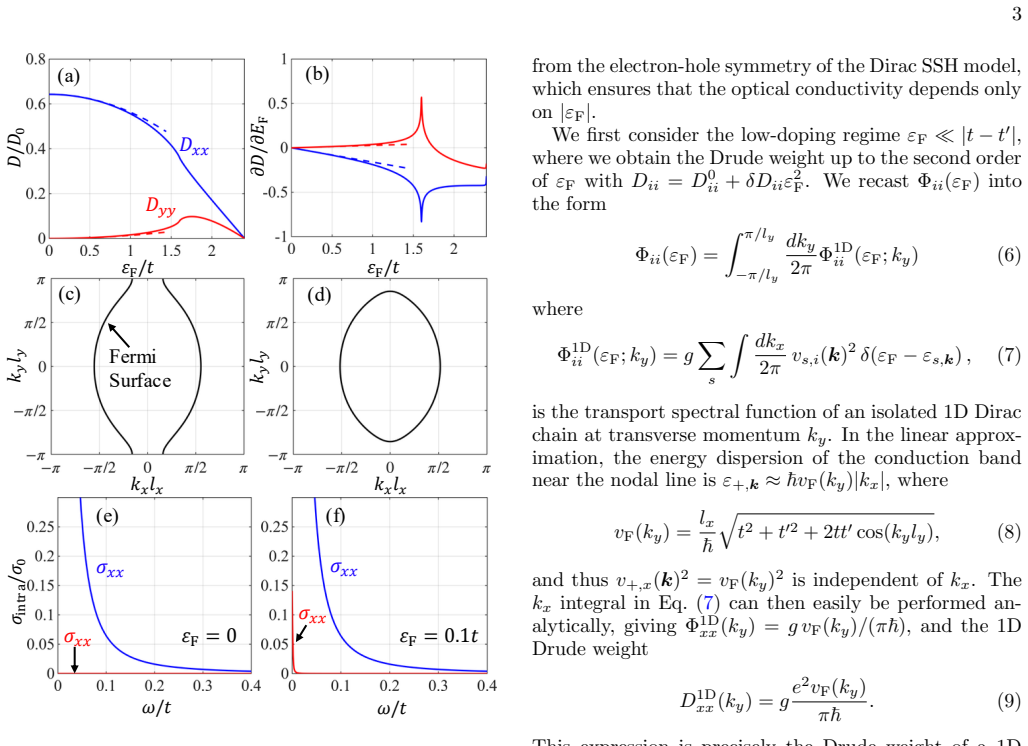
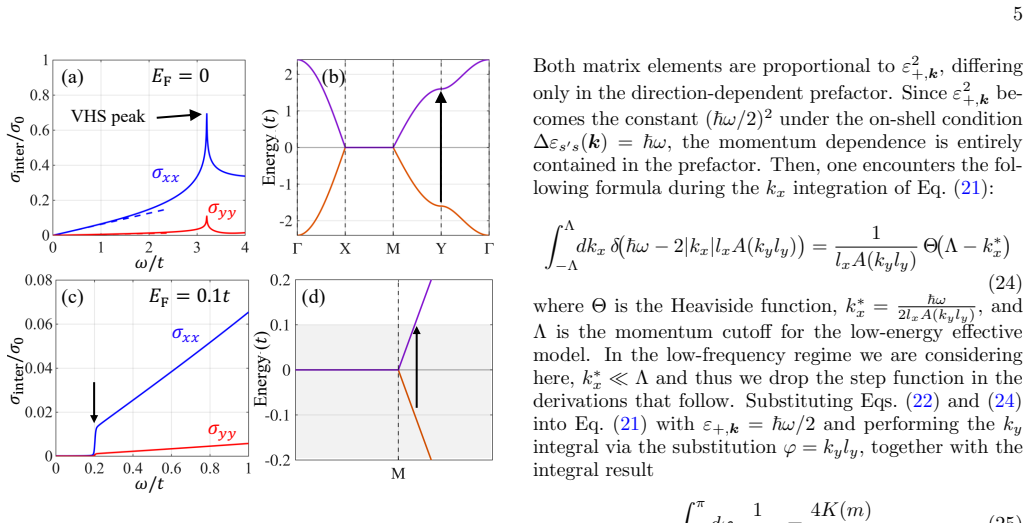
At zero temperature the Drude weight of the Nb2n+1SinTe4n+2 family is finite at charge neutrality along the nodal-line direction while it vanishes quadratically with Fermi energy in the transverse direction. The interband optical conductivity nevertheless follows a linear frequency dependence in both directions, with only the slope changing according to the measurement axis. Leading finite-temperature corrections to the intraband and interband conductivities leave the zero-temperature results intact up to experimentally relevant temperatures.
What carries the argument
Analytic evaluation of the Kubo formula on a model Hamiltonian that captures the quasi-one-dimensional nodal-line states of the material family.
Load-bearing premise
The electronic bands near the nodal lines are faithfully described by a quasi-one-dimensional model that permits closed-form Kubo-formula conductivities.
What would settle it
Polarization-resolved optical measurements at charge neutrality that find a vanishing Drude weight along the nodal direction, or a non-linear frequency dependence in the interband conductivity, would falsify the analytic predictions.
Figures
read the original abstract
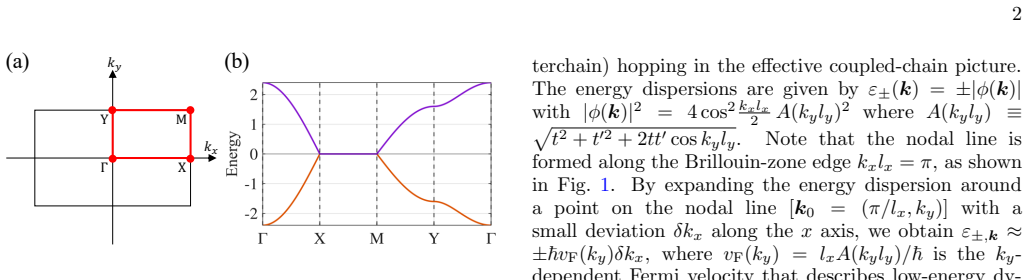
We study the linear optical conductivity of the Nb$_{2n+1}$Si$_n$Te$_{4n+2}$ family of layered van der Waals materials, which has recently gained considerable attention owing to its dimensionality-tunable electronic structure with a quasi-one-dimensional nodal-line state. At zero temperature, we analytically show that the Drude weight exhibits strong anisotropy: along the nodal-line direction it is finite at charge neutrality, whereas in the transverse direction it vanishes quadratically with Fermi energy. On the other hand, the interband optical conductivity exhibits the same linear frequency dependence along both the longitudinal and transverse directions, with only a direction-dependent slope in the low-frequency regime. We further analyze the leading finite-temperature corrections to the intraband and interband optical conductivities, showing that the zero-temperature results remain valid up to experimentally relevant temperatures.
Editorial analysis
A structured set of objections, weighed in public.
Referee Report
Summary. This paper analytically computes the linear optical conductivity of the Nb_{2n+1}Si_n Te_{4n+2} family using a quasi-one-dimensional nodal-line effective model. At T=0, the Drude weight is finite along the nodal-line direction at charge neutrality but vanishes quadratically with Fermi energy in the transverse direction. The interband optical conductivity shows linear frequency dependence in both directions, with direction-dependent slopes. Perturbative finite-temperature corrections are derived, indicating the T=0 results hold at relevant temperatures.
Significance. The analytic derivations of the anisotropic Drude weight and linear interband conductivity are a clear strength, yielding closed-form expressions from the Kubo formula within the assumed model. If the effective Hamiltonian accurately describes the materials, these results offer testable predictions for optical anisotropy that could guide experiments on this topological semimetal family.
major comments (1)
- [Low-energy effective model] Low-energy effective model: The analytic Drude-weight anisotropy (finite longitudinal Drude weight at neutrality, quadratic transverse vanishing) and the direction-independent linear interband slope rest entirely on the specific dispersion of the quasi-1D nodal-line Hamiltonian. The manuscript supplies no DFT band-structure calculations, ARPES data, or parameter fitting for Nb_{2n+1}Si_n Te_{4n+2} (especially n=1,2) to confirm that the transverse velocity, curvature, and interlayer coupling match the real compounds. Deviations from the assumed form would quantitatively change both the reported Drude behavior and the interband prefactors.
minor comments (1)
- [Finite-temperature corrections] Finite-temperature analysis: The perturbative finite-T corrections are presented as preserving the zero-T results up to experimentally relevant temperatures, but the manuscript could explicitly relate the temperature scale to the model's nodal-line energy parameters (e.g., Fermi velocity or gap scale) to make the validity range quantitative.
Simulated Author's Rebuttal
We thank the referee for their careful reading of our manuscript and for the constructive feedback. We address the major comment on the low-energy effective model below, providing the strongest honest defense of our analytic approach while acknowledging the point raised.
read point-by-point responses
-
Referee: Low-energy effective model: The analytic Drude-weight anisotropy (finite longitudinal Drude weight at neutrality, quadratic transverse vanishing) and the direction-independent linear interband slope rest entirely on the specific dispersion of the quasi-1D nodal-line Hamiltonian. The manuscript supplies no DFT band-structure calculations, ARPES data, or parameter fitting for Nb_{2n+1}Si_n Te_{4n+2} (especially n=1,2) to confirm that the transverse velocity, curvature, and interlayer coupling match the real compounds. Deviations from the assumed form would quantitatively change both the reported Drude behavior and the interband prefactors.
Authors: We agree that the quantitative predictions depend on the precise parameters of the effective Hamiltonian. The quasi-1D nodal-line model is chosen because it encodes the symmetry-protected dispersion known to describe the low-energy states in the Nb_{2n+1}Si_n Te_{4n+2} family, as established in prior literature on these van der Waals compounds. Our work is analytic and focuses on universal features (anisotropic Drude weight vanishing quadratically in the transverse direction, linear interband conductivity with direction-dependent prefactors) that follow directly from this dispersion form. While the manuscript does not contain new DFT or ARPES data, the assumed transverse velocity, curvature, and interlayer terms are consistent with reported band structures for n=1 and n=2. We will add a short paragraph and additional references in the revised manuscript to explicitly justify the model choice and note that future parameter fitting from experiment would allow quantitative comparison, without altering the reported qualitative anisotropies. revision: partial
Circularity Check
No significant circularity; analytic results follow from assumed model via standard Kubo response
full rationale
The paper assumes a quasi-1D nodal-line effective Hamiltonian as input and derives zero-temperature Drude weight anisotropy plus linear interband conductivity by direct analytic evaluation of the Kubo formula. No quoted steps show self-definition (e.g., a quantity defined in terms of the result it is said to predict), fitted parameters renamed as predictions, or load-bearing self-citations. The central claims are independent computations from the stated band model; external verification of that model is a separate correctness issue, not circularity. This is the normal non-circular case.
Axiom & Free-Parameter Ledger
axioms (1)
- domain assumption The electronic structure of Nb2n+1SinTe4n+2 is described by a model with a quasi-one-dimensional nodal-line state that permits analytic evaluation of the optical conductivities.
Reference graph
Works this paper leans on
-
[1]
B. J. Van Wees, H. Van Houten, C. W. J. Beenakker, J. G. Williamson, L. P. Kouwenhoven, D. Van Der Marel, and C. T. Foxon, Quantized conductance of point con- tacts in a two-dimensional electron gas, Physical Review Letters60, 848 (1988)
work page 1988
-
[2]
Voit, One-dimensional fermi liquids, Reports on Progress in Physics58, 977 (1995)
J. Voit, One-dimensional fermi liquids, Reports on Progress in Physics58, 977 (1995)
work page 1995
-
[3]
A. V. Pronin and M. Dressel, Nodal semimetals: A sur- vey on optical conductivity, Physica Status Solidi (b) 258, 2000027 (2021)
work page 2021
-
[4]
Z. Zhu, S. Li, M. Yang, X.-A. Nie, H.-K. Xu, X. Yang, D.- D. Guan, S. Wang, Y.-Y. Li, C. Liu, Z.-Q. Mao, N. Xu, Y. Yao, S. A. Yang, Y.-G. Shi, H. Zheng, and J.-F. Jia, A tunable and unidirectional one-dimensional electronic system Nb 2n+1SinTe4n+2, npj Quantum Materials5, 35 (2020)
work page 2020
-
[5]
T. Y. Yang, Q. Wan, D. Y. Yan, Z. Zhu, Z. W. Wang, C. Peng, Y. B. Huang, R. Yu, J. Hu, Z. Q. Mao, S. Li, S. A. Yang, H. Zheng, J. F. Jia, Y. G. Shi, and N. Xu, Directional massless dirac fermions in a layered van der waals material with one-dimensional long-range order, Nature Materials19, 27 (2020)
work page 2020
-
[6]
B. Wang, W. Xia, S. Li, K. Wang, S. A. Yang, Y. Guo, and J. Xue, One-dimensional metal embedded in two- dimensional semiconductor in Nb 2Six−1Te4, ACS Nano 15, 7149 (2021)
work page 2021
- [7]
-
[8]
S. Li, Y. Liu, S.-S. Wang, Z.-M. Yu, S. Guan, X.- L. Sheng, Y. Yao, and S. A. Yang, Nonsymmorphic- symmetry-protected hourglass dirac loop, nodal line, and dirac point in bulk and monolayer X 3 SiTe 6 ( X = Ta, Nb), Physical Review B97, 045131 (2018)
work page 2018
-
[9]
Z. Liu, T. Li, B. Zhang, M. L. Adam, W. Zhu, Y. Li, S. Wang, Y. Wu, H. Zhu, D. Cao, Q. Cui, S. Cui, Y. Liu, S. Chen, Z. Sun, and L. Song, Coexistence of the hour- glass and nodal-line dispersions in Nb3SiTe6 revealed by ARPES, iScience25, 103952 (2022)
work page 2022
-
[10]
R.-Y. Liu, A. Huang, R. Sankar, J. A. Hlevyack, C.-C. Su, S.-C. Weng, M.-K. Lin, P. Chen, C.-M. Cheng, J. D. Denlinger, S.-K. Mo, A. V. Fedorov, C.-S. Chang, H.-T. Jeng, T.-M. Chuang, and T.-C. Chiang, Dirac nodal line in hourglass semimetal Nb 3 SiTe6, Nano Letters23, 380 (2023)
work page 2023
- [11]
-
[12]
Y. Zhao, J. Cao, Z. Zhang, S. Li, Y. Li, F. Ma, and S. A. Yang, Berry curvature dipole and nonlinear hall effect in two-dimensional Nb 2n+1SinTe4n+2, Physical Review B107, 205124 (2023)
work page 2023
-
[13]
J. Ebad-Allah, A. A. Tsirlin, Y. L. Zhu, Z. Q. Mao, and C. A. Kuntscher, Signatures of van hove singularities in the anisotropic in-plane optical conductivity of the topo- logical semimetal Nb 3 SiTe 6, Physical Review B107, 115115 (2023)
work page 2023
-
[14]
S. Cao, C. Zhang, Y. Xu, J. Zhao, Y. Shi, Y.-Z. Long, J. Luo, and Z.-G. Chen, Optical signature of flat bands in topological hourglass semimetal Nb 3 SiTe6, Chinese Physics B34, 027101 (2025)
work page 2025
-
[15]
S. Ahn, E. J. Mele, and H. Min, Electrodynamics on fermi cyclides in nodal line semimetals, Physical Review Let- ters119, 147402 (2017)
work page 2017
-
[16]
S. Barati and S. H. Abedinpour, Optical conductiv- ity of three and two dimensional topological nodal-line semimetals, Physical Review B96, 155150 (2017)
work page 2017
-
[17]
S. P. Mukherjee and J. P. Carbotte, Transport and optics at the node in a nodal loop semimetal, Physical Review B95, 214203 (2017)
work page 2017
-
[18]
J. Jeon, J. Jang, H. Kim, T. Park, D. Kim, S. Moon, J. S. Kim, J. H. Shim, H. Min, and E. Choi, Optical transitions of a single nodal ring in SrAs 3: Radially and axially resolved characterization, Physical Review Letters131, 236903 (2023)
work page 2023
-
[19]
Y. Shao, Z. Sun, Y. Wang, C. Xu, R. Sankar, A. J. Brein- del, C. Cao, M. M. Fogler, A. J. Millis, F. Chou, Z. Li, T. Timusk, M. B. Maple, and D. N. Basov, Optical sig- natures of dirac nodal lines in NbAs 2, Proceedings of the National Academy of Sciences116, 1168 (2019)
work page 2019
-
[20]
S. Ahn, E. J. Mele, and H. Min, Optical conductivity of multi-weyl semimetals, Physical Review B95, 161112 (2017). 9
work page 2017
-
[21]
H. Gao, M. Tai, C. Ding, S. Liu, J. Wang, X.-J. Zhang, Y. Chen, and M. Zhao, Intrinsic hyperbolicity in two- dimensional dirac su-schrieffer-heeger materials, Physical Review B112, 235423 (2025)
work page 2025
-
[22]
G. D. Mahan,Many-particle physics, 3rd ed. (Kluwer Academic/Plenum Publishers, New York, 2000)
work page 2000
-
[23]
Giamarchi,Quantum Physics in One Dimension(Ox- ford University Press, Oxford, 2003)
T. Giamarchi,Quantum Physics in One Dimension(Ox- ford University Press, Oxford, 2003)
work page 2003
discussion (0)
Sign in with ORCID, Apple, or X to comment. Anyone can read and Pith papers without signing in.