Quantum Homomorphic Encryption: Towards Practical and Private Computation on Untrusted Quantum Hardware
Pith reviewed 2026-05-10 02:44 UTC · model grok-4.3
The pith
Quantum one-time pad encryption enables non-interactive homomorphic evaluation of Clifford+T circuits while preserving information-theoretic security.
A machine-rendered reading of the paper's core claim, the machinery that carries it, and where it could break.
Core claim
By exploiting the transformation properties of quantum gates under Pauli conjugation, the framework supplies a complete set of homomorphic implementations for Clifford and T gates together with controlled and parameterized operations, allowing any circuit in this family to be evaluated on an encrypted state with only a final classical key correction performed by the client.
What carries the argument
The systematic collection of homomorphic gate decompositions and classical key-update rules derived from how each gate conjugates the Pauli operators that encrypt the state.
Load-bearing premise
The effect of every gate in the supported set on the encrypted state can be reproduced by a modified operation whose difference is exactly compensated by a classical update to the pad keys.
What would settle it
Apply the homomorphic version of a T gate to a known encrypted input state, decrypt the output using the updated keys, and observe whether the result matches the direct application of T to the original state; systematic mismatch on multiple trials would falsify the claim.
Figures
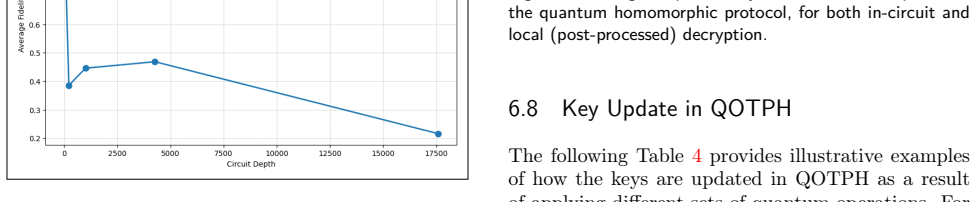
read the original abstract
As quantum computing matures into a practical paradigm, the need for secure and private quantum computation on untrusted hardware becomes increasingly urgent. While classical fully homomorphic encryption has enabled computation over encrypted data in untrusted environments, a fully homomorphic and practically implementable quantum counterpart remains elusive. In this work, we propose a universal quantum homomorphic encryption (QHE) framework developed from the Quantum One-Time Pad (QOTP) scheme. Our approach (QOTPH) maintains information-theoretic security and supports a broad class of quantum operations on encrypted quantum states through a systematic set of homomorphic gate decompositions and key update rules. By leveraging the symmetric structure of QOTP and exploiting the transformation properties of quantum gates under Pauli encryption, we enable non-interactive homomorphic evaluation of arbitrary circuits expressible in the Clifford+T gate set, as well as controlled and parameterized operations relevant to variational quantum algorithms and delegated computation. We provide a formal specification of the proposed encryption model, detail its implementation procedure, and report the results obtained from both simulated environments and real quantum processors. Experimental validation demonstrates the correctness of the homomorphic operations and the preservation of key secrecy under circuit-level noise and real-device constraints. This work takes a step toward bridging the gap between theoretical quantum homomorphic encryption and practical realization on near-term quantum hardware, offering a scalable and symmetric cryptographic primitive for privacy-preserving quantum computation.
Editorial analysis
A structured set of objections, weighed in public.
Referee Report
Summary. The paper proposes a quantum homomorphic encryption framework called QOTPH based on the Quantum One-Time Pad (QOTP). It maintains information-theoretic security and enables non-interactive homomorphic evaluation of Clifford+T circuits and parameterized operations using systematic gate decompositions and key update rules. The authors provide a formal specification, implementation procedure, and experimental results from simulators and real quantum processors showing correctness and key secrecy under noise.
Significance. If the claims hold, particularly the non-interactive support for universal Clifford+T circuits with information-theoretic security, this would be a significant step toward practical private quantum computation on untrusted hardware, bridging theoretical QHE with NISQ-era implementations and enabling applications in delegated quantum computing and variational algorithms.
major comments (2)
- [Abstract] Abstract, second paragraph: The central claim that the scheme enables non-interactive homomorphic evaluation of arbitrary Clifford+T circuits while preserving information-theoretic security is load-bearing. Because T does not conjugate Pauli operators to Pauli operators (e.g., T X T† yields a linear combination of X and Y), any decomposition restoring a Pauli form must be specified explicitly together with a security reduction showing that neither interactivity nor key-dependent server operations are introduced. The abstract description alone does not resolve this.
- [Experimental validation sections] Experimental validation sections: The reported simulator and hardware experiments demonstrate operational correctness under noise but supply no evidence for the information-theoretic security property. Information-theoretic security is a theoretical guarantee that cannot be established by empirical correctness tests; a formal proof or reduction for the T-gate case is required.
minor comments (1)
- The abstract refers to support for 'controlled and parameterized operations relevant to variational quantum algorithms'; an explicit enumeration of the supported gate set and any restrictions on parameterization would improve clarity.
Simulated Author's Rebuttal
We thank the referee for the constructive comments on our QOTPH framework. We address each major point below with references to the manuscript content and indicate planned revisions where they strengthen clarity without altering the core claims.
read point-by-point responses
-
Referee: [Abstract] Abstract, second paragraph: The central claim that the scheme enables non-interactive homomorphic evaluation of arbitrary Clifford+T circuits while preserving information-theoretic security is load-bearing. Because T does not conjugate Pauli operators to Pauli operators (e.g., T X T† yields a linear combination of X and Y), any decomposition restoring a Pauli form must be specified explicitly together with a security reduction showing that neither interactivity nor key-dependent server operations are introduced. The abstract description alone does not resolve this.
Authors: The manuscript (Sections 3 and 4) supplies the requested explicit decompositions: the T gate is realized homomorphically via a fixed sequence of Clifford operations on the encrypted state together with classical Pauli-key updates computed by the client after evaluation. These updates restore the QOTP form without requiring the server to know the key or perform key-dependent operations, preserving non-interactivity. The security reduction in Section 4 shows that the view of the server is indistinguishable from a fresh QOTP encryption, inheriting information-theoretic security. We will revise the abstract to include a concise reference to these T-gate decompositions and the post-evaluation key-update step. revision: partial
-
Referee: [Experimental validation sections] Experimental validation sections: The reported simulator and hardware experiments demonstrate operational correctness under noise but supply no evidence for the information-theoretic security property. Information-theoretic security is a theoretical guarantee that cannot be established by empirical correctness tests; a formal proof or reduction for the T-gate case is required.
Authors: We agree that information-theoretic security is a theoretical property and that the simulator and hardware experiments (Sections 5 and 6) serve only to confirm operational correctness and noise resilience. The formal security reduction for the full Clifford+T set, including the T gate, appears in Section 4 and proceeds by showing that every homomorphic gate (with its associated key update) maps an encrypted state to another encrypted state under an updated QOTP key, with no additional leakage. We will add explicit cross-references from the experimental sections to this theoretical analysis. revision: yes
Circularity Check
No circularity: QOTPH built from standard QOTP with explicit decompositions
full rationale
The paper's central derivation begins from the established Quantum One-Time Pad (QOTP) primitive and introduces a systematic set of homomorphic gate decompositions plus key-update rules for Clifford+T circuits and parameterized operations. These rules are presented as new but explicitly described constructions that preserve the Pauli form under encryption. No equation reduces the claimed information-theoretic security or non-interactive evaluation property to a fitted parameter, a self-referential definition, or a self-citation chain. The security argument is asserted to follow directly from the transformation properties of gates under Pauli encryption, without presupposing the target functionality. Experimental sections address hardware correctness under noise and are separate from the theoretical security claim. This satisfies the default expectation of a non-circular construction.
Axiom & Free-Parameter Ledger
axioms (2)
- domain assumption Symmetric structure and Pauli transformation properties of the Quantum One-Time Pad
- domain assumption Quantum gates can be rewritten to act homomorphically on Pauli-encrypted states
invented entities (1)
-
QOTPH framework
no independent evidence
Reference graph
Works this paper leans on
-
[1]
Yanwei Gong, Xiaolin Chang, Jelena Mišić, Vo- jislav B Mišić, Jianhua Wang, and Haoran Zhu. “Practical solutions in fully homomorphic en- cryption: a survey analyzing existing accelera- tion methods”. Cybersecurity7, 5 (2024)
work page 2024
-
[2]
Module-lattice-basedkey-encapsulation mechanism standard
National Institute of Standards and Technology (NIST). “Module-lattice-basedkey-encapsulation mechanism standard”. Federal Information Pro- cessing Standards Publication 203. National In- stitute of Standards and Technology (2024)
work page 2024
-
[3]
Digital sovereignty strategies for ev- ery nation
Ali Shoker. “Digital sovereignty strategies for ev- ery nation”. Applied Cybersecurity & Internet Governance1, 1–17 (2022)
work page 2022
-
[4]
(leveled) fully homomorphic encryption without bootstrapping
Zvika Brakerski, Craig Gentry, and Vinod Vaikuntanathan. “(leveled) fully homomorphic encryption without bootstrapping”. ACM Trans- actions on Computation Theory (TOCT)6, 1– 36 (2014)
work page 2014
-
[5]
Homomorphic encryption for arithmetic of approximate numbers
Jung Hee Cheon, Andrey Kim, Miran Kim, and Yongsoo Song. “Homomorphic encryption for arithmetic of approximate numbers”. In Interna- tional conference on the theory and application of cryptology and information security. Pages 409–437. Springer (2017)
work page 2017
-
[6]
Craig Gentry, Amit Sahai, and Brent Waters. “Homomorphic encryption from learning with errors: Conceptually-simpler, asymptotically- faster, attribute-based”. In Annual cryptology conference. Pages 75–92. Springer (2013)
work page 2013
-
[7]
Insider Market Research. “Homomorphic en- cryption market outlook report 2024–2031: Trends, strategic insights, and growth opportu- nities”.https://insidermarketresearch.com/ global-homomorphic-encryption-market/(2024). Market research report
work page 2024
-
[8]
Polynomial-time algorithms for prime factorization and discrete logarithms on a quantum computer
Peter W Shor. “Polynomial-time algorithms for prime factorization and discrete logarithms on a quantum computer”. SIAM review41, 303– 332 (1999)
work page 1999
-
[9]
A fast quantum mechanical algo- rithm for database search
Lov K Grover. “A fast quantum mechanical algo- rithm for database search”. In Proceedings of the twenty-eighth annual ACM symposium on The- ory of computing. Pages 212–219. (1996)
work page 1996
-
[10]
A true random number genera- tor for blockchain wallets based on quantum computation
Jon Hernández-Bueno, Julen Bernabé- Rodríguez, Iñaki Seco-Aguirre, and Leire Legarreta. “A true random number genera- tor for blockchain wallets based on quantum computation”. In International Congress on Blockchain and Applications. Pages 194–203. Springer (2024)
work page 2024
-
[11]
Enhancing blockchain with quantum-safe verification: A quantum finger- printing framework
Jon Hernández-Bueno, Oscar Lage, Marivi Higuero, Iñaki Seco-Aguirre, and Julen Bernabé- Rodríguez. “Enhancing blockchain with quantum-safe verification: A quantum finger- printing framework”. In International Congress on Blockchain and Applications. Pages 27–37. Springer (2025)
work page 2025
-
[12]
Quantum homomorphic encryption for polynomial-sized circuits
Yfke Dulek, Christian Schaffner, and Florian Speelman. “Quantum homomorphic encryption for polynomial-sized circuits”. In Annual in- ternational cryptology conference. Pages 3–32. Springer (2016)
work page 2016
-
[13]
A quantum approach to homomorphic encryption
Si-Hui Tan, Joshua A Kettlewell, Yingkai Ouyang, Lin Chen, and Joseph F Fitzsimons. “A quantum approach to homomorphic encryption”. Scientific reports6, 33467 (2016)
work page 2016
-
[14]
Ex- perimental quantum homomorphic encryption using a quantum photonic chip
Yuan Li, Lin Cao, Wei Luo, Hui Zhang, Hong Cai, MuhammadFaeyzKarim, FengGao, Joseph Fitzsimons, Qinghua Song, and Ai-Qun Liu. “Ex- perimental quantum homomorphic encryption using a quantum photonic chip”. Physical review letters132, 200801 (2024)
work page 2024
-
[15]
How to construct quantum fhe, generically
Aparna Gupte and Vinod Vaikuntanathan. “How to construct quantum fhe, generically”. In An- nual International Cryptology Conference. Pages 246–279. Springer (2024)
work page 2024
-
[16]
Implementing the grover algorithm in homomor- phic encryption schemes
Pablo Fernández and Miguel A Martin-Delgado. “Implementing the grover algorithm in homomor- phic encryption schemes”. Physical Review Re- search6, 043109 (2024)
work page 2024
-
[17]
Implementing semiclassical szegedy walks in classical-quantum circuits for homomorphic encryption
Sergio A Ortega, Pablo Fernández, and Miguel A Martin-Delgado. “Implementing semiclassical szegedy walks in classical-quantum circuits for homomorphic encryption”. Journal of Physics: Complexity6, 025010 (2025)
work page 2025
-
[18]
A secure quantum homomorphic encryp- tion ciphertext retrieval scheme
Zhen-Wen Cheng, Xiu-Bo Chen, Gang Xu, Yan Chang, Li-Hua Miao, Yi-Xian Yang, and Ya-Lan Wang. “A secure quantum homomorphic encryp- tion ciphertext retrieval scheme”. Soft Comput- ing29, 1497–1509 (2025)
work page 2025
-
[19]
A fully homomorphic encryption scheme
Craig Gentry. “A fully homomorphic encryption scheme”. Stanford university. (2009)
work page 2009
-
[20]
Quan- tum computation and quantum information
Michael A Nielsen and Isaac L Chuang. “Quan- tum computation and quantum information”. Cambridge university press. (2010)
work page 2010
-
[21]
Principles of quantum me- chanics
Ramamurti Shankar. “Principles of quantum me- chanics”. Springer Science & Business Media. (2012)
work page 2012
-
[22]
A new notation for quantum mechanics
Paul Adrien Maurice Dirac. “A new notation for quantum mechanics”. In Mathematical proceed- ings of the Cambridge philosophical society. Vol- ume 35, pages 416–418. Cambridge University Press (1939)
work page 1939
-
[23]
On the einstein podolsky rosen paradox
John S Bell. “On the einstein podolsky rosen paradox”. Physics Physique Fizika1, 195 (1964)
work page 1964
-
[24]
Teleporting an unknown quantum state via dual classical and einstein-podolsky- rosen channels
Charles H Bennett, Gilles Brassard, Claude Cré- peau, RichardJozsa, AsherPeres, andWilliamK 16 Wootters. “Teleporting an unknown quantum state via dual classical and einstein-podolsky- rosen channels”. Physical review letters70, 1895 (1993)
work page 1993
-
[25]
A single quantum cannot be cloned
William K Wootters and Wojciech H Zurek. “A single quantum cannot be cloned”. Nature299, 802–803 (1982)
work page 1982
-
[26]
DGBJ Dieks. “Communication by epr devices”. Physics Letters A92, 271–272 (1982)
work page 1982
-
[27]
Quan- tum cryptography: Public key distribution and coin tossing
Charles H Bennett and Gilles Brassard. “Quan- tum cryptography: Public key distribution and coin tossing”. Theoretical computer science560, 7–11 (2014)
work page 2014
-
[28]
Christopher M Dawson and Michael A Nielsen. “The solovay-kitaev algorithm” (2005)
work page 2005
-
[29]
Quantum supremacy us- ing a programmable superconducting processor
Frank Arute, Kunal Arya, Ryan Babbush, Dave Bacon, Joseph C Bardin, Rami Barends, Rupak Biswas, Sergio Boixo, Fernando GSL Brandao, David A Buell, et al. “Quantum supremacy us- ing a programmable superconducting processor”. Nature574, 505–510 (2019)
work page 2019
-
[30]
Qiskit: An open- source framework for quantum computing
Qiskit Development Team. “Qiskit: An open- source framework for quantum computing”. https://qiskit.org(2025)
work page 2025
-
[31]
Op- timal encryption of quantum bits
P Oscar Boykin and Vwani Roychowdhury. “Op- timal encryption of quantum bits”. Physical re- view A67, 042317 (2003)
work page 2003
-
[32]
Communication theory of secrecy systems
Claude E Shannon. “Communication theory of secrecy systems”. The Bell system technical jour- nal28, 656–715 (1949)
work page 1949
-
[33]
Andris Ambainis, Michele Mosca, Alain Tapp, and Ronald De Wolf. “Private quantum chan- nels”. In Proceedings 41st Annual Symposium on Foundations of Computer Science. Pages 547–
-
[34]
Au- thentication of quantum messages
Howard Barnum, Claude Crépeau, Daniel Gottesman, Adam Smith, and Alain Tapp. “Au- thentication of quantum messages”. In The 43rd Annual IEEE Symposium on Foundations of Computer Science, 2002. Proceedings. Pages 449–458. IEEE (2002)
work page 2002
-
[35]
Quantum homomorphic encryption from quantum codes
Yingkai Ouyang, Si-Hui Tan, and Joseph F Fitzsimons. “Quantum homomorphic encryption from quantum codes”. Physical Review A98, 042334 (2018)
work page 2018
-
[36]
Quantum computing in the nisq era and beyond
John Preskill. “Quantum computing in the nisq era and beyond”. Quantum2, 79 (2018). 17
work page 2018
discussion (0)
Sign in with ORCID, Apple, or X to comment. Anyone can read and Pith papers without signing in.