Recognition: unknown
A neural operator framework for data-driven discovery of stability and receptivity in physical systems
Pith reviewed 2026-05-10 01:23 UTC · model grok-4.3
The pith
A neural network trained on data alone can compute eigenmodes and resolvent modes via automatic differentiation on its Jacobian.
A machine-rendered reading of the paper's core claim, the machinery that carries it, and where it could break.
Core claim
By training a neural network as a dynamics emulator and using automatic differentiation to extract its Jacobian, eigenmodes and resolvent modes can be computed directly from data. The method identifies dominant instability modes and input-output structures on canonical chaotic models and high-dimensional fluid flows, even in strongly nonlinear regimes, while also providing a nonlinear representation of system dynamics.
What carries the argument
A neural network trained as a dynamics emulator, from whose output the Jacobian is obtained by automatic differentiation to furnish eigenmodes and resolvent modes.
If this is right
- Stability and receptivity analysis becomes feasible for systems whose governing equations are unknown or incomplete.
- The same trained emulator supplies both nonlinear dynamics and linear modal information.
- Dominant modes can be recovered in strongly nonlinear and high-dimensional regimes where classical linearization is difficult.
- The approach applies to observational datasets in climate science, neuroscience, and fluid engineering without requiring model derivation.
Where Pith is reading between the lines
- The framework could be tested on experimental time-series data where no full model exists, to check whether predicted modes align with observed perturbation growth.
- Embedding the emulator in a control loop would allow real-time adjustment of forcings based on the extracted resolvent information.
- Accuracy in recovering known modes from data with added noise would quantify the method's robustness for practical measurements.
Load-bearing premise
The trained neural network must approximate the true underlying dynamics closely enough that derivatives of its outputs with respect to inputs recover meaningful stability and receptivity information about the physical system.
What would settle it
In a system with known equations, such as the Lorenz attractor or a simple shear flow, the eigenmodes or resolvent modes extracted from the neural Jacobian would fail to match those computed analytically or numerically from the equations.
Figures


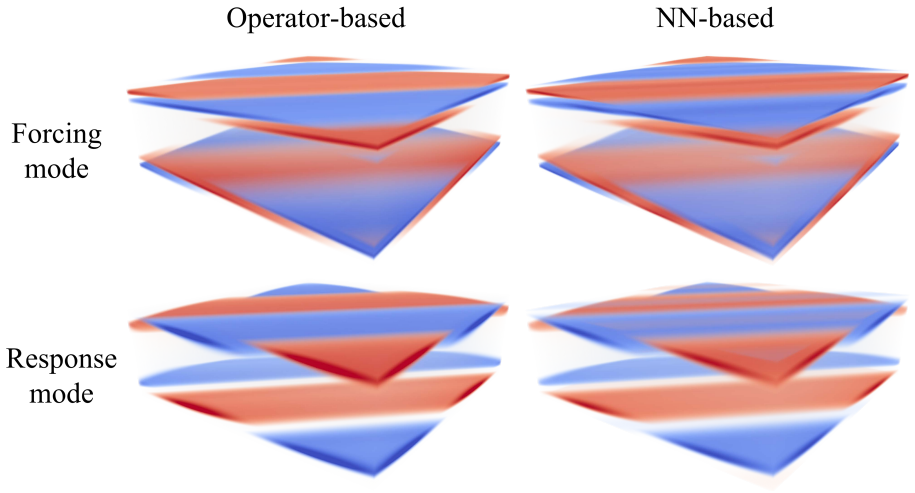
read the original abstract
Understanding how complex systems respond to perturbations, such as whether they will remain stable or what their most sensitive patterns are, is a fundamental challenge across science and engineering. Traditional stability and receptivity (resolvent) analyses are powerful but rely on known equations and linearization, limiting their use in nonlinear or poorly modeled systems. Here, we introduce a data-driven framework that automatically identifies stability properties and optimal forcing responses from observation data alone, without requiring governing equations. By training a neural network as a dynamics emulator and using automatic differentiation to extract its Jacobian, we can compute eigenmodes and resolvent modes directly from data. We demonstrate the method on both canonical chaotic models and high-dimensional fluid flows, successfully identifying dominant instability modes and input-output structures even in strongly nonlinear regimes. By leveraging a neural network-based emulator, we readily obtain a nonlinear representation of system dynamics while additionally retrieving intricate dynamical patterns that were previously difficult to resolve. This equation-free methodology establishes a broadly applicable tool for analyzing complex, high-dimensional datasets, with immediate relevance to grand challenges in fields such as climate science, neuroscience, and fluid engineering.
Editorial analysis
A structured set of objections, weighed in public.
Referee Report
Summary. The manuscript introduces a data-driven framework for discovering stability and receptivity properties in physical systems. It trains a neural network to emulate the system's dynamics from observational data and employs automatic differentiation to extract the Jacobian matrix, enabling computation of eigenmodes for stability analysis and resolvent modes for receptivity analysis without requiring explicit governing equations. Demonstrations are provided on canonical chaotic models and high-dimensional fluid flows, showing identification of dominant modes even in nonlinear regimes.
Significance. If the extracted modes prove accurate, the method would offer a broadly applicable equation-free tool for stability and receptivity analysis in complex, high-dimensional systems where governing equations are unavailable, with relevance to fluid dynamics, climate science, and neuroscience. The combination of neural emulation for nonlinear dynamics with automatic differentiation for linear operators is a notable strength, as is the demonstration on both low-dimensional chaotic systems and fluid data.
major comments (3)
- Demonstrations section: The reported results on canonical models and fluid flows show only qualitative agreement with expected modes; no quantitative metrics are supplied, such as eigenvalue errors relative to analytical or linearized-operator references, eigenvalue perturbation under retraining, or comparison of resolvent gains to known values. This leaves the central claim that the NN Jacobian yields meaningful physical stability/receptivity information unverified.
- Method section (neural dynamics emulator and Jacobian extraction): State-prediction loss (e.g., trajectory MSE) is used to train the emulator, but no analysis, bounds, or regularization is provided to ensure that the automatically differentiated Jacobian approximates the true linearized vector field DF sufficiently closely; small state errors can produce large derivative discrepancies, especially in chaotic or high-dimensional regimes.
- Fluid-flow demonstrations: No direct validation is performed against the linearized Navier-Stokes operator or known resolvent spectra for the same base flows, so it is unclear whether the data-driven modes recover the physical input-output structures rather than artifacts of the emulator.
minor comments (2)
- The notation for the neural operator and its embedding of the dynamics emulator could be made more explicit with additional equations relating the network output to the discrete-time map.
- Figure captions and legends in the results section would benefit from clearer indication of which curves or fields correspond to the neural-operator modes versus reference solutions.
Simulated Author's Rebuttal
We thank the referee for the detailed and constructive review of our manuscript. We address each major comment below and indicate the revisions we will implement to improve the clarity and rigor of the work.
read point-by-point responses
-
Referee: Demonstrations section: The reported results on canonical models and fluid flows show only qualitative agreement with expected modes; no quantitative metrics are supplied, such as eigenvalue errors relative to analytical or linearized-operator references, eigenvalue perturbation under retraining, or comparison of resolvent gains to known values. This leaves the central claim that the NN Jacobian yields meaningful physical stability/receptivity information unverified.
Authors: We agree that quantitative validation would strengthen the central claims. In the revised manuscript we will add explicit metrics for the canonical models, including eigenvalue errors against analytical references and sensitivity of the extracted eigenvalues to retraining with different random initializations. For the fluid cases we will report comparisons of resolvent gains against literature values where such references exist. revision: yes
-
Referee: Method section (neural dynamics emulator and Jacobian extraction): State-prediction loss (e.g., trajectory MSE) is used to train the emulator, but no analysis, bounds, or regularization is provided to ensure that the automatically differentiated Jacobian approximates the true linearized vector field DF sufficiently closely; small state errors can produce large derivative discrepancies, especially in chaotic or high-dimensional regimes.
Authors: The referee correctly identifies a gap between the training objective and the accuracy of the extracted Jacobian. We will revise the methods section to include empirical checks that compare the automatically differentiated Jacobian against finite-difference approximations evaluated on the trained network. We will also add a brief discussion of the limitations that may arise in strongly chaotic regimes. Adding a Jacobian-regularization term during training is feasible and will be explored; however, deriving rigorous a-priori bounds on the derivative error without further assumptions on the data distribution remains outside the scope of the present framework. revision: partial
-
Referee: Fluid-flow demonstrations: No direct validation is performed against the linearized Navier-Stokes operator or known resolvent spectra for the same base flows, so it is unclear whether the data-driven modes recover the physical input-output structures rather than artifacts of the emulator.
Authors: The method is intended for equation-free settings where the linearized operator is unavailable by construction. Nevertheless, we will strengthen the fluid-flow section by comparing the extracted modes against well-documented resolvent and stability results from the literature for the specific base flows examined. Where computational resources permit, we will also generate reference resolvent spectra from the linearized Navier-Stokes equations for at least one canonical case to enable direct side-by-side validation. revision: yes
Circularity Check
No significant circularity in derivation chain
full rationale
The paper trains a neural network emulator on observed trajectory data to approximate system dynamics, then applies automatic differentiation to obtain the Jacobian of this emulator and computes its eigenmodes or resolvent modes via standard linear algebra. This chain does not reduce any claimed result to a fitted parameter by construction, nor does it rely on self-definitional mappings, self-citation load-bearing premises, or imported uniqueness theorems. The central output (data-driven modes) is obtained by post-processing the trained emulator rather than being statistically forced by the training loss itself. The method is self-contained against external benchmarks once the emulator is trained, with no evidence of the enumerated circularity patterns.
Axiom & Free-Parameter Ledger
axioms (1)
- domain assumption A neural network can be trained to emulate the dynamics of a physical system from observation data alone.
invented entities (1)
-
Neural dynamics emulator
no independent evidence
Reference graph
Works this paper leans on
-
[1]
Nonlinear oscillations, dynamical systems, and bifurcations of vector fields , volume 42
John Guckenheimer and Philip Holmes. Nonlinear oscillations, dynamical systems, and bifurcations of vector fields , volume 42. Springer Science & Business Media, 2013
2013
-
[2]
A theory of modal control
Jerome D Simon and Sanjoy K Mitter. A theory of modal control. Information and control, 13(4):316–353, 1968
1968
-
[3]
Turbulence, coherent structures, dynamical systems and symmetry
Philip Holmes. Turbulence, coherent structures, dynamical systems and symmetry. Cam- bridge university press, 2012
2012
-
[4]
Dynamic mode decomposition with control
Joshua L Proctor, Steven L Brunton, and J Nathan Kutz. Dynamic mode decomposition with control. SIAM Journal on Applied Dynamical Systems , 15(1):142–161, 2016
2016
-
[5]
Model reduction for flow analysis and control
Clarence W Rowley and Scott TM Dawson. Model reduction for flow analysis and control. Annual Review of Fluid Mechanics , 49(1):387–417, 2017
2017
-
[6]
Modal analysis of fluid flows: An overview
Kunihiko Taira, Steven L Brunton, Scott TM Dawson, Clarence W Rowley, Tim Colo- nius, Beverley J McKeon, Oliver T Schmidt, Stanislav Gordeyev, Vassilios Theofilis, and Lawrence S Ukeiley. Modal analysis of fluid flows: An overview. AIAA journal , 55(12):4013–4041, 2017
2017
-
[7]
Advances in global linear instability analysis of nonparallel and three-dimensional flows
Vassilios Theofilis. Advances in global linear instability analysis of nonparallel and three-dimensional flows. Progress in aerospace sciences, 39(4):249–315, 2003
2003
-
[8]
Global linear instability
Vassilios Theofilis. Global linear instability. Annual Review of Fluid Mechanics , 43(1):319–352, 2011. 41
2011
-
[9]
Hydro- dynamic stability without eigenvalues
Lloyd N Trefethen, Anne E Trefethen, Satish C Reddy, and Tobin A Driscoll. Hydro- dynamic stability without eigenvalues. Science, 261(5121):578–584, 1993
1993
-
[10]
A critical-layer framework for turbulent pipe flow
Beverley J McKeon and Ati S Sharma. A critical-layer framework for turbulent pipe flow. Journal of Fluid Mechanics , 658:336–382, 2010
2010
-
[11]
Dynamic mode decomposition of numerical and experimental data
Peter J Schmid. Dynamic mode decomposition of numerical and experimental data. Journal of fluid mechanics , 656:5–28, 2010
2010
-
[12]
Dynamic mode decomposition: data-driven modeling of complex systems
J Nathan Kutz, Steven L Brunton, Bingni W Brunton, and Joshua L Proctor. Dynamic mode decomposition: data-driven modeling of complex systems . SIAM, 2016
2016
-
[13]
The structure of inhomogeneous turbulent flows
John Leask Lumley. The structure of inhomogeneous turbulent flows. Atmospheric turbulence and radio wave propagation , pages 166–178, 1967
1967
-
[14]
Discovering governing equa- tions from data by sparse identification of nonlinear dynamical systems
Steven L Brunton, Joshua L Proctor, and J Nathan Kutz. Discovering governing equa- tions from data by sparse identification of nonlinear dynamical systems. Proceedings of the national academy of sciences , 113(15):3932–3937, 2016
2016
-
[15]
Nonmodal stability theory
Peter J Schmid. Nonmodal stability theory. Annu. Rev. Fluid Mech. , 39(1):129–162, 2007
2007
-
[16]
From bypass transition to flow control and data-driven turbulence modeling: an input–output viewpoint
Mihailo R Jovanović. From bypass transition to flow control and data-driven turbulence modeling: an input–output viewpoint. Annual Review of Fluid Mechanics , 53(1):311– 345, 2021
2021
-
[17]
An invitation to resolvent analysis
Laura Victoria Rolandi, Jean Hélder Marques Ribeiro, Chi-An Yeh, and Kunihiko Taira. An invitation to resolvent analysis. Theoretical and Computational Fluid Dynamics , 38(5):603–639, 2024
2024
-
[18]
Spectral analysis of nonlinear flows
Clarence W Rowley, Igor Mezić, Shervin Bagheri, Philipp Schlatter, and Dan S Hen- ningson. Spectral analysis of nonlinear flows. Journal of fluid mechanics , 641:115–127, 2009
2009
-
[19]
Data-driven resolvent analysis
Benjamin Herrmann, Peter J Baddoo, Richard Semaan, Steven L Brunton, and Bever- ley J McKeon. Data-driven resolvent analysis. Journal of Fluid Mechanics , 918:A10, 2021
2021
-
[20]
Physics-informed dynamic mode decomposition
Peter J Baddoo, Benjamin Herrmann, Beverley J McKeon, J Nathan Kutz, and Steven L Brunton. Physics-informed dynamic mode decomposition. Proceedings of the Royal Society A, 479(2271):20220576, 2023
2023
-
[21]
Kernel learning for robust dynamic mode decomposition: linear and nonlinear disam- biguation optimization
Peter J Baddoo, Benjamin Herrmann, Beverley J McKeon, and Steven L Brunton. Kernel learning for robust dynamic mode decomposition: linear and nonlinear disam- biguation optimization. Proceedings of the Royal Society A: Mathematical, Physical and Engineering Sciences, 478(2260), 2022
2022
-
[22]
Hernández, Katherine Cao, Benjamin Herrmann, Steven L
Carlos G. Hernández, Katherine Cao, Benjamin Herrmann, Steven L. Brunton, and Beverley J. McKeon. Toward data-driven resolvent analysis of nonlinear flows. CTR Annual Research Briefs , pages 33–42, 2023. 42
2023
-
[23]
Data-driven discovery of intrinsic dynamics
Daniel Floryan and Michael D Graham. Data-driven discovery of intrinsic dynamics. Nature Machine Intelligence , 4(12):1113–1120, 2022
2022
-
[24]
Learning dynamical systems from data: An introduction to physics-guided deep learning
Rose Yu and Rui Wang. Learning dynamical systems from data: An introduction to physics-guided deep learning. Proceedings of the National Academy of Sciences , 121(27):e2311808121, 2024
2024
-
[25]
Recurrent flow patterns as a basis for two-dimensional turbulence: Predicting statistics from structures
Jacob Page, Peter Norgaard, Michael P Brenner, and Rich R Kerswell. Recurrent flow patterns as a basis for two-dimensional turbulence: Predicting statistics from structures. Proceedings of the National Academy of Sciences , 121(23):e2320007121, 2024
2024
-
[26]
Deep dynamical modeling and control of unsteady fluid flows
Jeremy Morton, Antony Jameson, Mykel J Kochenderfer, and Freddie Witherden. Deep dynamical modeling and control of unsteady fluid flows. In Advances in Neural Infor- mation Processing Systems , 2018
2018
-
[27]
Deep learning methods for reynolds-averaged navier–stokes simulations of airfoil flows
Nils Thuerey, Konstantin Weißenow, Lukas Prantl, and Xiangyu Hu. Deep learning methods for reynolds-averaged navier–stokes simulations of airfoil flows. AIAA Journal, 58(1):25–36, 2020
2020
-
[28]
Towards high-accuracy deep learning inference of com- pressible flows over aerofoils
Li-Wei Chen and Nils Thuerey. Towards high-accuracy deep learning inference of com- pressible flows over aerofoils. Computers & Fluids , 250:105707, 2023
2023
-
[29]
Learning data- driven discretizations for partial differential equations
Yohai Bar-Sinai, Stephan Hoyer, Jason Hickey, and Michael P Brenner. Learning data- driven discretizations for partial differential equations. Proceedings of the National Academy of Sciences , 116(31):15344–15349, 2019
2019
-
[30]
Physics-informed neural networks: A deep learning framework for solving forward and inverse problems involving nonlinear partial differential equations
Maziar Raissi, Paris Perdikaris, and George E Karniadakis. Physics-informed neural networks: A deep learning framework for solving forward and inverse problems involving nonlinear partial differential equations. Journal of Computational physics , 378:686–707, 2019
2019
-
[31]
Machine learning–accelerated computational fluid dynamics
Dmitrii Kochkov, Jamie A Smith, Ayya Alieva, Qing Wang, Michael P Brenner, and Stephan Hoyer. Machine learning–accelerated computational fluid dynamics. Proceed- ings of the National Academy of Sciences , 118(21):e2101784118, 2021
2021
-
[32]
Learned turbulence modelling with differ- entiable fluid solvers: physics-based loss functions and optimisation horizons
Björn List, Li-Wei Chen, and Nils Thuerey. Learned turbulence modelling with differ- entiable fluid solvers: physics-based loss functions and optimisation horizons. Journal of Fluid Mechanics , 949:A25, 2022
2022
-
[33]
Deep learning-based predictive modeling of transonic flow over an airfoil
Liwei Chen and Nils Thuerey. Deep learning-based predictive modeling of transonic flow over an airfoil. Physics of Fluids , 36(12), 2024
2024
-
[34]
Apebench: A benchmark for autoregressive neural emulators of pdes
Felix Koehler, Simon Niedermayr, Nils Thuerey, et al. Apebench: A benchmark for autoregressive neural emulators of pdes. Advances in Neural Information Processing Systems, 37:120252–120310, 2024
2024
-
[35]
Fourier Neural Operator for Parametric Partial Differential Equations
Zongyi Li, Nikola Kovachki, Kamyar Azizzadenesheli, Burigede Liu, Kaushik Bhat- tacharya, Andrew Stuart, and Anima Anandkumar. Fourier neural operator for para- metric partial differential equations. arXiv preprint arXiv:2010.08895 , 2020. 43
work page internal anchor Pith review arXiv 2010
-
[36]
Towards stability of autoregressive neural operators
Michael McCabe, Peter Harrington, Shashank Subramanian, and Jed Brown. Towards stability of autoregressive neural operators. Transactions on Machine Learning Re- search, 2023
2023
-
[37]
On the mechanism of trailing vortex wandering
Adam M Edstrand, Timothy B Davis, Peter J Schmid, Kunihiko Taira, and Louis N Cattafesta III. On the mechanism of trailing vortex wandering. Journal of Fluid Me- chanics, 801:R1, 2016
2016
-
[38]
Three-dimensional floquet stability analysis of the wake of a circular cylinder
Dwight Barkley and Ronald D Henderson. Three-dimensional floquet stability analysis of the wake of a circular cylinder. Journal of Fluid Mechanics , 322:215–241, 1996
1996
-
[39]
Factorized fourier neural operators.arXiv preprint arXiv:2111.13802, 2021
Alasdair Tran, Alexander Mathews, Lexing Xie, and Cheng Soon Ong. Factorized fourier neural operators. arXiv preprint arXiv:2111.13802 , 2021
-
[40]
Solver- in-the-loop: Learning from differentiable physics to interact with iterative pde-solvers
Kiwon Um, Robert Brand, Yun Raymond Fei, Philipp Holl, and Nils Thuerey. Solver- in-the-loop: Learning from differentiable physics to interact with iterative pde-solvers. Advances in neural information processing systems , 33:6111–6122, 2020
2020
-
[41]
Energy growth in viscous channel flows
Satish C Reddy and Dan S Henningson. Energy growth in viscous channel flows. Journal of Fluid Mechanics , 252:209–238, 1993
1993
-
[42]
Stability and transition in shear flows , volume
Peter J Schmid and Dan S Henningson. Stability and transition in shear flows , volume
-
[43]
Springer Science & Business Media, 2012
2012
-
[44]
Turbulence and the dynamics of coherent structures
Lawrence Sirovich. Turbulence and the dynamics of coherent structures. i. coherent structures. Quarterly of applied mathematics , 45(3):561–571, 1987
1987
-
[45]
Deep rein- forcement learning in a handful of trials using probabilistic dynamics models
Kurtland Chua, Roberto Calandra, Rowan McAllister, and Sergey Levine. Deep rein- forcement learning in a handful of trials using probabilistic dynamics models. Advances in neural information processing systems , 31, 2018
2018
-
[46]
Inverse design for fluid- structure interactions using graph network simulators
Kelsey Allen, Tatiana Lopez-Guevara, Kimberly L Stachenfeld, Alvaro Sanchez Gon- zalez, Peter Battaglia, Jessica B Hamrick, and Tobias Pfaff. Inverse design for fluid- structure interactions using graph network simulators. Advances in Neural Information Processing Systems, 35:13759–13774, 2022
2022
-
[47]
Data-driven science and engineering: Machine learning, dynamical systems, and control
Steven L Brunton and J Nathan Kutz. Data-driven science and engineering: Machine learning, dynamical systems, and control . Cambridge University Press, 2022
2022
-
[48]
Definition and properties of lagrangian coherent structures from finite-time lyapunov exponents in two-dimensional aperiodic flows
Shawn C Shadden, Francois Lekien, and Jerrold E Marsden. Definition and properties of lagrangian coherent structures from finite-time lyapunov exponents in two-dimensional aperiodic flows. Physica D: Nonlinear Phenomena , 212(3-4):271–304, 2005
2005
-
[49]
Input-output analysis and control design applied to a linear model of spatially developing flows
S Bagheri, DS Henningson, J Hœpffner, and Peter J Schmid. Input-output analysis and control design applied to a linear model of spatially developing flows. Applied Mechanics Reviews, 62(2):020803, 2009
2009
-
[50]
H2 optimal actuator and sensor placement in the linearised complex ginzburg–landau system
Kevin K Chen and Clarence W Rowley. H2 optimal actuator and sensor placement in the linearised complex ginzburg–landau system. Journal of Fluid Mechanics , 681:241–260, 2011. 44
2011
-
[51]
Efficient computation of global resolvent modes
Eduardo Martini, Daniel Rodríguez, Aaron Towne, and André VG Cavalieri. Efficient computation of global resolvent modes. Journal of Fluid Mechanics , 919:A3, 2021
2021
-
[52]
Non- normality and classification of amplification mechanisms in stability and resolvent anal- ysis
Sean Symon, Kevin Rosenberg, Scott TM Dawson, and Beverley J McKeon. Non- normality and classification of amplification mechanisms in stability and resolvent anal- ysis. Physical Review Fluids , 3(5):053902, 2018
2018
-
[53]
Shenfun - automating the spectral galerkin method
Mikael Mortensen. Shenfun - automating the spectral galerkin method. In Bjorn Helge Skallerud and Helge Ingolf Andersson, editors, MekIT’17 - Ninth national conference on Computational Mechanics, pages 273–298. International Center for Numerical Methods in Engineering (CIMNE), 2017
2017
-
[54]
Shenfun: High performance spectral galerkin computing platform
Mikael Mortensen. Shenfun: High performance spectral galerkin computing platform. Journal of Open Source Software , 3(31):1071, 2018
2018
-
[55]
U-net: Convolutional networks for biomedical image segmentation
Olaf Ronneberger, Philipp Fischer, and Thomas Brox. U-net: Convolutional networks for biomedical image segmentation. In International Conference on Medical image com- puting and computer-assisted intervention , pages 234–241. Springer, 2015
2015
-
[56]
A numerical study of the temporal eigenvalue spectrum of the blasius boundary layer
Leslie M Mack. A numerical study of the temporal eigenvalue spectrum of the blasius boundary layer. Journal of Fluid Mechanics , 73(3):497–520, 1976
1976
-
[57]
Componentwise energy amplification in channel flows
Mihailo R Jovanović and Bassam Bamieh. Componentwise energy amplification in channel flows. Journal of Fluid Mechanics , 534:145–183, 2005
2005
-
[58]
Sparsity-promoting dy- namic mode decomposition
Mihailo R Jovanović, Peter J Schmid, and Joseph W Nichols. Sparsity-promoting dy- namic mode decomposition. Physics of Fluids , 26(2), 2014
2014
-
[59]
A dynamic mode decompo- sition approach for large and arbitrarily sampled systems
Florimond Guéniat, Lionel Mathelin, and Luc R Pastur. A dynamic mode decompo- sition approach for large and arbitrarily sampled systems. Physics of Fluids , 27(2), 2015
2015
-
[60]
Cortical stability and chaos during focal seizures: insights from inference-based modeling
Yun Zhao, David B Grayden, Mario Boley, Yueyang Liu, Philippa J Karoly, Mark J Cook, and Levin Kuhlmann. Cortical stability and chaos during focal seizures: insights from inference-based modeling. Journal of Neural Engineering , 22(3):036021, 2025
2025
-
[61]
Nonlinearly induced low- frequency variability in a midlatitude coupled ocean–atmosphere model of intermediate complexity
E Van der A voird, H Dijkstra, J Nauw, and C Schuurmans. Nonlinearly induced low- frequency variability in a midlatitude coupled ocean–atmosphere model of intermediate complexity. Climate dynamics , 19(3):303–320, 2002
2002
-
[62]
Resolvent and dynamic mode analysis of flow past a square cylinder at subcritical reynolds numbers
Hao Yuan, Jiaqing Kou, Chuanqiang Gao, and Weiwei Zhang. Resolvent and dynamic mode analysis of flow past a square cylinder at subcritical reynolds numbers. Physics of Fluids , 35(7), 2023
2023
-
[63]
On the energy transfer to small disturbances in fluid flow (part i)
Boa-Teh Chu. On the energy transfer to small disturbances in fluid flow (part i). Acta Mechanica, 1(3):215–234, 1965
1965
-
[64]
On two-dimensional temporal modes in spatially evolving open flows: the flat-plate boundary layer
Uwe Ehrenstein and Francois Gallaire. On two-dimensional temporal modes in spatially evolving open flows: the flat-plate boundary layer. Journal of Fluid Mechanics , 536:209– 218, 2005. 45
2005
-
[65]
Perturbed free shear layers
C-M Ho and Patrick Huerre. Perturbed free shear layers. Annual review of fluid me- chanics, 16:365–424, 1984
1984
-
[66]
Nonlinear global modes in hot jets
Lutz Lesshafft, Patrick Huerre, Pierre Sagaut, and Marc Terracol. Nonlinear global modes in hot jets. Journal of Fluid Mechanics , 554:393–409, 2006
2006
-
[67]
Performance of a linear robust control strategy on a nonlinear model of spatially developing flows
Eric Lauga and Thomas R Bewley. Performance of a linear robust control strategy on a nonlinear model of spatially developing flows. Journal of Fluid Mechanics , 512:343–374, 2004
2004
-
[68]
Closed- loop approaches to control of a wake flow modeled by the ginzburg–landau equation
Kelly Cohen, Stefan Siegel, Thomas McLaughlin, Eric Gillies, and James Myatt. Closed- loop approaches to control of a wake flow modeled by the ginzburg–landau equation. Computers & Fluids , 34(8):927–949, 2005
2005
-
[69]
A matlab differentiation matrix suite
J Andre Weideman and Satish C Reddy. A matlab differentiation matrix suite. ACM transactions on mathematical software (TOMS) , 26(4):465–519, 2000
2000
-
[70]
The principle of minimized iterations in the solution of the matrix eigenvalue problem
Walter Edwin Arnoldi. The principle of minimized iterations in the solution of the matrix eigenvalue problem. Quarterly of applied mathematics , 9(1):17–29, 1951
1951
-
[71]
Variations on arnoldi’s method for computing eigenelements of large unsymmetric matrices
Yousef Saad. Variations on arnoldi’s method for computing eigenelements of large unsymmetric matrices. Linear algebra and its applications , 34:269–295, 1980
1980
-
[72]
Nek5000, 05 2007
Paul Fischer, James Lottes, and Henry Tufo. Nek5000, 05 2007
2007
-
[73]
Loiseau, J.-Ch
J.-Ch. Loiseau, J.-Ch. Robinet, S. Cherubini, and E. Leriche. Investigation of the roughness-induced transition: global stability analyses and direct numerical simulations. J. Fluid Mech. , 760:175–211, 2014
2014
-
[74]
Linear analysis of the cylinder wake mean flow
Dwight Barkley. Linear analysis of the cylinder wake mean flow. Europhysics Letters, 75(5):750, 2006
2006
-
[75]
Structural sensitivity of the first instability of the cylinder wake
Flavio Giannetti and Paolo Luchini. Structural sensitivity of the first instability of the cylinder wake. Journal of Fluid Mechanics , 581:167–197, 2007
2007
-
[76]
Sensitivity analysis and passive control of cylinder flow
Olivier Marquet, Denis Sipp, and Laurent Jacquin. Sensitivity analysis and passive control of cylinder flow. Journal of Fluid Mechanics , 615:221–252, 2008
2008
-
[77]
Gaussian Error Linear Units (GELUs)
Dan Hendrycks and Kevin Gimpel. Gaussian error linear units (gelus). arXiv preprint arXiv:1606.08415, 2016. 46
work page internal anchor Pith review arXiv 2016
discussion (0)
Sign in with ORCID, Apple, or X to comment. Anyone can read and Pith papers without signing in.