Recognition: 2 theorem links
· Lean TheoremReaLB: Real-Time Load Balancing for Multimodal MoE Inference
Pith reviewed 2026-05-12 01:19 UTC · model grok-4.3
The pith
ReaLB balances multimodal MoE inference by dynamically lowering precision on vision-heavy experts per rank with no added scheduling cost.
A machine-rendered reading of the paper's core claim, the machinery that carries it, and where it could break.
Core claim
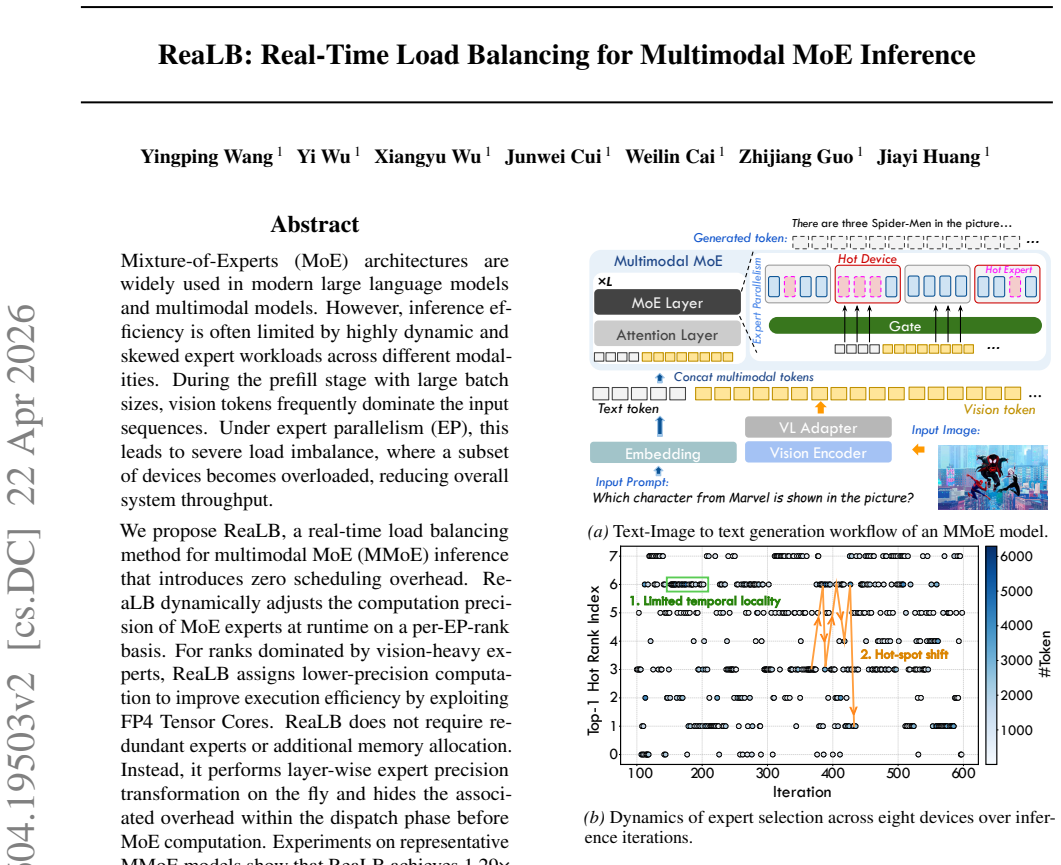
ReaLB dynamically adjusts the computation precision of MoE experts at runtime on a per-EP-rank basis. For ranks dominated by vision-heavy experts, it assigns lower-precision computation to exploit FP4 Tensor Cores and improve execution efficiency. The precision transformation occurs layer-wise on the fly and is hidden inside the dispatch phase before MoE computation begins, eliminating the need for redundant experts or additional memory allocation.
What carries the argument
Per-EP-rank runtime precision adjustment of experts, performed layer-wise and hidden inside the dispatch phase to enable FP4 Tensor Core usage on vision-heavy ranks.
If this is right
- End-to-end inference throughput increases by 1.10× to 1.32× on representative multimodal MoE models.
- Average accuracy degradation stays within 1 percent across tested workloads.
- No additional memory or redundant expert copies are required.
- Load imbalance from vision-token dominance during prefill is mitigated without new scheduling stages.
Where Pith is reading between the lines
- The same per-rank precision switch could be tested on language-only or audio-heavy inputs to check whether the imbalance pattern generalizes.
- Combining the dispatch-hidden transformation with existing quantization methods might compound throughput gains on the same hardware.
- If the accuracy tolerance holds on larger batches, the approach could support higher concurrency without proportional hardware scaling.
Load-bearing premise
That reducing precision to FP4 for vision-dominated experts produces negligible impact on overall accuracy and that the transformation overhead stays fully hidden inside the existing dispatch phase.
What would settle it
Measure wall-clock time and task accuracy on a vision-heavy input batch using the full-precision baseline versus ReaLB-enabled runs on the same hardware and model.
Figures


read the original abstract
Mixture-of-Experts (MoE) architectures are widely used in modern large language models and multimodal models. However, inference efficiency is often limited by highly dynamic and skewed expert workloads across different modalities. During the prefill stage with large batch sizes, vision tokens frequently dominate the input sequences. Under expert parallelism (EP), this leads to severe load imbalance, where a subset of devices becomes overloaded, reducing overall system throughput. We propose ReaLB, a real-time load balancing method for multimodal MoE (MMoE) inference that introduces zero scheduling overhead. ReaLB dynamically adjusts the computation precision of MoE experts at runtime on a per-EP-rank basis. For ranks dominated by vision-heavy experts, ReaLB assigns lower-precision computation to improve execution efficiency by exploiting FP4 Tensor Cores. ReaLB does not require redundant experts or additional memory allocation. Instead, it performs layer-wise expert precision transformation on the fly and hides the associated overhead within the dispatch phase before MoE computation. Experiments on representative MMoE models show that ReaLB achieves 1.10$\times$-1.32$\times$ end-to-end speedup while limiting average accuracy degradation to within 1%.
Editorial analysis
A structured set of objections, weighed in public.
Referee Report
Summary. The paper proposes ReaLB, a real-time load balancing technique for multimodal MoE (MMoE) inference under expert parallelism. It dynamically reduces precision to FP4 for vision-dominated experts on overloaded ranks, performs layer-wise transformations on the fly, and hides the overhead inside the existing dispatch phase, claiming 1.10×–1.32× end-to-end speedup while keeping average accuracy degradation within 1% on representative MMoE models.
Significance. If the empirical results hold, ReaLB offers a memory-efficient way to mitigate modality-induced load imbalance in distributed MoE inference without redundant experts or extra scheduling. The approach is timely given hardware support for FP4 Tensor Cores and could improve throughput for large multimodal models during prefill stages with skewed vision-token workloads.
major comments (3)
- [Abstract] Abstract: the central speedup and accuracy claims (1.10×–1.32× with ≤1% degradation) are stated without naming the MMoE models tested, the baselines, number of runs, error bars, or per-phase timing breakdowns. These omissions make it impossible to verify whether the reported gains are robust or statistically significant.
- [Abstract] Abstract / method description: the claim that 'layer-wise expert precision transformation overhead can be completely hidden inside the dispatch phase' is load-bearing for the net speedup but is unsupported by any analysis of kernel launches, SM/memory-bandwidth contention with all-to-all communication, or whether FP4 conversion uses native Tensor Cores versus emulation.
- [Abstract] Abstract: no description is given of how vision-dominated experts are identified per EP rank or of any sensitivity study showing accuracy versus expert specialization and modality mix; without this, the bounded accuracy-loss claim cannot be assessed.
minor comments (1)
- [Abstract] The abstract refers to 'representative MMoE models' without naming them; this should be expanded for reproducibility even in the abstract.
Simulated Author's Rebuttal
We thank the referee for the constructive feedback on our manuscript. The comments highlight important areas for improving clarity and verifiability in the abstract and supporting sections. We address each point below and have revised the manuscript accordingly to incorporate additional details and analysis.
read point-by-point responses
-
Referee: [Abstract] Abstract: the central speedup and accuracy claims (1.10×–1.32× with ≤1% degradation) are stated without naming the MMoE models tested, the baselines, number of runs, error bars, or per-phase timing breakdowns. These omissions make it impossible to verify whether the reported gains are robust or statistically significant.
Authors: We agree that the abstract would benefit from greater specificity to support verification of the claims. In the revised manuscript, we have updated the abstract to name the representative MMoE models evaluated (as detailed in Section 4 and Table 1), identify the baseline as standard expert parallelism without ReaLB, and note that speedups are averaged over multiple runs with error bars and per-phase breakdowns presented in Section 5.2 and Figure 6. These changes make the experimental context explicit while respecting abstract length constraints. revision: yes
-
Referee: [Abstract] Abstract / method description: the claim that 'layer-wise expert precision transformation overhead can be completely hidden inside the dispatch phase' is load-bearing for the net speedup but is unsupported by any analysis of kernel launches, SM/memory-bandwidth contention with all-to-all communication, or whether FP4 conversion uses native Tensor Cores versus emulation.
Authors: We acknowledge that the abstract does not include supporting analysis for the overhead-hiding claim. The mechanism is described in Section 3.3 of the full manuscript, but to strengthen the presentation we have added a dedicated overhead analysis in the revised Section 3.4. This includes profiling results on kernel launch times, SM and memory-bandwidth contention during overlapped all-to-all dispatch, and confirmation that FP4 conversion leverages native Tensor Core instructions on the evaluated hardware, resulting in negligible added latency. revision: yes
-
Referee: [Abstract] Abstract: no description is given of how vision-dominated experts are identified per EP rank or of any sensitivity study showing accuracy versus expert specialization and modality mix; without this, the bounded accuracy-loss claim cannot be assessed.
Authors: We agree that details on expert identification and sensitivity to modality mix are necessary to substantiate the accuracy claims. In the revised manuscript we have expanded the abstract to briefly describe the identification process (monitoring per-rank token modality histograms during dispatch with a 70% vision-token threshold) and added a sensitivity study in Section 4.3 plus Appendix B. The study varies modality ratios and expert specialization, confirming accuracy degradation remains within 1% across tested conditions. revision: yes
Circularity Check
No circularity: empirical systems optimization without derivation chain
full rationale
The paper describes ReaLB as a runtime technique that dynamically lowers precision to FP4 for vision-heavy experts under EP and overlaps the transformation inside the existing dispatch phase. No equations, first-principles derivations, fitted parameters, or predictions appear in the provided text. The central claims (1.10–1.32× speedup with ≤1% accuracy loss) are supported solely by experimental measurements on representative MMoE models. No self-definitional steps, fitted-input-as-prediction, or load-bearing self-citations reduce any result to its own inputs by construction. The work is self-contained empirical systems research.
Axiom & Free-Parameter Ledger
axioms (2)
- domain assumption FP4 Tensor Cores deliver faster execution with acceptable accuracy for vision-heavy experts in the tested models
- ad hoc to paper Layer-wise expert precision transformation overhead can be completely hidden inside the dispatch phase
Lean theorems connected to this paper
-
IndisputableMonolith/Cost/FunctionalEquation.leanwashburn_uniqueness_aczel unclear?
unclearRelation between the paper passage and the cited Recognition theorem.
ReaLB dynamically adjusts the computation precision of MoE experts at runtime on a per-EP-rank basis... hides the associated overhead within the dispatch phase
-
IndisputableMonolith/Foundation/AbsoluteFloorClosure.leanreality_from_one_distinction unclear?
unclearRelation between the paper passage and the cited Recognition theorem.
modality-aware LB scheduler... W4A4 GEMM on FP4 Tensor Cores
What do these tags mean?
- matches
- The paper's claim is directly supported by a theorem in the formal canon.
- supports
- The theorem supports part of the paper's argument, but the paper may add assumptions or extra steps.
- extends
- The paper goes beyond the formal theorem; the theorem is a base layer rather than the whole result.
- uses
- The paper appears to rely on the theorem as machinery.
- contradicts
- The paper's claim conflicts with a theorem or certificate in the canon.
- unclear
- Pith found a possible connection, but the passage is too broad, indirect, or ambiguous to say the theorem truly supports the claim.
Reference graph
Works this paper leans on
-
[1]
URLhttps://arxiv.org/abs/2510.14686. Lu, P., Bansal, H., Xia, T., Liu, J., Li, C., Hajishirzi, H., Cheng, H., Chang, K.-W., Galley, M., and Gao, J. Mathvista: Evaluating mathematical reasoning of foun- dation models in visual contexts, 2024. URL https: //arxiv.org/abs/2310.02255. Mathew, M., Karatzas, D., Manmatha, R., and Jawa- har, C. Docvqa: A dataset ...
-
[2]
Curran Associates Inc. ISBN 9798331314385. Zou, C., Guo, X., Yang, R., Zhang, J., Hu, B., and Zhang, H. Dynamath: A dynamic visual benchmark for evalu- ating mathematical reasoning robustness of vision lan- guage models, 2025. URL https://arxiv.org/abs/ 2411.00836. 12 ReaLB: Real-Time Load Balancing for Multimodal MoE Inference A. Implementation Details M...
discussion (0)
Sign in with ORCID, Apple, or X to comment. Anyone can read and Pith papers without signing in.