Regulation Zero 2: A Flow-Centric Sequential Regulation Planning Framework to Counter Regulation Cascading in Pre-tactical Air Traffic Flow Management
Pith reviewed 2026-05-10 01:55 UTC · model grok-4.3
The pith
A sequential flow-centric planner using Monte Carlo tree search mitigates regulation cascading in air traffic management.
A machine-rendered reading of the paper's core claim, the machinery that carries it, and where it could break.
Core claim
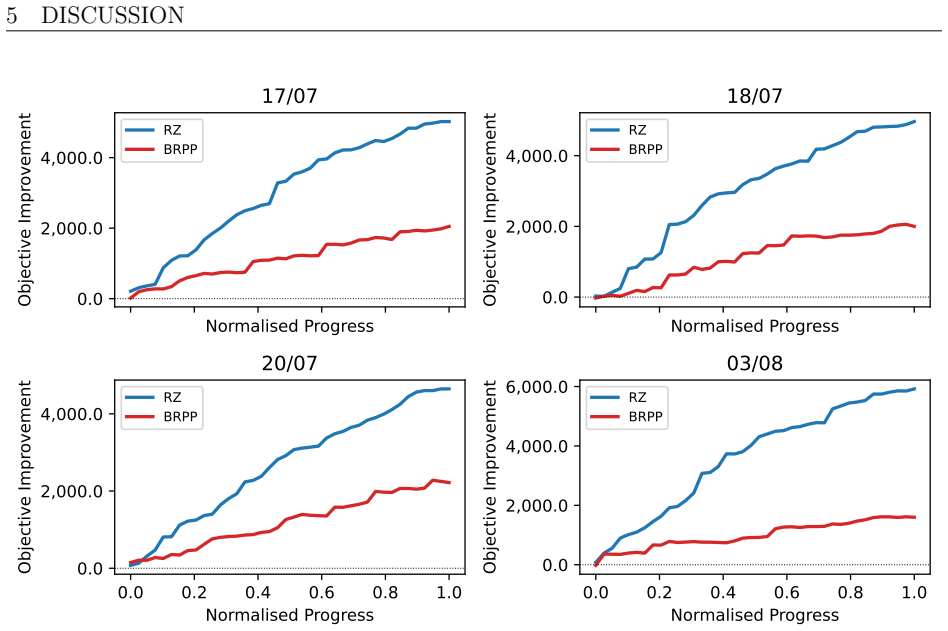
Regulation Zero 2 is a flow-centric framework that optimizes compatible sequences of regulations using hierarchical MCTS, where hotspot sampling and local proposals are scored by fast FPFS to find effective plans. On multiple summer-peak traffic days, it outperforms flight-centric simulated annealing and NSGA-II in objective improvements while limiting the scope of network impact. Ablations reveal that regulation cascading can reduce up to 50% of potential effectiveness, underscoring the value of sequential compatibility-aware planning.
What carries the argument
Hierarchical Monte Carlo Tree Search that first identifies congestion hotspots and then selects regulation proposals from a local engine, with rewards estimated by a fast First-Planned-First-Served allocator.
If this is right
- Ordered regulation sequences can be found that are compatible with existing slot-allocation systems such as CASA and RBS++.
- The planner achieves consistent performance improvements across various pan-European summer-peak traffic scenarios.
- A tighter scope of impact on the network is maintained compared to flight-centric optimization approaches.
- FPFS fairness is preserved while supporting the injection of expert knowledge into the planning process.
Where Pith is reading between the lines
- Applying similar sequential planning to other domains with cascading constraints, like railway scheduling or supply chain flows, could yield comparable benefits.
- Deploying this in operational ATFM systems might enable more automated, less disruptive regulation during high-demand periods.
- Testing the framework with real-time updates could extend its use beyond pre-tactical phases.
Load-bearing premise
The fast FPFS allocator supplies sufficiently accurate reward estimates to steer the MCTS toward effective global sequences, and the local proposal engine produces candidates that include the high-impact regulations.
What would settle it
If experiments on new peak traffic days show that Regulation Zero 2 does not deliver markedly higher objective improvements than the flight-centric baselines, the claim of effective cascading mitigation would be weakened.
Figures



read the original abstract
Air Traffic Flow Management (ATFM) traffic regulations are being increasingly used as rising demand meets persistent workforce shortages. This operational strain has amplified a critical phenomenon that we call \emph{regulation cascading}: the compounding, non-linear interactions that occur when multiple regulations influence one another in unpredictable ways. As the number and complexity of regulations grow, cascading effects become more pronounced, undermining the network operator's ability to protect sectors reliably. To address this challenge, we introduce Regulation Zero 2, an updated sequential planning framework that natively operates in the regulation space, optimizing over ordered sequences of flow-level regulations that remain compatible as much as possible with existing slot-allocation systems such as CASA and RBS++. We equipped Regulation Zero 2 with new heuristics to render flow finding more efficient. At its core, the method employs a hierarchical Monte Carlo Tree Search (MCTS) that first samples congestion hotspots and then selects candidate regulations synthesized by a local proposal engine. Each proposal is evaluated by a fast First-Planned-First-Served (FPFS) allocator to estimate its reward, with these feedbacks guiding the subsequent MCTS exploration. Experiments on many pan-European summer-peak traffic days that Regulation Zero delivers promising and consistent performance. Compared to a flight-centric simulated-annealing and NSGA-II baselines, it achieves markedly higher objective improvements, while maintaining a tighter scope of impact on the network. Ablation studies also found that Regulation Cascading could reduce up to 50\% of potential effectiveness. RZ also preserves FPFS fairness and supports expert knowledge injection, offering a pragmatic and low-disruption pathway toward automation in operations.
Editorial analysis
A structured set of objections, weighed in public.
Referee Report
Summary. The manuscript introduces Regulation Zero 2, a flow-centric sequential planning framework for pre-tactical air traffic flow management that employs hierarchical Monte Carlo Tree Search (MCTS) over ordered sequences of flow-level regulations. Proposals are generated by a local engine and evaluated via a fast FPFS allocator to estimate rewards, with the goal of mitigating regulation cascading effects. Experiments on pan-European summer-peak traffic days are reported to show markedly higher objective improvements than flight-centric simulated-annealing and NSGA-II baselines, a tighter network impact scope, and an ablation indicating that cascading can reduce up to 50% of potential effectiveness, while preserving FPFS fairness.
Significance. If the performance claims and proxy validity hold, the framework could provide a pragmatic, low-disruption pathway for automating regulation planning in ATFM operations that respects existing slot-allocation systems. The explicit modeling of cascading interactions and use of MCTS for sequence optimization address a real and growing operational strain from rising demand and workforce shortages.
major comments (2)
- [Abstract and Experiments section] Abstract and Experiments section: The central claim of superior performance rests on FPFS serving as a faithful reward proxy inside the MCTS tree search. No demonstration is given that FPFS rankings or relative magnitudes correlate with outcomes from the operational allocator (CASA/RBS++) on identical candidate sets, despite the abstract noting that cascading effects are non-linear and can reduce effectiveness by 50%. This is load-bearing for the claim that the hierarchical MCTS yields globally effective sequences.
- [Experiments section] Experiments section: The abstract asserts 'promising and consistent performance' and 'markedly higher objective improvements' across 'many' pan-European summer-peak days, yet supplies no details on the exact number of days, the precise objective function, statistical significance testing, variance across instances, or controls against post-hoc selection of favorable scenarios. Without these, the reported gains cannot be independently verified or compared to the baselines.
minor comments (1)
- [Abstract] Abstract: The sentence beginning 'Experiments on many pan-European summer-peak traffic days that Regulation Zero delivers...' is grammatically incomplete and should be revised for clarity (e.g., insert 'show that').
Simulated Author's Rebuttal
We thank the referee for the constructive feedback and the recommendation for major revision. The comments highlight important aspects of proxy validation and experimental transparency that we will address to strengthen the manuscript. Below we respond point by point to the major comments.
read point-by-point responses
-
Referee: [Abstract and Experiments section] Abstract and Experiments section: The central claim of superior performance rests on FPFS serving as a faithful reward proxy inside the MCTS tree search. No demonstration is given that FPFS rankings or relative magnitudes correlate with outcomes from the operational allocator (CASA/RBS++) on identical candidate sets, despite the abstract noting that cascading effects are non-linear and can reduce effectiveness by 50%. This is load-bearing for the claim that the hierarchical MCTS yields globally effective sequences.
Authors: We agree that demonstrating the correlation between FPFS-based rewards and those from an operational allocator such as CASA/RBS++ would provide stronger support for the proxy's validity, particularly given the non-linear cascading effects noted in the ablation. FPFS was selected as the reward estimator because it is computationally efficient, deterministic, and preserves the first-planned-first-served fairness principle central to existing slot allocation systems, enabling scalable MCTS search. The 50% effectiveness reduction from cascading was quantified via ablation under this same proxy. In the revised manuscript we will add a dedicated validation subsection that applies both FPFS and a re-implemented CASA-like allocator to the same set of candidate regulation sequences drawn from the test instances, reporting rank correlation (Spearman) and relative objective error to quantify alignment. revision: yes
-
Referee: [Experiments section] Experiments section: The abstract asserts 'promising and consistent performance' and 'markedly higher objective improvements' across 'many' pan-European summer-peak days, yet supplies no details on the exact number of days, the precise objective function, statistical significance testing, variance across instances, or controls against post-hoc selection of favorable scenarios. Without these, the reported gains cannot be independently verified or compared to the baselines.
Authors: We concur that greater specificity is required for independent verification and fair comparison with the baselines. The current abstract and Experiments section use the term 'many' without enumerating the instances or providing supporting statistics. In the revision we will (i) state the exact number of pan-European summer-peak days evaluated, (ii) give a formal mathematical definition of the objective function, (iii) report mean performance together with variance (standard deviation) across all instances, (iv) include statistical significance tests (e.g., paired t-tests or Wilcoxon signed-rank tests with p-values) against the simulated-annealing and NSGA-II baselines, and (v) describe the day-selection criteria and confirm that no post-hoc filtering of favorable scenarios occurred. These additions will appear in both the abstract and the expanded Experiments section. revision: yes
Circularity Check
No significant circularity; framework and claims are self-contained against external benchmarks
full rationale
The paper describes a hierarchical MCTS framework that samples hotspots, proposes regulations via a local engine, and evaluates each via an external fast FPFS allocator to obtain rewards that guide search. Performance is assessed via direct comparison to independent flight-centric baselines (simulated annealing and NSGA-II) on pan-European traffic data, plus ablation studies on cascading. No equations or steps reduce a claimed result to a fitted parameter or self-citation by construction; FPFS is treated as an independent proxy rather than derived from the method itself. The 50% cascading reduction is reported as an experimental observation, not a definitional tautology. The derivation chain therefore remains non-circular and externally falsifiable.
Axiom & Free-Parameter Ledger
free parameters (1)
- MCTS exploration parameters
axioms (1)
- domain assumption FPFS allocator provides reliable reward estimates for regulation sequences
Reference graph
Works this paper leans on
- [1]
- [2]
- [3]
-
[4]
12th SESAR Innovation Days (SID) , address =
Optimal Air Traffic Flow Management Regulations Scheme with Adaptive Large Neighbourhood Search , author =. 12th SESAR Innovation Days (SID) , address =. 2022 , note =
work page 2022
-
[5]
11th SESAR Innovation Days (SID) , year =
Dalmau, Ramon and Zerrouki, Zinedine and Anoraud, Camille and Smith, Duncan and Cramet, Benjamin , title =. 11th SESAR Innovation Days (SID) , year =
-
[6]
Octavio Richetta and Amedeo R. Odoni , title =. Transportation Science , year =
-
[7]
Peter B. Vranas and Dimitris J. Bertsimas and Amedeo R. Odoni , title =. Operations Research , year =
-
[8]
Dimitris Bertsimas and Sarah Stock Patterson , title =. Operations Research , year =
-
[9]
Transportation Science , year =
Dimitris Bertsimas and Sarah Stock Patterson , title =. Transportation Science , year =
- [10]
- [11]
-
[12]
Alexander Lau and Robert Budde and Jan Berling and Volker Gollnick , title =. Proceedings of the 29th Congress of the International Council of the Aeronautical Sciences (ICAS) , year =
-
[13]
Nikola Ivanov and Fedja Netjasov and Radosav Jovanovi. Air Traffic Flow Management Slot Allocation to Minimize Propagated Delay and Improve Airport Slot Adherence , journal =. 2017 , volume =
work page 2017
-
[14]
Transportation Research Part B: Methodological , year =
Jun Chen and Lijian Chen and Dengfeng Sun , title =. Transportation Research Part B: Methodological , year =
-
[15]
CEAS Aeronautical Journal , year =
Jan Berling and Alexander Lau and Volker Gollnick , title =. CEAS Aeronautical Journal , year =. doi:10.1007/s13272-023-00708-4 , note =
-
[16]
Transportation Research Part C: Emerging Technologies , year =
Wang, Yanjun and Liu, Chang and Wang, Hai and Duong, Vu , title =. Transportation Research Part C: Emerging Technologies , year =
-
[17]
Journal of Air Transport Management , year =
Liu, Wenjing and Zhao, Qiuhong and Delahaye, Daniel , title =. Journal of Air Transport Management , year =
- [18]
-
[19]
An Auction-Based Mechanism for a Privacy-Preserving Marketplace for ATFM Slots , booktitle =
Sch. An Auction-Based Mechanism for a Privacy-Preserving Marketplace for ATFM Slots , booktitle =. 2022 , address =
work page 2022
-
[20]
Multi-Objective Air Traffic Flow Management Through Lexicographic Optimisation , booktitle =
Dalmau, Ricard and Kyne, Sin. Multi-Objective Air Traffic Flow Management Through Lexicographic Optimisation , booktitle =. 2024 , address =
work page 2024
- [21]
-
[22]
Liu, Fengfan and Hu, Minghua and Zhang, Qingxian and Yang, Lei , title =. Aerospace , year =
-
[23]
Transactions of the Japan Society for Aeronautical and Space Sciences , year =
Liu, Chang and Liao, Chaohao and Hang, Xu and Wang, Yanjun and Delahaye, Daniel , title =. Transactions of the Japan Society for Aeronautical and Space Sciences , year =
- [24]
-
[25]
Transportation Research Part D: Transport and Environment , year =
Feng, Huilin and Hu, Rong and Wang, Deyun and Zhang, Junfeng and Wu, Chuntao , title =. Transportation Research Part D: Transport and Environment , year =
-
[26]
Journal of Air Transport Management , year =
Lee, Heeyeon and Jung, Jihyeok and Lee, Deok-Joo , title =. Journal of Air Transport Management , year =
-
[27]
Computers & Industrial Engineering , year =
Tian, Jing and Hao, Xinchang and Huang, Jibo and Huang, Jinglei and Gen, Mitsuo , title =. Computers & Industrial Engineering , year =
-
[28]
Pellegrini, Paola and Castelli, Lorenzo and Pesenti, Raffaele , title =. 2011 , doi =
work page 2011
-
[29]
Abdelghany, Khaled F. and Abdelghany, Ahmed F. and Niznik, Tim , title =. Journal of Air Transport Management , year =
-
[30]
IEEE Computational Intelligence Magazine , year =
Chaimatanan, Supatcha and Delahaye, Daniel and Mongeau, Marie , title =. IEEE Computational Intelligence Magazine , year =
-
[31]
Proceedings of the 2007 IEEE Intelligent Transportation Systems Conference (ITSC) , year =
Zhang, Xuejun and Zhou, Yan and Liu, Bo and Wang, Zheng , title =. Proceedings of the 2007 IEEE Intelligent Transportation Systems Conference (ITSC) , year =. doi:10.1109/ITSC.2007.4357707 , isbn =
-
[32]
International Conference on Machine Learning , pages=
Monte-Carlo tree search as regularized policy optimization , author=. International Conference on Machine Learning , pages=. 2020 , organization=
work page 2020
-
[33]
Modeling purposeful adaptive behavior with the principle of maximum causal entropy , author=. 2010 , publisher=
work page 2010
- [34]
-
[35]
A general reinforcement learning algorithm that masters chess, shogi, and Go through self-play , author=. Science , volume=. 2018 , publisher=
work page 2018
-
[36]
Proceedings of the International Conference on Automated Planning and Scheduling , volume=
PROST: Probabilistic planning based on UCT , author=. Proceedings of the International Conference on Automated Planning and Scheduling , volume=
-
[37]
From Louvain to Leiden: guaranteeing well-connected communities , author=. Scientific reports , volume=. 2019 , publisher=
work page 2019
-
[38]
International conference on machine learning , pages=
Soft actor-critic: Off-policy maximum entropy deep reinforcement learning with a stochastic actor , author=. International conference on machine learning , pages=. 2018 , organization=
work page 2018
-
[39]
Selective simulated annealing for large scale airspace congestion mitigation , author=. Aerospace , volume=. 2021 , publisher=
work page 2021
-
[40]
MATEC Web of Conferences , volume=
Multi-objective optimization approach for air traffic flow management , author=. MATEC Web of Conferences , volume=
-
[41]
Air Transportation R&D Symposium 2026 , year=
A Flow-Centric Approach for Network-Level ATFM Delay Optimization and Hotspot Resolution Using Hierarchical Monte Carlo Tree Search , author=. Air Transportation R&D Symposium 2026 , year=
work page 2026
-
[42]
Handbook of metaheuristics , pages=
Simulated annealing: From basics to applications , author=. Handbook of metaheuristics , pages=. 2018 , publisher=
work page 2018
-
[43]
Lavandier, Julien and Islami, Arianit and Delahaye, Daniel and Chaimatanan, Supatcha and Abecassis, Amir , TITLE =. Aerospace , VOLUME =. 2021 , NUMBER =
work page 2021
discussion (0)
Sign in with ORCID, Apple, or X to comment. Anyone can read and Pith papers without signing in.