Recognition: unknown
Abstract null hypersurfaces and characteristic initial value problems in General Relativity
Pith reviewed 2026-05-10 01:59 UTC · model grok-4.3
The pith
Hypersurface data formalism unifies detached analysis of characteristic Cauchy problems and null hypersurface structures in general relativity.
A machine-rendered reading of the paper's core claim, the machinery that carries it, and where it could break.
Core claim
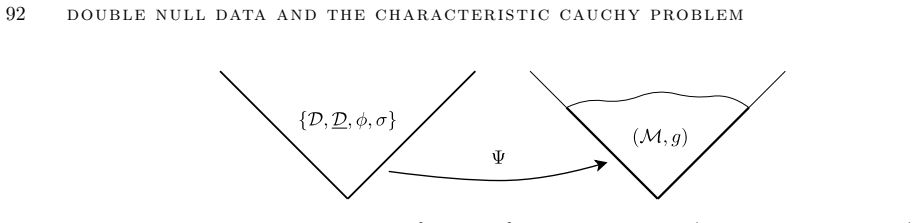
The central claim is that after reviewing and further developing the hypersurface data formalism in Chapter 2, the thesis uses it to analyze the characteristic Cauchy problem from a fully detached perspective in Chapter 3, the Killing initial data problem in Chapter 4, the transverse metric expansion at a general null hypersurface in Chapter 5, and the geometry of conformal null infinity in Chapter 6, with the formalism serving as the single consistent thread throughout.
What carries the argument
The hypersurface data formalism, which encodes geometric data on an abstract null hypersurface independently of the surrounding spacetime.
If this is right
- The characteristic Cauchy problem admits a detached formulation based solely on hypersurface data.
- Killing initial data conditions can be stated using only the data on the null hypersurface.
- The transverse expansion of the metric follows directly from the hypersurface data at null surfaces.
- The geometry of conformal null infinity is characterized through the same formalism.
Where Pith is reading between the lines
- The detached approach may simplify characteristic-based numerical methods in relativity by reducing dependence on full spacetime coordinates.
- It could extend naturally to include matter sources or higher-dimensional spacetimes while preserving the unifying structure.
- Connections might emerge to asymptotic flatness conditions in other gravitational settings.
Load-bearing premise
The hypersurface data formalism can be consistently extended and applied across the characteristic Cauchy problem, Killing initial data, metric expansions, and conformal null infinity without introducing unstated inconsistencies.
What would settle it
An explicit inconsistency arising when the formalism is applied to derive the transverse metric expansion or the geometry at conformal null infinity that cannot be resolved within the stated framework.
Figures



read the original abstract
This thesis is framed within the field of Mathematical Relativity and is organized into six chapters. After an introduction to the topic in Chapter 1, Chapter 2 reviews and further develops the formalism of hypersurface data, which provides the unifying framework for the entire thesis. In Chapter 3 we study the characteristic Cauchy problem from a fully detached perspective. Chapter 4 is devoted to the Killing initial data problem, also analyzed within this detached framework. In Chapter 5 we investigate the transverse (or asymptotic) expansion of the metric at a general null hypersurface. Finally, Chapter 6 addresses the geometry of conformal null infinity.
Editorial analysis
A structured set of objections, weighed in public.
Referee Report
Summary. This thesis develops a hypersurface data formalism in Chapter 2 as a unifying, detached framework for null hypersurface problems in mathematical relativity. It applies this to the characteristic Cauchy problem (Ch. 3), the Killing initial data problem (Ch. 4), the transverse metric expansion at general null hypersurfaces (Ch. 5), and the geometry of conformal null infinity (Ch. 6).
Significance. If the central unification claim holds without unstated extensions, the work supplies a consistent, coordinate-independent treatment of characteristic initial-value problems and asymptotic structures that could streamline analyses of null boundaries and conformal completions in GR. The explicit development of the formalism and its application across multiple distinct problems is a strength.
major comments (2)
- [Chapter 6] Chapter 6: The claim that the hypersurface data formalism of Ch. 2 supplies a direct, detached treatment of conformal null infinity is load-bearing for the unification thesis. Standard treatments impose a conformal factor Ω with Ω=0 on I, specific fall-off rates for the metric and curvature, and the universal structure at I. The manuscript must show explicitly (e.g., via the data sets defined in Ch. 2) that these are either derived from the general hypersurface data or that no additional fields/constraints are introduced; otherwise the “unifying framework” reduces to a loose analogy rather than a verbatim application.
- [Chapter 2] Chapter 2, definition of hypersurface data: The formalism is presented as general, yet its application to conformal infinity in Ch. 6 appears to require asymptotic conditions not encoded in the basic data. If these conditions are added separately, the paper should state the precise extension and verify that it preserves the detached character claimed for the earlier chapters.
minor comments (2)
- Ensure consistent notation for the hypersurface data across chapters; cross-references from Ch. 3–6 back to the definitions in Ch. 2 would improve readability.
- [Chapter 5] Chapter 5: The transverse expansion is analyzed at a general null hypersurface; clarify whether the expansion coefficients are uniquely determined by the hypersurface data or require additional gauge choices.
Simulated Author's Rebuttal
We thank the referee for their thorough review and valuable feedback on our manuscript. We address each of the major comments below and outline the revisions we will make to strengthen the presentation of the unifying framework.
read point-by-point responses
-
Referee: [Chapter 6] Chapter 6: The claim that the hypersurface data formalism of Ch. 2 supplies a direct, detached treatment of conformal null infinity is load-bearing for the unification thesis. Standard treatments impose a conformal factor Ω with Ω=0 on I, specific fall-off rates for the metric and curvature, and the universal structure at I. The manuscript must show explicitly (e.g., via the data sets defined in Ch. 2) that these are either derived from the general hypersurface data or that no additional fields/constraints are introduced; otherwise the “unifying framework” reduces to a loose analogy rather than a verbatim application.
Authors: We appreciate the referee's emphasis on this crucial aspect of our unification claim. Upon re-examination, we agree that the explicit derivation of the standard conformal null infinity data from the general hypersurface data sets of Chapter 2 should be made more transparent. In the revised manuscript, we will add a dedicated subsection in Chapter 6 that maps the general hypersurface data (including the choice of the null hypersurface, the induced metric, and the connection forms) directly to the conformal factor Ω vanishing on I, the fall-off conditions, and the universal structure. This will demonstrate that no additional fields or constraints beyond those already present in the formalism are required, thereby confirming the verbatim application rather than analogy. revision: yes
-
Referee: [Chapter 2] Chapter 2, definition of hypersurface data: The formalism is presented as general, yet its application to conformal infinity in Ch. 6 appears to require asymptotic conditions not encoded in the basic data. If these conditions are added separately, the paper should state the precise extension and verify that it preserves the detached character claimed for the earlier chapters.
Authors: The referee correctly identifies a potential point of confusion. The hypersurface data in Chapter 2 is defined in a fully general and detached manner, without reference to any specific asymptotic behavior. The asymptotic conditions for conformal null infinity are not extensions but rather specific choices within the general data: for instance, selecting the hypersurface to be at conformal infinity by setting the appropriate component of the data to encode Ω=0, and imposing the fall-offs as restrictions on the transverse expansion (as developed in Chapter 5). We will revise Chapter 2 to include a brief discussion of how the formalism accommodates such specializations while preserving its detached nature, and cross-reference this in Chapter 6 to verify consistency. revision: yes
Circularity Check
No significant circularity detected in derivation chain
full rationale
The thesis develops the hypersurface data formalism in Chapter 2 as the unifying framework and then applies it to the characteristic Cauchy problem (Ch. 3), Killing initial data (Ch. 4), transverse metric expansion (Ch. 5), and conformal null infinity (Ch. 6). No equations, definitions, or claims in the abstract or chapter structure reduce any result by construction to its own inputs, rename fitted parameters as predictions, or rely on load-bearing self-citations whose content is unverified. The framework is presented as an extension of standard GR and differential geometry tools, with each application treated as an independent analysis within the detached perspective; the derivation chain remains self-contained against external benchmarks.
Axiom & Free-Parameter Ledger
axioms (1)
- standard math Standard axioms of general relativity including Einstein's equations and differential geometry on manifolds
invented entities (1)
-
Hypersurface data formalism
no independent evidence
Reference graph
Works this paper leans on
-
[1]
More specifically, we compute the components of the tensorQ := r ( Hessg v +v Schg )
associated to the metric (C.7) withβ = 0. More specifically, we compute the components of the tensorQ := r ( Hessg v +v Schg ) . The computation has been done using thexAct package of Mathematica. We introduce the variables :=uv and we denote a derivative w.r.t. s with a dot. Qvv = u 4 ( 2(s trµ • µ−2r) • G G +s ( | • µ|2−2 trµ •• µ )) , Quv = v 4(r + 1) ...
-
[2]
B. P. Abbott, R Abbott, T. Abbott, M. Abernathy, F. Acernese, K Ackley, C Adams, T Adams, P. Addesso, R. Adhikariet al., ‘Binary black hole mergers in the first advanced LIGO observing run’, Physical Review X, vol. 6, p. 041015, 2016
2016
-
[3]
Adamo, E
T. Adamo, E. Casali and D. Skinner, ‘Ambitwistor strings and the scattering equations at one loop’, Journal of High Energy Physics, vol. 2014, pp. 1–34, 2014
2014
-
[4]
Adamo, E
T. Adamo, E. Casali and D. Skinner, ‘Perturbative gravity at null infinity’,Classical and Quantum Gravity, vol. 31, p. 225008, 2014
2014
-
[5]
Adamo, A
T. Adamo, A. Cristofoli, A. Ilderton and S. Klisch, ‘All order gravitational waveforms from scattering amplitudes’,Physical Review Letters, vol. 131, p. 011601, 2023
2023
-
[6]
W. S. Adams, ‘The relativity displacement of the spectral lines in the companion of Sirius’,Proceedings of the National Academy of Sciences, vol. 11, pp. 382–387, 1925
1925
-
[7]
S. Agrawal, P. Charalambous and L. Donnay, ‘Null infinity as an inverted extremal horizon: Matching an infinite set of conserved quantities for gravitational perturbations’,arXiv:2506.15526, 2025
-
[8]
Akiyama, A
K. Akiyama, A. Alberdi, W. Alef, K. Asada, R. Azulay, A.-K. Baczko, D. Ball, M. Baloković, J. Barrett, D. Bintleyet al., ‘First M87 event horizon telescope results. II. Array and instrumentation’, The Astrophysical Journal Letters, vol. 875, p. L2, 2019
2019
-
[9]
Bintleyet al., ‘First M87 event horizon telescope results
K.Akiyama,A.Alberdi,W.Alef,K.Asada,R.Azulay,A.-K.Baczko,D.Ball,M.Baloković,J.Barrett, D. Bintleyet al., ‘First M87 event horizon telescope results. III. Data processing and calibration’,The Astrophysical Journal Letters, vol. 875, p. L3, 2019
2019
-
[10]
Bintleyet al., ‘First M87 event horizon telescope results
K.Akiyama,A.Alberdi,W.Alef,K.Asada,R.Azulay,A.-K.Baczko,D.Ball,M.Baloković,J.Barrett, D. Bintleyet al., ‘First M87 event horizon telescope results. IV. Imaging the central supermassive black hole’,The Astrophysical Journal Letters, vol. 875, p. L4, 2019
2019
-
[11]
Akiyama, A
K. Akiyama, A. Alberdi, W. Alef, K. Asada, R. Azulay, A.-K. Baczko, D. Ball, M. Baloković, J. Barrett, D. Bintleyet al., ‘First M87 event horizon telescope results. VI. The shadow and mass of the central black hole’,The Astrophysical Journal Letters, vol. 875, p. L6, 2019
2019
-
[12]
Akiyama, J
K. Akiyama, J. C. Algaba, A. Alberdi, W. Alef, R. Anantua, K. Asada, R. Azulay, A.-K. Baczko, D. Ball, M. Balokovićet al., ‘First M87 event horizon telescope results. VII. Polarization of the ring’, The Astrophysical Journal Letters, vol. 910, p. L12, 2021
2021
-
[13]
Alcubierre, Introduction to 3 + 1 numerical relativity
M. Alcubierre, Introduction to 3 + 1 numerical relativity. Oxford University Press, 2008
2008
-
[14]
Alexakis, A
S. Alexakis, A. D. Ionescu and S. Klainerman, ‘Hawking’s local rigidity theorem without analyticity’, Geometric and Functional Analysis, vol. 20, pp. 845–869, 2010
2010
-
[15]
N. d. A. Alves, ‘Lectures on the Bondi–Metzner–Sachs group and related topics in infrared physics’, arXiv:2504.12521, 2025
work page internal anchor Pith review arXiv 2025
-
[16]
A. J. Amsel, G. T. Horowitz, D. Marolf and M. M. Roberts, ‘Uniqueness of extremal Kerr and Kerr- Newman black holes’,Physical Review D, vol. 81, p. 024033, 2010
2010
- [17]
- [18]
- [19]
-
[20]
M. T. Anderson, ‘Existence and stability of even-dimensional asymptotically de Sitter spaces’,Annales Henri Poincaré, vol. 6, pp. 801–820, 2005
2005
-
[21]
M.T.AndersonandP.T.Chruściel,‘AsymptoticallysimplesolutionsofthevacuumEinsteinequations in even dimensions’,Communications in Mathematical Physics, vol. 260, pp. 557–577, 2005
2005
-
[22]
hyperboloidal
L. Andersson and P. T. Chruściel, ‘On “hyperboloidal” Cauchy data for vacuum Einstein equations and obstructions to smoothness of scri’,Communications in Mathematical Physics, vol.161, pp. 533– 568, 1994. 309 310 references
1994
-
[23]
Andersson, P
L. Andersson, P. T. Chruściel and H. Friedrich, ‘On the regularity of solutions to the Yamabe equation and the existence of smooth hyperboloidal initial data for Einstein’s field equations’,Communications in Mathematical Physics, vol. 149, pp. 587–612, 1992
1992
-
[24]
Aretakis, S
S. Aretakis, S. Czimek and I. Rodnianski, ‘The characteristic gluing problem for the Einstein vacuum equations: Linear and nonlinear analysis’,Annales Henri Poincaré, vol. 25, pp. 3081–3205, 2024
2024
-
[25]
Aretakis, S
S. Aretakis, S. Czimek and I. Rodnianski, ‘The characteristic gluing problem for the Einstein equations and applications’,Duke Mathematical Journal, vol. 174, pp. 355–402, 2025
2025
-
[26]
Arnowitt, S
R. Arnowitt, S. Deser and C. W. Misner, ‘Republication of: The dynamics of General Relativity’, General Relativity and Gravitation, vol. 40, p. 1997, 2008
1997
-
[27]
A.Ashtekar,‘Radiativedegreesoffreedomofthegravitationalfieldinexactgeneralrelativity’, Journal of Mathematical Physics, vol. 22, pp. 2885–2895, 1981
1981
-
[28]
Ashtekar, ‘Geometry and physics of null infinity’,Surveys in Differential Geometry, vol.20, pp
A. Ashtekar, ‘Geometry and physics of null infinity’,Surveys in Differential Geometry, vol.20, pp. 99– 122, 2015
2015
-
[29]
Ashtekar, C
A. Ashtekar, C. Beetle, O. Dreyer, S. Fairhurst, B. Krishnan, J. Lewandowski and J. Wiśniewski, ‘Generic isolated horizons and their applications’,Physical Review Letters, vol. 85, p. 3564, 2000
2000
-
[30]
Ashtekar, C
A. Ashtekar, C. Beetle and J. Lewandowski, ‘Geometry of generic isolated horizons’,Classical and Quantum Gravity, vol. 19, p. 1195, 2002
2002
-
[31]
Ashtekar, M
A. Ashtekar, M. Campiglia and A. Laddha, ‘Null infinity, the BMS group and infrared issues’,General Relativity and Gravitation, vol. 50, p. 140, 2018
2018
-
[32]
Ashtekar, S
A. Ashtekar, S. Fairhurst and B. Krishnan, ‘Isolated horizons: Hamiltonian evolution and the first law’,Physical Review D, vol. 62, p. 104025, 2000
2000
-
[33]
Ashtekar and S
A. Ashtekar and S. Speziale, ‘Null infinity as a weakly isolated horizon’,Physical Review D, vol. 110, p. 044048, 2024
2024
-
[34]
Bahuaud, S
E. Bahuaud, S. Gunasekaran, H. K. Kunduri and E. Woolgar, ‘Static near-horizon geometries and rigidity of quasi-Einstein manifolds’,Letters in Mathematical Physics, vol. 112, p. 116, 2022
2022
-
[35]
M. S. Baouendi and C. Goulaouic, ‘Singular nonlinear Cauchy problems’,Journal of Differential Equations, vol. 22, pp. 268–291, 1976
1976
-
[36]
J. M. Bardeen, B. Carter and S. W. Hawking, ‘The four laws of black hole mechanics’,Communications in Mathematical Physics, vol. 31, pp. 161–170, 1973
1973
-
[37]
Baumann, Cosmology
D. Baumann, Cosmology. Cambridge University Press, 2022
2022
-
[38]
Beig and P
R. Beig and P. T. Chrusciel, ‘Killing initial data’,Classical and Quantum Gravity, vol. 14, A83–A92, 1997
1997
-
[39]
A. L. Besse, Einstein manifolds. Springer Science & Business Media, 2007
2007
-
[40]
Bieri, ‘New effects in gravitational waves and memory’,Physical Review D, vol
L. Bieri, ‘New effects in gravitational waves and memory’,Physical Review D, vol. 103, p. 024043, 2021
2021
-
[41]
Bieri and D
L. Bieri and D. Garfinkle, ‘Perturbative and gauge invariant treatment of gravitational wave memory’, Physical Review D, vol. 89, p. 084039, 2014
2014
-
[42]
Bonazzola, E
S. Bonazzola, E. Gourgoulhon, P. Grandclement and J. Novak, ‘Constrained scheme for the Einstein equations based on the Dirac gauge and spherical coordinates’,Physical Review D, vol.70, p. 104007, 2004
2004
-
[43]
Bondi, M
H. Bondi, M. G. J. Van der Burg and A. W. K. Metzner, ‘Gravitational waves in General Relativity, VII. Waves from axi-symmetric isolated system’,Proceedings of the Royal Society of London. Series A. Mathematical and Physical Sciences, vol. 269, pp. 21–52, 1962
1962
-
[44]
Bondi, M
H. Bondi, M. G. J. Van der Burg and A. Metzner, ‘Gravitational waves in general relativity, VII. Waves from axi-symmetric isolated system’,Proceedings of the Royal Society of London. Series A. Mathematical and Physical Sciences, vol. 269, pp. 21–52, 1962
1962
-
[45]
Bondi, F
H. Bondi, F. A. Pirani and I. Robinson, ‘Gravitational waves in general relativity III. Exact plane waves’,Proceedings of the Royal Society of London. Series A. Mathematical and Physical Sciences, vol. 251, pp. 519–533, 1959
1959
-
[46]
Booth, ‘Spacetime near isolated and dynamical trapping horizons’,Physical Review D, vol
I. Booth, ‘Spacetime near isolated and dynamical trapping horizons’,Physical Review D, vol. 87, p. 024008, 2013
2013
-
[47]
Borghini, P
S. Borghini, P. T. Chruściel and L. Mazzieri, ‘On the uniqueness of Schwarzschild–de Sitter spacetime’, Archive for Rational Mechanics and Analysis, vol. 247, p. 22, 2023. references 311
2023
-
[48]
Borthwick, E
J. Borthwick, E. Gourgoulhon and J.-P. Nicolas, ‘Peeling at extreme black hole horizons’,Journal of Hyperbolic Differential Equations, vol. 22, pp. 29–62, 2025
2025
-
[49]
Bott, ‘Lectures on Morse theory, old and new’,Bulletin of the American Mathematical Society, vol
R. Bott, ‘Lectures on Morse theory, old and new’,Bulletin of the American Mathematical Society, vol. 7, pp. 331–358, 1982
1982
-
[50]
Van der Burg, ‘Gravitational waves in general relativity IX
M. Van der Burg, ‘Gravitational waves in general relativity IX. Conserved quantities’,Proceedings of the Royal Society of London. Series A. Mathematical and Physical Sciences, vol. 294, pp. 112–122, 1966
1966
-
[51]
Cabet, P
A. Cabet, P. T. Chruściel and R. T. Wafo, ‘On the characteristic initial value problem for nonlinear symmetric hyperbolic systems, including Einstein equations’,Dissertationes Mathematicae, vol. 515, pp. 1–67, 2016
2016
-
[52]
Evidence for a New Soft Graviton Theorem
F. Cachazo and A. Strominger, ‘Evidence for a new soft graviton theorem’,arXiv:1404.4091, 2014
work page Pith review arXiv 2014
-
[53]
Campiglia and A
M. Campiglia and A. Laddha, ‘Asymptotic symmetries and subleading soft graviton theorem’,Physical Review D, vol. 90, 2014
2014
-
[54]
Campoleoni, A
A. Campoleoni, A. Delfante, D. Francia and C. Heissenberg, ‘Finite actions and asymptotic charges at null infinity for any spin’,Physics Letters B, p. 139908, 2025
2025
-
[55]
Capone, P
F. Capone, P. Mitra, A. Poole and B. Tomova, ‘Phase space renormalization and finite BMS charges in six dimensions’,Journal of High Energy Physics, vol. 2023, pp. 1–75, 2023
2023
-
[56]
Carlotto, ‘The general relativistic constraint equations’,Living Reviews in Relativity, vol
A. Carlotto, ‘The general relativistic constraint equations’,Living Reviews in Relativity, vol. 24, p. 2, 2021
2021
-
[57]
Carter, ‘Axisymmetric black hole has only two degrees of freedom’,Physical Review Letters, vol.26, p
B. Carter, ‘Axisymmetric black hole has only two degrees of freedom’,Physical Review Letters, vol.26, p. 331, 1971
1971
-
[58]
Choquet-Bruhat, P
Y. Choquet-Bruhat, P. T. Chruściel and J. M. Martín-García, ‘The Cauchy problem on a characteristic cone for the Einstein equations in arbitrary dimensions’,Annales Henri Poincaré, vol.12, pp. 419–482, 2011
2011
-
[59]
Choquet-Bruhat, ‘Théorème d’existence pour certains systèmes d’équations aux dérivées partielles non linéaires’,Acta Mathematica, vol
Y. Choquet-Bruhat, ‘Théorème d’existence pour certains systèmes d’équations aux dérivées partielles non linéaires’,Acta Mathematica, vol. 88, pp. 141–225, 1952
1952
-
[60]
Choquet-Bruhat, General relativity and the Einstein equations
Y. Choquet-Bruhat, General relativity and the Einstein equations. Oxford University Press, 2009
2009
-
[61]
Choquet-Bruhat and R
Y. Choquet-Bruhat and R. Geroch, ‘Global aspects of the Cauchy problem in general relativity’, Communications in Mathematical Physics, vol. 14, pp. 329–335, 1969
1969
-
[62]
Christodoulou, ‘The formation of black holes in General Relativity’,XVIth International Congress on Mathematical Physics, pp
D. Christodoulou, ‘The formation of black holes in General Relativity’,XVIth International Congress on Mathematical Physics, pp. 45–55, 2010
2010
-
[63]
Séminaire Goulaouic-Schwartz
D. Christodoulou and S. Klainerman, ‘The global nonlinear stability of the Minkowski space’,Sémin- aire Équations aux dérivées partielles (Polytechnique) dit aussi “Séminaire Goulaouic-Schwartz”,pp.1– 29, 1993
1993
-
[64]
Christodoulou, ‘Nonlinear nature of gravitation and gravitational-wave experiments’,Physical Re- view Letters, vol
D. Christodoulou, ‘Nonlinear nature of gravitation and gravitational-wave experiments’,Physical Re- view Letters, vol. 67, p. 1486, 1991
1991
-
[65]
P. T. Chruściel and T.-T. Paetz, ‘The many ways of the characteristic Cauchy problem’,Classical and Quantum Gravity, vol. 29, 2012
2012
-
[66]
P. T. Chrusciel, ‘Uniqueness of stationary, electrovacuum black holes revisited’,Helvetica Physica Acta, vol. 69, pp. 529–552, 1996
1996
-
[67]
P. T. Chrusciel, ‘On analyticity of static vacuum metrics at nondegenerate horizons’,Acta Physica Polonica B, vol. 36, pp. 17–26, 2005
2005
-
[68]
P. T. Chruściel,Geometry of black holes. Oxford University Press, 2020
2020
- [69]
-
[70]
P. T. Chruściel, W. Cong and F. Gray, ‘Characteristic gluing withΛ: III. High-differentiability non- linear gluing’,Communications in Mathematical Physics, vol. 407, p. 23, 2026
2026
-
[71]
P. T. Chrusciel and J. a. L. Costa, ‘On uniqueness of stationary vacuum black holes’, inGéométrie différentielle, physique mathématique, mathématiques et société (I) : Volume en l’honneur de Jean Pierre Bourguignon, ser. Astérisque, H. Oussama, Ed., Société mathématique de France, 2008, pp. 195– 265
2008
-
[72]
P. T. Chruściel, M. A. MacCallum and D. B. Singleton, ‘Gravitational waves in general relativity XIV. Bondi expansions and the ‘polyhomogeneity’ ofI’,Philosophical Transactions of the Royal Society of London. Series A: Physical and Engineering Sciences, vol. 350, pp. 113–141, 1995. 312 references
1995
-
[73]
P. T. Chruściel and M. Mars, ‘On staticity of bifurcate Killing horizons’,Classical and Quantum Gravity, vol. 40, p. 225012, 2023
2023
-
[74]
P. T. Chruściel and L. Nguyen, ‘A uniqueness theorem for degenerate Kerr–Newman black holes’, Annales Henri Poincaré, vol. 11, pp. 585–609, 2010
2010
-
[75]
P. T. Chruściel and T.-T. Paetz, ‘KIDs like cones’,Classical and Quantum Gravity, vol.30, p. 235036, 2013
2013
-
[76]
P. T. Chruściel and T.-T. Paetz, ‘Characteristic initial data and smoothness of Scri. I. Framework and results’,Annales Henri Poincaré, vol. 16, pp. 2131–2162, 2015
2015
-
[77]
P. T. Chruściel, H. S. Reall and P. Tod, ‘On non-existence of static vacuum black holes with degenerate components of the event horizon’,Classical and Quantum Gravity, vol. 23, p. 549, 2005
2005
-
[78]
P. T. Chruściel and W. Simon, ‘Towards the classification of static vacuum spacetimes with negative cosmological constant’,Journal of Mathematical Physics, vol. 42, pp. 1779–1817, 2001
2001
-
[79]
P. T. Chrusciel, R. T. Wafo and F. Gray, ‘The “neighborhood theorem” for the general relativistic characteristic Cauchy problem in higher dimension’,arXiv:2305.07306, 2023
-
[80]
P. T. Chrusciel and R. M. Wald, ‘On the topology of stationary black holes’,Classical and Quantum Gravity, vol. 11, 1994
1994
discussion (0)
Sign in with ORCID, Apple, or X to comment. Anyone can read and Pith papers without signing in.