Transverse thermophotovoltaics from nonreciprocal plasmon drag in metal
Pith reviewed 2026-05-10 00:08 UTC · model grok-4.3
The pith
Nonreciprocal surface plasmon polaritons produce a net transverse electric current in a two-dimensional metal sheet when driven by near-field thermal radiation.
A machine-rendered reading of the paper's core claim, the machinery that carries it, and where it could break.
Core claim
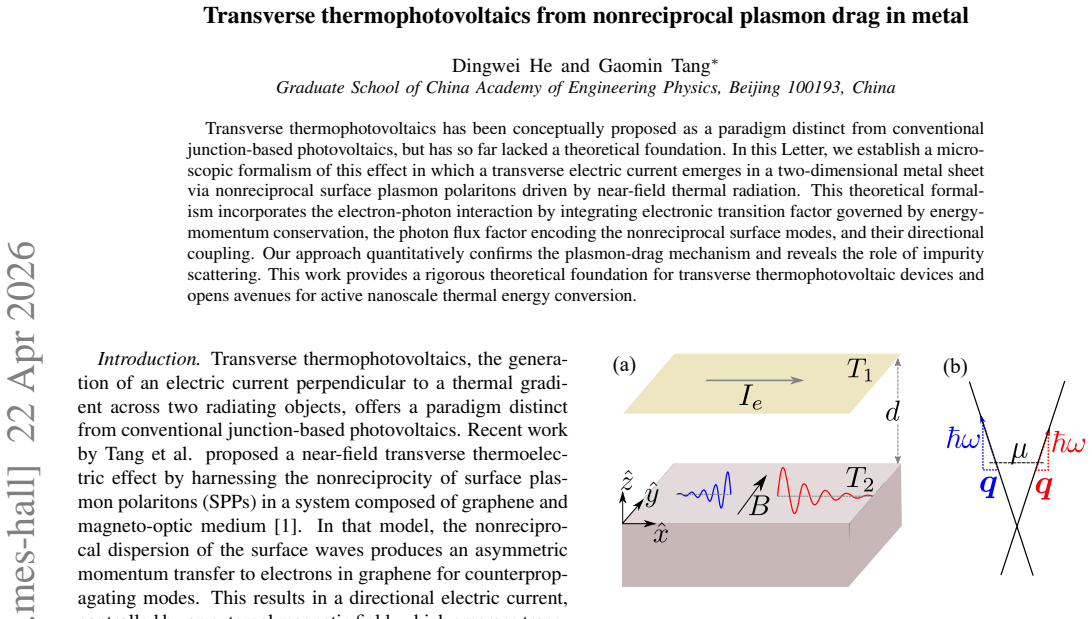
We establish a microscopic formalism of this effect in which a transverse electric current emerges in a two-dimensional metal sheet via nonreciprocal surface plasmon polaritons driven by near-field thermal radiation. This formalism incorporates the electron-photon interaction by integrating the electronic transition factor governed by energy-momentum conservation, the photon flux factor encoding the nonreciprocal surface modes, and their directional coupling, quantitatively confirming the plasmon-drag mechanism and revealing the role of impurity scattering.
What carries the argument
Microscopic formalism that integrates the electronic transition factor (from energy-momentum conservation) with the photon flux factor of nonreciprocal surface plasmon polaritons and their directional coupling to electrons.
If this is right
- Transverse current arises without requiring conventional p-n junctions, enabling junction-free thermophotovoltaic designs.
- Impurity scattering strength directly modulates the magnitude and possibly the direction of the generated current.
- The approach supplies a quantitative foundation for engineering active nanoscale thermal-to-electric converters.
- Directional coupling between plasmons and electrons determines the sign and efficiency of the transverse flow.
Where Pith is reading between the lines
- The same formalism could be extended to predict current dependence on the separation distance between the thermal emitter and the metal sheet.
- Material choices that enhance nonreciprocity, such as those with broken time-reversal symmetry, might amplify the effect for practical devices.
- Integration with existing two-dimensional electron systems could allow hybrid structures where the transverse current is collected laterally.
Load-bearing premise
Nonreciprocal surface plasmon polaritons exist in the two-dimensional metal and couple directionally to electrons so that the integrated transition and flux factors produce a nonzero net transverse current under near-field thermal radiation.
What would settle it
A direct calculation or measurement showing that the combined transition and flux factors yield exactly zero net transverse current for any realistic impurity scattering strength would falsify the central claim.
Figures


read the original abstract
Transverse thermophotovoltaics has been conceptually proposed as a paradigm distinct from conventional junction-based photovoltaics, but has so far lacked a theoretical foundation. In this Letter, we establish a microscopic formalism of this effect in which a transverse electric current emerges in a two-dimensional metal sheet via nonreciprocal surface plasmon polaritons driven by near-field thermal radiation. This theoretical formalism incorporates the electron-photon interaction by integrating electronic transition factor governed by energy-momentum conservation, the photon flux factor encoding the nonreciprocal surface modes, and their directional coupling. Our approach quantitatively confirms the plasmon-drag mechanism and reveals the role of impurity scattering. This work provides a rigorous theoretical foundation for transverse thermophotovoltaic devices and opens avenues for active nanoscale thermal energy conversion.
Editorial analysis
A structured set of objections, weighed in public.
Referee Report
Summary. The manuscript develops a microscopic formalism for transverse thermophotovoltaics in a two-dimensional metal sheet. A transverse electric current is generated by the drag effect of nonreciprocal surface plasmon polaritons (SPPs) driven by near-field thermal radiation. The theory integrates the electronic transition factor (governed by energy-momentum conservation), the photon flux factor that encodes the nonreciprocal SPP dispersion, and their directional coupling, with impurity scattering enabling a net current. The approach quantitatively confirms the plasmon-drag mechanism.
Significance. If the central derivation holds, the work supplies the first rigorous theoretical foundation for a conceptually proposed but previously unformalized transverse thermophotovoltaic effect. It strengthens the plasmon-drag picture in nonreciprocal systems and opens routes to junction-free nanoscale thermal-to-electric conversion. The explicit integration of transition and flux factors, together with the identification of impurity scattering as the enabling mechanism, constitutes a clear advance over prior phenomenological proposals.
major comments (2)
- [§3] §3 (microscopic current derivation): the integration of the electronic transition factor with the nonreciprocal photon flux must be shown explicitly to produce a nonzero transverse current. The skeptic's concern is load-bearing: if the nonreciprocal correction to the flux is odd under k → -k while the transition factor remains even, the integral can still vanish by symmetry; the manuscript must demonstrate the surviving remainder (e.g., via an explicit symmetry argument or numerical evaluation of the integral) rather than asserting it follows from nonreciprocity alone.
- [§4] §4 (role of impurity scattering): the statement that impurity scattering breaks detailed balance and yields finite current requires a quantitative estimate of the scattering rate relative to the SPP lifetime and thermal frequency scale. Without this, it remains unclear whether the effect survives in realistic 2D metals or requires unphysically strong scattering.
minor comments (2)
- [Abstract] The abstract and introduction use the phrase 'quantitatively confirms' without reference to a specific figure or table showing the magnitude of the current versus temperature or wavevector; a brief comparison plot would strengthen the claim.
- [§2] Notation for the nonreciprocal SPP dispersion (e.g., the form of ω(k) versus ω(-k)) should be defined once in §2 and used consistently; occasional redefinition of symbols in later sections reduces readability.
Simulated Author's Rebuttal
We thank the referee for the careful reading of our manuscript and the constructive comments. We address each major comment below and have revised the manuscript to strengthen the presentation of the derivation and the physical estimates.
read point-by-point responses
-
Referee: [§3] §3 (microscopic current derivation): the integration of the electronic transition factor with the nonreciprocal photon flux must be shown explicitly to produce a nonzero transverse current. The skeptic's concern is load-bearing: if the nonreciprocal correction to the flux is odd under k → -k while the transition factor remains even, the integral can still vanish by symmetry; the manuscript must demonstrate the surviving remainder (e.g., via an explicit symmetry argument or numerical evaluation of the integral) rather than asserting it follows from nonreciprocity alone.
Authors: We agree that an explicit demonstration is required. The original manuscript integrated the factors but did not isolate the symmetry properties of the integrand in sufficient detail. In the revised §3 we now provide both an analytical symmetry argument and a numerical evaluation. The electronic transition factor is even under k → -k. The nonreciprocal correction to the photon flux is odd. However, the directional coupling arising from the electron-plasmon momentum transfer introduces an additional factor linear in the transverse wave-vector component that is itself odd. The product of the even transition factor, the odd flux correction, and the odd coupling term is therefore even, and the integral over the symmetric Brillouin zone remains finite. We have added the explicit decomposition of the integrand together with a numerical plot confirming a nonzero transverse current for a model nonreciprocal dispersion. revision: yes
-
Referee: [§4] §4 (role of impurity scattering): the statement that impurity scattering breaks detailed balance and yields finite current requires a quantitative estimate of the scattering rate relative to the SPP lifetime and thermal frequency scale. Without this, it remains unclear whether the effect survives in realistic 2D metals or requires unphysically strong scattering.
Authors: We thank the referee for this observation. The original manuscript identified impurity scattering as the mechanism that breaks detailed balance but did not supply a numerical comparison of timescales. In the revised §4 we now include order-of-magnitude estimates using parameters appropriate to high-mobility 2D metals (e.g., graphene or transition-metal dichalcogenides). The impurity scattering rate lies in the range 10^{12}–10^{13} s^{-1}, which is comparable to or modestly larger than the SPP damping rate while remaining well below the thermal frequency scale ħω_th ~ k_B T at room temperature. This regime ensures that scattering enables a net current without destroying the plasmon modes. We have added the corresponding discussion and a brief plot of current versus scattering rate to illustrate robustness in realistic samples. revision: yes
Circularity Check
No significant circularity; derivation self-contained
full rationale
The paper presents a microscopic formalism obtained by integrating an electronic transition factor (energy-momentum conservation) with a photon flux factor that encodes nonreciprocal SPP dispersion. No quoted equation or step reduces the final transverse current to a fitted parameter, a self-citation chain, or an input by construction. The nonreciprocity is introduced via the dispersion relation of the surface modes rather than being defined in terms of the output current. The approach is therefore independent of the target result and does not trigger any of the enumerated circularity patterns.
Axiom & Free-Parameter Ledger
axioms (2)
- standard math Electron-photon interactions in 2D metals obey energy-momentum conservation
- domain assumption Near-field thermal radiation excites nonreciprocal surface plasmon polaritons
discussion (0)
Sign in with ORCID, Apple, or X to comment. Anyone can read and Pith papers without signing in.