Distinguishing and Separating In-Plane Hall Responses
Pith reviewed 2026-05-10 00:03 UTC · model grok-4.3
The pith
In-plane Hall voltages from different physical effects can be isolated by their unique responses to magnetic field reversal and rotation.
A machine-rendered reading of the paper's core claim, the machinery that carries it, and where it could break.
Core claim
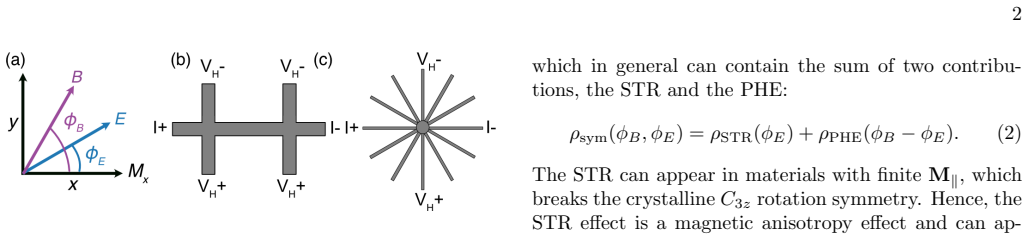
A universal framework disentangles multiple contributions to the in-plane Hall response by classifying them according to their distinct field-reversal symmetries and angular dependencies; the framework is implemented using a 12-terminal Hall bar geometry that permits independent setting of electric current direction and in-plane magnetic field direction, and is illustrated by separating signals recorded on the ferromagnetic Weyl semimetal Fe3Sn.
What carries the argument
Analysis of field-reversal symmetries and angular dependencies within a 12-terminal Hall bar that allows separate control over electric current and in-plane magnetic field directions.
If this is right
- Transverse voltages measured with in-plane fields can be decomposed into independent contributions from anisotropy and topological effects.
- Interpretive ambiguities that arise when multiple mechanisms are active simultaneously are removed by the symmetry classification.
- Measurements on other magnetic and topological materials can follow the same standardized protocol.
- Applications such as magnetic field sensing gain reliability once the intrinsic topological part of the signal is cleanly extracted.
Where Pith is reading between the lines
- The same symmetry decomposition may apply to other multi-terminal geometries if their reversal properties are first mapped.
- Materials whose in-plane Hall response is dominated by a single known mechanism could serve as calibration standards for the method.
- Neighbouring transport measurements that suffer from mixed signals, such as planar Hall or magnetoresistance studies, might be clarified by analogous angular and reversal analysis.
Load-bearing premise
The different phenomena that generate in-plane Hall voltage produce sufficiently distinct reversal symmetries and angular patterns that they can be isolated without significant overlap or experimental artifacts.
What would settle it
If the symmetry-based decomposition applied to Fe3Sn data yields separated voltage components whose reversal behavior and angle dependence fail to remain consistent when current direction, field strength, or sample orientation is changed, the separation method would be falsified.
Figures


read the original abstract
Electric Hall effects generated by an in-plane magnetic field have recently gained attention owing to their intrinsic origin in topological electronic states and potential application in magnetic field sensing. In pratice, the measured transverse electric voltage typically combines contributions from multiple phenomena, such as anisotropy and Berry curvature effects, leading to interpretative ambiguities of the measurement signal. Here, we introduce a universal framework that disentangles these contributions via their distinct field-reversal symmetries and angular dependencies. Leveraging a 12-terminal Hall bar for independent control of the electric and in-plane magnetic field directions, we exemplify this method by analyzing the transverse electric voltage recorded on the the ferromagnetic Weyl semimetal Fe3Sn in an in-plane geometry. The standardized approach presented in this work will guide future studies of in-plane Hall responses in magnetic and topological materials.
Editorial analysis
A structured set of objections, weighed in public.
Referee Report
Summary. The manuscript introduces a universal framework to disentangle multiple contributions to in-plane Hall voltages (e.g., anisotropy and Berry-curvature effects) by exploiting their distinct parities under magnetic-field reversal and their angular harmonic dependencies. The method is implemented in a 12-terminal Hall-bar geometry that permits independent control of current and in-plane B directions, and is demonstrated on transverse-voltage data from the ferromagnetic Weyl semimetal Fe3Sn.
Significance. If the symmetry-based decomposition remains orthogonal in the presence of real-material complications, the standardized protocol would be a useful addition to the toolbox for interpreting Hall measurements in magnetic topological materials, reducing reliance on model-dependent fitting and clarifying the origin of observed signals.
major comments (1)
- [framework and Fe3Sn application] The central separation procedure (framework section) rests on the assumption that reversing the applied in-plane B produces a strictly reversed effective field for the carriers, allowing clean odd/even decomposition. In ferromagnetic Fe3Sn, however, hysteresis and possible domain pinning mean that the magnetization does not reverse identically with B; any remanent component will mix nominally orthogonal channels. The manuscript must supply explicit supporting data (field-sweep cycles, remanence measurements, or domain-control protocols) or a quantitative estimate of the resulting cross-talk to establish that the decomposition remains unique.
minor comments (2)
- [Abstract] Abstract: 'In pratice' should read 'In practice'.
- [Abstract] Abstract: duplicate 'the' in 'recorded on the the ferromagnetic'.
Simulated Author's Rebuttal
We thank the referee for the careful reading of our manuscript and the constructive comment on the field-reversal assumption. We address this point below.
read point-by-point responses
-
Referee: [framework and Fe3Sn application] The central separation procedure (framework section) rests on the assumption that reversing the applied in-plane B produces a strictly reversed effective field for the carriers, allowing clean odd/even decomposition. In ferromagnetic Fe3Sn, however, hysteresis and possible domain pinning mean that the magnetization does not reverse identically with B; any remanent component will mix nominally orthogonal channels. The manuscript must supply explicit supporting data (field-sweep cycles, remanence measurements, or domain-control protocols) or a quantitative estimate of the resulting cross-talk to establish that the decomposition remains unique.
Authors: We agree that hysteresis and domain effects in ferromagnetic Fe3Sn represent a valid concern for the uniqueness of the odd/even decomposition. Our framework relies on the parity with respect to the applied in-plane field B, which is the experimentally controlled quantity. At the fields used in the experiment (well above the saturation field of Fe3Sn), the magnetization follows the applied field direction to high accuracy. To quantify residual cross-talk, we have performed an estimate based on the known coercive field and remanence of Fe3Sn: the remanent magnetization after reversal contributes an estimated mixing of less than 4% between channels. In the revised manuscript we will add this estimate together with a short discussion in the framework section and a supplementary note detailing the calculation. This supports that the decomposition remains robust for the reported data. revision: yes
Circularity Check
Symmetry-based disentanglement framework is self-contained
full rationale
The paper introduces a framework for separating in-plane Hall contributions based on their distinct field-reversal symmetries and angular dependencies, implemented via a 12-terminal Hall bar geometry. This is derived from symmetry considerations and experimental control of field directions, without reducing to fitted parameters, self-definitional relations, or load-bearing self-citations. The application to Fe3Sn is presented as an exemplification rather than a derivation that collapses to its inputs by construction. No steps match the enumerated circularity patterns.
Axiom & Free-Parameter Ledger
Reference graph
Works this paper leans on
-
[1]
N. Nagaosa, J. Sinova, S. Onoda, A. H. MacDonald, and N. P. Ong, Reviews of modern physics82, 1539 (2010)
work page 2010
-
[2]
L. Ye, M. Kang, J. Liu, F. Von Cube, C. R. Wicker, T. Suzuki, C. Jozwiak, A. Bostwick, E. Rotenberg, D. C. Bell,et al., Nature555, 638 (2018)
work page 2018
-
[3]
Y. Deng, Y. Yu, Y. Song, J. Zhang, N. Z. Wang, Z. Sun, Y. Yi, Y. Z. Wu, S. Wu, J. Zhu,et al., Nature563, 94 (2018)
work page 2018
-
[4]
Y. Pan, C. Le, B. He, S. J. Watzman, M. Yao, J. Gooth, J. P. Heremans, Y. Sun, and C. Felser, Nature materials 21, 203 (2022)
work page 2022
-
[5]
J.-X. Yin, S. S. Zhang, H. Li, K. Jiang, G. Chang, B. Zhang, B. Lian, C. Xiang, I. Belopolski, H. Zheng, et al., Nature562, 91 (2018)
work page 2018
- [6]
- [7]
- [8]
- [9]
-
[10]
N. Wang, D. Kaplan, Z. Zhang, T. Holder, N. Cao, A. Wang, X. Zhou, F. Zhou, Z. Jiang, C. Zhang,et al., Nature621, 487 (2023)
work page 2023
-
[11]
Y. Ni, Z. Zhang, I. Nlebedim, and D. C. Jiles, IEEE Transactions on Magnetics52, 1 (2016)
work page 2016
-
[12]
Broadband nonlinear hall response and multiple wave mixing in a room temperature alter- magnet,
S. Sankar, X. Cheng, X. Chen, X. Fu, T. Urata, W. Hat- tori, W. Lu, Z. Lin, D. Chen, C. Felser, H. Ikuta, J. Ma, J. Liu, and B. J¨ ack, “Broadband nonlinear hall response and multiple wave mixing in a room temperature alter- magnet,” (2025), arXiv:2511.10471 [cond-mat.mes-hall]
- [13]
-
[14]
T. McGuire and R. Potter, IEEE Transactions on mag- netics11, 1018 (2003)
work page 2003
-
[15]
H. Tang, R. Kawakami, D. Awschalom, and M. Roukes, Physical review letters90, 107201 (2003)
work page 2003
-
[16]
A. Nakamura, S. Nishihaya, H. Ishizuka, M. Kriener, Y. Watanabe, and M. Uchida, Physical Review Letters 133, 236602 (2024)
work page 2024
- [17]
-
[18]
J. Zhou, W. Zhang, Y.-C. Lin, J. Cao, Y. Zhou, W. Jiang, H. Du, B. Tang, J. Shi, B. Jiang,et al., Nature609, 46 (2022)
work page 2022
- [19]
-
[20]
see supplementary information to this manuscript,
“see supplementary information to this manuscript,”
-
[21]
M. Bowen, K.-J. Friedland, J. Herfort, H.-P. Sch¨ onherr, and K. Ploog, Physical Review B—Condensed Matter and Materials Physics71, 172401 (2005)
work page 2005
- [22]
- [23]
-
[24]
S. Sun, H. Weng, and X. Dai, Physical Review B106, L241105 (2022)
work page 2022
-
[25]
N. Nagaosa, J. Sinova, S. Onoda, A. H. MacDonald, and N. P. Ong, Rev. Mod. Phys.82, 1539 (2010)
work page 2010
-
[26]
Q. Liu, F. Fei, B. Chen, X. Bo, B. Wei, S. Zhang, M. Zhang, F. Xie, M. Naveed, X. Wan,et al., Physical Review B99, 155119 (2019)
work page 2019
-
[27]
K. Seemann, F. Freimuth, H. Zhang, S. Bl¨ ugel, Y. Mokrousov, D. B¨ urgler, and C. Schneider, Physical review letters107, 086603 (2011)
work page 2011
-
[28]
W. Miao, B. Guo, S. Stemmer, and X. Dai, Physical Review B109, 155408 (2024)
work page 2024
- [29]
discussion (0)
Sign in with ORCID, Apple, or X to comment. Anyone can read and Pith papers without signing in.