Column Generation for the Optimization of Switching in Repeaterless Quantum Networks
Pith reviewed 2026-05-10 00:26 UTC · model grok-4.3
The pith
A graph model and column generation solve optimal switching for repeaterless quantum networks.
A machine-rendered reading of the paper's core claim, the machinery that carries it, and where it could break.
Core claim
By representing the repeaterless quantum network as a graph, the switching optimization problem is cast as a linear program whose solutions correspond to feasible high-performing switching strategies. Column generation is used to handle the large number of variables implicitly, enabling computation that scales with network size rather than exploding with configuration count.
What carries the argument
Graph model of the network paired with a column-generation solver for the associated linear program that selects optimal switching configurations.
If this is right
- The computed switching plans maximize key rates under the modeled constraints.
- The solver remains practical as the number of nodes and links increases.
- The same framework supports adaptation to varying network topologies.
- It supplies a formal basis for later dynamic control algorithms.
Where Pith is reading between the lines
- If the graph abstraction holds, the method could be embedded in real-time controllers that reconfigure switches on the fly.
- Analogous column-generation formulations might address routing or entanglement scheduling in larger quantum networks.
- Coupling the optimizer with a physical-layer simulator would let engineers quantify actual key-rate gains on hardware.
Load-bearing premise
The physical and logical structure of repeaterless quantum networks can be accurately captured by a graph model that permits a linear programming formulation whose optimal solutions correspond to feasible and high-performing switching strategies.
What would settle it
For any small network whose complete set of switching configurations can be enumerated by brute force, run the column-generation solver and check whether its best objective value and feasibility match the true optimum from the enumeration.
Figures


read the original abstract
Efficient resource allocation and optical switching promise high key rates, network adaptability, and cost reduction in repeaterless quantum communication networks. However, identifying optimal switching configurations remains a significant challenge due to the combinatorial complexity. We introduce a novel graph formulation to model the physical and logical structure of repeaterless quantum networks, enabling the systematic optimization of switching strategies. The problem is posed as a linear program and solved using a column generation approach. This method enables scalable computation despite the exponential number of possible network configurations. Our results not only provide a formal foundation but also a practical algorithm for the optimization of switching. Empirical tests confirm the solver's scalability with network size, demonstrating the framework's effectiveness and laying the groundwork for future optimization of quantum network control.
Editorial analysis
A structured set of objections, weighed in public.
Referee Report
Summary. The paper presents a graph-based model of repeaterless quantum networks that captures physical and logical structure, formulates switching optimization as a linear program, and applies column generation to solve it despite an exponential number of configurations. It claims this yields a scalable algorithm whose empirical performance improves with network size, providing both a formal foundation and a practical method for optimizing switching strategies to achieve higher key rates and adaptability.
Significance. If the LP solutions are guaranteed to be implementable (integer) switching configurations and the column-generation procedure scales as asserted, the work would offer a concrete algorithmic tool for resource allocation in quantum networks without repeaters. The adaptation of standard column generation to this setting is a clear strength, as is the explicit graph modeling that separates the combinatorial explosion from the master problem.
major comments (2)
- [LP formulation and column-generation procedure] The central claim that optimal solutions correspond to feasible, high-performing switching strategies rests on the master LP. The formulation uses configuration columns with (presumably continuous) variables in the master problem; without a demonstration that the polytope is integral (e.g., total unimodularity of the constraint matrix) or an explicit rounding/branching step, fractional solutions may be returned that do not map to any valid switch setting. This issue is load-bearing for the practicality assertion in the abstract.
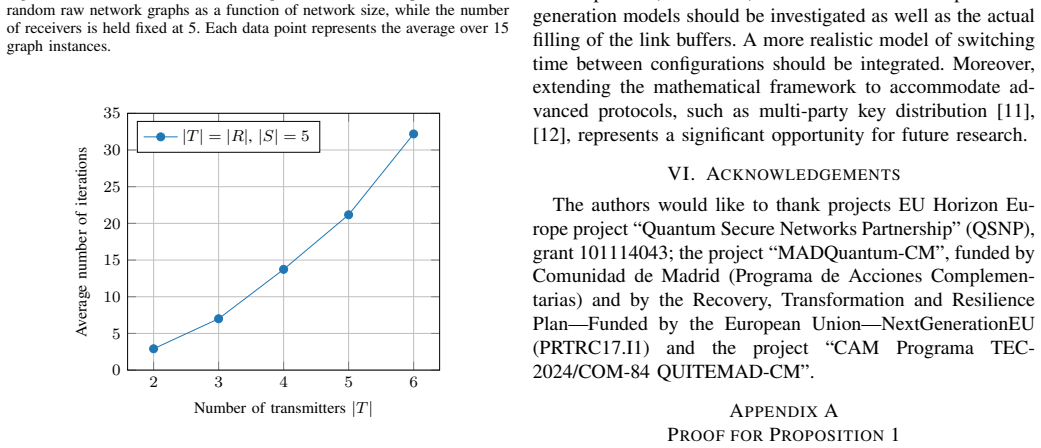
- [Empirical evaluation section] The abstract states that 'empirical tests confirm the solver's scalability with network size,' yet the provided description supplies no quantitative results (network sizes, runtimes, baselines, success rates, or instance generation details). If the full manuscript contains only qualitative statements or unstated test parameters, the scalability claim cannot be evaluated and remains unsupported.
minor comments (1)
- [Model definition] Notation for the graph model (vertices, edges, loss parameters) should be introduced with a single consistent table or figure early in the manuscript to aid readability.
Simulated Author's Rebuttal
We thank the referee for their careful reading and for highlighting the strengths of the graph modeling and column-generation adaptation. We address the two major comments point by point below, indicating the revisions we will make.
read point-by-point responses
-
Referee: [LP formulation and column-generation procedure] The central claim that optimal solutions correspond to feasible, high-performing switching strategies rests on the master LP. The formulation uses configuration columns with (presumably continuous) variables in the master problem; without a demonstration that the polytope is integral (e.g., total unimodularity of the constraint matrix) or an explicit rounding/branching step, fractional solutions may be returned that do not map to any valid switch setting. This issue is load-bearing for the practicality assertion in the abstract.
Authors: We agree that the integrality of master-LP solutions is essential for the claimed practicality. The current manuscript does not contain an explicit argument or proof establishing that the polytope is integral. We will revise the paper by adding a dedicated subsection that either proves total unimodularity of the constraint matrix (leveraging the path-cover structure of the configurations) or describes a rounding procedure that preserves feasibility and near-optimality. This directly addresses the load-bearing concern. revision: yes
-
Referee: [Empirical evaluation section] The abstract states that 'empirical tests confirm the solver's scalability with network size,' yet the provided description supplies no quantitative results (network sizes, runtimes, baselines, success rates, or instance generation details). If the full manuscript contains only qualitative statements or unstated test parameters, the scalability claim cannot be evaluated and remains unsupported.
Authors: The referee correctly notes that the abstract claim requires concrete quantitative support to be evaluable. While the manuscript contains an empirical section, the presentation of network sizes, runtimes, baselines, and instance-generation details is insufficiently explicit. We will revise both the abstract (to include key metrics) and the evaluation section (to state all parameters clearly) so that the scalability assertion is fully substantiated. revision: yes
Circularity Check
No significant circularity; standard LP and column generation applied to a new graph model
full rationale
The derivation introduces a graph model of repeaterless quantum networks, formulates switching optimization as a linear program, and applies column generation to handle the exponential number of configurations. Column generation is a standard, externally validated technique from operations research whose correctness does not depend on the quantum-network application or on any fitted parameters from the target data. No equations reduce by construction to their own inputs, no predictions are statistically forced by prior fits, and no load-bearing claims rest on self-citations or imported uniqueness theorems. Scalability is asserted via empirical tests on network size rather than derived tautologically. The central claim therefore remains self-contained against external benchmarks.
Axiom & Free-Parameter Ledger
Reference graph
Works this paper leans on
-
[1]
Introduction to quantum key distribution,
V . Martin, J. Martinez-Mateo, and M. Peev, “Introduction to quantum key distribution,” inWiley Encyclopedia of Electrical and Electronics Engineering. John Wiley & Sons, Ltd, 2017
work page 2017
-
[2]
MadQCI: a heterogeneous and scalable SDN-QKD network deployed in production facilities,
V . Martinet al., “MadQCI: a heterogeneous and scalable SDN-QKD network deployed in production facilities,”npj Quantum Information, vol. 10, no. 1, p. 80, Sep 2024
work page 2024
-
[3]
D. R. Lopezet al., “Demonstration of software defined network ser- vices utilizing quantum key distribution fully integrated with standard telecommunication network,”Quantum Reports, vol. 2, no. 3, pp. 453– 458, Sep. 2020
work page 2020
-
[4]
Quantum key distri- bution based on selective post-processing in passive optical networks,
J. Martinez-Mateo, A. Ciurana, and V . Martin, “Quantum key distri- bution based on selective post-processing in passive optical networks,” IEEE Photonics Technology Letters, vol. 26, no. 9, pp. 881–884, 2014
work page 2014
-
[5]
Demonstration of a switched CV-QKD network,
H. H. Brunneret al., “Demonstration of a switched CV-QKD network,” EPJ Quantum Technology, vol. 10, no. 38, Sep. 2023
work page 2023
-
[6]
R. Wanget al., “End-to-end quantum secured inter-domain 5G service orchestration over dynamically switched flex-grid optical networks en- abled by a q-ROADM,”Journal of Lightwave Technology, vol. 38, no. 1, pp. 139–149, 2020
work page 2020
-
[7]
M. Conforti, G. Cornu ´ejols, and G. Zambelli,Integer Programming, ser. Graduate Texts in Mathematics. Cham, Switzerland: Springer, 2014, vol. 271
work page 2014
-
[8]
Optimizing key consumption in switched QKD networks,
K. Christodoulopoulos, N. Makris, G. T. Kanellos, and D. Syvridis, “Optimizing key consumption in switched QKD networks,” in2024 Optical Fiber Communications Conference and Exhibition (OFC), Mar. 2024
work page 2024
-
[9]
Relayed vs. switched QKD: a comparison in non-uniform ring net- works,
A. Selentis-Boulntadakis, K. Christodoulopoulos, and G. T. Kanellos, “Relayed vs. switched QKD: a comparison in non-uniform ring net- works,” in2025 International Conference on Optical Network Design and Modeling (ONDM), 2025
work page 2025
-
[10]
Fundamental limits of repeaterless quantum communications,
S. Pirandola, R. Laurenza, C. Ottaviani, and L. Banchi, “Fundamental limits of repeaterless quantum communications,”Nature Communica- tions, vol. 8, p. 15043, Apr. 2017
work page 2017
-
[11]
Continuous-variable quantum passive optical network,
A. A. E. Hajomer, I. Derkach, R. Filip, U. L. Andersen, V . C. Usenko, and T. Gehring, “Continuous-variable quantum passive optical network,” Light: Science & Applications, vol. 13, no. 1, Oct. 2024. [Online]. Available: http://dx.doi.org/10.1038/s41377-024-01633-9
-
[12]
High-rate point-to-multipoint quantum key distribution using coherent states,
Y . Bian, Y .-C. Zhang, C. Zhou, S. Yu, Z. Li, and H. Guo, “High-rate point-to-multipoint quantum key distribution using coherent states,”
- [13]
discussion (0)
Sign in with ORCID, Apple, or X to comment. Anyone can read and Pith papers without signing in.