Fundamental Tradeoff in Movable Antenna Systems: How Long to Move Before Transmission?
Pith reviewed 2026-05-11 00:48 UTC · model grok-4.3
The pith
Movable antennas should remain stationary if movement speed is below a closed-form threshold to maximize effective throughput.
A machine-rendered reading of the paper's core claim, the machinery that carries it, and where it could break.
Core claim
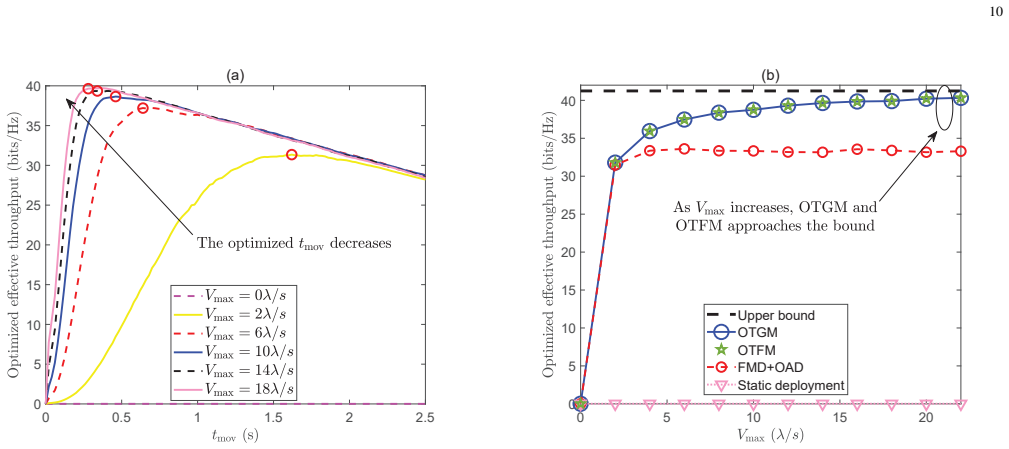
In movable antenna (MA) enabled multiuser downlink, there is a fundamental tradeoff between the duration allocated for antenna movement to achieve favorable channel conditions and the remaining time for data transmission. The optimization problem of movement duration and antenna deployment to maximize effective throughput is solved via one-dimensional search or a proposed fitting method that yields a closed-form rate expression. A closed-form condition on the maximum antenna movement speed is derived such that when the speed is below the threshold, the optimal strategy is to keep the antennas stationary throughout the transmission period.
What carries the argument
The movement duration variable trading off channel reconfiguration gains against reduced transmission time, optimized via a fitting-based closed-form approximation.
If this is right
- Below the derived speed threshold, stationary antennas are optimal and maximize throughput.
- The fitting method enables a low-complexity closed-form solution by sampling few rate-duration pairs.
- The tradeoff is explicitly characterized in the two-MA two-user special case.
- Simulations validate that the proposed optimization outperforms non-optimized strategies.
Where Pith is reading between the lines
- This tradeoff analysis could extend to scenarios with multiple base stations or uplink communications where antenna movement similarly affects performance.
- Hardware implementations of movable antennas might incorporate the speed threshold to decide movement dynamically without complex computation.
- Accounting for real-world factors like energy consumption during movement could further influence the optimal strategy beyond the throughput focus.
Load-bearing premise
The rate trend over movement durations can be accurately represented by a closed-form expression obtained from fitting a small number of sampled points across various antenna deployments.
What would settle it
Simulate the multiuser MA system at speeds around the derived threshold and check whether the stationary strategy indeed yields higher effective throughput than any positive movement duration.
Figures




read the original abstract
The movable antenna (MA) technology enables flexible reconfiguration of wireless channels through adaptive antenna deployment, offering significant potential for enhancing communication performance. However, antenna movement requires a certain duration within which communication may be compromised due to factors such as channel fluctuation and Doppler effect. This leads to a fundamental tradeoff: A longer movement duration allows antennas to reach more favorable positions for better channel conditions, but it inevitably reduces the time available for data transmission. To characterize the aforementioned tradeoff, we focus on the MAs-enabled multiuser downlink scenario, and jointly optimize the movement duration and antenna deployment at the base station to maximize the effective throughput. The formulated problem is highly non-convex. The general solutions require an one-dimensional search over movement durations, each with optimized antenna deployment. To reduce complexity, we propose a fitting method that samples only a few rate-duration pairs, yielding a closed-form expression that captures the rate trend and enables a favorable solution immediately. We further derive a closed-form condition on the maximum antenna movement speed: When the speed is below a certain threshold, the optimal strategy is to keep antennas stationary throughout the transmission period. The fundamental tradeoff and the effectiveness of the proposed solutions are examined in a special case with two MAs and two users. Finally, numerical simulations validate the efficacy of the proposed schemes.
Editorial analysis
A structured set of objections, weighed in public.
Referee Report
Summary. The paper studies the fundamental tradeoff in movable antenna (MA) systems between the time spent moving antennas to favorable positions and the remaining time for data transmission in a multiuser downlink setting. It formulates a non-convex joint optimization of movement duration and antenna deployment to maximize effective throughput, proposes a one-dimensional search over durations combined with per-duration antenna optimization, and introduces a fitting method that samples a small number of rate-duration pairs to obtain a closed-form approximation of the rate trend. From this, a closed-form threshold on maximum antenna speed is derived: below the threshold, the optimum is to keep antennas stationary. The claims are illustrated and validated via simulations in a two-MA, two-user special case.
Significance. If the fitting approximation is shown to be sufficiently accurate and to preserve the location of the optimum, the work supplies a practical, low-complexity design rule for MA systems together with an easily checked speed threshold that directly informs whether movement is ever worthwhile. The explicit accounting for movement time as a resource and the derivation of the stationary-antenna condition from first principles are useful contributions to the emerging MA literature.
major comments (2)
- [fitting method and closed-form speed condition] The fitting method (described after the one-dimensional search approach) replaces the true effective-rate function with a closed-form expression obtained from only a few sampled rate-duration pairs, yet no error bound, uniform approximation guarantee, or sensitivity analysis is supplied. Because the closed-form speed-threshold condition is obtained by substituting this fitted expression into the optimality condition, any distortion of the value or derivative of the underlying rate curve directly affects the reported threshold; without quantified approximation quality across movement durations and antenna placements, the threshold's validity for general deployments remains unverified.
- [validation and simulation setup] The abstract and validation section state that the approach is examined in a two-MA two-user case, but the manuscript provides neither the explicit channel model (including Doppler and fluctuation statistics during movement) nor the precise functional form used for the rate-duration fit. These omissions make it impossible to reproduce the sampled pairs or to assess whether the fit remains accurate when the rate curve is non-monotonic.
minor comments (1)
- [problem formulation] Notation for effective throughput and the movement-duration variable should be introduced once and used consistently; several passages switch between symbols without explicit redefinition.
Simulated Author's Rebuttal
We thank the referee for the constructive comments and for recognizing the contributions of our work on the fundamental tradeoff in movable antenna systems. We address each major comment below and will incorporate revisions to improve clarity and rigor.
read point-by-point responses
-
Referee: The fitting method (described after the one-dimensional search approach) replaces the true effective-rate function with a closed-form expression obtained from only a few sampled rate-duration pairs, yet no error bound, uniform approximation guarantee, or sensitivity analysis is supplied. Because the closed-form speed-threshold condition is obtained by substituting this fitted expression into the optimality condition, any distortion of the value or derivative of the underlying rate curve directly affects the reported threshold; without quantified approximation quality across movement durations and antenna placements, the threshold's validity for general deployments remains unverified.
Authors: We agree that the current manuscript does not provide theoretical error bounds or a uniform approximation guarantee for the fitting method. In the revision, we will add a dedicated analysis subsection that quantifies the approximation error through numerical sensitivity studies over varying numbers of samples, movement durations, and antenna placements in the two-MA two-user case. We will also examine the impact of the fitted curve on the location of the optimal duration and the resulting speed threshold, including a discussion of conditions under which the approximation preserves optimality for broader deployments. revision: yes
-
Referee: The abstract and validation section state that the approach is examined in a two-MA two-user case, but the manuscript provides neither the explicit channel model (including Doppler and fluctuation statistics during movement) nor the precise functional form used for the rate-duration fit. These omissions make it impossible to reproduce the sampled pairs or to assess whether the fit remains accurate when the rate curve is non-monotonic.
Authors: We acknowledge these omissions in the current version. The revised manuscript will include the full explicit channel model for the two-MA two-user scenario, detailing the Doppler effect modeling and channel fluctuation statistics during movement. We will also specify the exact functional form of the rate-duration fit (including the mathematical expression and sampling procedure). In our simulations the effective rate was monotonically decreasing with movement duration, but we will add a discussion of potential non-monotonic cases and how the fitting approach would be applied or adapted in those settings. revision: yes
Circularity Check
No significant circularity in derivation chain
full rationale
The paper's core optimization maximizes effective throughput defined directly from movement duration and resulting channel gains, using standard non-convex joint optimization over duration and antenna positions. The fitting procedure is an explicit, post-hoc approximation that samples a few numerically solved rate-duration points to obtain a closed-form surrogate for faster search; this surrogate is not substituted back into the objective as a redefinition, nor does any claimed prediction (including the speed threshold) reduce by construction to the sampled inputs. The closed-form speed condition is mathematically derived from the surrogate model rather than being tautological with the samples. No self-citations, uniqueness theorems, or ansatzes from prior author work are invoked to justify the central tradeoff or threshold. The derivation therefore remains self-contained against the stated first-principles model.
Axiom & Free-Parameter Ledger
free parameters (1)
- number of rate-duration sample pairs
axioms (1)
- domain assumption Effective throughput is a decreasing function of movement duration due to reduced transmission time and potential channel fluctuations during movement.
Reference graph
Works this paper leans on
-
[1]
An overvi ew of MIMO communications - a key to gigabit wireless,
A. PAULRAJ, D. GORE, R. NABAR, and H. BOLCSKEI, “An overvi ew of MIMO communications - a key to gigabit wireless,” Proc. IEEE , vol. 92, no. 2, pp. 198–218, 2004
work page 2004
-
[2]
Massive MIMO for next generation wireless systems,
E. G. Larsson, O. Edfors, F. Tufvesson, and T. L. Marzetta , “Massive MIMO for next generation wireless systems,” IEEE Commun. Mag. , vol. 52, no. 2, pp. 186–195, 2014
work page 2014
-
[3]
An overview of massive MIMO: Benefits and challenges,
L. Lu, G. Y . Li, A. L. Swindlehurst, A. Ashikhmin, and R. Zh ang, “An overview of massive MIMO: Benefits and challenges,” IEEE J. Sel. Topics Signal Process. , vol. 8, no. 5, pp. 742–758, 2014
work page 2014
-
[4]
Modeling and performance ana lysis for movable antenna enabled wireless communications,
L. Zhu, W. Ma, and R. Zhang, “Modeling and performance ana lysis for movable antenna enabled wireless communications,” IEEE Trans. Wireless Commun., vol. 23, no. 6, pp. 6234–6250, 2024
work page 2024
-
[5]
K.-K. Wong, A. Shojaeifard, K.-F. Tong, and Y . Zhang, “Fl uid antenna systems,” IEEE Trans. Wireless Commun., vol. 20, no. 3, pp. 1950–1962, 2021
work page 1950
-
[6]
Movable antennas for wireles s commu- nication: Opportunities and challenges,
L. Zhu, W. Ma, and R. Zhang, “Movable antennas for wireles s commu- nication: Opportunities and challenges,” IEEE Commun. Mag. , vol. 62, no. 6, pp. 114–120, 2024
work page 2024
-
[7]
X. Shao and R. Zhang, “6DMA enhanced wireless network wit h flexible antenna position and rotation: Opportunities and challeng es,” IEEE Commun. Mag. , vol. 63, no. 4, pp. 121–128, 2025
work page 2025
-
[8]
B. Ning, S. Y ang, Y . Wu, P . Wang, W. Mei, C. Y uen, and E. Björ nson, “Movable antenna-enhanced wireless communications: Gene ral architec- tures and implementation methods,” IEEE Wireless Commun. , vol. 32, no. 5, pp. 108–116, 2025
work page 2025
-
[9]
Movable an tenna enhanced wide-beam coverage: Joint antenna position and be amforming optimization,
D. Wang, W. Mei, B. Ning, Z. Chen, and R. Zhang, “Movable an tenna enhanced wide-beam coverage: Joint antenna position and be amforming optimization,” IEEE Trans. Wireless Commun. , vol. 25, pp. 3541–3558, 2026
work page 2026
-
[11]
Performance analys is and optimization for movable antenna aided wideband communica tions,
L. Zhu, W. Ma, Z. Xiao, and R. Zhang, “Performance analys is and optimization for movable antenna aided wideband communica tions,” IEEE Trans. Wireless Commun. , vol. 23, no. 12, pp. 18 653–18 668, 2024
work page 2024
-
[12]
A tutorial on movable antennas for wi reless networks,
L. Zhu, W. Ma, W. Mei, Y . Zeng, Q. Wu, B. Ning, Z. Xiao, X. Sh ao, J. Zhang, and R. Zhang, “A tutorial on movable antennas for wi reless networks,” IEEE Commun. Surv. Tut. , vol. 28, pp. 3002–3054, 2026
work page 2026
-
[13]
Movable-antenna array enha nced beam- forming: Achieving full array gain with null steering,
L. Zhu, W. Ma, and R. Zhang, “Movable-antenna array enha nced beam- forming: Achieving full array gain with null steering,” IEEE Commun. Lett., vol. 27, no. 12, pp. 3340–3344, 2023
work page 2023
-
[14]
MIMO capacity characteriza tion for movable antenna systems,
W. Ma, L. Zhu, and R. Zhang, “MIMO capacity characteriza tion for movable antenna systems,” IEEE Trans. Wireless Commun. , vol. 23, no. 4, pp. 3392–3407, 2024
work page 2024
-
[15]
Energy ef ficiency maximization for movable antenna-enhanced MIMO downlink s ystem based on s-CSI,
X. Chen, B. Feng, Y . Wu, X.-G. Xia, and C. Xiao, “Energy ef ficiency maximization for movable antenna-enhanced MIMO downlink s ystem based on s-CSI,” IEEE Trans. Wireless Commun. , vol. 25, pp. 4642– 4657, 2026
work page 2026
-
[16]
Movable antenna ena bled near-field communications: Channel modeling and performan ce opti- mization,
L. Zhu, W. Ma, Z. Xiao, and R. Zhang, “Movable antenna ena bled near-field communications: Channel modeling and performan ce opti- mization,” IEEE Trans. Commun. , vol. 73, no. 9, pp. 7240–7256, 2025
work page 2025
-
[17]
6D movable antenna base d on user distribution: Modeling and optimization,
X. Shao, Q. Jiang, and R. Zhang, “6D movable antenna base d on user distribution: Modeling and optimization,” IEEE Trans. Wireless Commun., vol. 24, no. 1, pp. 355–370, 2025
work page 2025
-
[18]
6D movable a ntenna en- hanced wireless network via discrete position and rotation optimization,
X. Shao, R. Zhang, Q. Jiang, and R. Schober, “6D movable a ntenna en- hanced wireless network via discrete position and rotation optimization,” IEEE J. Sel. Areas Commun. , vol. 43, no. 3, pp. 674–687, 2025
work page 2025
-
[19]
G. Hu, Q. Wu, K. Xu, J. Ouyang, J. Si, Y . Cai, and N. Al-Dhah ir, “Fluid antennas-enabled multiuser uplink: A low-complexity grad ient descent for total transmit power minimization,” IEEE Commun. Lett. , vol. 28, no. 3, pp. 602–606, 2024
work page 2024
-
[20]
Z. Xiao, X. Pi, L. Zhu, X.-G. Xia, and R. Zhang, “Multiuse r commu- nications with movable-antenna base station: Joint antenn a positioning, receive combining, and power control,” IEEE Trans. Wireless Commun., vol. 23, no. 12, pp. 19 744–19 759, 2024
work page 2024
-
[21]
Two-timescale design for movable antenna array-enabled m ultiuser uplink communications,
G. Hu, Q. Wu, G. Li, D. Xu, K. Xu, J. Si, Y . Cai, and N. Al-Dha hir, “Two-timescale design for movable antenna array-enabled m ultiuser uplink communications,” IEEE Trans. V eh. Technol., vol. 74, no. 3, pp. 5152–5157, 2025
work page 2025
-
[22]
Movable-antenna en hanced multiuser communication via antenna position optimizatio n,
L. Zhu, W. Ma, B. Ning, and R. Zhang, “Movable-antenna en hanced multiuser communication via antenna position optimizatio n,” IEEE Trans. Wireless Commun. , vol. 23, no. 7, pp. 7214–7229, 2024
work page 2024
-
[23]
Y . Wu, D. Xu, D. Wing Kwan Ng, W. Gerstacker, and R. Schobe r, “Globally optimal movable antenna-enabled multiuser comm unication: Discrete antenna positioning, power consumption, and impe rfect CSI,” IEEE Trans. Commun. , vol. 73, no. 10, pp. 9903–9923, 2025
work page 2025
-
[24]
Flexible precoding for multi-user movable antenna communications,
S. Y ang, W. Lyu, B. Ning, Z. Zhang, and C. Y uen, “Flexible precoding for multi-user movable antenna communications,” IEEE Wireless Com- mun. Lett. , vol. 13, no. 5, pp. 1404–1408, 2024
work page 2024
-
[25]
Two-timescale desig n for mov- able antenna-enabled multiuser MIMO systems,
Z. Zheng, Q. Wu, W. Chen, and G. Hu, “Two-timescale desig n for mov- able antenna-enabled multiuser MIMO systems,” IEEE Trans. Commun., vol. 73, no. 11, pp. 10 554–10 571, 2025
work page 2025
-
[26]
Z. Xiao, S. Cao, L. Zhu, Y . Liu, B. Ning, X.-G. Xia, and R. Z hang, “Channel estimation for movable antenna communication sys tems: A framework based on compressed sensing,” IEEE Trans. Wireless Com- mun., vol. 23, no. 9, pp. 11 814–11 830, 2024
work page 2024
-
[27]
Compressed sensing based ch annel estimation for movable antenna communications,
W. Ma, L. Zhu, and R. Zhang, “Compressed sensing based ch annel estimation for movable antenna communications,” IEEE Commun. Lett. , vol. 27, no. 10, pp. 2747–2751, 2023
work page 2023
-
[28]
Movable antenna enhanced integrated sensing and c ommunica- tion via antenna position optimization,
——, “Movable antenna enhanced integrated sensing and c ommunica- tion via antenna position optimization,” IEEE Trans. Signal Process. , pp. 1–17, 2026
work page 2026
-
[29]
Mo vable antenna enabled integrated sensing and communication,
W. Lyu, S. Y ang, Y . Xiu, Z. Zhang, C. Assi, and C. Y uen, “Mo vable antenna enabled integrated sensing and communication,” IEEE Trans. Wireless Commun., vol. 24, no. 4, pp. 2862–2875, 2025
work page 2025
-
[31]
Movable antennas meet intelligent reflecting surface: Friends or fo es?
X. Wei, W. Mei, Q. Wu, Q. Jia, B. Ning, Z. Chen, and J. Fang, “Movable antennas meet intelligent reflecting surface: Friends or fo es?” IEEE Trans. Commun., vol. 73, no. 11, pp. 12 756–12 770, 2025
work page 2025
-
[32]
Passive six- dimensional movable antenna (6DMA)-assisted multiuser co mmunica- tion,
H. Wang, X. Shao, B. Zheng, X. Shi, and R. Zhang, “Passive six- dimensional movable antenna (6DMA)-assisted multiuser co mmunica- tion,” IEEE Wireless Commun. Lett. , vol. 14, no. 4, pp. 1014–1018, 2025
work page 2025
-
[33]
Z. Zheng, Q. Wu, W. Chen, X. Wu, and W. Zhu, “Movable intel ligent surface (MIS) for wireless communications: Architecture, modeling, algorithm, and prototyping,” IEEE Trans. Wireless Commun. , vol. 25, pp. 5749–5765, 2026
work page 2026
-
[34]
Y . Gao, Q. Wu, Z. Zheng, Y . Zhu, W. Chen, X. Lin, and S. Shen , “Two- scale spatial deployment for cost-effective wireless netw orks via coop- erative irss and movable antennas,” arXiv preprint arXiv:2601.09463 , 2026
-
[35]
Q. Wu, Z. Zheng, Y . Gao, W. Mei, X. Wei, W. Chen, and B. Ning , “Integrating movable antennas and intelligent reflecting s urfaces (MA- IRS): Fundamentals, practical solutions, and ISAC,” IEEE Wireless Commun., vol. 33, no. 1, pp. 155–163, 2026
work page 2026
-
[36]
Z. Zheng, Q. Wu, W. Chen, W. Zhu, and Y . Gao, “Movable inte lligent surface-enabled wireless communications: When static pha se shift meets mechanical reconfigurability,” arXiv preprint arXiv:2511.17058 , 2025
-
[37]
Wire less sensing with movable intelligent surface,
Z. Zheng, Q. Wu, Y . Zhu, W. Chen, Y . Gao, and H. Wang, “Wire less sensing with movable intelligent surface,” IEEE J. Sel. Topics Signal Process., pp. 1–16, 2026. 14
work page 2026
-
[38]
Q. Peng, Q. Wu, G. Chen, W. Chen, S. Shen, and S. Ma, “Coope rative rotatable IRSs for wireless communications: Joint beamfor ming and orientation optimization,” arXiv preprint arXiv:2512.14037 , 2025
-
[39]
Rotatable IRS aided wireless communication,
Q. Peng, Q. Wu, G. Chen, W. Chen, S. Ma, S. Shen, and R. Zhang, “Rotatable IRS aided wireless communication,” arXiv preprint arXiv:2511.10006, 2025
-
[40]
A survey on reconfigurable and movable antennas for wireless communica tions and sensing,
W. Ma, L. Zhu, Y . Tan, B. Zheng, Y . Zhang, Y . Zhang, K. Ying , Z. Gao, H. Sun, X. Shao, Z. Xiao, D. Niyato, and R. Zhang, “A survey on reconfigurable and movable antennas for wireless communica tions and sensing,” IEEE Commun. Surv. Tut. , vol. 28, pp. 4842–4882, 2026
work page 2026
-
[41]
Flexible-ant enna systems: A pinching-antenna perspective,
Z. Ding, R. Schober, and H. Vincent Poor, “Flexible-ant enna systems: A pinching-antenna perspective,” IEEE Trans. Commun. , vol. 73, no. 10, pp. 9236–9253, 2025
work page 2025
-
[42]
Rotatable antenna enabled spectrum sharing: Joint antenna ori- entation and beamforming design,
X. Peng, Q. Wu, Z. Zheng, W. Chen, Y . Zhu, and Y . Gao, “Rota table antenna enabled spectrum sharing: Joint antenna orientati on and beam- forming design,” arXiv preprint arXiv:2509.19912 , 2025
-
[43]
Throughput maximization for movable antenna systems with movement delay consideration,
H. Wang, Q. Wu, Y . Gao, W. Chen, W. Mei, G. Hu, and L. Xu, “Throughput maximization for movable antenna systems with movement delay consideration,” IEEE Trans. Wireless Commun. , vol. 25, pp. 883– 899, 2026
work page 2026
-
[44]
H. Lu and Y . Zeng, “Near-field modeling and performance a nalysis for multi-user extremely large-scale MIMO communication, ” IEEE Commun. Lett. , vol. 26, no. 2, pp. 277–281, 2022
work page 2022
-
[45]
Y . Jin, Q. Lin, Y . Li, H. Zhu, B. Cheng, Y .-C. Wu, and R. Zha ng, “A general optimization framework for tackling distance co nstraints in movable antenna-aided systems,” IEEE Trans. Wireless Commun. , vol. 25, pp. 10 869–10 885, 2026
work page 2026
discussion (0)
Sign in with ORCID, Apple, or X to comment. Anyone can read and Pith papers without signing in.