Quantum Optical Signatures of Band Topology in Solid-State High Harmonics
Pith reviewed 2026-05-09 23:31 UTC · model grok-4.3
The pith
In the SSH model the topological phase produces stronger high-harmonic signals and more squeezed quantum light than the trivial phase.
A machine-rendered reading of the paper's core claim, the machinery that carries it, and where it could break.
Core claim
Within the weak-correlation expansion, the emitted high-harmonic field in the topological phase of the SSH model exhibits both an enhanced amplitude and stronger quadrature squeezing than in the trivial phase. The squeezing is imprinted by the current-current fluctuations of the solid and does not require an additional quartic interaction; the relevant non-classical effect is carried by the complex susceptibility already present in the linear response of the material.
What carries the argument
Density-matrix evolution of the coupled light-matter system under a weak-correlation expansion, which lets current-current fluctuations in the solid directly determine the photon statistics of the high harmonics.
If this is right
- Cavity-embedded topological insulators can function as sources of topology-controlled squeezed high-harmonic light.
- Photon-statistics measurements can serve as a spectroscopic probe of band topology in solids.
- The link between current fluctuations and emitted squeezing holds for any solid whose linear susceptibility encodes its band geometry.
- Topology-sensitive quantum light generation becomes possible without engineered nonlinearities beyond the cavity-matter coupling itself.
Where Pith is reading between the lines
- The same density-matrix treatment could be applied to other one-dimensional or two-dimensional topological models to predict their distinct squeezing signatures.
- Time-resolved quadrature measurements on the high harmonics might allow real-time tracking of a topological phase transition driven by an external parameter.
- The framework suggests that any solid-state system whose current fluctuations are modified by band topology will imprint corresponding changes on the quantum state of the emitted light.
Load-bearing premise
The weak-correlation expansion between photons and electrons remains valid throughout the dual regime of the SSH model, and the genuine quantum Kerr term stays negligible compared with fluctuation-driven effects in the mesoscopic limit.
What would settle it
An experiment that measures equal or weaker high-harmonic intensity and equal or weaker squeezing in the topological phase relative to the trivial phase, under otherwise identical cavity and driving conditions, would falsify the central claim.
Figures


read the original abstract
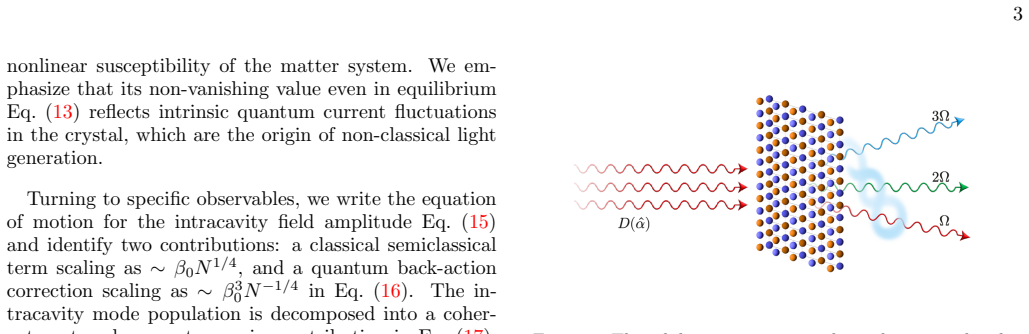
We develop a general theory of high-harmonic generation (HHG) in solid-state systems, based on a weak-correlation expansion of photonic and matter degrees of freedom. Unlike standard HHG theories, which treat light-matter dynamics through the Schrodinger equation, our approach employs density-matrix evolution, naturally capturing the mixed-state character of both the field and the matter - a critical aspect for describing complex solid-state band structures. We show explicitly that the properties of the emitted fields are governed by the quantum statistics and quantum geometry of the underlying solid. Taking the Su-Schrieffer-Heeger (SSH) model in a one-sided optical cavity as a paradigmatic example and considering the dual regime, we demonstrate that in the topological phase a system exhibits a stronger HHG response and stronger quantum-light signatures than in the trivial phase. Furthermore, we show that cavity-matter interaction gives rise to squeezed high-harmonic quantum light, whose properties are directly imprinted by the current-current fluctuations in the material system. Crucially, the observed squeezing does not rely on a separate quartic Kerr mechanism. In the mesoscopic regime, the genuine quantum Kerr term is higher order in light-matter coupling strength and negligible, while the relevant non-classical effect is governed by current-current fluctuations encoded in the complex susceptibility of the material. This work establishes a direct link between band topology and photon statistics, opening new avenues for topology-sensitive quantum light generation and photon statistics based spectroscopy of solid-state systems.
Editorial analysis
A structured set of objections, weighed in public.
Referee Report
Summary. The manuscript develops a general theory of high-harmonic generation (HHG) in solid-state systems based on a weak-correlation expansion of photonic and matter degrees of freedom, employing density-matrix evolution to capture mixed states. Using the Su-Schrieffer-Heeger (SSH) model in a one-sided optical cavity in the dual regime as an example, it claims that the topological phase exhibits a stronger HHG response and stronger quantum-light signatures than the trivial phase, and that cavity-matter interactions produce squeezed high-harmonic quantum light whose properties are imprinted by current-current fluctuations encoded in the material's complex susceptibility, without relying on a separate quartic Kerr mechanism (which is argued to be negligible in the mesoscopic regime).
Significance. If the central approximations are valid, the work establishes a direct connection between band topology, quantum geometry, and photon statistics in HHG, which could enable new topology-sensitive sources of quantum light and photon-statistics-based spectroscopy of solids. The density-matrix approach for handling complex band structures is a methodological strength.
major comments (2)
- [Section on SSH model and dual regime (around the derivation of squeezed light)] The validity of the weak-correlation expansion of photonic and matter degrees of freedom, and the claim that the genuine quantum Kerr term is higher-order in light-matter coupling and thus negligible compared to current-current fluctuation effects, lacks explicit expansion parameters, error estimates, or order-of-magnitude comparisons for the SSH model parameters in the dual regime. This assumption is load-bearing for the central claim that squeezing is directly imprinted by the susceptibility rather than other mechanisms, and topology could in principle alter the relative size of the quartic term.
- [Application to SSH model and results on phase comparison] No numerical benchmarks, error bars, or explicit validation are provided to confirm that the weak-correlation expansion remains valid across topological and trivial phases for the chosen cavity parameters; this undermines the comparative claim of stronger HHG and quantum signatures in the topological phase.
minor comments (1)
- [Abstract and introduction] The term 'dual regime' is used without a concise definition or reference to its parameter range in the abstract and early sections; adding this would improve accessibility.
Simulated Author's Rebuttal
We thank the referee for the careful reading and constructive feedback on our manuscript. We address each major comment point by point below, indicating where revisions will be made to strengthen the presentation.
read point-by-point responses
-
Referee: [Section on SSH model and dual regime (around the derivation of squeezed light)] The validity of the weak-correlation expansion of photonic and matter degrees of freedom, and the claim that the genuine quantum Kerr term is higher-order in light-matter coupling and thus negligible compared to current-current fluctuation effects, lacks explicit expansion parameters, error estimates, or order-of-magnitude comparisons for the SSH model parameters in the dual regime. This assumption is load-bearing for the central claim that squeezing is directly imprinted by the susceptibility rather than other mechanisms, and topology could in principle alter the relative size of the quartic term.
Authors: We agree that the manuscript would be strengthened by explicit expansion parameters and order-of-magnitude estimates. In the revised version we will add a dedicated paragraph (or short subsection) in the methods/results section that defines the small parameter of the weak-correlation expansion for the dual regime and provides numerical estimates for the SSH parameters. This will show that the quartic Kerr term is suppressed by at least one order of magnitude relative to the current-current fluctuation contribution for the chosen cavity and material parameters. We will also explicitly verify that the relative size of the Kerr term does not change between the topological and trivial phases for these parameters, thereby confirming that the squeezing mechanism remains imprinted by the susceptibility in both cases. revision: yes
-
Referee: [Application to SSH model and results on phase comparison] No numerical benchmarks, error bars, or explicit validation are provided to confirm that the weak-correlation expansion remains valid across topological and trivial phases for the chosen cavity parameters; this undermines the comparative claim of stronger HHG and quantum signatures in the topological phase.
Authors: We acknowledge the value of explicit validation. While the dual-regime definition already ensures the expansion parameter remains small and independent of topology for the cavity parameters employed, we will add supporting analysis in the revision. This will include a brief convergence check or comparison against higher-order perturbative terms (presented either in the main text or as supplementary material) that confirms the expansion accuracy holds to the same precision in both the topological and trivial phases. These benchmarks will directly support the reported comparative differences in HHG response and quantum signatures. revision: yes
Circularity Check
Derivation chain self-contained; no reduction to inputs by construction
full rationale
The paper introduces a weak-correlation expansion for density-matrix evolution of light-matter system, applies it to compute HHG and photon statistics for the SSH model in cavity, and shows squeezing arises from current-current fluctuations via the complex susceptibility (a derived response function) rather than a separate Kerr term argued to be higher-order. No quoted step reduces a prediction to a fitted parameter, self-citation load-bearing premise, or ansatz smuggled from prior work; the topological vs trivial comparison follows from explicit model diagonalization and geometry factors. The approximation validity and Kerr negligibility are stated assumptions without explicit bounds, but this is a correctness issue, not circularity in the derivation itself.
Axiom & Free-Parameter Ledger
axioms (2)
- domain assumption Weak-correlation expansion of photonic and matter degrees of freedom is valid
- domain assumption Dual regime for SSH model in one-sided cavity
Reference graph
Works this paper leans on
-
[1]
(A2) By one integration over the time of matter reduced density matrix we obtain an integral equation, which em- phasizes the non-Markovian nature of equations
Matter subsystem We start form the weak-correlation expansion for re- duced density matrices for matter and photonic subsys- tems, namely ˙ρM(t) =−i[Tr F [Hef f(t)ρF (t)], ρ M(t)] −TrF h Hef f(t), tZ −∞ dt′[ ˜Hef f(t′), ρM(t′)⊗ρ F (t′)] i , ˙ρF (t) =−i[Tr M[Hef f(t)ρM(t)], ρ F (t)] −TrM h Hef f(t), tZ −∞ dt′[ ˜Hef f(t′), ρM(t′)⊗ρ F (t′)] i , (A1) where ˜H...
-
[2]
(10) by opening the brackets in the Lindbladian term
Photonic subsystem We can rewrite the photonic density matrix equa- tion (A1) in the form of Eq. (10) by opening the brackets in the Lindbladian term. This equation can be simplified 15 further. Taking into account our discussion of the aver- age paramagnetic current from the previous subsection, we can say that the unitary term in Eq. (10) is ⟨ ˆHef f(t)...
-
[3]
Plasma perspective on strong field mul- tiphoton ionization,
P. B. Corkum, “Plasma perspective on strong field mul- tiphoton ionization,” Phys. Rev. Lett.71, 1994–1997 (1993)
1994
-
[4]
Harmonic generation in co2 laser target interaction,
N. H. Burnett, H. A. Baldis, M. C. Richardson, and G. D. Enright, “Harmonic generation in co2 laser target interaction,” Applied Physics Letters31, 172–174 (1977)
1977
-
[5]
Multiple-harmonic conversion of 1064 nm radiation in rare gases,
M Ferray, A L’Huillier, X F Li, L A Lompre, G Mainfray, and C Manus, “Multiple-harmonic conversion of 1064 nm radiation in rare gases,” Journal of Physics B: Atomic, Molecular and Optical Physics21, L31 (1988)
1988
-
[6]
Observa- tion of a train of attosecond pulses from high harmonic generation,
P. M. Paul, E. S. Toma, P. Breger, G. Mullot, F. Aug´ e, Ph. Balcou, H. G. Muller, and P. Agostini, “Observa- tion of a train of attosecond pulses from high harmonic generation,” Science292, 1689–1692 (2001)
2001
-
[7]
Attosecond physics,
Ferenc Krausz and Misha Ivanov, “Attosecond physics,” Rev. Mod. Phys.81, 163–234 (2009)
2009
-
[8]
Theory of high-harmonic generation by low-frequency laser fields,
M. Lewenstein, Ph. Balcou, M. Yu. Ivanov, Anne L’Huillier, and P. B. Corkum, “Theory of high-harmonic generation by low-frequency laser fields,” Phys. Rev. A 49, 2117–2132 (1994)
1994
-
[9]
High-order harmonic generation from atoms and ions in the high intensity regime,
Jeffrey L. Krause, Kenneth J. Schafer, and Kenneth C. Kulander, “High-order harmonic generation from atoms and ions in the high intensity regime,” Phys. Rev. Lett. 68, 3535–3538 (1992)
1992
-
[10]
Theoretical analysis of high-harmonic generation in solids,
G. Vampa, C. R. McDonald, G. Orlando, D. D. Klug, P. B. Corkum, and T. Brabec, “Theoretical analysis of high-harmonic generation in solids,” Phys. Rev. Lett. 113, 073901 (2014)
2014
-
[11]
Redshift in the optical absorption of zno single crystals in the presence of an intense midinfrared laser field,
Shambhu Ghimire, Anthony D. DiChiara, Emily Sistrunk, Urszula B. Szafruga, Pierre Agostini, Louis F. DiMauro, and David A. Reis, “Redshift in the optical absorption of zno single crystals in the presence of an intense midinfrared laser field,” Phys. Rev. Lett.107, 167407 (2011)
2011
-
[12]
Sub- cycle control of terahertz high-harmonic generation by dynamical bloch oscillations,
O. Schubert, M. Hohenleutner, F. Langer,et al., “Sub- cycle control of terahertz high-harmonic generation by dynamical bloch oscillations,” Nature Photonics8, 119– 123 (2014)
2014
-
[13]
Observa- tion of high-order harmonic generation in a bulk crystal,
S. Ghimire, A. DiChiara, E. Sistrunk,et al., “Observa- tion of high-order harmonic generation in a bulk crystal,” Nature Physics7, 138–141 (2011)
2011
-
[14]
Quantum optical signatures in strong-field laser physics: Infrared photon counting in high-order-harmonic generation,
I. Gonoskov, N. Tsatrafyllis, I. Kominis,et al., “Quantum optical signatures in strong-field laser physics: Infrared photon counting in high-order-harmonic generation,” Sci- entific Reports6, 32821 (2016)
2016
-
[15]
High-order harmonic generation as induced by a quantized field: Phase-space picture,
´Akos Gombk¨ ot˝ o, S´ andor Varr´ o, P´ eter Mati, and P´ eter F¨ oldi, “High-order harmonic generation as induced by a quantized field: Phase-space picture,” Phys. Rev. A101, 013418 (2020)
2020
-
[16]
Quantum theory of radiation by nonstation- ary systems with application to high-order harmonic gen- eration,
Danis N. Yangaliev, Vladimir P. Krainov, and Oleg I. Tolstikhin, “Quantum theory of radiation by nonstation- ary systems with application to high-order harmonic gen- eration,” Phys. Rev. A101, 013410 (2020)
2020
-
[17]
The quantum- optical nature of high harmonic generation,
A. Gorlach, O. Neufeld, N. Rivera,et al., “The quantum- optical nature of high harmonic generation,” Nature Communications11, 4598 (2020)
2020
-
[18]
Entanglement and squeezing of the opti- cal field modes in high harmonic generation,
Philipp Stammer, Javier Rivera-Dean, Andrew S. Maxwell, Theocharis Lamprou, Javier Arg¨ uello-Luengo, Paraskevas Tzallas, Marcelo F. Ciappina, and Maciej Lewenstein, “Entanglement and squeezing of the opti- cal field modes in high harmonic generation,” Phys. Rev. Lett.132, 143603 (2024)
2024
-
[19]
Squeezed states of light after high- order harmonic generation in excited atomic systems,
J. Rivera-Dean, H. B. Crispin, P. Stammer, Th. Lam- prou, E. Pisanty, M. Kr¨ uger, P. Tzallas, M. Lewenstein, and M. F. Ciappina, “Squeezed states of light after high- order harmonic generation in excited atomic systems,” Phys. Rev. A110, 063118 (2024)
2024
-
[20]
M. F. Ciappina, “Solid-state high-order harmonic gen- eration: emerging frontiers in ultrafast and quan- tum light science,” Advances in Physics (2025), 10.1080/00018732.2025.2598130
-
[21]
Generation of massively entangled bright states of light during harmonic generation in res- onant media,
Sili Yi, Nikolai D. Klimkin, Graham Gardiner Brown, Olga Smirnova, Serguei Patchkovskii, Ihar Babushkin, and Misha Ivanov, “Generation of massively entangled bright states of light during harmonic generation in res- onant media,” Phys. Rev. X15, 011023 (2025)
2025
-
[22]
Characterizing anoma- lous high-harmonic generation in solids,
Lun Yue and Mette B. Gaarde, “Characterizing anoma- lous high-harmonic generation in solids,” Phys. Rev. Lett.130, 166903 (2023)
2023
-
[23]
Light emis- sion from strongly driven many-body systems,
A. Pizzi, A. Gorlach, N. Rivera,et al., “Light emis- sion from strongly driven many-body systems,” Nature Physics19, 551–561 (2023)
2023
-
[24]
Quantum interfer- ence and occupation control in high harmonic genera- tion from monolayer ws2,
M. Kim, T. Kim, A. Galler,et al., “Quantum interfer- ence and occupation control in high harmonic genera- tion from monolayer ws2,” Nature Communications16 (2025), 10.1038/s41467-025-65725-9
-
[25]
Anomalous temperature dependence of high-harmonic generation in mott insula- tors,
Yuta Murakami, Kento Uchida, Akihisa Koga, Koichiro Tanaka, and Philipp Werner, “Anomalous temperature dependence of high-harmonic generation in mott insula- tors,” Phys. Rev. Lett.129, 157401 (2022)
2022
-
[26]
Track- ing ultrafast solid-state dynamics using high harmonic spectroscopy,
Mina R. Bionta, Elissa Haddad, Adrien Leblanc, Vin- cent Gruson, Philippe Lassonde, Heide Ibrahim, J´ er´ emie Chaillou, Nicolas ´Emond, Martin R. Otto, ´Alvaro Jim´ enez-Gal´ an, Rui E. F. Silva, Misha Ivanov, Bradley J. Siwick, Mohamed Chaker, and Fran ¸ cois L´ egar´ e, “Track- ing ultrafast solid-state dynamics using high harmonic spectroscopy,” Phys....
2021
-
[27]
High-order harmonic gen- eration and its unconventional scaling law in the mott- insulating ca2ruo4,
K. Uchida, G. Mattoni, S. Yonezawa, F. Nakamura, Y. Maeno, and K. Tanaka, “High-order harmonic gen- eration and its unconventional scaling law in the mott- insulating ca2ruo4,” Phys. Rev. Lett.128, 127401 (2022)
2022
-
[28]
Electron-correlation-induced non- classicality of light from high-order harmonic genera- tion,
Christian Saugbjerg Lange, Thomas Hansen, and Lars Bojer Madsen, “Electron-correlation-induced non- classicality of light from high-order harmonic genera- tion,” Phys. Rev. A109, 033110 (2024)
2024
-
[29]
Hi- 24 erarchy of approximations for describing quantum light from high-harmonic generation: A fermi-hubbard-model study,
Christian Saugbjerg Lange and Lars Bojer Madsen, “Hi- 24 erarchy of approximations for describing quantum light from high-harmonic generation: A fermi-hubbard-model study,” Phys. Rev. A111, 013113 (2025)
2025
-
[30]
Semiconductor bloch- equations formalism: Derivation and application to high- harmonic generation from dirac fermions,
Jan Wilhelm, Patrick Gr¨ ossing, Adrian Seith, Jack Crewse, Maximilian Nitsch, Leonard Weigl, Christoph Schmid, and Ferdinand Evers, “Semiconductor bloch- equations formalism: Derivation and application to high- harmonic generation from dirac fermions,” Phys. Rev. B 103, 125419 (2021)
2021
-
[31]
Reduced density matrix description of high-harmonic generation in multielectron atoms: Exploring subcycle correlation effects,
Katharina Buczolich, Takeshi Sato, Kenichi L. Ishikawa, Fabian Lackner, Joachim Burgd¨ orfer, and Iva Bˇ rezinov´ a, “Reduced density matrix description of high-harmonic generation in multielectron atoms: Exploring subcycle correlation effects,” Phys. Rev. Res.7, 043322 (2025)
2025
-
[32]
Second-order optical re- sponse in semiconductors,
J. E. Sipe and A. I. Shkrebtii, “Second-order optical re- sponse in semiconductors,” Phys. Rev. B61, 5337–5352 (2000)
2000
-
[33]
Resonant second-harmonic generation as a probe of quantum geometry,
Pankaj Bhalla, Kamal Das, Dimitrie Culcer, and Amit Agarwal, “Resonant second-harmonic generation as a probe of quantum geometry,” Phys. Rev. Lett.129, 227401 (2022)
2022
-
[34]
Second harmonic gen- eration in the weyl semimetal taas from a quantum ki- netic equation,
Zhi Li, Ya-Qin Jin, Takami Tohyama, Toshiaki Iitaka, Jiu-Xing Zhang, and Haibin Su, “Second harmonic gen- eration in the weyl semimetal taas from a quantum ki- netic equation,” Phys. Rev. B97, 085201 (2018)
2018
-
[35]
Correlation-picture approach to open-quantum-system dynamics,
S. Alipour, A. T. Rezakhani, A. P. Babu, K. Mølmer, M. M¨ ott¨ onen, and T. Ala-Nissila, “Correlation-picture approach to open-quantum-system dynamics,” Phys. Rev. X10, 041024 (2020)
2020
-
[36]
Framework to measure quantum metric from step response,
Nishchhal Verma and Raquel Queiroz, “Framework to measure quantum metric from step response,” Phys. Rev. Lett.134, 106403 (2025)
2025
-
[37]
Scully and M
Marlan O. Scully and M. Suhail Zubairy,Quantum Op- tics(Cambridge University Press, 1997)
1997
-
[38]
Direct observation of sub-binomial light,
Tim J. Bartley, Gaia Donati, Xian-Min Jin, Animesh Datta, Marco Barbieri, and Ian A. Walmsley, “Direct observation of sub-binomial light,” Phys. Rev. Lett.110, 173602 (2013)
2013
-
[39]
Measure- ment of the quantum states of squeezed light,
G. Breitenbach, S. Schiller, and J. Mlynek, “Measure- ment of the quantum states of squeezed light,” Nature 387, 471–475 (1997)
1997
-
[40]
Gaussian quantum informa- tion,
Christian Weedbrook, Stefano Pirandola, Ra´ ul Garc´ia- Patr´ on, Nicolas J. Cerf, Timothy C. Ralph, Jeffrey H. Shapiro, and Seth Lloyd, “Gaussian quantum informa- tion,” Rev. Mod. Phys.84, 621–669 (2012)
2012
-
[41]
Quantum entanglement,
Ryszard Horodecki, Pawe l Horodecki, Micha l Horodecki, and Karol Horodecki, “Quantum entanglement,” Rev. Mod. Phys.81, 865–942 (2009)
2009
-
[42]
Quantum Noise in Quantum Optics: the Stochastic Schr\"odinger Equation
Peter Zoller and C. W. Gardiner, “Quantum noise in quantum optics: The Stochastic Schr¨ odinger equation,” (1997), arXiv:quant-ph/9702030
work page Pith review arXiv 1997
-
[43]
Master equation derivation of quantum regres- sion theorem,
S Swain, “Master equation derivation of quantum regres- sion theorem,” Journal of Physics A: Mathematical and General14, 2577 (1981)
1981
-
[44]
Quantum regression theorem for out-of-time-ordered correlation functions,
Philip Daniel Blocher and Klaus Mølmer, “Quantum regression theorem for out-of-time-ordered correlation functions,” Phys. Rev. A99, 033816 (2019)
2019
-
[45]
Adjoint master equation for mul- titime correlators,
Ivan V. Panyukov, Vladislav Yu. Shishkov, and Evgeny S. Andrianov, “Adjoint master equation for mul- titime correlators,” Phys. Rev. A109, 052207 (2024)
2024
-
[46]
Solitons in polyacetylene,
W. P. Su, J. R. Schrieffer, and A. J. Heeger, “Solitons in polyacetylene,” Phys. Rev. Lett.42, 1698–1701 (1979)
1979
-
[47]
Topological edge states in the su-schrieffer-heeger model,
Daichi Obana, Feng Liu, and Katsunori Wakabayashi, “Topological edge states in the su-schrieffer-heeger model,” Phys. Rev. B100, 075437 (2019)
2019
-
[48]
Observation of the topo- logical soliton state in the su–schrieffer–heeger model,
An F. Meier and B. Gadway, “Observation of the topo- logical soliton state in the su–schrieffer–heeger model,” Nat Commun7(2016), 10.1038/ncomms13986
-
[49]
Quantum origin of anomalous floquet phases in cavity- qed materials,
B. P´ erez-Gonz´ alez, G. Platero, and ´A. G´ omez-Le´ on, “Quantum origin of anomalous floquet phases in cavity- qed materials,” Communications Physics7, 395 (2024)
2024
-
[50]
Su- schrieffer-heeger model — from fundamentals to re- sponses,
D. Mondal, A. Bandyopadhyay, and D. Jana, “Su- schrieffer-heeger model — from fundamentals to re- sponses,” International Journal of Theoretical Physics (2025), 10.1007/s10773-025-05981-z
-
[51]
High-harmonic gener- ation in su-schrieffer-heeger chains,
Hannah J¨ urß and Dieter Bauer, “High-harmonic gener- ation in su-schrieffer-heeger chains,” Phys. Rev. B99, 195428 (2019)
2019
-
[52]
Band structure of poly- acetylene, (ch)x,
P. M. Grant and I. P. Batra, “Band structure of poly- acetylene, (ch)x,” Solid State Communications29, 225– 229 (1979)
1979
discussion (0)
Sign in with ORCID, Apple, or X to comment. Anyone can read and Pith papers without signing in.