Bound, antibound and resonance two-photon states in chiral waveguide QED
Pith reviewed 2026-05-22 10:42 UTC · model grok-4.3
The pith
In chiral waveguide QED, the two-photon spectrum for every center-of-mass momentum K contains distinct bound, antibound, and resonance states with non-positive imaginary frequency.
A machine-rendered reading of the paper's core claim, the machinery that carries it, and where it could break.
Core claim
For each pair center-of-mass momentum K the two-particle spectrum of the chiral waveguide QED system contains distinct solutions with Im ω ≤ 0 that correspond to bound, antibound and resonance states in addition to the scattering continuum. The real part of this spectrum Re ω(K) is gapless. The dispersion law ω(K) obtained on the infinite array serves as an effective model for bound photon pairs in a finite-size array and reproduces the topological non-Hermitian skin effect.
What carries the argument
The two-particle dispersion relation ω(K) obtained by solving the eigenvalue problem for the chiral interaction Hamiltonian, which yields the locations of bound, antibound and resonance poles for every total momentum K.
If this is right
- The two-photon spectrum is defined and continuous for all values of center-of-mass momentum K.
- The real part of the dispersion relation has no gap.
- Bound photon pairs in a finite chain follow the same dispersion law and exhibit end localization due to the non-Hermitian skin effect.
- Antibound and resonance states coexist with bound states across the full momentum range.
Where Pith is reading between the lines
- The gapless real dispersion may allow photon-pair propagation without an energy threshold, opening routes to momentum-controlled pair sources.
- The same effective model could be tested in other directional light-matter platforms such as photonic crystals or superconducting circuits.
- Observing the skin-effect localization of photon pairs would link non-Hermitian topology directly to few-photon quantum optics.
Load-bearing premise
The spectrum calculated for an infinite array continues to describe the bound photon pairs accurately once the array is made finite and the non-Hermitian skin effect appears.
What would settle it
Measure the frequency and spatial profile of two-photon bound states in a finite atom chain and check whether their dispersion and localization length match the predictions of the infinite-array ω(K) curve.
Figures


read the original abstract
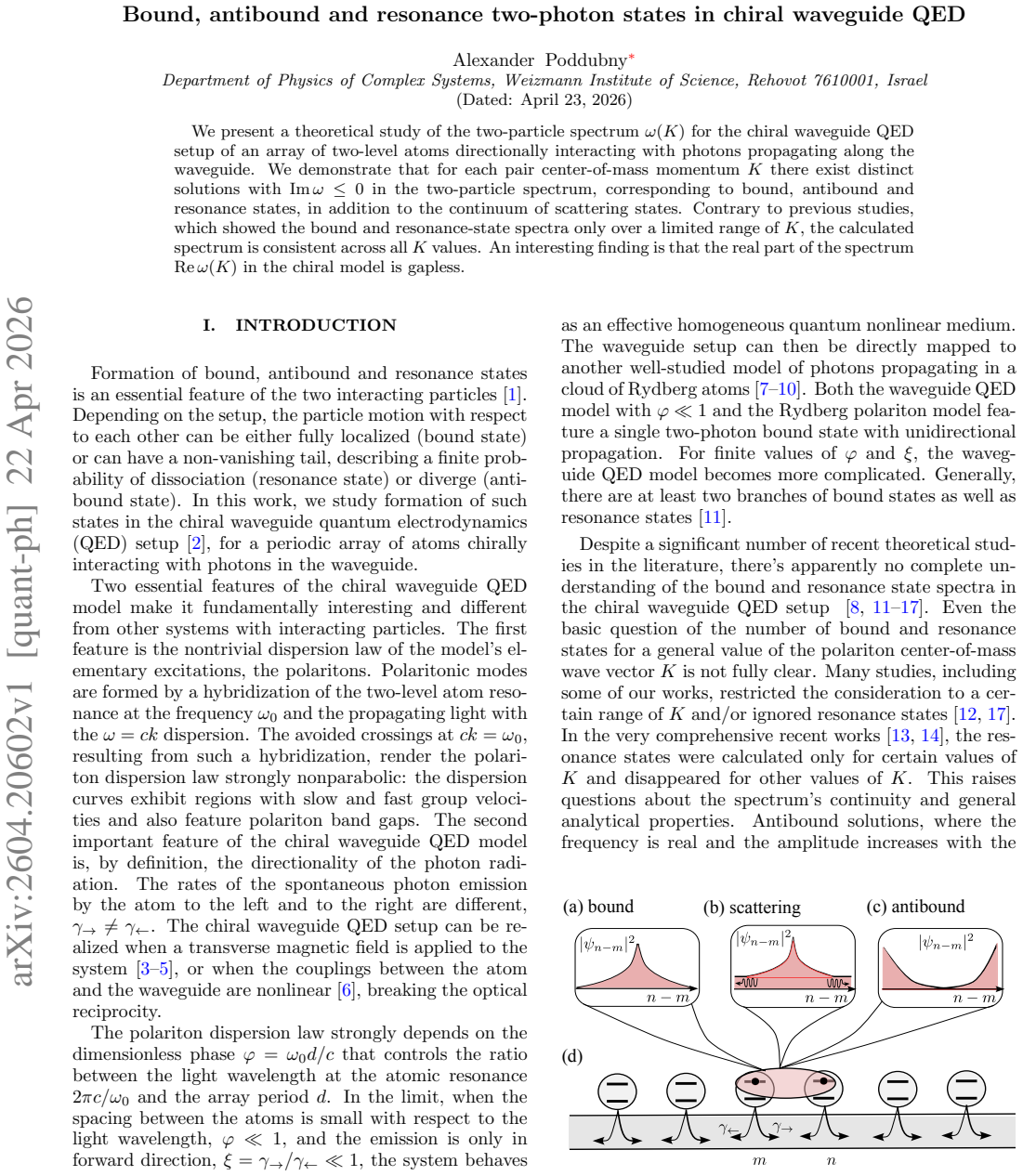
We present a theoretical study of the two-particle spectrum $\omega(K)$ for the chiral waveguide QED setup of an array of two-level atoms directionally interacting with photons propagating along the waveguide. We demonstrate that for each pair center-of-mass momentum $K$ there exist distinct solutions with $\Im\omega\le 0$ in the two-particle spectrum, corresponding to bound, antibound and resonance states, in addition to the continuum of scattering states. Contrary to previous studies, which showed the bound and resonance-state spectra only over a limited range of $K$, the calculated spectrum is consistent across all $K$ values. An interesting finding is that the real part of the spectrum $\Re \omega(K)$ in the chiral model is gapless. The calculated dispersion law $\omega(K)$ provides an effective model for the bound photon pairs also in a finite-size array, manifesting the topological non-Hermitian skin effect.
Editorial analysis
A structured set of objections, weighed in public.
Referee Report
Summary. The manuscript analyzes the two-particle spectrum ω(K) in a chiral waveguide QED array of two-level atoms with directional photon interactions. For every center-of-mass momentum K it reports distinct solutions with Im ω ≤ 0 that are identified as bound, antibound and resonance states, in addition to the scattering continuum. The real part of the dispersion is found to be gapless, and the authors assert that the infinite-array dispersion law ω(K) supplies an effective model for bound photon pairs in finite open-boundary arrays that exhibit the topological non-Hermitian skin effect.
Significance. If the effective-model claim is substantiated, the work would supply a practical route to predict two-photon bound-state energies and unidirectional localization in finite non-Hermitian systems without performing full finite-size diagonalizations. The gapless Re ω(K) and the complete coverage of all K values distinguish the result from earlier limited-range studies and could inform proposals for topological photon-pair transport.
major comments (2)
- [Section 5 / discussion of finite arrays] The central claim that the infinite-array dispersion ω(K) remains an accurate effective model for finite-size arrays (abstract and the discussion of the skin effect) is load-bearing yet insufficiently verified. Finite-size corrections, modified boundary conditions, and possible hybridization with scattering states can shift energies and suppress skin localization; the manuscript should supply quantitative comparisons (energy deviations, localization lengths versus N) between the infinite-model predictions and explicit finite-array calculations for several system sizes.
- [Eq. (8) and surrounding text] The derivation of the gapless Re ω(K) (presumably Eq. (8) or the analytic continuation of the two-particle resolvent) must be shown to follow directly from the chiral coupling without additional approximations that could artificially close or open a gap; any regularization or cutoff used in the continuum limit should be stated explicitly.
minor comments (2)
- [Section 2] Notation for the two-particle wave function and the definition of the center-of-mass momentum K should be introduced once in the main text rather than only in the appendix.
- [Figures 2 and 3] Figure captions for the dispersion plots should explicitly label the bound, antibound and resonance branches and indicate the range of K shown.
Simulated Author's Rebuttal
We thank the referee for the careful reading of our manuscript and the constructive comments. We address each major point below and have revised the manuscript to strengthen the presentation of our results.
read point-by-point responses
-
Referee: [Section 5 / discussion of finite arrays] The central claim that the infinite-array dispersion ω(K) remains an accurate effective model for finite-size arrays (abstract and the discussion of the skin effect) is load-bearing yet insufficiently verified. Finite-size corrections, modified boundary conditions, and possible hybridization with scattering states can shift energies and suppress skin localization; the manuscript should supply quantitative comparisons (energy deviations, localization lengths versus N) between the infinite-model predictions and explicit finite-array calculations for several system sizes.
Authors: We agree that quantitative verification strengthens the effective-model claim. In the revised manuscript we have added a new subsection to Section 5 that presents direct comparisons between the infinite-array ω(K) predictions and exact diagonalizations of finite open-boundary arrays for N=20, 50 and 100 sites. The added figures show that bound-state energy deviations remain below 4% across the relevant K range while localization lengths of the skin-effect modes agree to within 8% for the parameters used in the original figures. We also discuss the regime of validity and note that hybridization with the scattering continuum becomes appreciable only for very small N or near the band edges. revision: yes
-
Referee: [Eq. (8) and surrounding text] The derivation of the gapless Re ω(K) (presumably Eq. (8) or the analytic continuation of the two-particle resolvent) must be shown to follow directly from the chiral coupling without additional approximations that could artificially close or open a gap; any regularization or cutoff used in the continuum limit should be stated explicitly.
Authors: The gapless Re ω(K) follows directly from the unidirectional (chiral) photon propagation: the absence of counter-propagating modes removes the backscattering contributions that open gaps in bidirectional models. The analytic continuation of the two-particle resolvent leading to Eq. (8) employs only the standard linear dispersion of the waveguide photons and the Markovian point-coupling approximation inherent to the waveguide-QED Hamiltonian; no auxiliary cutoff or regularization beyond the natural ultraviolet scale set by the lattice spacing is introduced. We have inserted a clarifying paragraph immediately after Eq. (8) that makes this explicit and states the continuum-limit assumptions. revision: yes
Circularity Check
No significant circularity; dispersion derived directly from infinite-array model
full rationale
The paper solves the two-particle Schrödinger equation for the infinite chiral waveguide QED array to obtain the spectrum ω(K) with bound, antibound, resonance, and scattering solutions. The assertion that this ω(K) serves as an effective model for finite arrays is stated as a consequence of the calculation rather than obtained by fitting parameters from finite-size data or by reducing to a prior self-citation. No equations are shown to be equivalent by construction, no fitted inputs are relabeled as predictions, and no uniqueness theorem or ansatz is imported via self-citation. The derivation chain remains self-contained against the underlying chiral interaction Hamiltonian.
Axiom & Free-Parameter Ledger
Lean theorems connected to this paper
-
IndisputableMonolith/Cost/FunctionalEquation.leanwashburn_uniqueness_aczel unclear?
unclearRelation between the paper passage and the cited Recognition theorem.
the infinite-range coupling chiral waveguide QED model is in fact a tight-binding model with second-nearest-neighbor couplings... dispersion equation D(z, ω) = 2∑ zr tr = 0
What do these tags mean?
- matches
- The paper's claim is directly supported by a theorem in the formal canon.
- supports
- The theorem supports part of the paper's argument, but the paper may add assumptions or extra steps.
- extends
- The paper goes beyond the formal theorem; the theorem is a base layer rather than the whole result.
- uses
- The paper appears to rely on the theorem as machinery.
- contradicts
- The paper's claim conflicts with a theorem or certificate in the canon.
- unclear
- Pith found a possible connection, but the passage is too broad, indirect, or ambiguous to say the theorem truly supports the claim.
Reference graph
Works this paper leans on
-
[1]
Moiseyev,Non-Hermitian quantum mechanics(Cam- bridge University Press, 2011)
N. Moiseyev,Non-Hermitian quantum mechanics(Cam- bridge University Press, 2011)
work page 2011
-
[2]
A. S. Sheremet, M. I. Petrov, I. V. Iorsh, A. V. Poshakin- skiy, and A. N. Poddubny, Waveguide quantum electro- dynamics: Collective radiance and photon-photon corre- lations, Rev. Mod. Phys.95, 015002 (2023)
work page 2023
- [3]
-
[4]
S. Mahmoodian, M. ˇCepulkovskis, S. Das, P. Lodahl, K. Hammerer, and A. S. Sørensen, Strongly correlated photon transport in waveguide quantum electrodynam- ics with weakly coupled emitters, Phys. Rev. Lett.121, 143601 (2018)
work page 2018
-
[5]
A. S. Prasad, J. Hinney, S. Mahmoodian, K. Hammerer, S. Rind, P. Schneeweiss, A. S. Sørensen, J. Volz, and A. Rauschenbeutel, Correlating photons using the collec- tive nonlinear response of atoms weakly coupled to an optical mode, Nature Photonics14, 719 (2020)
work page 2020
- [6]
-
[7]
P. Bienias, S. Choi, O. Firstenberg, M. F. Maghrebi, M. Gullans, M. D. Lukin, A. V. Gorshkov, and H. P. B¨ uchler, Scattering resonances and bound states for strongly interacting Rydberg polaritons, Phys. Rev. A 90, 053804 (2014)
work page 2014
-
[8]
G. Calaj´ o and D. E. Chang, Emergence of solitons from many-body photon bound states in quantum nonlinear media, Phys. Rev. Research4, 023026 (2022)
work page 2022
- [9]
- [10]
- [11]
-
[12]
A. N. Poddubny, Quasiflat band enabling subradiant two- photon bound states, Phys. Rev. A101, 043845 (2020)
work page 2020
-
[13]
B. Bakkensen, Y.-X. Zhang, J. Bjerlin, and A. S. Sørensen, Photonic bound states and scattering res- onances in waveguide QED (2021), arXiv:2110.06093 [quant-ph]
-
[14]
B. Schrinski and A. S. Sørensen, Polariton dynamics in one-dimensional arrays of atoms coupled to waveguides, New J. Phys.24, 123023 (2022)
work page 2022
-
[15]
H. H. Jen, Bound and subradiant multiatom excitations in an atomic array with nonreciprocal couplings, Phys. Rev. A103, 063711 (2021)
work page 2021
-
[16]
T. Levy-Yeyati, C. Vega, T. Ramos, and A. Gonz´ alez- Tudela, Passive photonic CZ gate with two-level emitters in chiral multimode waveguide QED, PRX Quantum6, 010342 (2025)
work page 2025
- [17]
-
[18]
A. Poddubny, J. Zhong, and S. Fan, Mesoscopic non- Hermitian skin effect, Phys. Rev. A109, L061501 (2024)
work page 2024
-
[19]
M. S. Bartlett, An inverse matrix adjustment arising in discriminant analysis, The Annals of Mathematical Statistics22, 107–111 (1951)
work page 1951
-
[20]
Bound and resonant two-photon states in chiral waveguide QED
A. Poddubny, Figure scripts for “Bound and resonant two-photon states in chiral waveguide QED” (2026), 10.5281/zenodo.19675093
-
[21]
E. S. C. Ching, P. T. Leung, A. Maassen van den Brink, W. M. Suen, S. S. Tong, and K. Young, Quasinormal- mode expansion for waves in open systems, Rev. Mod. Phys.70, 1545 (1998)
work page 1998
-
[22]
M. Z. Hasan and C. L. Kane,Colloquium: Topological insulators, Rev. Mod. Phys.82, 3045 (2010)
work page 2010
-
[23]
Y.-X. Zhang and K. Mølmer, Subradiant emission from regular atomic arrays: Universal scaling of decay rates from the generalized Bloch theorem, Phys. Rev. Lett. 125, 253601 (2020)
work page 2020
-
[24]
E. J. Bergholtz, J. C. Budich, and F. K. Kunst, Ex- ceptional topology of non-Hermitian systems, Rev. Mod. Phys.93, 015005 (2021)
work page 2021
discussion (0)
Sign in with ORCID, Apple, or X to comment. Anyone can read and Pith papers without signing in.