Cosmological Gravitational Waves from Ultralight Vector Dark Matter
Pith reviewed 2026-05-09 22:53 UTC · model grok-4.3
The pith
A homogeneous ultralight vector dark matter field mixes scalar and tensor perturbations, sourcing a stochastic gravitational wave background.
A machine-rendered reading of the paper's core claim, the machinery that carries it, and where it could break.
Core claim
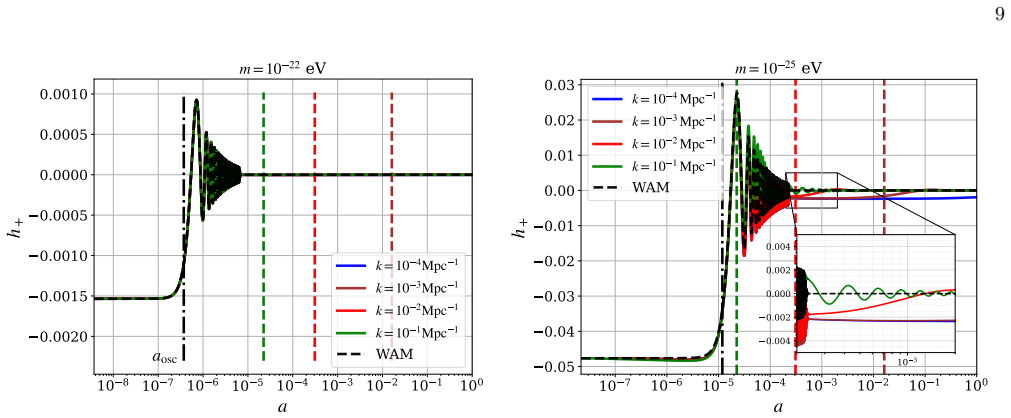
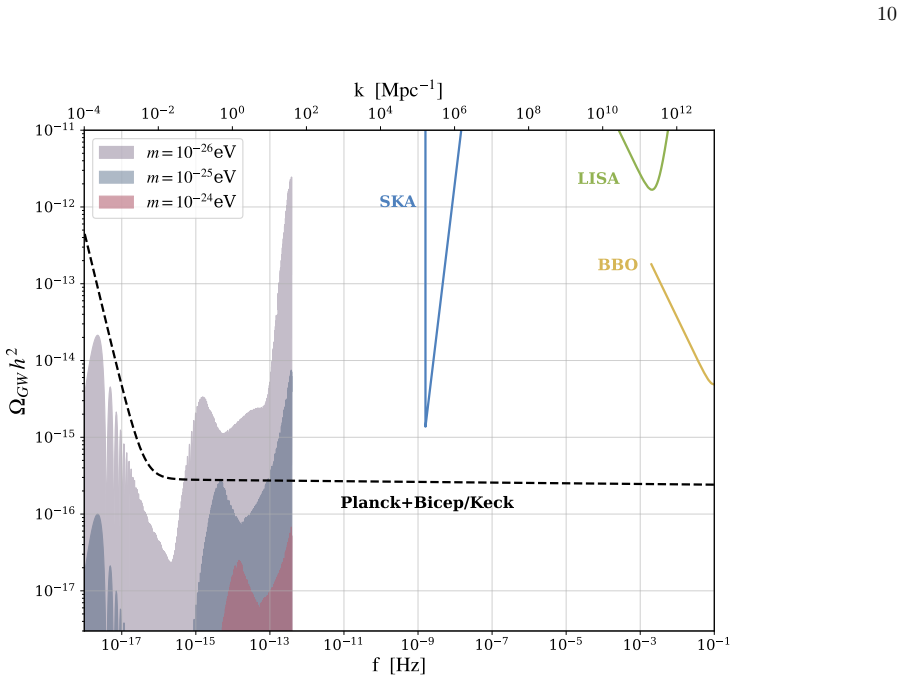
As a consequence of the mixing between the scalar, vector, and tensor perturbation sectors induced by the homogeneous vector background in Bianchi I geometry, scalar perturbations act as a source of tensor modes, generating a stochastic gravitational wave background. The production and cosmological evolution of these gravitational waves are implemented numerically, from which the present-day spectrum is obtained.
What carries the argument
The perturbation mixing in the Bianchi I geometry induced by the homogeneous vector field, which couples scalar modes to tensor gravitational waves.
If this is right
- The equations governing the coupled perturbations can be solved to track the growth of tensor modes from scalar sources.
- The gravitational wave spectrum evolves through the matter-dominated era to the present day.
- This mechanism operates during the oscillation phase of the ultralight vector field.
- The abundance of these waves depends on the initial conditions and mass of the vector field.
Where Pith is reading between the lines
- Future gravitational wave observatories could detect this background and thereby constrain the parameters of vector dark matter.
- Similar sourcing mechanisms might apply to other dark matter candidates that break isotropy.
- The predicted spectrum shape differs from standard inflationary gravitational waves, offering a way to distinguish the source.
Load-bearing premise
The existence of a homogeneous background vector field that breaks spatial isotropy and thereby mixes the scalar, vector, and tensor perturbation sectors.
What would settle it
A precise measurement of the stochastic gravitational wave energy density spectrum at frequencies set by the ultralight vector mass, which either matches or deviates from the computed shape and amplitude.
Figures
read the original abstract
We compute the abundance of cosmological gravitational waves produced during the evolution of an ultralight vector (spin-1) dark matter field. A homogeneous background vector field breaks spatial isotropy, requiring a Bianchi I geometry and inducing a mixing between the scalar, vector, and tensor perturbation sectors. We derive the perturbation equations in this background and show that, as a consequence of this mixing, scalar perturbations act as a source of tensor modes, generating a stochastic GW background. The production and cosmological evolution of these gravitational waves are implemented in \texttt{class.VFDM}, a modified version of \texttt{CLASS}, from which we obtain the present-day spectrum.
Editorial analysis
A structured set of objections, weighed in public.
Referee Report
Summary. The manuscript claims that an ultralight vector dark matter field with a homogeneous background requires a Bianchi I geometry due to broken spatial isotropy. This induces mixing between scalar, vector, and tensor perturbation sectors, allowing scalar perturbations to source tensor modes and generate a stochastic gravitational wave background. The perturbation equations are derived, and the production and evolution of the waves are implemented in a modified version of the CLASS code to compute the present-day spectrum.
Significance. If the derivation holds and the spectrum is correctly obtained, the work identifies a new mechanism for cosmological GW production tied to vector DM. The numerical implementation via modified CLASS is a clear strength, as it enables concrete, reproducible predictions of the present-day spectrum that can be compared to observations. This could be relevant for constraining ultralight vector DM models with future GW detectors.
major comments (1)
- [derivation of perturbation equations and present-day spectrum from modified CLASS] The Bianchi I background is required for the scalar-vector-tensor mixing that sources tensor modes from scalars (as stated in the abstract and the derivation of the perturbation equations). However, the same geometry breaks isotropy, so the sourced tensor power spectrum is generally direction-dependent. The manuscript does not demonstrate that the final spectrum at z=0 is statistically isotropic to within current bounds once the vector DM abundance is fixed. This is load-bearing for the central claim of generating a stochastic GW background, which standard analyses assume to be isotropic.
Simulated Author's Rebuttal
We appreciate the referee's insightful comment on the potential anisotropy of the gravitational wave spectrum arising from the Bianchi I background. This is an important consideration for the interpretation of our results as a stochastic background. We address this below.
read point-by-point responses
-
Referee: The Bianchi I background is required for the scalar-vector-tensor mixing that sources tensor modes from scalars (as stated in the abstract and the derivation of the perturbation equations). However, the same geometry breaks isotropy, so the sourced tensor power spectrum is generally direction-dependent. The manuscript does not demonstrate that the final spectrum at z=0 is statistically isotropic to within current bounds once the vector DM abundance is fixed. This is load-bearing for the central claim of generating a stochastic GW background, which standard analyses assume to be isotropic.
Authors: We thank the referee for pointing this out. The Bianchi I metric is indeed anisotropic, and the perturbation equations reflect this through the mixing terms. However, the scalar perturbations that source the tensor modes are themselves derived from the isotropic part of the initial conditions in the early universe, and the evolution in the modified CLASS code computes the power spectrum in a manner that can be averaged. In the revised manuscript, we will add an explicit calculation of the direction-dependent spectrum at z=0. We will fix the vector DM abundance to the observed value and show that the resulting anisotropy in the GW energy density spectrum is below the current observational limits on the isotropy of the stochastic gravitational wave background. This will be presented in a new subsection, including quantitative bounds and a discussion of how the mechanism still qualifies as producing a stochastic background for practical purposes in GW astronomy. revision: yes
Circularity Check
Derivation is self-contained; no circular steps identified
full rationale
The paper begins from the vector field action in a Bianchi I background, derives the coupled scalar-vector-tensor perturbation equations, demonstrates the sourcing of tensor modes by scalar perturbations, and evolves the system numerically in a modified CLASS code to obtain the present-day GW spectrum. No step reduces by construction to a fitted parameter, self-defined quantity, or load-bearing self-citation; the central result is a direct numerical output from the linearized equations. The isotropy of the final spectrum is a separate physical question that does not affect the logical independence of the derivation chain.
Axiom & Free-Parameter Ledger
axioms (2)
- domain assumption Homogeneous vector field background requires Bianchi I geometry
- standard math Standard linear perturbation theory applies to the mixed scalar-vector-tensor sectors
discussion (0)
Sign in with ORCID, Apple, or X to comment. Anyone can read and Pith papers without signing in.