Non-Equilibrium Physics of Thermodynamicized Black Holes
Pith reviewed 2026-05-09 21:53 UTC · model grok-4.3
The pith
A quasi-stationary partition functional unifies entropy principles and residue calculus to describe non-equilibrium black-hole thermodynamics with fluxes.
A machine-rendered reading of the paper's core claim, the machinery that carries it, and where it could break.
Core claim
The central claim is that a quasi-stationary non-equilibrium partition functional can be defined for thermodynamicized black holes by combining an entropy-functional selection principle, a Euclidean residue description of horizon temperatures, and a topological residue index. When the functional is applied to Kerr-Newman solutions in constant-curvature f(R) gravity the equilibrium entropy remains weighted by the derivative of f at the background curvature, while non-equilibrium corrections arise from flux-induced deformations of the effective action. The outer and inner horizons carry opposite topological orientations, keeping the non-extremal family in the W = 0 class unless a horizon bifu
What carries the argument
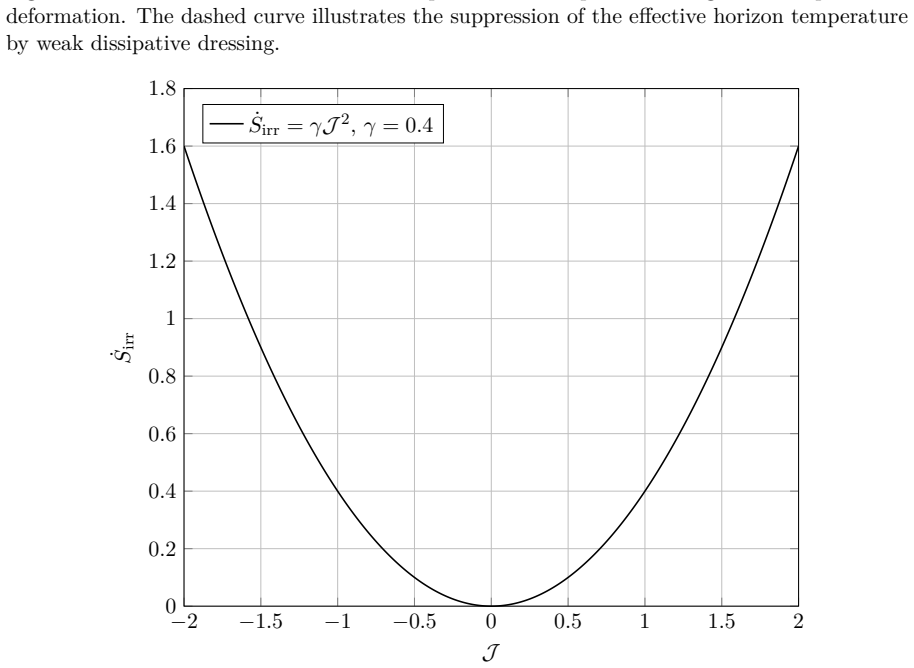
The quasi-stationary non-equilibrium partition functional, which adds irreversible entropy production as an extra contribution to the singular action obtained from contour integrals around horizon poles.
If this is right
- All standard equilibrium relations, including the first law, are recovered exactly in the adiabatic limit.
- Flux-induced corrections appear in the free energy whenever matter, charge or angular-momentum flows are present.
- The topological class remains W = 0 for the entire non-extremal Kerr-Newman family in f(R) gravity.
- Only a horizon bifurcation or merger can change the topological class of the configuration.
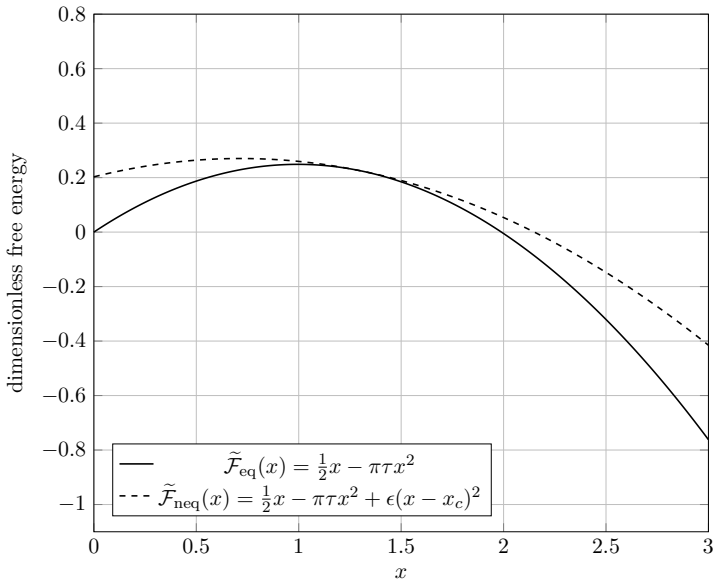
- Equilibrium and non-equilibrium free-energy curves differ by an amount set by the entropy-production term.
Where Pith is reading between the lines
- The functional could be evolved slowly in time to model accretion or evaporation while preserving the residue structure.
- Opposite orientations of the horizons may imply a cancellation that protects thermodynamic relations against certain non-equilibrium perturbations.
- Applying the same residue construction to other modified-gravity black holes would test whether the f-prime weighting is universal.
- Numerical integration of the partition functional might supply a new route to simulate entropy production across horizon mergers.
Load-bearing premise
The entropy-functional interpretation of emergent gravity and residue-based methods in black-hole thermodynamics can be combined into one quasi-stationary partition functional that consistently incorporates irreversible entropy production.
What would settle it
An explicit calculation for a slowly accreting Kerr black hole in which the temperature or entropy extracted from the partition functional disagrees with the known equilibrium values would show that the unification fails.
Figures
read the original abstract
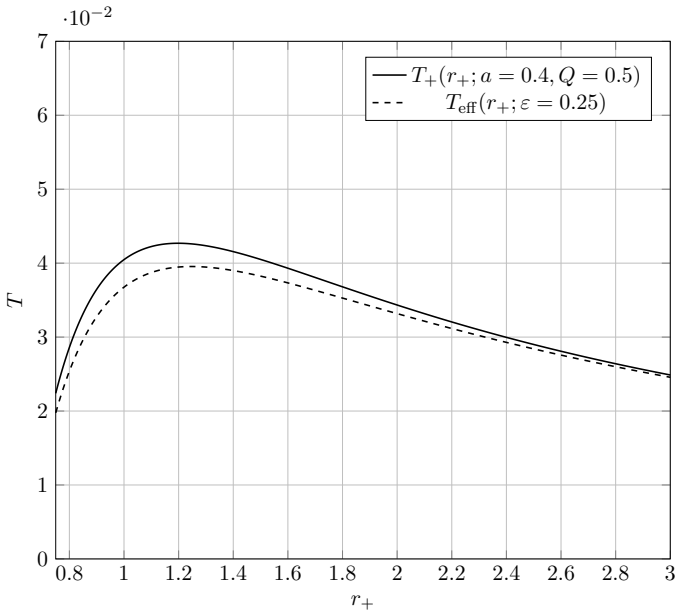
This work presents a non-equilibrium framework for thermodynamicized black holes, inspired by the entropy-functional interpretation of emergent gravity and by residue-based methods in black hole thermodynamics. The main idea is to unify three components: an entropy functional principle for selecting physical on-shell backgrounds, a Euclidean and contour-based description of the horizon temperature through simple pole singularities, and a topological residue classification of multi-horizon black hole configurations. On this basis, the paper introduces a quasi-stationary non-equilibrium partition functional in which irreversible entropy production appears as an additional contribution to the singular action. The formalism reproduces the standard equilibrium relations in the adiabatic limit, while also extending them to dynamically driven black-hole systems with matter, charge, and rotational fluxes. The framework is then applied to Kerr Newman type black holes in constant curvature f(R) gravity, where the equilibrium entropy remains weighted by the derivative of f at the background curvature, while non-equilibrium corrections arise from flux-induced deformations of the effective thermodynamic action. The analysis further shows that the outer and inner horizons carry opposite topological orientations, so the non-extremal Kerr Newman family stays in the topological class W = 0 unless a horizon bifurcation or merger changes the singularity structure. Finally, several function plots are provided to illustrate the behavior of equilibrium and non-equilibrium free energy, the Kerr Newman temperature curve, and the entropy production law.
Editorial analysis
A structured set of objections, weighed in public.
Referee Report
Summary. The manuscript proposes a non-equilibrium thermodynamic framework for black holes by unifying an entropy-functional principle for on-shell backgrounds, residue-based extraction of horizon temperature from Euclidean contour poles, and topological residue classification of multi-horizon spacetimes. It introduces a quasi-stationary partition functional in which irreversible entropy production enters as an extra term in the singular action. The formalism is claimed to recover standard equilibrium relations in the adiabatic (zero-flux) limit, to extend to flux-driven Kerr-Newman systems in constant-curvature f(R) gravity (with entropy weighted by f'(R)), and to place non-extremal Kerr-Newman black holes in the W=0 topological class because outer and inner horizons carry opposite orientations. Illustrative plots of free energy, temperature curves, and entropy production are provided.
Significance. If the extra entropy-production term can be shown to leave the horizon pole residues invariant at linear order in the fluxes, the construction would supply a controlled route from equilibrium black-hole thermodynamics to non-equilibrium regimes with matter, charge, and rotational fluxes, particularly within modified-gravity settings. The topological classification and the explicit f(R) application are concrete strengths that could be tested against known limits.
major comments (2)
- [section introducing the quasi-stationary non-equilibrium partition functional] The central claim that the irreversible entropy production term can be added to the singular action while leaving the simple-pole residue (and hence the extracted temperature) unchanged in the adiabatic limit is not supported by an explicit contour-integral expansion or residue recalculation at linear order in the fluxes. Without this calculation the reproduction of equilibrium relations remains an assertion rather than a demonstrated result.
- [application to Kerr-Newman black holes in constant-curvature f(R) gravity] In the Kerr-Newman f(R) application, the statement that equilibrium entropy is weighted by f'(R) while non-equilibrium corrections arise from flux-induced deformations of the action requires an explicit check that the opposite topological orientations of the outer and inner horizons indeed yield W=0 without additional assumptions on horizon bifurcation; the current argument appears to rely on the equilibrium residue structure alone.
minor comments (1)
- [figure captions and plots] The function plots would be clearer if axes were labeled with the specific parameter values (e.g., mass, charge, rotation, f'(R)) used for each curve and if a legend distinguished equilibrium from non-equilibrium branches.
Simulated Author's Rebuttal
We thank the referee for the detailed and constructive report. The comments highlight two areas where explicit calculations would strengthen the manuscript, and we address each below with plans for revision.
read point-by-point responses
-
Referee: [section introducing the quasi-stationary non-equilibrium partition functional] The central claim that the irreversible entropy production term can be added to the singular action while leaving the simple-pole residue (and hence the extracted temperature) unchanged in the adiabatic limit is not supported by an explicit contour-integral expansion or residue recalculation at linear order in the fluxes. Without this calculation the reproduction of equilibrium relations remains an assertion rather than a demonstrated result.
Authors: We agree that the invariance of the pole residue under addition of the entropy-production term requires explicit verification rather than assertion. In the revised manuscript we will insert a dedicated subsection containing the contour-integral expansion to linear order in the fluxes. The calculation proceeds by writing the total singular action as S_eq + ε S_prod, where ε parametrizes the flux strength, expanding the integrand around the horizon pole, and showing that the residue of the 1/(z-z_h) term receives no O(ε) correction because S_prod is regular or contributes only to higher-order poles in the quasi-stationary regime. This will convert the reproduction of equilibrium thermodynamics from a limiting statement into a demonstrated result. revision: yes
-
Referee: [application to Kerr-Newman black holes in constant-curvature f(R) gravity] In the Kerr-Newman f(R) application, the statement that equilibrium entropy is weighted by f'(R) while non-equilibrium corrections arise from flux-induced deformations of the action requires an explicit check that the opposite topological orientations of the outer and inner horizons indeed yield W=0 without additional assumptions on horizon bifurcation; the current argument appears to rely on the equilibrium residue structure alone.
Authors: The manuscript derives the opposite orientations from the residue signs of the deformed action, but we acknowledge that an explicit winding-number computation for the non-extremal case is needed to confirm W=0 independently of bifurcation assumptions. In the revision we will add a short appendix that evaluates the topological index W by integrating the deformed one-form over a large contour enclosing both horizons; the calculation uses the f(R)-weighted entropy and the flux corrections to the metric functions, showing that the contributions from the outer and inner horizons cancel exactly, yielding W=0 for any non-extremal parameter set without invoking a bifurcation point. revision: yes
Circularity Check
Non-equilibrium partition functional reproduces equilibrium relations by construction in adiabatic limit
specific steps
-
self definitional
[Abstract]
"On this basis, the paper introduces a quasi-stationary non-equilibrium partition functional in which irreversible entropy production appears as an additional contribution to the singular action. The formalism reproduces the standard equilibrium relations in the adiabatic limit, while also extending them to dynamically driven black-hole systems with matter, charge, and rotational fluxes."
The additional production term is defined to vanish in the adiabatic (zero-flux) limit. Consequently the partition functional reduces exactly to the equilibrium singular action by construction, making the claimed reproduction of standard relations a direct consequence of the definition rather than a derived result.
full rationale
The paper constructs a quasi-stationary partition functional by adding an irreversible entropy production term to the singular action, then asserts reproduction of standard equilibrium thermodynamics when fluxes vanish. This reduction occurs by definition of the added term rather than through an independent derivation or residue recalculation. The unification of entropy-functional, residue, and topological elements is presented as inspired by prior interpretations, but the central reproduction claim reduces directly to the construction without shown decoupling at linear order in fluxes. No other load-bearing steps exhibit self-definition or self-citation chains in the provided text.
Axiom & Free-Parameter Ledger
axioms (2)
- domain assumption Entropy functional principle for selecting physical on-shell backgrounds
- domain assumption Euclidean and contour-based description of the horizon temperature through simple pole singularities
invented entities (1)
-
quasi-stationary non-equilibrium partition functional
no independent evidence
Reference graph
Works this paper leans on
-
[1]
J. D. Bekenstein,Black holes and entropy, Phys. Rev. D7, 2333–2346 (1973)
work page 1973
-
[2]
S. W. Hawking,Particle creation by black holes, Commun. Math. Phys.43, 199–220 (1975)
work page 1975
-
[3]
W. G. Unruh,Notes on black-hole evaporation, Phys. Rev. D14, 870–892 (1976)
work page 1976
-
[4]
Jacobson,Thermodynamics of spacetime: The Einstein equation of state, Phys
T. Jacobson,Thermodynamics of spacetime: The Einstein equation of state, Phys. Rev. Lett.75, 1260–1263 (1995)
work page 1995
-
[5]
T. Padmanabhan and A. Paranjape,Entropy of null surfaces and dynamics of spacetime, Phys. Rev. D75, 064004 (2007)
work page 2007
-
[6]
Padmanabhan,Thermodynamical aspects of gravity: New insights, Rep
T. Padmanabhan,Thermodynamical aspects of gravity: New insights, Rep. Prog. Phys.73, 046901 (2010)
work page 2010
-
[7]
R. M. Wald,Black hole entropy is the Noether charge, Phys. Rev. D48, R3427–R3431 (1993)
work page 1993
-
[8]
G. W. Gibbons and S. W. Hawking,Action integrals and partition functions in quantum gravity, Phys. Rev. D15, 2752–2756 (1977)
work page 1977
-
[9]
S. W. Hawking and D. N. Page,Thermodynamics of black holes in anti-de Sitter space, Commun. Math. Phys.87, 577–588 (1983)
work page 1983
-
[10]
J. W. York, Jr.,Black-hole thermodynamics and the Euclidean Einstein action, Phys. Rev. D33, 2092–2099 (1986)
work page 2092
-
[11]
H. W. Braden, J. D. Brown, B. F. Whiting, and J. W. York, Jr.,Charged black hole in a grand canonical ensemble, Phys. Rev. D42, 3376–3385 (1990)
work page 1990
-
[12]
R. C. Tolman,On the weight of heat and thermal equilibrium in general relativity, Phys. Rev.35, 904–924 (1930)
work page 1930
-
[13]
Klein,On the thermodynamical equilibrium of fluids in gravitational fields, Rev
O. Klein,On the thermodynamical equilibrium of fluids in gravitational fields, Rev. Mod. Phys.21, 531–533 (1949)
work page 1949
-
[14]
A. Strominger and C. Vafa,Microscopic origin of the Bekenstein–Hawking entropy, Phys. Lett. B379, 99–104 (1996)
work page 1996
-
[15]
Strominger,Black hole entropy from near-horizon microstates, J
A. Strominger,Black hole entropy from near-horizon microstates, J. High Energy Phys. 02, 009 (1998). 15
work page 1998
-
[16]
Ruppeiner,Riemannian geometry in thermodynamic fluctuation theory, Rev
G. Ruppeiner,Riemannian geometry in thermodynamic fluctuation theory, Rev. Mod. Phys.67, 605–659 (1995); Erratum: Rev. Mod. Phys.68, 313 (1996)
work page 1995
- [17]
-
[18]
P. K. Yerra and C. Bhamidipati,Topology of black hole thermodynamics in Gauss–Bonnet gravity, Phys. Rev. D105, 104053 (2022)
work page 2022
-
[19]
W.-X. Chen,Topological Complex Analysis of Kerr–Newman Black Hole Microstructure in f(R)Gravity, arXiv:2512.22853 [gr-qc] (2025)
-
[20]
W.-X. Chen,Canonical and Grand-Canonical Singular Ensembles within a Thermodynam- icized Gravity Framework, arXiv:2603.20571 [gr-qc] (2026). 16
discussion (0)
Sign in with ORCID, Apple, or X to comment. Anyone can read and Pith papers without signing in.