Recognition: unknown
Uncertainty-Aware Spatiotemporal Super-Resolution Data Assimilation with Diffusion Models
Pith reviewed 2026-05-09 21:11 UTC · model grok-4.3
The pith
Diffusion models enable high-resolution probabilistic data assimilation from low-resolution forecasts at EnKF-level accuracy.
A machine-rendered reading of the paper's core claim, the machinery that carries it, and where it could break.
Core claim
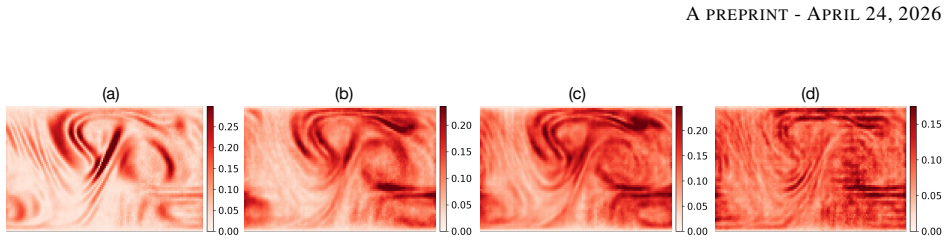
DiffSRDA is a probabilistic spatiotemporal super-resolution data assimilation framework based on denoising diffusion models. It is trained offline to generate short high-resolution analysis windows conditioned on a time series of low-resolution forecast frames and sparse high-resolution observations. Repeated reverse diffusion sampling produces an ensemble of high-resolution analyses that provide both point estimates and uncertainty information. On an idealized barotropic ocean jet instability testbed, this achieves reconstruction quality close to an Ensemble Kalman Filter driven by high-resolution forecasts and improves over deterministic CNN-based baselines, with ensemble spread focused in
What carries the argument
The denoising diffusion model conditioned on low-resolution forecast sequences and sparse observations, which generates high-resolution analysis ensembles through repeated reverse diffusion sampling.
Load-bearing premise
That an offline-trained diffusion model on the idealized barotropic ocean jet instability testbed produces accurate probabilistic high-resolution analyses for the target chaotic dynamics when conditioned only on low-resolution forecasts and sparse observations.
What would settle it
If an experiment on the barotropic jet testbed shows that the root mean square error of the high-resolution analyses from DiffSRDA exceeds that of a high-resolution EnKF or that the ensemble spread fails to concentrate in dynamically active regions, the claim of comparable performance would be falsified.
Figures




read the original abstract
Data assimilation (DA) improves prediction of chaotic systems by combining model forecasts with sparse, noisy observations. Many DA methods are inherently probabilistic, but accurate probabilistic DA is often computationally expensive because it requires repeated high-resolution (HR) forecasts and large ensembles. In this study, we develop DiffSRDA, a probabilistic spatiotemporal super-resolution data assimilation framework based on denoising diffusion models, and evaluate it on an idealized barotropic ocean jet instability testbed. DiffSRDA is trained offline to generate short HR analysis windows conditioned on (i) a time series of low-resolution (LR) forecast frames and (ii) sparse HR observations. Repeated reverse diffusion sampling then produces an ensemble of HR analyses, providing both point estimates and uncertainty information. Despite relying only on low-cost LR forecasts, DiffSRDA achieves reconstruction quality close to that of an Ensemble Kalman Filter (EnKF) driven by HR forecasts, while improving over deterministic CNN-based SRDA baselines. The sampled ensemble also yields physically meaningful uncertainty patterns, with spread concentrated in dynamically active regions similarly to EnKF. A key practical result is that accurate base DiffSRDA cycling does not require long reverse chains: most of the full-chain accuracy is retained with only a few reverse steps, making diffusion-based SRDA practical for repeated cycling. Finally, by exploiting the score-based structure of diffusion sampling, we demonstrate training-free observation-consistency guidance for deployment-time sensor-layout shifts, enabling improved use of changed observation configurations without retraining. Overall, diffusion models provide a practical, uncertainty-aware, and computationally efficient approach for spatiotemporal SRDA in chaotic fluid flows.
Editorial analysis
A structured set of objections, weighed in public.
Referee Report
Summary. The manuscript introduces DiffSRDA, a denoising diffusion model framework for probabilistic spatiotemporal super-resolution data assimilation. Trained offline on an idealized barotropic ocean jet instability testbed, the model generates ensembles of high-resolution analyses conditioned on low-resolution forecast time series and sparse high-resolution observations. It claims reconstruction quality close to an EnKF driven by high-resolution forecasts, improvement over deterministic CNN-based SRDA baselines, physically meaningful uncertainty patterns concentrated in dynamically active regions, retention of accuracy with few reverse diffusion steps for practical cycling, and training-free observation-consistency guidance for sensor-layout changes.
Significance. If the central claims hold, this provides a computationally efficient route to uncertainty-aware DA in chaotic fluid systems by replacing repeated high-resolution ensemble forecasts with offline-trained diffusion sampling. The combination of score-based guidance, few-step sampling, and ensemble spread that qualitatively matches EnKF is a notable practical strength for operational fluid-dynamics applications.
major comments (3)
- [§4] §4 (results on jet instability): the claim that DiffSRDA achieves reconstruction quality 'close to' EnKF is supported only by point-wise RMSE and spread metrics on the same idealized testbed used for training; no quantitative assessment of whether the learned prior recovers the high-frequency vorticity structures lost in the LR forecast operator is provided, leaving the central claim vulnerable to distribution shift.
- [§3.2] §3.2 (conditioning and sampling): the offline training procedure assumes the diffusion model can synthesize missing small-scale dynamics consistently with sparse observations, yet no ablation or sensitivity test is shown for training-trajectory length or attractor coverage; in an exponentially unstable jet, this is load-bearing for whether the sampled ensemble mean and spread remain reliable.
- [§5.2] §5.2 (training-free guidance): the observation-consistency guidance is presented as enabling deployment-time sensor shifts without retraining, but the manuscript reports only qualitative improvements; quantitative metrics (e.g., analysis RMSE before/after shift) are absent, weakening the practical-deployment claim.
minor comments (3)
- [Figures 4-6] Figure captions and axis labels in the uncertainty visualizations could more explicitly indicate whether spread is compared against true analysis error or only against EnKF spread.
- [Abstract] The abstract states that 'most of the full-chain accuracy is retained with only a few reverse steps' without citing the specific step count or the corresponding quantitative table/figure.
- [§3] Notation for the conditional score function could be clarified to distinguish the LR-forecast conditioning from the observation guidance term.
Simulated Author's Rebuttal
We thank the referee for their constructive and detailed comments, which have helped us identify areas where the manuscript can be strengthened. We address each major comment point by point below and outline the revisions we will make to the manuscript.
read point-by-point responses
-
Referee: §4 (results on jet instability): the claim that DiffSRDA achieves reconstruction quality 'close to' EnKF is supported only by point-wise RMSE and spread metrics on the same idealized testbed used for training; no quantitative assessment of whether the learned prior recovers the high-frequency vorticity structures lost in the LR forecast operator is provided, leaving the central claim vulnerable to distribution shift.
Authors: We appreciate the referee's observation that additional diagnostics would better support the claim of recovering small-scale structures. The reported RMSE and spread metrics already show DiffSRDA performance approaching that of the high-resolution EnKF on the testbed. To directly address recovery of high-frequency vorticity, we will add quantitative comparisons of kinetic energy spectra and vorticity structure functions between DiffSRDA analyses, the low-resolution forecasts, and the EnKF reference in the revised §4. These will demonstrate that the diffusion prior reconstructs the missing small scales consistently with the underlying dynamics. revision: yes
-
Referee: §3.2 (conditioning and sampling): the offline training procedure assumes the diffusion model can synthesize missing small-scale dynamics consistently with sparse observations, yet no ablation or sensitivity test is shown for training-trajectory length or attractor coverage; in an exponentially unstable jet, this is load-bearing for whether the sampled ensemble mean and spread remain reliable.
Authors: The referee correctly notes the importance of attractor coverage for an unstable system. Our training data consisted of long trajectories that include multiple full cycles of jet instability growth, saturation, and decay to sample the relevant dynamics. We agree that explicit sensitivity tests would increase confidence. In the revision we will add an ablation study in §3.2 (or a new supplementary section) varying training trajectory length and reporting the resulting changes in ensemble-mean RMSE and spread reliability. revision: yes
-
Referee: §5.2 (training-free guidance): the observation-consistency guidance is presented as enabling deployment-time sensor shifts without retraining, but the manuscript reports only qualitative improvements; quantitative metrics (e.g., analysis RMSE before/after shift) are absent, weakening the practical-deployment claim.
Authors: We acknowledge that the current §5.2 relies on qualitative visual comparisons for the training-free guidance. To strengthen the practical-deployment argument, we will add quantitative metrics in the revised manuscript, including analysis RMSE, ensemble spread, and observation-fit statistics computed before and after applying the guidance to shifted sensor layouts. These will be reported alongside the existing qualitative results. revision: yes
Circularity Check
No circularity: empirical application of diffusion models to SRDA on fixed testbed
full rationale
The paper trains a conditional diffusion model offline on the barotropic jet instability testbed and evaluates ensemble analyses against EnKF and CNN baselines using the same data. All reported metrics (reconstruction quality, uncertainty patterns, few-step sampling) are direct numerical outcomes of this training and sampling procedure. No derivation step equates a claimed prediction to its own fitted inputs by construction, no self-citation chain carries the central claim, and no ansatz or uniqueness theorem is smuggled in. The framework is self-contained against external benchmarks (EnKF, deterministic SRDA) and does not reduce to tautology.
Axiom & Free-Parameter Ledger
free parameters (1)
- diffusion hyperparameters
axioms (1)
- domain assumption The idealized barotropic ocean jet instability sufficiently captures the essential chaotic dynamics for evaluating super-resolution DA methods.
Reference graph
Works this paper leans on
-
[1]
M. S. Albergo, N. M. Boffi, and E. Vanden-Eijnden. Stochastic interpolants: A unifying framework for flows and diffusions.arXiv preprint arXiv:2303.08797,
work page internal anchor Pith review arXiv
-
[2]
doi: 10.1016/0304-4149(82)90051-5. F. Bao, Z. Zhang, and G. Zhang. An ensemble score filter for tracking high-dimensional nonlinear dynamical systems. Computer Methods in Applied Mechanics and Engineering, 432:117447,
-
[3]
Barthélémy, J
25 APREPRINT- APRIL24, 2026 S. Barthélémy, J. Brajard, L. Bertino, and F. Counillon. Super-resolution data assimilation.Ocean Dynamics, 72(8): 661–678,
2026
-
[4]
R. Bradbury and D. Zhong. Your latent mask is wrong: Pixel-equivalent latent compositing for diffusion models.arXiv preprint arXiv:2512.05198,
- [5]
- [6]
- [7]
-
[8]
Diffusion Posterior Sampling for General Noisy Inverse Problems
H. Chung, J. Kim, M. T. McCann, M. L. Klasky, and J. C. Ye. Diffusion posterior sampling for general noisy inverse problems.arXiv preprint arXiv:2209.14687,
work page internal anchor Pith review arXiv
-
[9]
Diffusion models for inverse problems
H. Chung, J. Kim, and J. C. Ye. Diffusion models for inverse problems.arXiv preprint arXiv:2508.01975,
- [10]
- [11]
- [12]
- [13]
-
[14]
I. Price, A. Sanchez-Gonzalez, F. Alet, T. R. Andersson, A. El-Kadi, D. Masters, T. Ewalds, J. Stott, S. Mohamed, P. Battaglia, et al. Gencast: Diffusion-based ensemble forecasting for medium-range weather.arXiv preprint arXiv:2312.15796,
-
[15]
J. Song, C. Meng, and S. Ermon. Denoising diffusion implicit models.arXiv preprint arXiv:2010.02502, 2020a. Y . Song and P. Dhariwal. Improved techniques for training consistency models.arXiv preprint arXiv:2310.14189,
work page internal anchor Pith review Pith/arXiv arXiv 2010
-
[16]
Y . Song, J. Sohl-Dickstein, D. P. Kingma, A. Kumar, S. Ermon, and B. Poole. Score-based generative modeling through stochastic differential equations.arXiv preprint arXiv:2011.13456, 2020b. Y . Song, P. Dhariwal, M. Chen, and I. Sutskever. Consistency models. InProceedings of the 40th International Conference on Machine Learning, volume 202 ofProceedings...
work page internal anchor Pith review Pith/arXiv arXiv 2011
- [17]
-
[18]
A. Vishwasrao, S. B. C. Gutha, A. Cremades, K. Wijk, A. Patil, C. Gorle, B. J. McKeon, H. Azizpour, and R. Vin- uesa. Diff-sport: Diffusion-based sensor placement optimization and reconstruction of turbulent flows in urban environments.arXiv preprint arXiv:2506.00214,
- [19]
-
[20]
Yasuda and R
27 APREPRINT- APRIL24, 2026 Y . Yasuda and R. Onishi. Unsupervised super-resolution data assimilation using conditional variational autoencoders with estimating background covariances via super-resolution.Physics of Fluids, 37(4),
2026
- [21]
-
[22]
A Interpreting DiffSRDA as a forecast-informed Bayesian posterior The DiffSRDA formulation admits a natural Bayesian interpretation. At each assimilation time, the analysis variable is a high-resolution (HR) state windowX conditioned on two sources of information: sparse observations and low-resolution (LR) forecast information from a physics-based numeri...
2026
-
[23]
˜p(X0 |c,y)dX 0.(47) Substituting equation (42) into equation (47) gives ˜pτ(Xτ |c,y)∝ Z qτ(Xτ |X 0)p θ(X0 |c)p(y|X 0)dX 0.(48) 29 APREPRINT- APRIL24, 2026 To separate this guided marginal into an unguided term inXτ and an observation-likelihood term, Bayes’ rule is applied under the induced joint densityp θ(X0 |c)q τ(Xτ |X 0), leading to pθ(X0 |X τ ,c) :...
2026
-
[24]
Substitution of equation (61) into equation (60) gives gτ = ∂ ˆX0 ∂Xτ !⊤ JA( ˆX0)⊤R−1 y−A( ˆX0) .(62) In the present work,A(X
=J A(X0)⊤R−1(y−A(X 0)),(61) 30 APREPRINT- APRIL24, 2026 where JA(X0) :=∇ X0 A(X0) is the Jacobian of the forward operator. Substitution of equation (61) into equation (60) gives gτ = ∂ ˆX0 ∂Xτ !⊤ JA( ˆX0)⊤R−1 y−A( ˆX0) .(62) In the present work,A(X
2026
-
[25]
To avoid this backward pass, a stop-gradient (straight- through) Jacobian approximation is adopted based on equation (56)
=HX 0 is linear, soJ A(·) =H, and equation (62) reduces to gτ = ∂ ˆX0 ∂Xτ !⊤ H ⊤R−1 y−H ˆX0 .(63) Full DPS evaluates equation (63) by differentiating through the denoiser, which requires Jacobian–vector products involving ∂εθ/∂Xτ at every reverse step (Chung et al., 2022). To avoid this backward pass, a stop-gradient (straight- through) Jacobian approxima...
2022
-
[26]
In this formulation, guidance influences the reverse dynamics through the corrected clean estimate ˆX0, and through εrec if it is recomputed. It is sometimes useful to interpret the likelihood-score approximation in equation (66) through the generic lifted- residual template summarized in diffusion inverse-problem surveys (Daras et al., 2024). In that not...
2024
-
[27]
=HX 0, one hasJ A(·) =H, and equation (79) reduces to equation (66). It is emphasized that equation (65) is a stop-gradient approximation motivated by efficiency and by the simplicity of the sparse on-grid masking operator used here; in general, it does not yield an exact diffusion-time posterior score. For more challenging cases, including nonlinear obse...
2023
-
[28]
The noisy diffusion variable is therefore the latent tensor zτ rather than the pixel-space state window
For LatDiffSRDA, shown in Figure 17(b), the SRDA cycle and conditioning structure remain the same, but diffusion is performed in the vector-quantized latent space produced by a VQ-V AE, as described in Appendix C. The noisy diffusion variable is therefore the latent tensor zτ rather than the pixel-space state window. The conditioning channels from the LR ...
2026
discussion (0)
Sign in with ORCID, Apple, or X to comment. Anyone can read and Pith papers without signing in.