Linking molecular timescales to linear viscoelastic response in dilute and semidilute unentangled wormlike micelle solutions
Pith reviewed 2026-05-08 13:43 UTC · model grok-4.3
The pith
Wormlike micelle solutions link molecular scission, fusion, and relaxation times directly to unique features in their storage and loss moduli.
A machine-rendered reading of the paper's core claim, the machinery that carries it, and where it could break.
Core claim
A multiparticle mesoscopic Brownian dynamics framework represents persistent worms as bead-spring chains with sticky ends that assemble into linear and ring-like micelles through reversible scission and fusion. Accurate dynamics are obtained by including hydrodynamic interactions via the RPY tensor. Multiple characteristic timescales are quantified, their dependence on sticker strength, concentration, topology, and hydrodynamics is mapped, and non-self-recombination and breakage times collapse onto master curves when scaled by mean length. These timescales are shown to govern the locations of distinctive features in the storage and loss moduli that are absent in homopolymer solutions, giving
What carries the argument
The bead-spring chain with sticky ends for reversible scission and fusion, together with the Rotne-Prager-Yamakawa tensor for hydrodynamic interactions, which tracks the hierarchy of molecular timescales and their separate contributions to stress.
If this is right
- Non-self-recombination and micelle breakage times collapse onto master curves when scaled by mean micellar length.
- Ring micelles moderately prolong both recombination and breakage processes relative to linear micelles.
- Hydrodynamic interactions reduce sticker mobility and thereby shift several of the governing timescales.
- Storage and loss moduli exhibit intermediate-frequency features tied to the micellar timescales that do not appear in ordinary polymer solutions.
- The longest relaxation time arises from the combined action of bond lifetime, recombination, breakage, and intrachain relaxation.
Where Pith is reading between the lines
- The same timescale-to-moduli mapping could be tested in experiments by varying surfactant concentration or end-cap energy while monitoring both rheology and scattering-derived lengths.
- Because the model separates stress contributions from different molecular processes, it could be extended to predict how those processes respond under large-amplitude oscillatory shear.
- If the identified master curves survive in more entangled regimes, the framework would offer a route to parameter-free estimates of relaxation spectra in practical micellar fluids.
- The approach supplies a template for analyzing other reversible supramolecular networks whose relaxation is controlled by a similar hierarchy of bond and chain times.
Load-bearing premise
The bead-spring representation with sticky ends plus the RPY tensor for hydrodynamic interactions sufficiently captures the real physics of scission, fusion, and stress relaxation in these systems without missing important many-body or entanglement effects.
What would settle it
If frequency-dependent measurements of storage and loss moduli in a dilute or semidilute unentangled wormlike micelle solution fail to show the predicted intermediate-frequency signatures at locations set by the simulated molecular timescales, the claimed direct link would be contradicted.
Figures




read the original abstract
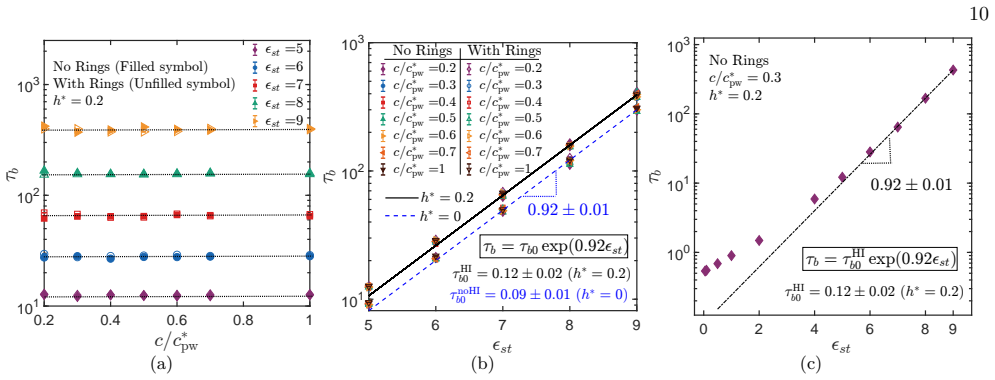
Unentangled wormlike micelle solutions relax stress through a dynamic interplay of reversible scission and intrachain relaxation involving a hierarchy of molecular timescales whose relationship to linear viscoelastic response remains incompletely resolved. A multiparticle mesoscopic Brownian dynamics framework has been developed in which persistent worms, represented by bead-spring chains with sticky ends, assemble to form wormlike micelles via reversible scission and fusion. Both linear and ring-like micelles are formed across the dilute and semidilute concentration regimes. Accurate predictions of dynamic properties are obtained through inclusion of hydrodynamic interactions using a RPY tensor. We identify and quantify characteristic timescales governing micellar dynamics, including bond lifetimes, self- and non-self-recombination times, breakage times of wormlike micelles of length $L$, relaxation times of various contributions to stress, and the longest relaxation time. The dependence of these timescales on sticker strength, concentration, micellar topology and hydrodynamic interactions is established. The presence of ring micelles is found to moderately prolong recombination and breakage processes, while hydrodynamic interactions are shown to affect some of the timescales by reducing sticker mobility. When appropriately scaled, the dependence on mean length of the non-self-recombination and micelle breakage times collapse onto master curves. Storage and loss moduli exhibit distinctive features in the intermediate-frequency regime that are absent in homopolymer solutions. A clear connection is made between micellar timescales and these signatures in the dynamic moduli at various characteristic frequencies, providing a direct link between microscopic dynamics and macroscopic rheology in unentangled wormlike micellar solutions, in dilute and semidilute concentration regimes.
Editorial analysis
A structured set of objections, weighed in public.
Referee Report
Summary. The manuscript develops a multiparticle mesoscopic Brownian dynamics framework for dilute and semidilute unentangled wormlike micelle solutions, representing persistent worms as bead-spring chains with sticky ends that undergo reversible scission and fusion to form linear and ring-like micelles. It extracts and quantifies a hierarchy of molecular timescales (bond lifetimes, self- and non-self-recombination times, breakage times, intrachain relaxation times, and longest relaxation time) directly from simulation trajectories, examines their dependence on sticker strength, concentration, topology, and hydrodynamic interactions (via RPY tensor), and links these timescales to distinctive intermediate-frequency features in the storage and loss moduli G'(ω) and G''(ω). Scaled timescales are shown to collapse onto master curves, providing a direct microscopic-to-macroscopic connection in linear viscoelastic response.
Significance. If the central results hold, the work supplies a valuable simulation-based mapping from scission/fusion kinetics and intrachain dynamics to specific signatures in the dynamic moduli without post-hoc fitting of timescales to rheology data. The direct extraction of timescales from trajectories and the observed master-curve collapse represent clear strengths. The inclusion of ring micelles and hydrodynamic interactions adds mechanistic insight. However, the absence of quantitative error bars, direct experimental comparisons, or checks against more detailed theories limits the immediate impact on material design or consensus understanding of unentangled WLM rheology.
major comments (2)
- [Abstract] Abstract: the claim of 'accurate predictions of dynamic properties' and a 'clear connection' between micellar timescales and intermediate-frequency features in G' and G'' lacks any reported quantitative validation metrics (e.g., error bars on moduli, RMS deviation from experiment, or sensitivity analysis), which is load-bearing for the central claim that the bead-spring + RPY model produces the observed viscoelastic signatures.
- [Abstract] The model-fidelity assumption (bead-spring chains with sticky ends plus pairwise RPY hydrodynamics suffice for scission/fusion kinetics and stress relaxation in the semidilute regime) is not tested against concentration-dependent many-body HI screening or experimental breakage rates; this directly affects whether the reported prolongation of recombination by ring micelles and the HI-induced shifts in sticker mobility map reliably to the moduli features without omitted physics.
minor comments (1)
- The abstract mentions 'various contributions to stress' and 'characteristic frequencies' but does not define the precise frequency windows or stress decomposition used; adding a brief methods reference would improve clarity.
Simulated Author's Rebuttal
We thank the referee for the careful reading and constructive feedback on our manuscript. We respond point-by-point to the major comments below, indicating planned revisions where appropriate.
read point-by-point responses
-
Referee: [Abstract] Abstract: the claim of 'accurate predictions of dynamic properties' and a 'clear connection' between micellar timescales and intermediate-frequency features in G' and G'' lacks any reported quantitative validation metrics (e.g., error bars on moduli, RMS deviation from experiment, or sensitivity analysis), which is load-bearing for the central claim that the bead-spring + RPY model produces the observed viscoelastic signatures.
Authors: We agree that the abstract phrasing 'accurate predictions' implies a level of validation that is not quantitatively demonstrated. The dynamic moduli in our work are obtained directly from the stress autocorrelation function via the Green-Kubo relation applied to simulation trajectories, and the connection to timescales is established by associating characteristic frequencies in G' and G'' with the inverses of the independently extracted molecular times (bond lifetime, recombination times, breakage times, and longest relaxation time). Statistical variability is assessed via multiple independent runs, but explicit error bars on the moduli curves and a formal sensitivity analysis were not included in the presented figures. We will revise the abstract to replace 'accurate predictions' with 'model predictions' and 'clear connection' with 'direct link demonstrated through timescale-frequency matching'. In the revised manuscript we will add error bars to the G' and G'' plots based on ensemble averaging and include a short sensitivity study varying sticker strength and concentration to quantify robustness of the intermediate-frequency features. revision: partial
-
Referee: [Abstract] The model-fidelity assumption (bead-spring chains with sticky ends plus pairwise RPY hydrodynamics suffice for scission/fusion kinetics and stress relaxation in the semidilute regime) is not tested against concentration-dependent many-body HI screening or experimental breakage rates; this directly affects whether the reported prolongation of recombination by ring micelles and the HI-induced shifts in sticker mobility map reliably to the moduli features without omitted physics.
Authors: This comment correctly identifies a limitation of the current model. Pairwise RPY hydrodynamics is a standard approximation that captures leading-order HI effects in the dilute-to-semidilute unentangled regime, but it omits many-body screening that becomes relevant at higher concentrations. We did not perform explicit tests against experimental breakage rates, as the study focuses on internal extraction of timescales from trajectories rather than parameter fitting to experiment. The observed effects of ring micelles on recombination/breakage and the modest HI-induced changes in sticker mobility are direct outcomes of the simulated dynamics and remain robust within the model. In the revision we will add a limitations paragraph discussing the pairwise HI approximation, referencing literature on HI screening in semidilute solutions, and noting that many-body effects would require more advanced methods such as fast multipole or lattice Boltzmann approaches. revision: partial
- Direct quantitative experimental comparisons (e.g., RMS deviation from measured moduli or breakage rates), as the work is a purely computational study without new experimental data.
Circularity Check
No significant circularity: timescales extracted from trajectories, moduli computed from same dynamics
full rationale
The paper implements a bead-spring Brownian dynamics model with explicit sticky-end scission/fusion rules and RPY hydrodynamics, then measures all reported timescales (bond lifetime, recombination, breakage, relaxation) directly from the generated trajectories. Storage and loss moduli are obtained by Fourier transform of the stress autocorrelation computed in the identical simulations. The connection between specific molecular timescales and intermediate-frequency features in G'(ω) and G''(ω) is therefore an output of the dynamics under the stated model assumptions, not a re-expression of fitted parameters or a self-referential definition. No load-bearing step reduces to a self-citation chain, an ansatz smuggled via prior work, or a parameter fitted to the target viscoelastic data and then relabeled as a prediction. The derivation chain remains self-contained against external benchmarks.
Axiom & Free-Parameter Ledger
free parameters (2)
- sticker strength
- bead friction coefficient
axioms (2)
- domain assumption Brownian dynamics with RPY tensor accurately captures hydrodynamic interactions in dilute and semidilute regimes without explicit solvent particles.
- domain assumption Reversible scission and fusion rules for sticky ends produce equilibrium length distributions consistent with real wormlike micelles.
Reference graph
Works this paper leans on
-
[1]
, " * write output.state after.block = add.period write newline
ENTRY address author booktitle chapter edition editor howpublished institution journal key month note number organization pages publisher school series title type volume year label extra.label sort.label INTEGERS output.state before.all mid.sentence after.sentence after.block FUNCTION init.state.consts #0 'before.all := #1 'mid.sentence := #2 'after.sente...
-
[2]
write newline
" write newline "" before.all 'output.state := FUNCTION n.dashify 't := "" t empty not t #1 #1 substring "-" = t #1 #2 substring "--" = not "--" * t #2 global.max substring 't := t #1 #1 substring "-" = "-" * t #2 global.max substring 't := while if t #1 #1 substring * t #2 global.max substring 't := if while FUNCTION word.in "in " FUNCTION format.date ye...
-
[3]
Anderson, J. A., J. Glaser and S. C. Glotzer, HOOMD -blue: A python package for high-performance molecular dynamics and hard particle monte carlo simulations, Comput. Mater. Sci. 173, 109363 (2020)
2020
-
[4]
Berret, J.-F., Rheology of wormlike micelles: Equilibrium properties and shear banding transitions, in Molecular Gels: Materials with Self-Assembled Fibrillar Networks, eds. R. G. Weiss and P. Terech, pp. 667--720, Springer Netherlands, Dordrecht (2006)
2006
-
[5]
Bird, R. B., C. F. Curtiss, R. C. Armstrong and O. Hassager, Dynamics of Polymeric Liquids - Volume 2 : Kinetic Theory, John Wiley and Sons, New York (1987)
1987
-
[6]
Cates, M., Reptation of living polymers: dynamics of entangled polymers in the presence of reversible chain-scission reactions, Macromolecules 20, 2289--2296 (1987)
1987
-
[7]
Cates, M., Dynamics of living polymers and flexible surfactant micelles: scaling laws for dilution, J. Phys. 49, 1593--1600 (1988)
1988
-
[8]
Cates, M. E. and S. J. Candau, Statics and dynamics of worm-like surfactant micelles, J. Phys.: Condens. Matter 2, 6869 (1990)
1990
-
[9]
Cates, M. E. and S. J. Candau, Ring-driven shear thickening in wormlike micelles? Europhys. Lett. 55, 887 (2001)
2001
-
[10]
Cates, M. E. and S. M. Fielding, Rheology of giant micelles, Adv. Phys. 55, 799--879 (2006)
2006
-
[11]
Chu, Z., C. A. Dreiss and Y. Feng, Smart wormlike micelles, Chem. Soc. Rev. 42, 7174--7203 (2013)
2013
-
[12]
A., Wormlike micelles: where do we stand? R ecent developments, linear rheology and scattering techniques, Soft Matter 3, 956--970 (2007)
Dreiss, C. A., Wormlike micelles: where do we stand? R ecent developments, linear rheology and scattering techniques, Soft Matter 3, 956--970 (2007)
2007
-
[13]
Fiore, A. M., F. Balboa Usabiaga, A. Donev and J. W. Swan, Rapid sampling of stochastic displacements in brownian dynamics simulations, J. Chem. Phys. 146, 124116 (2017)
2017
-
[14]
Gowers, R. J. and P. Carbone, A multiscale approach to model hydrogen bonding: The case of polyamide, J. Chem. Phys. 142, 224907 (2015)
2015
-
[15]
Hoffmann, H., Viscoelastic Surfactant Solutions, chap. 1, pp. 2--31, ACS Symp. Ser. (1994)
1994
-
[16]
Howard, M. P., A. Statt, F. Madutsa, T. M. Truskett and A. Z. Panagiotopoulos, Quantized bounding volume hierarchies for neighbor search in molecular simulations on graphics processing units, Comput. Mater. Sci. 164, 139--146 (2019)
2019
-
[17]
Ryckaert and H
Huang, C.-C., J.-P. Ryckaert and H. Xu, Structure and dynamics of cylindrical micelles at equilibrium and under shear flow, Phys. Rev. E 79, 041501 (2009)
2009
-
[18]
Huang, C.-C., H. Xu, F. Crevel, J. Wittmer and J.-P. Ryckaert, Reaction kinetics of coarse-grained equilibrium polymers: a brownian dynamics study, in Computer Simulations in Condensed Matter Systems: From Materials to Chemical Biology Volume 2, pp. 379--418, Springer, Berlin, Heidelberg (2006a)
-
[19]
Xu and J.-P
Huang, C.-C., H. Xu and J.-P. Ryckaert, Kinetics and dynamic properties of equilibrium polymers, J. Chem. Phys. 125, 094901 (2006b)
-
[20]
N., Intermolecular and surface forces, Academic Press, Burlington, MA, 3rd edn
Israelachvili, J. N., Intermolecular and surface forces, Academic Press, Burlington, MA, 3rd edn. (2011)
2011
-
[21]
Sunthar, B
Jain, A., P. Sunthar, B. D \"u nweg and J. R. Prakash, Optimization of a B rownian dynamics algorithm for semidilute polymer solutions, Phys. Rev. E 85, 066703 (2012)
2012
-
[22]
Kaplan, E. L. and P. Meier, Nonparametric estimation from incomplete observations, J. Am. Stat. Assoc. 53, 457--481 (1958)
1958
-
[23]
Katashima, T., R. Kudo, M. Naito, S. Nagatoishi, K. Miyata, U.-i. Chung, K. Tsumoto and T. Sakai, Experimental comparison of bond lifetime and viscoelastic relaxation in transient networks with well-controlled structures, ACS Macro Lett. 11, 753--759 (2022), PMID: 35594190
2022
-
[24]
Klein, J., The statistical analysis of failure time data, Technometrics 24 (2012)
2012
-
[25]
Koide, Y., Recombination statistics of nonionic surfactant micelles at equilibrium, J. Chem. Phys. 159, 224906 (2023)
2023
-
[26]
Koide, Y. and S. Goto, Flow-induced scission of wormlike micelles in nonionic surfactant solutions under shear flow, J. Chem. Phys. 157, 084903 (2022)
2022
-
[27]
Kumar, A., R. F. Tabor, P. Sunthar and J. Ravi Prakash, A mesoscopic model for the rheology of dilute and semidilute solutions of wormlike micelles, J. Rheol. 69, 873--903 (2025)
2025
-
[28]
Kumar, P. and I. Saha Dalal, Fraenkel springs as an efficient approximation to rods for brownian dynamics simulations and modeling of polymer chains, Macromol. Theory Simul. 31, 2200008 (2022)
2022
-
[29]
Aguerre-Chariol and R
Martin In , O. Aguerre-Chariol and R. Zana, Closed-looped micelles in surfactant tetramer solutions, J. Phys. Chem. B 103, 7747--7750 (1999)
1999
-
[30]
D \"o hler, W
Mordvinkin, A., D. D \"o hler, W. H. Binder, R. H. Colby and K. Saalwächter, Rheology, sticky chain, and sticker dynamics of supramolecular elastomers based on cluster-forming telechelic linear and star polymers, Macromolecules 54, 5065--5076 (2021)
2021
-
[31]
493--514, CRC Press, Boca Raton (2007)
Nicolas-Morgantini, L., Giant micelles and shampoos, in Giant Micelles, pp. 493--514, CRC Press, Boca Raton (2007)
2007
-
[32]
Waton, E
Oelschlaeger, C., G. Waton, E. Buhler, S. Candau and M. Cates, Rheological and light scattering studies of cationic fluorocarbon surfactant solutions at low ionic strength, Langmuir 18, 3076--3085 (2002)
2002
-
[33]
Waton and S
Oelschlaeger, C., G. Waton and S. J. Candau, Rheological behavior of locally cylindrical micelles in relation to their overall morphology, Langmuir 19, 10495--10500 (2003)
2003
-
[34]
O'Shaughnessy, B. and J. Yu, Rheology of wormlike micelles: two universality classes, Phys. Rev. Lett. 74, 4329 (1995)
1995
-
[35]
Padding, J. T. and E. S. Boek, Evidence for diffusion-controlled recombination kinetics in model wormlike micelles, Europhys. Lett. 66, 756 (2004)
2004
-
[36]
Padding, J. T., E. S. Boek and W. J. Briels, Dynamics and rheology of wormlike micelles emerging from particulate computer simulations, J. Chem. Phys. 129, 074903 (2008)
2008
-
[37]
Rehage, H. and H. Hoffmann, Viscoelastic surfactant solutions: model systems for rheological research, Mol. Phys. 74, 933--973 (1991)
1991
-
[38]
Santra, G
Robe, D., A. Santra, G. H. McKinley and J. R. Prakash, Evanescent gels: Competition between sticker dynamics and single-chain relaxation, Macromolecules 57, 4220--4235 (2024)
2024
-
[39]
Rubinstein, M. and R. H. Colby, Polymer Physics, Oxford University Press, New York (2003)
2003
-
[40]
Shibaev, A. V., V. S. Molchanov and O. E. Philippova, Rheological behavior of oil-swollen wormlike surfactant micelles, Chem. B 119, 15938--15946 (2015)
2015
-
[41]
Duenweg and K
Soddemann, T., B. Duenweg and K. Kremer, A generic computer model for amphiphilic systems, Eur. Phys. J. E 6 (2001)
2001
-
[42]
B., L.-H
Stukalin, E. B., L.-H. Cai, N. A. Kumar, L. Leibler and M. Rubinstein, Self-healing of unentangled polymer networks with reversible bonds, Macromolecules 46, 7525--7541 (2013)
2013
-
[43]
Sullivan, P., E. B. Nelson, V. Anderson and T. Hughes, Oilfield applications of giant micelles, in Giant Micelles, pp. 453--472, CRC Press, Boca Raton (2007)
2007
-
[44]
Sunthar and J
Varakhedkar, A., P. Sunthar and J. R. Prakash, Linear viscoelasticity of semiflexible polymers with hydrodynamic interactions, Soft Matter 22, 369--386 (2026)
2026
-
[45]
Wang, J., Y. Feng, N. R. Agrawal and S. R. Raghavan, Wormlike micelles versus water-soluble polymers as rheology-modifiers: similarities and differences, Phys. Chem. Chem. Phys. 19, 24458--24466 (2017)
2017
-
[46]
Milchev and M
Wittmer, J., A. Milchev and M. Cates, Dynamical M onte C arlo study of equilibrium polymers: Static properties, J. Chem. Phys. 109, 834--845 (1998)
1998
-
[47]
van der Schoot, A
Wittmer, J., P. van der Schoot, A. Milchev and J. Barrat, Dynamical M onte C arlo study of equilibrium polymers. ii. T he role of rings, J. Chem. Phys. 113, 6992--7005 (2000)
2000
-
[48]
crew-cut
Zhu, J., Y. Liao and W. Jiang, Ring-shaped morphology of “crew-cut” aggregates from ABA amphiphilic triblock copolymer in a dilute solution, Langmuir 20, 3809--3812 (2004)
2004
discussion (0)
Sign in with ORCID, Apple, or X to comment. Anyone can read and Pith papers without signing in.