Recognition: unknown
Can MLLMs "Read" What is Missing?
Pith reviewed 2026-05-09 21:34 UTC · model grok-4.3
The pith
Multimodal language models struggle to reconstruct masked text from visual layouts in documents without prompts
A machine-rendered reading of the paper's core claim, the machinery that carries it, and where it could break.
Core claim
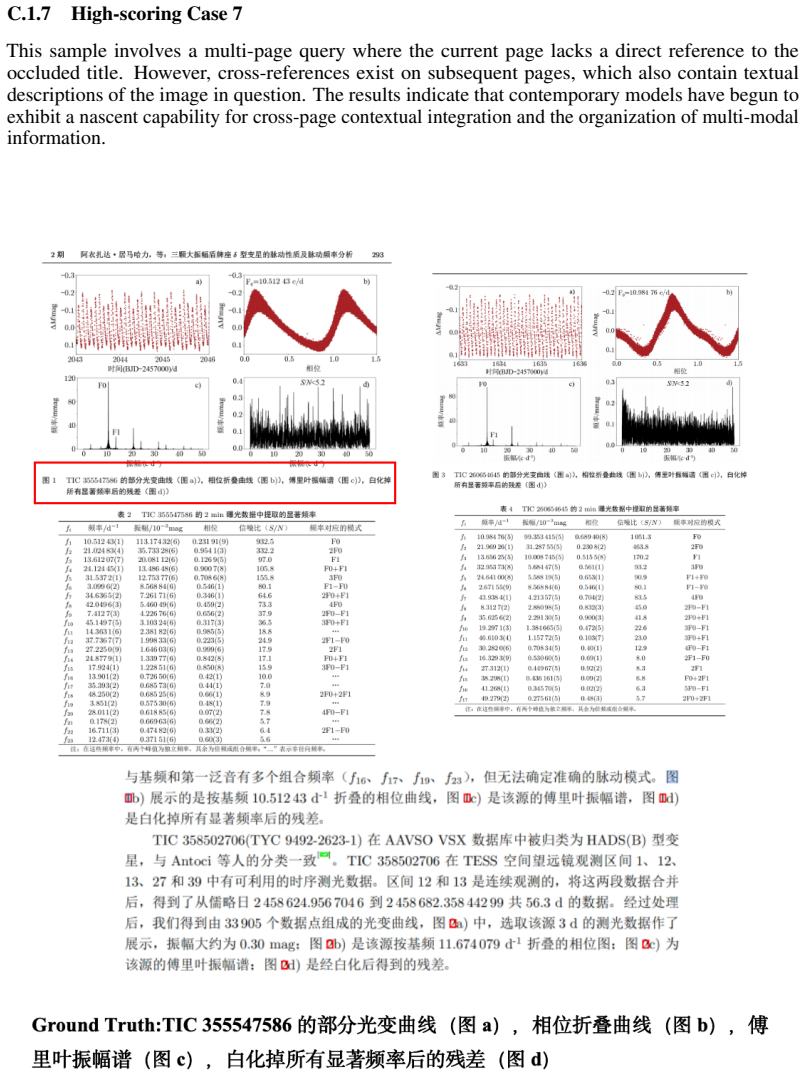
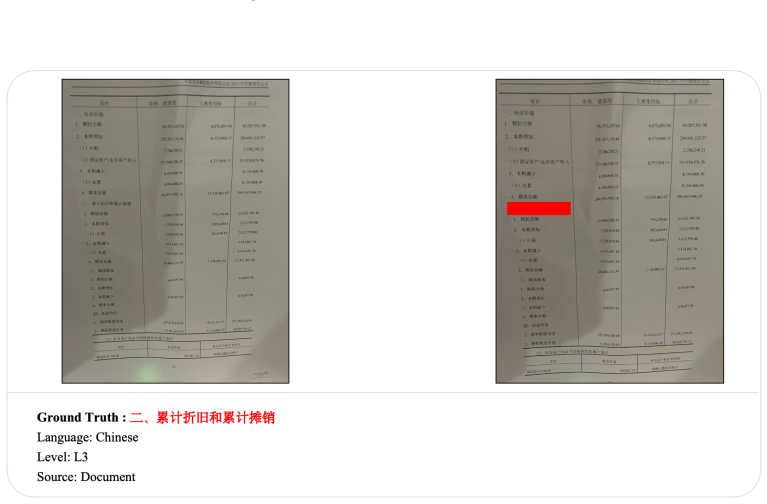
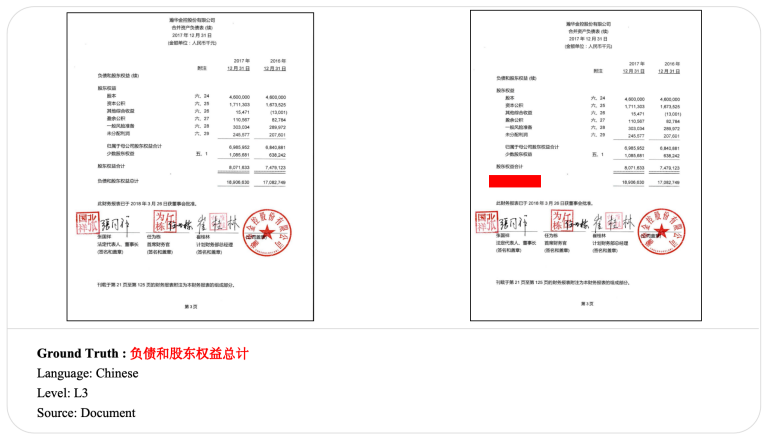
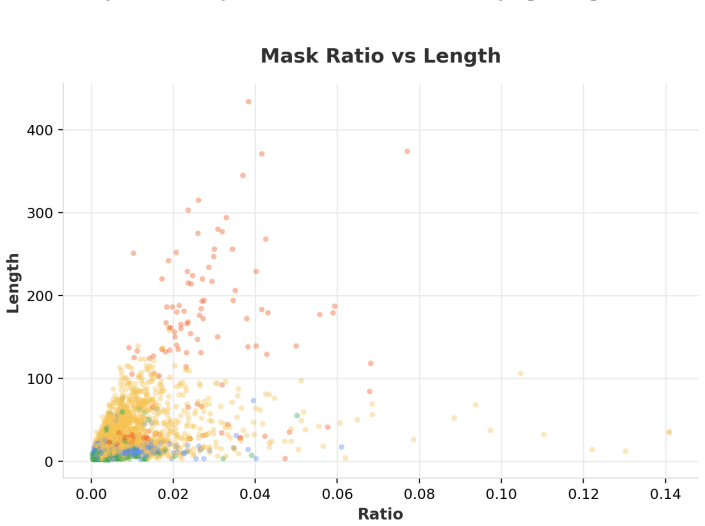
MMTR-Bench evaluates the intrinsic ability of MLLMs to reconstruct masked text directly from visual context in single- or multi-page inputs from real-world domains. It eliminates explicit prompts to isolate layout understanding, visual grounding, and knowledge integration. The benchmark includes 2,771 test samples in multiple languages with varying lengths, using a level-aware evaluation protocol. Experiments demonstrate that the task poses a significant challenge to representative MLLMs, especially for sentence- and paragraph-level reconstruction.
What carries the argument
MMTR-Bench, a prompt-free benchmark for text reconstruction from visual document inputs that assesses layout understanding and visual grounding.
If this is right
- Performance drops notably for sentence- and paragraph-length reconstructions compared to shorter spans.
- The task remains difficult across multiple languages and real-world domains like documents and webpages.
- Models show limited success on multi-page inputs where visual context spans several pages.
- The level-aware evaluation accounts for target length diversity to measure reconstruction at different scales.
Where Pith is reading between the lines
- Future training of MLLMs could add reconstruction objectives to strengthen visual-text integration.
- The benchmark might extend to testing other cases of incomplete visual or textual information.
- Document analysis tools could improve by addressing the layout and grounding weaknesses identified here.
Load-bearing premise
Removing explicit prompts successfully isolates the model's intrinsic layout understanding, visual grounding, and knowledge integration from its instruction-following abilities.
What would settle it
Observing high reconstruction accuracy on paragraph-level masked texts without prompts would falsify the claim that MLLMs face significant challenges in this intrinsic ability.
Figures








read the original abstract
We introduce MMTR-Bench, a benchmark designed to evaluate the intrinsic ability of Multimodal Large Language Models (MLLMs) to reconstruct masked text directly from visual context. Unlike conventional question-answering tasks, MMTR-Bench eliminates explicit prompts, requiring models to recover masked text from single- or multi-page inputs across real-world domains such as documents and webpages. This design isolates the reconstruction task from instruction-following abilities, enabling a direct assessment of a model's layout understanding, visual grounding, and knowledge integration. MMTR-Bench comprises 2,771 test samples spanning multiple languages and varying target lengths. To account for this diversity, we propose a level-aware evaluation protocol. Experiments on representative MLLMs show that the benchmark poses a significant challenge, especially for sentence- and paragraph-level reconstruction. The homepage is available at https://mmtr-bench-dataset.github.io/MMTR-Bench/.
Editorial analysis
A structured set of objections, weighed in public.
Referee Report
Summary. The manuscript introduces MMTR-Bench, a benchmark of 2,771 samples designed to test MLLMs' intrinsic ability to reconstruct masked text from visual context in single- or multi-page documents and webpages. By omitting explicit prompts, the design aims to isolate layout understanding, visual grounding, and knowledge integration from instruction-following. The benchmark spans multiple languages and reconstruction lengths, employs a level-aware evaluation protocol, and reports that experiments on representative MLLMs show the task is especially challenging at sentence- and paragraph-level.
Significance. If the no-prompt protocol validly isolates the targeted capabilities and the empirical results prove robust, MMTR-Bench would supply a useful new evaluation axis for MLLMs that moves beyond standard QA formats. The level-aware protocol and multi-lingual/multi-length coverage are concrete strengths that address real diversity in reconstruction difficulty.
major comments (2)
- [Abstract] Abstract: the claim that 'experiments on representative MLLMs show that the benchmark poses a significant challenge' supplies no quantitative metrics, baselines, error analysis, or model-specific scores, leaving the central empirical assertion without visible support.
- [Method] Method / no-prompt design: the assumption that removing explicit prompts cleanly separates intrinsic layout understanding, visual grounding, and knowledge integration from instruction-following is load-bearing yet untested; no analysis is given of whether models produce targeted reconstructions, generic captions, refusals, or ignore masked regions, an issue that is most acute for sentence- and paragraph-level items.
minor comments (1)
- [Abstract] The provided homepage URL is useful, but the manuscript does not state dataset licensing, access method, or construction reproducibility details.
Simulated Author's Rebuttal
We thank the referee for the constructive comments. We address each major point below and indicate the corresponding revisions to the manuscript.
read point-by-point responses
-
Referee: [Abstract] Abstract: the claim that 'experiments on representative MLLMs show that the benchmark poses a significant challenge' supplies no quantitative metrics, baselines, error analysis, or model-specific scores, leaving the central empirical assertion without visible support.
Authors: We agree that the abstract would be strengthened by including concrete metrics. In the revised manuscript we will expand the abstract to report key quantitative results, including average reconstruction accuracy across models, the performance gap between word-level and paragraph-level items, and a brief mention of the strongest baseline. revision: yes
-
Referee: [Method] Method / no-prompt design: the assumption that removing explicit prompts cleanly separates intrinsic layout understanding, visual grounding, and knowledge integration from instruction-following is load-bearing yet untested; no analysis is given of whether models produce targeted reconstructions, generic captions, refusals, or ignore masked regions, an issue that is most acute for sentence- and paragraph-level items.
Authors: We acknowledge the concern. The no-prompt protocol is intended to reduce instruction-following confounds, but we did not previously characterize output types. In the revision we add a dedicated qualitative analysis subsection that samples model generations at each length, showing that models predominantly attempt contextually grounded text rather than generic captions or refusals, while still failing to recover the masked content at longer spans. This supports the design while making the assumption more transparent. revision: partial
Circularity Check
No circularity in empirical benchmark paper
full rationale
This is an empirical benchmark introduction paper with no derivations, equations, fitted parameters, or mathematical claims. The core contribution is the definition and application of MMTR-Bench to test MLLMs on masked text reconstruction from images, with results reported from direct experiments on representative models. No step reduces a 'prediction' or 'first-principles result' to its own inputs by construction, and there are no self-citation chains or uniqueness theorems invoked to justify the methodology. The assumption that no-prompt evaluation isolates intrinsic abilities is a design choice open to empirical scrutiny rather than a circular definitional loop.
Axiom & Free-Parameter Ledger
Reference graph
Works this paper leans on
-
[1]
Websrc: A dataset for web-based structural reading comprehension
Xingyu Chen, Zihan Zhao, Lu Chen, JiaBao Ji, Danyang Zhang, Ao Luo, Yuxuan Xiong, and Kai Yu. Websrc: A dataset for web-based structural reading comprehension. InProceedings of the 2021 Conference on Empirical Methods in Natural Language Processing, pages 4173–4185, 2021. 10
2021
-
[2]
M-longdoc: A benchmark for multimodal super-long document understanding and a retrieval-aware tuning framework
Yew Ken Chia, Liying Cheng, Hou Pong Chan, Maojia Song, Chaoqun Liu, Mahani Aljunied, Soujanya Poria, and Lidong Bing. M-longdoc: A benchmark for multimodal super-long document understanding and a retrieval-aware tuning framework. InProceedings of the 2025 Conference on Empirical Methods in Natural Language Processing, pages 9244–9261, 2025
2025
-
[3]
Longdocurl: a comprehensive multimodal long document benchmark integrating understanding, reasoning, and locating
Chao Deng, Jiale Yuan, Pi Bu, Peijie Wang, Zhong-Zhi Li, Jian Xu, Xiao-Hui Li, Yuan Gao, Jun Song, Bo Zheng, et al. Longdocurl: a comprehensive multimodal long document benchmark integrating understanding, reasoning, and locating. InProceedings of the 63rd Annual Meeting of the Association for Computational Linguistics (Volume 1: Long Papers), pages 1135–...
2025
-
[4]
A survey on llm-as-a-judge.The Innovation, 2024
Jiawei Gu, Xuhui Jiang, Zhichao Shi, Hexiang Tan, Xuehao Zhai, Chengjin Xu, Wei Li, Yinghan Shen, Shengjie Ma, Honghao Liu, et al. A survey on llm-as-a-judge.The Innovation, 2024
2024
-
[5]
End-to-end document understanding via chain-of-reading
Jindi Guo, Chaozheng Huang, Haoyi Tao, Zhulin An, Guolin Ke, and Xi Fang. End-to-end document understanding via chain-of-reading
-
[6]
Layoutlmv3: Pre-training for document ai with unified text and image masking
Yupan Huang, Tengchao Lv, Lei Cui, Yutong Lu, and Furu Wei. Layoutlmv3: Pre-training for document ai with unified text and image masking. InProceedings of the 30th ACM international conference on multimedia, pages 4083–4091, 2022
2022
-
[7]
Pix2struct: Screenshot parsing as pretraining for visual language understanding
Kenton Lee, Mandar Joshi, Iulia Raluca Turc, Hexiang Hu, Fangyu Liu, Julian Martin Eisensch- los, Urvashi Khandelwal, Peter Shaw, Ming-Wei Chang, and Kristina Toutanova. Pix2struct: Screenshot parsing as pretraining for visual language understanding. InInternational Confer- ence on Machine Learning, pages 18893–18912. PMLR, 2023
2023
-
[8]
Mmlongbench-doc: Benchmarking long-context document understanding with visualizations.Advances in Neural Information Processing Systems, 37: 95963–96010, 2024
Yubo Ma, Yuhang Zang, Liangyu Chen, Meiqi Chen, Yizhu Jiao, Xinze Li, Xinyuan Lu, Ziyu Liu, Yan Ma, Xiaoyi Dong, et al. Mmlongbench-doc: Benchmarking long-context document understanding with visualizations.Advances in Neural Information Processing Systems, 37: 95963–96010, 2024
2024
-
[9]
Chartqa: A benchmark for question answering about charts with visual and logical reasoning
Ahmed Masry, Xuan Long Do, Jia Qing Tan, Shafiq Joty, and Enamul Hoque. Chartqa: A benchmark for question answering about charts with visual and logical reasoning. InFindings of the association for computational linguistics: ACL 2022, pages 2263–2279, 2022
2022
-
[10]
Docvqa: A dataset for vqa on document images
Minesh Mathew, Dimosthenis Karatzas, and CV Jawahar. Docvqa: A dataset for vqa on document images. InProceedings of the IEEE/CVF winter conference on applications of computer vision, pages 2200–2209, 2021
2021
-
[11]
Infographicvqa
Minesh Mathew, Viraj Bagal, Rubèn Tito, Dimosthenis Karatzas, Ernest Valveny, and CV Jawa- har. Infographicvqa. InProceedings of the IEEE/CVF Winter Conference on Applications of Computer Vision, pages 1697–1706, 2022
2022
-
[12]
Unifying vision, text, and layout for universal document processing
Zineng Tang, Ziyi Yang, Guoxin Wang, Yuwei Fang, Yang Liu, Chenguang Zhu, Michael Zeng, Cha Zhang, and Mohit Bansal. Unifying vision, text, and layout for universal document processing. InProceedings of the IEEE/CVF conference on computer vision and pattern recognition, pages 19254–19264, 2023
2023
-
[13]
Document understanding dataset and evaluation (dude)
Jordy Van Landeghem, Rubèn Tito, Łukasz Borchmann, Michał Pietruszka, Pawel Joziak, Rafal Powalski, Dawid Jurkiewicz, Mickaël Coustaty, Bertrand Anckaert, Ernest Valveny, et al. Document understanding dataset and evaluation (dude). InProceedings of the IEEE/CVF International Conference on Computer Vision, pages 19528–19540, 2023
2023
-
[14]
DeepSeek-OCR: Contexts Optical Compression
Haoran Wei, Yaofeng Sun, and Yukun Li. Deepseek-ocr: Contexts optical compression.arXiv preprint arXiv:2510.18234, 2025
work page internal anchor Pith review arXiv 2025
-
[15]
Hawker 800 series (BAe 125/Hawker 800)
Runjie Zhou, Youbo Shao, Haoyu Lu, Bowei Xing, Tongtong Bai, Yujie Chen, Jie Zhao, Lin Sui, Haotian Yao, Zijia Zhao, et al. Worldvqa: Measuring atomic world knowledge in multimodal large language models.arXiv preprint arXiv:2602.02537, 2026. 11 Table 3: Overview of the level-aware dynamic evaluation strategy.w and τ represent the semantic weight and factu...
discussion (0)
Sign in with ORCID, Apple, or X to comment. Anyone can read and Pith papers without signing in.