Finding Pareto frontier for one-sided matching
Pith reviewed 2026-05-14 22:10 UTC · model grok-4.3
The pith
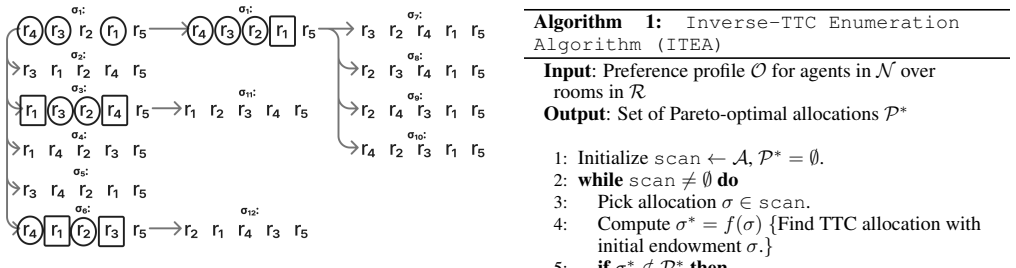
An algorithm computes every Pareto-optimal allocation in one-sided matching by inverting the Top Trading Cycles mechanism.
A machine-rendered reading of the paper's core claim, the machinery that carries it, and where it could break.
Core claim
The Inverse Top Trading Cycles Enumeration Algorithm (ITEA) efficiently computes the complete set of Pareto-optimal allocations for one-sided matching problems with ordinal preferences, and it is sound and complete with better practical time complexity than brute force when the Pareto frontier is small.
What carries the argument
The Inverse Top Trading Cycles Enumeration Algorithm (ITEA), which generates all PO allocations by enumerating inverse TTC steps from the preference profile.
If this is right
- The full Pareto frontier can be used for further optimization over fairness or welfare.
- ITEA is sound and complete for finding all PO allocations.
- Computation time improves over brute force when few PO allocations exist.
- Multiple initial endowments can lead to the same PO outcome under TTC.
Where Pith is reading between the lines
- Designers could apply secondary criteria like envy-freeness directly on the enumerated set.
- The approach might generalize to other cycle-based mechanisms in matching theory.
- Empirical testing on real-world preference data from housing or course allocation would validate the speedup.
Load-bearing premise
That the number of Pareto-optimal allocations remains small enough for enumeration to be practical in typical cases.
What would settle it
Running ITEA and brute force on a preference profile known to have many Pareto-optimal allocations, such as when all agents have identical rankings, and checking if the runtime difference matches the claimed reduction.
Figures


read the original abstract
One-sided matching problems with ordinal preferences, such as hostel room allocation, are commonly solved using the Top Trading Cycles (TTC) mechanism, which guarantees Pareto-optimal (PO) outcomes. However, TTC does not yield a unique solution: multiple PO allocations may exist, and many distinct initial endowments can converge to the same outcome. Focusing on a single TTC result obscures the structure of the Pareto-efficient frontier and limits principled secondary optimization over fairness or welfare objectives. Therefore, the goal is to find the entire set of PO allocations for a given preference profile. We propose the Inverse Top Trading Cycles Enumeration Algorithm (ITEA), a novel method that efficiently computes the complete set of Pareto-optimal allocations in one-sided matching problems. We prove the soundness and completeness of the proposed algorithm and analyze its computational complexity. Although in the worst case, there can be $n!$ PO allocations; however, compared to the brute-force approach, our algorithm reduces time complexity when there are fewer PO allocations. Empirical results demonstrate substantial reductions in redundant TTC computations compared to brute-force enumeration, enabling efficient characterization of the Pareto frontier.
Editorial analysis
A structured set of objections, weighed in public.
Referee Report
Summary. The manuscript introduces the Inverse Top Trading Cycles Enumeration Algorithm (ITEA) to compute the complete set of Pareto-optimal allocations in one-sided matching problems with ordinal preferences. It claims proofs of soundness and completeness for ITEA, a complexity analysis establishing output-sensitive improvement over brute-force enumeration of all n! allocations when the number of PO allocations is small, and empirical results showing substantial reductions in redundant TTC calls.
Significance. If the claimed proofs hold, ITEA would provide a useful output-sensitive method for enumerating the Pareto frontier in one-sided matching, supporting applications such as room allocation where secondary optimization over fairness or welfare is desired. The explicit acknowledgment of the n! worst case and focus on practical cases with few PO allocations is a constructive feature.
minor comments (2)
- [Abstract] The abstract sentence beginning 'Although in the worst case, there can be $n!$ PO allocations; however, compared to the brute-force approach...' is grammatically awkward due to the semicolon and repeated contrast; rephrasing would improve readability.
- [Empirical Results] The empirical claims would be strengthened by reporting the exact number of preference profiles tested, the range of n examined, and quantitative speedup factors rather than the qualitative statement of 'substantial reductions'.
Simulated Author's Rebuttal
We thank the referee for the positive summary of our work on ITEA and for recommending minor revision. No specific major comments were provided in the report, so we have no points to address point-by-point at this stage. We are prepared to incorporate any minor suggestions that may arise during the revision process.
Circularity Check
No significant circularity detected
full rationale
The paper introduces ITEA as an independent algorithmic construction for enumerating all Pareto-optimal allocations by inverting the Top Trading Cycles mechanism. It states explicit proofs of soundness and completeness plus an output-sensitive complexity analysis that acknowledges the n! worst case while claiming practical improvement only when the number of PO allocations is small. No equations, definitions, or self-citations reduce any claimed result to a fitted parameter, renamed input, or prior self-referential premise; the derivation chain rests on standard algorithmic design and external verification of the proofs rather than internal redefinition.
Axiom & Free-Parameter Ledger
axioms (1)
- domain assumption Agents have strict ordinal preferences over items
Lean theorems connected to this paper
-
IndisputableMonolith/Foundation/RealityFromDistinction.leanreality_from_one_distinction unclear?
unclearRelation between the paper passage and the cited Recognition theorem.
We propose the Inverse Top Trading Cycles Enumeration Algorithm (ITEA)... prove the soundness and completeness... time complexity O(|P|·n³) + O(n!·n²)
What do these tags mean?
- matches
- The paper's claim is directly supported by a theorem in the formal canon.
- supports
- The theorem supports part of the paper's argument, but the paper may add assumptions or extra steps.
- extends
- The paper goes beyond the formal theorem; the theorem is a base layer rather than the whole result.
- uses
- The paper appears to rely on the theorem as machinery.
- contradicts
- The paper's claim conflicts with a theorem or certificate in the canon.
- unclear
- Pith found a possible connection, but the passage is too broad, indirect, or ambiguous to say the theorem truly supports the claim.
Reference graph
Works this paper leans on
-
[1]
Ordinal efficiency and dominated sets of assignments.Journal of Economic Theory, 112(1):157– 172,
[Abdulkadiro˘glu and S¨onmez, 2003] Atila Abdulkadiro ˘glu and Tayfun S¨onmez. Ordinal efficiency and dominated sets of assignments.Journal of Economic Theory, 112(1):157– 172,
work page 2003
-
[2]
Pareto optimality in house allocation problems
[Abrahamet al., 2004 ] David J Abraham, Katar ´ına Cechl´arov´a, David F Manlove, and Kurt Mehlhorn. Pareto optimality in house allocation problems. In International symposium on algorithms and computation, pages 3–15. Springer,
work page 2004
-
[3]
[Asinowskiet al., 2016 ] Andrei Asinowski, Bal´azs Keszegh, and Tillmann Miltzow. Counting houses of pareto optimal matchings in the house allocation problem.Discrete Math- ematics, 339(12):2919–2932,
work page 2016
-
[4]
On the tradeoff between efficiency and strategyproofness.Games and Economic Behavior, 110:1–18,
[Azizet al., 2018 ] Haris Aziz, Florian Brandl, Felix Brandt, and Markus Brill. On the tradeoff between efficiency and strategyproofness.Games and Economic Behavior, 110:1–18,
work page 2018
-
[5]
Finding fair and efficient allocations
[Barmanet al., 2018 ] Siddharth Barman, Sanath Kumar Kr- ishnamurthy, and Rohit Vaish. Finding fair and efficient allocations. InProceedings of the 2018 ACM Conference on Economics and Computation (EC ’18),
work page 2018
-
[6]
Equitable allocations of indivisible goods
[Freemanet al., 2019 ] Rupert Freeman, Sujoy Sikdar, Rohit Vaish, and Lirong Xia. Equitable allocations of indivisible goods. InProceedings of the Twenty-Eighth International Joint Conference on Artificial Intelligence (IJCAI), pages 280–286,
work page 2019
-
[7]
[Garg and Murhekar, 2024] Jugal Garg and Aniket Murhekar. Computing pareto-optimal and almost envy-free allocations of indivisible goods.Journal of Artificial Intelligence Research,
work page 2024
-
[8]
Fair societies: Algorithms for house allo- cations
[Hosseiniet al., 2025 ] Hadi Hosseini, Sanjukta Roy, and Aditi Sethia. Fair societies: Algorithms for house allo- cations. arXiv:2511.07022,
-
[9]
Two-person fair division with additive valua- tions.Group Decision and Negotiation, 33(4):745–774,
[Kilgour and Vetschera, 2024] D Marc Kilgour and Rudolf Vetschera. Two-person fair division with additive valua- tions.Group Decision and Negotiation, 33(4):745–774,
work page 2024
-
[10]
Approximate pareto set for fair and efficient al- location: Few agent types or few resource types
[Nguyen and Rothe, 2020] Trung Thanh Nguyen and J ¨org Rothe. Approximate pareto set for fair and efficient al- location: Few agent types or few resource types. InIJCAI, pages 290–296, 2020
work page 2020
discussion (0)
Sign in with ORCID, Apple, or X to comment. Anyone can read and Pith papers without signing in.