Navigating Order-(Dis)Order Family Trees via Group-Subgroup Transitions
Pith reviewed 2026-05-09 21:40 UTC · model grok-4.3
The pith
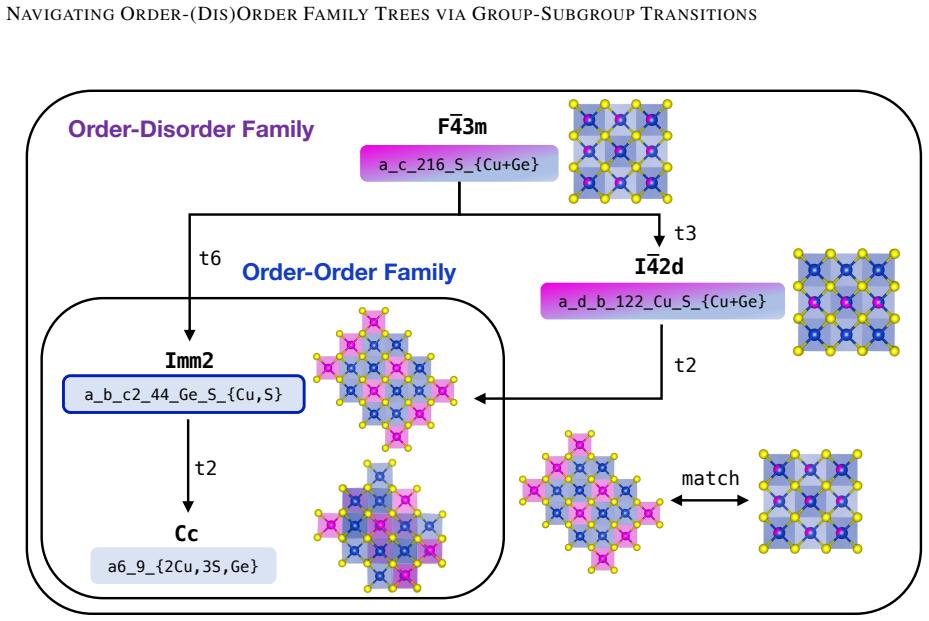
Order-disorder family trees linked by group-subgroup symmetry show that many apparently novel crystal structures are actually specific orderings of known disordered phases.
A machine-rendered reading of the paper's core claim, the machinery that carries it, and where it could break.
Core claim
By building family trees that link ordered structures to disordered parents via group-subgroup transitions, the framework makes it possible to test whether a candidate is a new phase or merely one particular ordering of an already-known disordered material. When applied to experimental and computational datasets, the method shows that many entries appearing novel in isolation are in fact members of these families, with symmetry-agnostic generative models producing such derived structures two to four times more often than symmetry-constrained ones.
What carries the argument
order-(dis)order family trees, which use group-subgroup symmetry relations to connect disordered parent structures (statistical averages over multiple species) to their ordered child structures.
If this is right
- Many structures reported as novel in computational datasets such as MP-20, Alex-MP-20, and GNoME are actually derived orderings of experimentally known disordered phases.
- Symmetry-agnostic all-atom generative models produce ordered structures from known disordered parents at two to four times the rate of symmetry-constrained models.
- The family-matching procedure correctly recovers existing disordered parents for ordered structures targeted in closed-loop synthesis campaigns such as A-Lab.
- Genuine novelty assessment in data-driven discovery must check candidate structures against order-(dis)order family trees rather than against ordered entries alone.
Where Pith is reading between the lines
- Integrating family-tree checks into closed-loop discovery loops could reduce wasted experimental effort on rediscoveries.
- The same symmetry relations might be used to generate new ordered phases deliberately from known disordered parents rather than searching randomly.
- Extending the trees to include temperature- or composition-dependent disorder could link structural families to phase diagrams more directly.
Load-bearing premise
Group-subgroup symmetry relations reliably identify physical order-disorder relationships and existing databases contain representative disordered parents for the structures being evaluated.
What would settle it
An ordered structure that the matching procedure places inside a known family tree yet is later shown by experiment to be a distinct new phase with no order-disorder relation to the supposed parent.
Figures


read the original abstract
As closed-loop materials discovery systems scale to produce millions of candidate compounds, the credibility of the novelty they reward becomes a critical concern. Novelty is commonly assessed against databases of ordered crystal structures, in which atomic sites are fully occupied. Yet, a predicted ordered structure may simply correspond to a particular ordering of a known disordered phase, whose sites are occupied by multiple species in the statistical average structure; we refer to such a structure as an ordered child of a disordered parent. Here, we introduce order-(dis)order family trees, a symmetry-based framework that organizes ordered and disordered structures through group-subgroup relations and enables novelty to be explicitly evaluated. We develop a high-throughput family matching procedure, to identify possible disordered parents and symmetry-related ordered relatives for a given ordered structure. As validation, we test our framework on synthesis-facing case studies (A-Lab), where it correctly recovers existing disordered parents for the targeted ordered structures. Extending this family-tree-based benchmark to experimental structure databases (ICSD), computational datasets (MP-20, Alex-MP-20, and GNoME), and crystal generative models further reveals that many ordered structures that appear novel as individual entries are, in fact, better understood as members of experimentally known order-(dis)order family trees. We also show that this is particularly evident in symmetry-agnostic all-atom generative models, which more frequently produce ordered structures derived from known disordered parents, whereas symmetry-constrained models are 2-4x less prone to this behavior. Our results establish order-(dis)order family trees as a key requirement for achieving genuine novelty in data-driven materials discovery.
Editorial analysis
A structured set of objections, weighed in public.
Referee Report
Summary. The manuscript introduces order-(dis)order family trees, a symmetry-based framework that organizes ordered crystal structures and their potential disordered parents via crystallographic group-subgroup relations. It develops a high-throughput family matching procedure to identify such relationships for a given ordered structure, validates recovery of known disordered parents on A-Lab synthesis case studies, and applies the approach to ICSD, MP-20, Alex-MP-20, GNoME, and crystal generative models. The results indicate that many structures appearing novel against ordered databases are in fact members of experimentally known family trees, with symmetry-agnostic generative models producing 2-4x more such cases than symmetry-constrained ones.
Significance. If the symmetry-based matches reliably correspond to physical order-disorder relationships, the framework offers a practical way to refine novelty assessment in high-throughput and generative materials discovery, reducing overcounting of structures that are merely orderings of known disordered phases. The concrete validation on synthesis cases and the quantitative cross-dataset comparisons (including model-type differences) provide actionable benchmarks; the approach builds directly on established group theory without introducing free parameters.
major comments (3)
- [high-throughput family matching procedure] The high-throughput family matching procedure relies exclusively on group-subgroup symmetry descent to identify disordered parents, without energetic, entropic, or phase-stability filters. In cases with multiple possible subgroup paths or where disorder is not the dominant stabilization mechanism, this risks spurious family trees; the central claim that the trees represent physically meaningful order-disorder parents (and thus a 'key requirement' for genuine novelty) therefore rests on an untested assumption that symmetry descent alone suffices.
- [validation on A-Lab synthesis case studies] The A-Lab validation reports successful recovery of existing disordered parents, yet provides no quantitative detail on matching criteria, false-positive rates, or error analysis. This makes it difficult to assess robustness, particularly given the skeptic concern that databases may not contain representative disordered parents at scale.
- [application to experimental and computational databases] The reported reductions in apparent novelty for ICSD/MP/GNoME entries and generative-model outputs assume that the databases already contain representative disordered parents for the evaluated structures. This assumption is not tested beyond the limited case studies, weakening the quantitative claims about how many 'novel' structures are actually family-tree members.
minor comments (2)
- [Abstract] The abstract introduces 'order-(dis)order family trees' without a concise one-sentence definition; adding this would improve accessibility for readers outside crystallography.
- [Introduction] Notation for 'ordered child' versus 'disordered parent' is used consistently in the abstract but should be explicitly defined once in the main text with a small schematic.
Simulated Author's Rebuttal
We thank the referee for their constructive comments, which help clarify the scope and limitations of our symmetry-based framework. We respond to each major comment below and indicate revisions to strengthen the manuscript.
read point-by-point responses
-
Referee: [high-throughput family matching procedure] The high-throughput family matching procedure relies exclusively on group-subgroup symmetry descent to identify disordered parents, without energetic, entropic, or phase-stability filters. In cases with multiple possible subgroup paths or where disorder is not the dominant stabilization mechanism, this risks spurious family trees; the central claim that the trees represent physically meaningful order-disorder parents (and thus a 'key requirement' for genuine novelty) therefore rests on an untested assumption that symmetry descent alone suffices.
Authors: Our framework deliberately uses only group-subgroup relations because these provide a necessary, parameter-free condition for an ordered structure to be derivable from a disordered parent via site ordering. If no such symmetry path exists, the structure cannot be a simple ordering of that parent, making the match a conservative filter for overcounting novelty. We do not claim every symmetry match is physically realized; additional energetic or entropic validation remains necessary for confirmation. In revision we will add explicit discussion of this scope, noting that the trees flag candidate relationships rather than asserting physical disorder without further checks, and suggest integration of stability filters as future work. revision: partial
-
Referee: [validation on A-Lab synthesis case studies] The A-Lab validation reports successful recovery of existing disordered parents, yet provides no quantitative detail on matching criteria, false-positive rates, or error analysis. This makes it difficult to assess robustness, particularly given the skeptic concern that databases may not contain representative disordered parents at scale.
Authors: We will expand the A-Lab section with quantitative details: the precise matching tolerances (lattice and positional thresholds), number of subgroup paths evaluated per case, and recovery success rate across the reported syntheses. As these are known positive cases, we will clarify that false-positive assessment requires separate benchmarks, which we note as a limitation. We will also discuss how database scale affects robustness and frame the current results as proof-of-concept validation of the procedure. revision: yes
-
Referee: [application to experimental and computational databases] The reported reductions in apparent novelty for ICSD/MP/GNoME entries and generative-model outputs assume that the databases already contain representative disordered parents for the evaluated structures. This assumption is not tested beyond the limited case studies, weakening the quantitative claims about how many 'novel' structures are actually family-tree members.
Authors: The reported fractions are lower bounds based on matches to currently available disordered entries (primarily from ICSD). Any additional disordered parents would only increase the count of family-tree members. The A-Lab cases confirm recovery is possible when parents exist. Because the identical database is used for all datasets and models, the relative comparisons (including the 2-4x difference between generative model types) remain valid. We will add explicit caveats in the results and discussion sections stating the dependence on database completeness and that the numbers are conservative estimates. revision: partial
Circularity Check
No significant circularity; framework applies standard crystallographic group-subgroup relations to new use case
full rationale
The derivation defines order-(dis)order family trees directly from established group-subgroup symmetry relations and applies a high-throughput matching procedure to external databases (ICSD, MP, GNoME) and generative models. Validation on A-Lab synthesis cases recovers known disordered parents via symmetry descent without fitting parameters or renaming inputs as predictions. No self-citations are load-bearing for the central claim, no uniqueness theorems are imported from the authors' prior work, and no ansatzes are smuggled in. The result that many 'novel' ordered structures belong to known family trees follows from applying the symmetry procedure to independent data, not from any definitional reduction or tautology.
Axiom & Free-Parameter Ledger
axioms (1)
- domain assumption Group-subgroup relations in space groups accurately capture the symmetry relationship between ordered and disordered crystal phases
Reference graph
Works this paper leans on
-
[1]
Szymanski, Bernardus Rendy, Yuxing Fei, Rishi E
Nathan J. Szymanski, Bernardus Rendy, Yuxing Fei, Rishi E. Kumar, Tanjin He, David Milsted, Matthew J. McDermott, Max Gallant, Ekin Dogus Cubuk, Amil Merchant, Haegyeom Kim, Anubhav Jain, Christopher J. Bartel, Kristin Persson, Yan Zeng, and Gerbrand Ceder. An autonomous laboratory for the accelerated synthesis of inorganic materials.Nature, 624(7990):86–...
work page 2023
-
[2]
Schoenholz, Muratahan Aykol, Gowoon Cheon, and Ekin Dogus Cubuk
Amil Merchant, Simon Batzner, Samuel S. Schoenholz, Muratahan Aykol, Gowoon Cheon, and Ekin Dogus Cubuk. Scaling deep learning for materials discovery.Nature, 624(7990):80–85, November 2023
work page 2023
-
[3]
Anthony K. Cheetham and Ram Seshadri. Artificial intelligence driving materials discovery? perspective on the article: Scaling deep learning for materials discovery.Chemistry of Materials, 36(8):3490–3495, April 2024
work page 2024
-
[4]
Josh Leeman, Yuhan Liu, Joseph Stiles, Scott B. Lee, Prajna Bhatt, Leslie M. Schoop, and Robert G. Palgrave. Challenges in high-throughput inorganic materials prediction and autonomous synthesis.PRX Energy, 3(1), March 2024
work page 2024
-
[5]
Crystal diffusion variational autoencoder for periodic material generation, 2021
Tian Xie, Xiang Fu, Octavian-Eugen Ganea, Regina Barzilay, and Tommi Jaakkola. Crystal diffusion variational autoencoder for periodic material generation, 2021
work page 2021
-
[6]
A generative model for inorganic materials design.Nature, 639(8055):624–632, January 2025
Claudio Zeni, Robert Pinsler, Daniel Zügner, Andrew Fowler, Matthew Horton, Xiang Fu, Zilong Wang, Aliaksan- dra Shysheya, Jonathan Crabbé, Shoko Ueda, Roberto Sordillo, Lixin Sun, Jake Smith, Bichlien Nguyen, Hannes Schulz, Sarah Lewis, Chin-Wei Huang, Ziheng Lu, Yichi Zhou, Han Yang, Hongxia Hao, Jielan Li, Chunlei Yang, Wenjie Li, Ryota Tomioka, and Ti...
work page 2025
-
[7]
Siddharth Betala, Samuel P. Gleason, Ali Ramlaoui, Andy Xu, Georgia Channing, Daniel Levy, Clémentine Fourrier, Nikita Kazeev, Chaitanya K. Joshi, Sékou-Oumar Kaba, Félix Therrien, Alex Hernandez-Garcia, Rocío Mercado, N. M. Anoop Krishnan, and Alexandre Duval. Lemat-genbench: A unified evaluation framework for crystal generative models, 2025
work page 2025
-
[8]
The inorganic crystal structure database (icsd): A tool for materials sciences, August 2019
Stephan Rühl. The inorganic crystal structure database (icsd): A tool for materials sciences, August 2019
work page 2019
-
[9]
Mikkel Juelsholt. Continued challenges in high-throughput materials predictions: Mattergen predicts compounds from the training dataset. January 2026
work page 2026
-
[10]
H. Bärnighausen. Group-subgroup relations between space groups: A useful tool in crystal chemistry.MATCH Communications in Mathematical and in Computer Chemistry, 9:139–175, 1980
work page 1980
-
[11]
S. Ivantchev, E. Kroumova, G. Madariaga, J. M. Pérez-Mato, and M. I. Aroyo. Subgroupgraph: a computer program for analysis of group–subgroup relations between space groups.Journal of Applied Crystallography, 33(4):1190–1191, August 2000
work page 2000
-
[12]
Yu Han, Chi Ding, Junjie Wang, Hao Gao, Jiuyang Shi, Shaobo Yu, Qiuhan Jia, Shuning Pan, and Jian Sun. Effi- cient crystal structure prediction based on the symmetry principle.Nature Computational Science, 5(3):255–267, February 2025. 11 NAVIGATINGORDER-(DIS)ORDERFAMILYTREES VIAGROUP-SUBGROUPTRANSITIONS
work page 2025
-
[13]
Kesong Yang, Corey Oses, and Stefano Curtarolo. Modeling off-stoichiometry materials with a high-throughput ab-initio approach.Chemistry of Materials, 28(18):6484–6492, September 2016
work page 2016
-
[14]
Sword: Symmetry and wyckoff-sequence of ordered and disordered crystals, 2026
Yuyao Huang, Wei Nong, Shuya Yamazaki, Martin Hoffmann Petersen, Jianghai Wang, Ruiming Zhu, and Kedar Hippalgaonkar. Sword: Symmetry and wyckoff-sequence of ordered and disordered crystals, 2026
work page 2026
-
[15]
D. Zagorac, H. Müller, S. Ruehl, J. Zagorac, and S. Rehme. Recent developments in the inorganic crystal structure database: theoretical crystal structure data and related features.Journal of Applied Crystallography, 52(5):918–925, September 2019
work page 2019
-
[16]
Crystal structure prediction by joint equivariant diffusion, 2023
Rui Jiao, Wenbing Huang, Peijia Lin, Jiaqi Han, Pin Chen, Yutong Lu, and Yang Liu. Crystal structure prediction by joint equivariant diffusion, 2023
work page 2023
-
[17]
Space group constrained crystal generation, 2024
Rui Jiao, Wenbing Huang, Yu Liu, Deli Zhao, and Yang Liu. Space group constrained crystal generation, 2024
work page 2024
-
[18]
Benjamin Kurt Miller, Ricky T. Q. Chen, Anuroop Sriram, and Brandon M Wood. Flowmm: Generating materials with riemannian flow matching. 2024
work page 2024
-
[19]
Miad: Mirage atom diffusion for de novo crystal generation, 2025
Andrey Okhotin, Maksim Nakhodnov, Nikita Kazeev, Andrey E Ustyuzhanin, and Dmitry Vetrov. Miad: Mirage atom diffusion for de novo crystal generation, 2025
work page 2025
-
[20]
Symmcd: Symmetry-preserving crystal generation with diffusion models, 2025
Daniel Levy, Siba Smarak Panigrahi, Sékou-Oumar Kaba, Qiang Zhu, Kin Long Kelvin Lee, Mikhail Galkin, Santiago Miret, and Siamak Ravanbakhsh. Symmcd: Symmetry-preserving crystal generation with diffusion models, 2025
work page 2025
-
[21]
Crystaldit: A diffusion transformer for crystal generation, 2025
Xiaohan Yi, Guikun Xu, Xi Xiao, Zhong Zhang, Liu Liu, Yatao Bian, and Peilin Zhao. Crystaldit: A diffusion transformer for crystal generation, 2025
work page 2025
-
[22]
Joshi, Xiang Fu, Yi-Lun Liao, Vahe Gharakhanyan, Benjamin Kurt Miller, Anuroop Sriram, and Zachary W
Chaitanya K. Joshi, Xiang Fu, Yi-Lun Liao, Vahe Gharakhanyan, Benjamin Kurt Miller, Anuroop Sriram, and Zachary W. Ulissi. All-atom diffusion transformers: Unified generative modelling of molecules and materials, 2025
work page 2025
-
[23]
Guiding generative models to uncover diverse and novel crystals via reinforcement learning
Hyunsoo Park and Aron Walsh. Guiding generative models to uncover diverse and novel crystals via reinforcement learning. 2025
work page 2025
-
[24]
Nikita Kazeev, Wei Nong, Ignat Romanov, Ruiming Zhu, Andrey Ustyuzhanin, Shuya Yamazaki, and Kedar Hippalgaonkar. Wyckoff transformer: Generation of symmetric crystals.Proceedings of the 42nd International Conference on Machine Learning, 2025
work page 2025
-
[25]
R. W. G. Wyckoff.The Analytical Expression of the Results of the Theory of Space-Groups, volume 318. Carnegie Institution of Washington, 1922
work page 1922
-
[26]
Dmytro Antypov, Chris M. Collins, Matthew S. Dyer, John B. Claridge, and Matthew J. Rosseinsky. Classification and statistical analysis of structural disorder in crystalline materials.Journal of Applied Crystallography, 58(3):659–677, May 2025
work page 2025
-
[27]
Anthony L. Spek. What makes a crystal structure report valid?Inorganica Chimica Acta, 470:232–237, January 2018
work page 2018
-
[28]
Denis Gratias and Marianne Quiquandon. Bicrystallography and beyond: Example of group–subgroup phase transformations.Crystals, 10(7):560, July 2020
work page 2020
-
[29]
Jakob, Aron Walsh, Karsten Reuter, and Johannes T
Konstantin S. Jakob, Aron Walsh, Karsten Reuter, and Johannes T. Margraf. Learning crystallographic disorder: Bridging prediction and experiment in materials discovery.Advanced Materials, 38(5), October 2025
work page 2025
-
[30]
Hagen Eckert, Simon Divilov, Michael J. Mehl, David Hicks, Adam C. Zettel, Marco Esters, Xiomara Campilongo, and Stefano Curtarolo. The aflow library of crystallographic prototypes: Part 4.Computational Materials Science, 240:112988, May 2024
work page 2024
-
[31]
V . S. Urusov and T. N. Nadezhina. Frequency distribution and selection of space groups in inorganic crystal chemistry.Journal of Structural Chemistry, 50(S1):22–37, December 2009
work page 2009
-
[32]
Richard E. Marsh. P1 or p-1? or something else?Acta Crystallographica Section B Structural Science, 55(6):931–936, December 1999
work page 1999
-
[33]
Horton, Patrick Huck, Ruo Xi Yang, Jason M
Matthew K. Horton, Patrick Huck, Ruo Xi Yang, Jason M. Munro, Shyam Dwaraknath, Alex M. Ganose, Ryan S. Kingsbury, Mingjian Wen, Jimmy X. Shen, Tyler S. Mathis, Aaron D. Kaplan, Karlo Berket, Janosh Riebesell, Janine George, Andrew S. Rosen, Evan W. C. Spotte-Smith, Matthew J. McDermott, Orion A. Cohen, Alex Dunn, Matthew C. Kuner, Gian-Marco Rignanese, G...
work page 2025
-
[34]
Simon Divilov, Hagen Eckert, David Hicks, Corey Oses, Cormac Toher, Rico Friedrich, Marco Esters, Michael J. Mehl, Adam C. Zettel, Yoav Lederer, Eva Zurek, Jon-Paul Maria, Donald W. Brenner, Xiomara Campilongo, Suzana Filipovi´c, William G. Fahrenholtz, Caillin J. Ryan, Christopher M. DeSalle, Ryan J. Crealese, Douglas E. Wolfe, Arrigo Calzolari, and Stef...
work page 2024
-
[35]
Atsushi Togo, Kohei Shinohara, and Isao Tanaka. Spglib: a software library for crystal symmetry search.Science and Technology of Advanced Materials: Methods, 4(1), October 2024
work page 2024
-
[36]
Shyue Ping Ong, William Davidson Richards, Anubhav Jain, Geoffroy Hautier, Michael Kocher, Shreyas Cholia, Dan Gunter, Vincent L. Chevrier, Kristin A. Persson, and Gerbrand Ceder. Python materials genomics (pymatgen): A robust, open-source python library for materials analysis.Computational Materials Science, 68:314–319, February 2013
work page 2013
-
[37]
Atomate2: Modular workflows for materials science
Alex Ganose, Hrushikesh Sahasrabuddhe, Mark Asta, Kevin Beck, Tathagata Biswas, Alexander Bonkowski, Joana Bustamante, Xin Chen, Yuan Chiang, Daryl Chrzan, Jacob Clary, Orion Cohen, Christina Ertural, Max Gallant, Janine George, Sophie Gerits, Rhys Goodall, Rishabh Guha, Geoffroy Hautier, Matthew Horton, Aaron Kaplan, Ryan Kingsbury, Matthew Kuner, Bryant...
work page 2025
-
[38]
G. Kresse and J. Furthmüller. Efficient iterative schemes forab initiototal-energy calculations using a plane-wave basis set.Physical Review B, 54(16):11169–11186, October 1996
work page 1996
-
[39]
G. Kresse and D. Joubert. From ultrasoft pseudopotentials to the projector augmented-wave method.Physical Review B, 59(3):1758–1775, January 1999
work page 1999
-
[40]
Perdew, Kieron Burke, and Matthias Ernzerhof
John P. Perdew, Kieron Burke, and Matthias Ernzerhof. Generalized gradient approximation made simple.Physical Review Letters, 77(18):3865–3868, October 1996
work page 1996
-
[41]
Janosh Riebesell, Rhys E. A. Goodall, Philipp Benner, Yuan Chiang, Bowen Deng, Gerbrand Ceder, Mark Asta, Alpha A. Lee, Anubhav Jain, and Kristin A. Persson. A framework to evaluate machine learning crystal stability predictions.Nature Machine Intelligence, 7(6):836–847, 2025. 13 NAVIGATINGORDER-(DIS)ORDERFAMILYTREES VIAGROUP-SUBGROUPTRANSITIONS A Order-(...
work page 2025
discussion (0)
Sign in with ORCID, Apple, or X to comment. Anyone can read and Pith papers without signing in.