Recognition: unknown
Supermassive Black Hole Winds in X-rays: SUBWAYS IV. Tracing Radio Emission and Unveiling the Role of Winds
Pith reviewed 2026-05-09 21:17 UTC · model grok-4.3
The pith
AGN with ultra-fast outflows show larger radio structures with steep spectra matching wind-shock models.
A machine-rendered reading of the paper's core claim, the machinery that carries it, and where it could break.
Core claim
In the SUBWAYS sample, AGN hosting ultra-fast outflows exhibit larger radio extensions and steeper radio spectra than those without, with the radio emission of the six UFO hosts consistent with predictions from wind-driven shock models, indicating a possible direct link between the X-ray and radio outflow phases.
What carries the argument
Comparison of radio extension, spectral index, and luminosity between the six UFO hosts and the remaining fifteen sources, tested against wind-driven shock model predictions to isolate outflow signatures from star formation or weak jets.
If this is right
- Radio observations can serve as an indirect tracer of ultra-fast outflows on galactic scales.
- Multi-phase AGN winds couple X-ray and radio emission through shock acceleration.
- Wind-driven shocks contribute measurably to the radio emission of radio-quiet AGN.
- UFO selection identifies sources with distinct, extended radio morphologies.
Where Pith is reading between the lines
- If the connection holds, it supplies a practical way to identify wind feedback using radio surveys alone.
- High-resolution radio maps of these six sources could locate the shock fronts and test the driving mechanism.
- The result raises the question whether the same wind-shock link appears in higher-redshift or lower-luminosity AGN samples.
Load-bearing premise
The radio differences between UFO and non-UFO AGN are produced by wind-driven shocks and not by selection effects, weak jets, or star formation, and the small sample of six UFO detections yields reliable trends.
What would settle it
A larger sample or deeper radio imaging that shows identical radio extensions and spectral indices in UFO hosts and non-UFO hosts after subtracting star-formation contributions would falsify the claimed connection.
Figures


read the original abstract
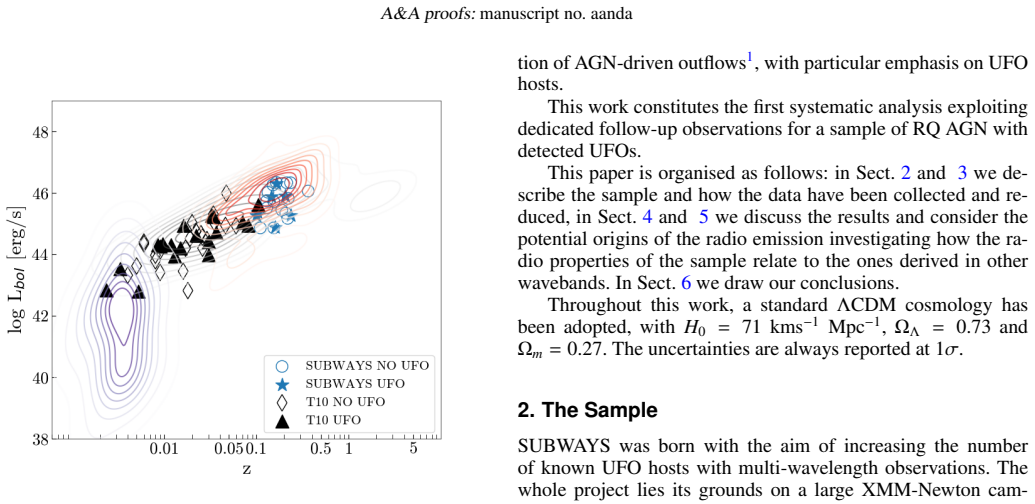
Most Active Galactic Nuclei (AGN) are Radio Quiet, with radio emission that may arise from star-formation activity, AGN-driven winds, weak jets, and coronal activity. Disentangling these mechanisms is challenging and requires detailed multi-wavelength investigation, but it is crucial for quantifying AGN feedback in galaxy evolution. We present a detailed radio investigation of 21 X-ray selected AGN in the Supermassive Black Hole Winds in X-Rays (SUBWAYS) sample (log Lbol = 44.9-46.3 erg/s, z=0.1-0.5), selected to systematically search for Ultra-Fast Outflows (UFOs). UFOs are detected in 30% of the targets, making the sample particularly well-suited for investigating the role and signatures of multi-scale outflows at different frequencies. We build the radio SED of the sources complementing our proprietary data, collected with the JVLA at 1.5 and 6 GHz, with images from LoTSS and other publicly available radio surveys between 150 and 1400 MHz. We investigate the role and occurrence of the aforementioned mechanisms, with particular interest in outflows and their possible relation with UFOs. We combined information on spectral indices, luminosities, and morphologies of the radio emission with properties derived in other wavebands, such as Star Formation Rate, X-ray luminosity, Eddington ratio or the UFO kinetic luminosity. All the sources are detected and are mostly consistent with RQ AGN. For 80% of the sources the data suggest the presence of an outflow (wind or weak jet). Interestingly, our results indicate that AGN with UFOs tend to have larger radio extension and a steep radio spectrum consistent with outflows. Moreover, the radio emission of the 6 UFO hosts is consistent with predictions from wind-driven shock models, possibly indicating a direct connection between the two phases. Alternatively, this may reflect physical conditions favouring the rise of both phenomena.
Editorial analysis
A structured set of objections, weighed in public.
Referee Report
Summary. The manuscript presents a radio investigation of 21 X-ray selected AGN from the SUBWAYS sample (log L_bol = 44.9-46.3 erg/s, z=0.1-0.5), using JVLA observations at 1.5 and 6 GHz supplemented by LoTSS and other surveys to build radio SEDs. It reports that all sources are detected and mostly radio-quiet, with 80% showing evidence for outflows; crucially, the 6 sources hosting Ultra-Fast Outflows (UFOs) exhibit larger radio extensions and steeper spectra than the 15 non-UFO sources, with their radio properties consistent with wind-driven shock models, suggesting a possible direct connection between X-ray winds and radio-emitting outflows.
Significance. If the reported trends hold after statistical scrutiny, the work would strengthen the case for multi-phase AGN outflows by linking X-ray detected UFOs to extended radio emission, with implications for quantifying AGN feedback in galaxy evolution. The homogeneous X-ray selection and multi-frequency radio coverage are strengths that allow direct comparison of wind and radio properties.
major comments (3)
- [Abstract and §4] Abstract and §4 (Results): The claim that 'AGN with UFOs tend to have larger radio extension and a steep radio spectrum consistent with outflows' is presented without a formal statistical test (e.g., Kolmogorov-Smirnov or Mann-Whitney U test) comparing the radio extension and spectral-index distributions of the N=6 UFO subsample versus the N=15 non-UFO subsample. With such a small UFO subsample, this test is load-bearing to rule out Poisson fluctuations or selection effects.
- [§5] §5 (Discussion): The statement that 'the radio emission of the 6 UFO hosts is consistent with predictions from wind-driven shock models' does not demonstrate uniqueness; the manuscript should show that plausible ranges of ambient density, shock velocity, and magnetic-field parameters in alternative models (weak jets or star formation) cannot reproduce the same combination of extension, spectral index, and luminosity.
- [§3] §3 (Data and Methods): Tabulated values of radio extension, spectral index, and luminosity (with uncertainties) for all 21 sources are not provided, preventing independent verification of the reported differences and assessment of how measurement errors affect the trends.
minor comments (2)
- [Abstract] The abstract states that 'for 80% of the sources the data suggest the presence of an outflow' but does not define the quantitative criteria (e.g., morphology, spectral index threshold) used for this classification.
- A dedicated figure plotting radio extension versus spectral index, with UFO and non-UFO sources distinguished and error bars shown, would improve clarity of the central observational result.
Simulated Author's Rebuttal
We thank the referee for their thorough and constructive review. Their comments have highlighted areas where we can strengthen the statistical support, clarify model comparisons, and improve data transparency. We address each major comment point by point below.
read point-by-point responses
-
Referee: [Abstract and §4] Abstract and §4 (Results): The claim that 'AGN with UFOs tend to have larger radio extension and a steep radio spectrum consistent with outflows' is presented without a formal statistical test (e.g., Kolmogorov-Smirnov or Mann-Whitney U test) comparing the radio extension and spectral-index distributions of the N=6 UFO subsample versus the N=15 non-UFO subsample. With such a small UFO subsample, this test is load-bearing to rule out Poisson fluctuations or selection effects.
Authors: We agree that a formal statistical test is important to substantiate the trends, particularly with the small UFO subsample. In the revised manuscript we will add the results of a two-sample Kolmogorov-Smirnov test (and, if appropriate, a Mann-Whitney U test) comparing the radio-extension and spectral-index distributions between the UFO and non-UFO groups. These tests will be described in §4, with the p-values and interpretation reported, and the abstract will be updated to note the statistical support for the reported differences. revision: yes
-
Referee: [§5] §5 (Discussion): The statement that 'the radio emission of the 6 UFO hosts is consistent with predictions from wind-driven shock models' does not demonstrate uniqueness; the manuscript should show that plausible ranges of ambient density, shock velocity, and magnetic-field parameters in alternative models (weak jets or star formation) cannot reproduce the same combination of extension, spectral index, and luminosity.
Authors: We acknowledge that the current §5 demonstrates consistency with wind-driven shock models but does not explicitly rule out alternatives across their full parameter space. We will revise §5 to include a concise comparison, drawing on literature values, showing that typical weak-jet models predict smaller extensions at the observed luminosities and that star-formation scenarios usually produce flatter spectra than observed in the UFO hosts. A full hydrodynamic parameter exploration lies beyond the scope of this observational study; we will therefore note this limitation while arguing that the combination of properties favors the wind-shock interpretation. revision: partial
-
Referee: [§3] §3 (Data and Methods): Tabulated values of radio extension, spectral index, and luminosity (with uncertainties) for all 21 sources are not provided, preventing independent verification of the reported differences and assessment of how measurement errors affect the trends.
Authors: We agree that providing the full set of measured values is necessary for reproducibility and error assessment. We will add a new table (Table 2) in §3 that reports, for each of the 21 sources, the radio extension (both angular and physical), the spectral index between 1.5 and 6 GHz, the 1.5 GHz and 6 GHz luminosities with 1σ uncertainties, and brief morphological notes. This table will be referenced in the results and discussion sections when the trends are presented. revision: yes
Circularity Check
No circularity: purely observational comparisons to external data and models
full rationale
The paper conducts an empirical radio survey of 21 X-ray selected AGN, measuring extensions, spectral indices, and luminosities from JVLA, LoTSS, and public surveys, then comparing UFO hosts (N=6) versus non-UFO sources. All load-bearing statements rest on direct observational contrasts and consistency checks against independently published wind-driven shock models from the literature. No equations, parameter fits, or derivations are presented that reduce a claimed prediction back to the paper's own inputs by construction. No self-citation chains are invoked to justify uniqueness or to define the central result. The analysis is self-contained against external benchmarks and does not exhibit any of the enumerated circularity patterns.
Axiom & Free-Parameter Ledger
Reference graph
Works this paper leans on
-
[1]
Winds of change: The nuclear and galaxy-scale outflows and the X-ray variability of 2MASS 0918+2117. , keywords =. doi:10.1051/0004-6361/202349071 , archivePrefix =. 2402.16966 , primaryClass =
-
[2]
Memorie della Societa Astronomica Italiana , year = 2022, volume =
Supermassive Black Hole Winds in X-rays. Memorie della Societa Astronomica Italiana , year = 2022, volume =. doi:10.36116/MEMSAIT_93N2_3.2022.6 , adsurl =
-
[3]
Supermassive Black Hole Winds in X-rays: SUBWAYS. I. Ultra-fast outflows in quasars beyond the local Universe , journal =. 2023 , month =. doi:10.1051/0004-6361/202245036 , archivePrefix =. 2212.02960 , primaryClass =
-
[4]
, keywords =. 2024 , month =. doi:10.1051/0004-6361/202348908 , adsurl =
-
[5]
, keywords =. 2023 , month =. doi:0.1051/0004-6361/202245047 , archivePrefix =. 2212.02961 , primaryClass =
-
[6]
Second data release , DOI=
The LOFAR Two-metre Sky Survey - V. Second data release , DOI=. , year =
-
[7]
The LOFAR Two-metre Sky Survey. I. Survey description and preliminary data release , journal =. 2017 , month =. doi:10.1051/0004-6361/201629313 , archivePrefix =. 1611.02700 , primaryClass =
-
[8]
The Karl G. Jansky Very Large Array Sky Survey (VLASS). Science Case and Survey Design , journal =. 2020 , month =. doi:10.1088/1538-3873/ab63eb , archivePrefix =. 1907.01981 , primaryClass =
-
[9]
CHANDRA Detects Relativistic Broad Absorption Lines from APM 08279+5255. , keywords =. doi:10.1086/342744 , archivePrefix =. astro-ph/0207196 , primaryClass =
-
[10]
2016 , series =
The VLA Sky Survey (VLASS): Description and Science Goals , booktitle =. 2016 , series =
2016
-
[11]
The Rapid ASKAP Continuum Survey I: Design and first results , volume=. 2020 , pages=. doi:10.1017/pasa.2020.41 , journal=
-
[12]
The Rapid ASKAP Continuum Survey Paper II: First Stokes I Source Catalogue Data Release , volume=. 2021 , pages=. doi:10.1017/pasa.2021.47 , journal=
-
[13]
, keywords =. 1995 , month =. doi:10.1086/176166 , adsurl =
-
[14]
A Quick Look at the 3 GHz Radio Sky. I. Source Statistics from the Very Large Array Sky Survey , journal =. 2021 , month =. doi:10.3847/1538-4365/ac05c0 , archivePrefix =. 2102.11753 , primaryClass =
-
[15]
2022 , month =
CASA, the Common Astronomy Software Applications for Radio Astronomy , journal =. 2022 , month =
2022
-
[16]
2014 , doi =
WSClean: an implementation of a fast, generic wide-field imager for radio astronomy , volume =. 2014 , doi =
2014
-
[17]
arXiv e-prints , keywords =. 2009 , month =. doi:10.48550/arXiv.0908.2784 , archivePrefix =. 0908.2784 , primaryClass =
-
[18]
T., Jagannathan, P., Mooley, K
The GMRT 150 MHz all-sky radio survey. First alternative data release TGSS ADR1 , journal =. 2017 , month =. doi:10.1051/0004-6361/201628536 , archivePrefix =. 1603.04368 , primaryClass =
-
[19]
DISTRIBUTION OF QUASAR HOSTS ON THE GALAXY MAIN SEQUENCE PLANE , journal =. 2016 , month =. doi:10.3847/2041-8205/819/2/L27 , url =
-
[20]
Evidence for ultra-fast outflows in radio-quiet AGNs. I. Detection and statistical incidence of Fe K-shell absorption lines , journal =. 2010 , month =. doi:10.1051/0004-6361/200913440 , archivePrefix =. 1006.2858 , primaryClass =
-
[21]
The obstructed jet in Mrk 231 , volume=
Wang, Ailing and An, Tao and Jaiswal, Sumit and Mohan, Prashanth and Wang, Yuchan and Baan, Willem A and Zhang, Yingkang and Yang, Xiaolong , year=. The obstructed jet in Mrk 231 , volume=. Monthly Notices of the Royal Astronomical Society , publisher=. doi:10.1093/mnras/stab587 , number=
-
[22]
Peter and Elvis, Martin and Fabbiano, Giuseppina and Trindade Falcão, Anna and Kraemer, Steven B
Maksym, W. Peter and Elvis, Martin and Fabbiano, Giuseppina and Trindade Falcão, Anna and Kraemer, Steven B. and Fischer, Travis C. and Crenshaw, D. Michael and Storchi-Bergmann, Thaisa , title =. 2023 , month =. doi:10.3847/1538-4357/acd7f1 , url =
-
[23]
Hubble Space Telescope and VLA Observations of Seyfert 2 Galaxies: The Relationship between Radio Ejecta and the Narrow-Line Region. , keywords =. doi:10.1086/305886 , archivePrefix =. astro-ph/9801086 , primaryClass =
-
[24]
Linking macro-, meso- and microscales in multiphase AGN feeding and feedback. Nature Astronomy , keywords =. doi:10.1038/s41550-019-0970-1 , archivePrefix =. 2001.04985 , primaryClass =
-
[25]
NGC 2992: Interplay between the multiphase disc, wind, and radio bubbles. , keywords =. doi:10.1051/0004-6361/202245729 , archivePrefix =. 2308.04108 , primaryClass =
-
[26]
Longinotti, Anna Lia and Salomé, Q and Feruglio, C and Krongold, Y and García-Burillo, S and Giroletti, M and Panessa, F and Stanghellini, C and Vega, O and Patiño-Álvarez, V M and Chavushyan, V and Elías-Chavez, M and Robleto-Orús, A , year=. NOEMA spatially resolved view of the multiphase outflow in IRAS17020+4544: a shocked wind in action? , volume=. M...
-
[27]
2024 , eprint=
Deciphering Radio Emissions from Accretion Disk Winds in Radio-Quiet Active Galactic Nuclei , author=. 2024 , eprint=
2024
-
[28]
Bubbles and outflows: The novel JWST/NIRSpec view of the z = 1.59 obscured quasar XID2028. , keywords =. doi:10.1051/0004-6361/202346001 , archivePrefix =. 2301.11060 , primaryClass =
-
[29]
Tombesi, F. and Sambruna, R. M. and Reeves, J. N. and Braito, V. and Ballo, L. and Gofford, J. and Cappi, M. and Mushotzky, R. F. , year=. DISCOVERY OF ULTRA-FAST OUTFLOWS IN A SAMPLE OF BROAD-LINE RADIO GALAXIES OBSERVED WITHSUZAKU , volume=. The Astrophysical Journal , publisher=. doi:10.1088/0004-637x/719/1/700 , number=
-
[30]
, year = 1943, month = jan, volume =
Nuclear Emission in Spiral Nebulae. , journal =. 1943 , month =. doi:10.1086/144488 , adsurl =
-
[31]
2013, A&A, 558, A43, doi: 10.1051/0004-6361/201322062
The nature of LINER galaxies:. Ubiquitous hot old stars and rare accreting black holes , journal =. 2013 , month =. doi:10.1051/0004-6361/201322062 , archivePrefix =. 1308.4271 , primaryClass =
-
[32]
The NRAO VLA Sky Survey , journal =. 1998 , month =. doi:10.1086/300337 , adsurl =
-
[33]
Ade, P. A. R. and Aghanim, N. and Arnaud, M. and Ashdown, M. and Aumont, J. and Baccigalupi, C. and Banday, A. J. and Barreiro, R. B. and Bartlett, J. G. and Bartolo, N. and Battaner, E. and Battye, R. and Benabed, K. and Benoît, A. and Benoit-Lévy, A. and Bernard, J.-P. and Bersanelli, M. and Bielewicz, P. and Bock, J. J. and Bonaldi, A. and Bonavera, L....
-
[34]
The nature of compact radio sources: the case of FR 0 radio galaxies. , keywords =. doi:10.1007/s00159-023-00148-3 , archivePrefix =. 2307.08379 , primaryClass =
-
[35]
Simultaneous millimetric and X-ray intraday variability in the radio-quiet AGN MCG+08-11-11. , keywords =. doi:10.1051/0004-6361/202347495 , archivePrefix =. 2309.01804 , primaryClass =
-
[36]
Pilot study of the radio-emitting AGN population: the emerging new class of FR 0 radio-galaxies. , keywords =. doi:10.1051/0004-6361/201425426 , archivePrefix =. 1502.00427 , primaryClass =
-
[37]
The Wide-field Infrared Survey Explorer (WISE): Mission Description and Initial On-orbit Performance , journal =. 2010 , month =. doi:10.1088/0004-6256/140/6/1868 , archivePrefix =. 1008.0031 , primaryClass =
work page internal anchor Pith review Pith/arXiv arXiv doi:10.1088/0004-6256/140/6/1868 2010
-
[38]
Astronomische Nachrichten , publisher=
The new class of FR 0 radio galaxies , volume=. Astronomische Nachrichten , publisher=. 2016 , month=. doi:10.1002/asna.201512275 , number=
-
[39]
The morphology of extragalactic radio sources of high and low luminosity , journal =. 1974 , month =. doi:10.1093/mnras/167.1.31P , adsurl =
-
[40]
A Cosmology Calculator for the World Wide Web , journal =. 2006 , month =. doi:10.1086/510102 , archivePrefix =. astro-ph/0609593 , primaryClass =
-
[41]
, keywords =. 2001 , month =. doi:10.1086/319185 , archivePrefix =. astro-ph/0102506 , primaryClass =
-
[42]
Radio Loudness of Active Galactic Nuclei: Observational Facts and Theoretical Implications , journal =. 2007 , month =. doi:10.1086/511972 , archivePrefix =. astro-ph/0604095 , primaryClass =
-
[43]
VLA Observations of Objects in the Palomar Bright Quasar Survey , journal =. 1989 , month =. doi:10.1086/115207 , adsurl =
-
[44]
Radio Properties of Optically Selected Quasars , journal =. 1992 , month =. doi:10.1086/171370 , adsurl =
-
[45]
Radio loudness and classification for radio sources , journal =. 2021 , month =. doi:10.1093/pasj/psaa122 , url =
-
[46]
Nuclear Luminosities and Radio Loudness of Seyfert Nuclei , journal =. 2001 , month =. doi:10.1086/321524 , archivePrefix =. astro-ph/0102502 , primaryClass =
-
[47]
Workshop sull'Astronomia Millimetrica in Italia , year =
The Main Sequence of Star Forming Galaxies and AGNs at High-Z: Evidence for in situ Coevolution , keywords =. Workshop sull'Astronomia Millimetrica in Italia , year =. doi:10.5281/zenodo.1048809 , adsurl =
-
[48]
Unveiling the nature of 11 dusty star-forming galaxies at the peak of cosmic star formation history , volume=. , publisher=. 2021 , month=. doi:10.1093/mnras/stab674 , number=
-
[49]
S., 2003, @doi [ ] 10.1086/345339 , https://ui.adsabs.harvard.edu/abs/2003ApJ...583..145T 583, 145
Chandra Snapshot Observations of Low-Luminosity Active Galactic Nuclei with a Compact Radio Source , journal =. 2003 , month =. doi:10.1086/345339 , archivePrefix =. astro-ph/0209607 , primaryClass =
-
[50]
, year =
The X-ray and radio connection in low-luminosity active nuclei , DOI=. , year =
-
[51]
On the origin of radio emission in radio-quiet quasars , volume=. , publisher=. 2008 , month=. doi:10.1111/j.1365-2966.2008.13806.x , number=
-
[52]
What drives the radio slopes in radio-quiet quasars? , journal =. 2019 , month =. doi:10.1093/mnras/sty3098 , adsurl =
-
[53]
2017, Nature Astronomy, 1, 0194, doi: 10.1038/s41550-017-0194
On the two main classes of active galactic nuclei , journal =. 2017 , month =. doi:10.1038/s41550-017-0194 , archivePrefix =. 1707.08069 , primaryClass =
-
[54]
Galaxy-wide radio-induced feedback in a radio-quiet quasar , journal =. 2017 , month =. doi:10.1093/mnras/stx2209 , adsurl =
-
[55]
The Soft X-Ray Properties of a Complete Sample of Optically Selected Quasars. II. Final Results , journal =. 1997 , month =. doi:10.1086/303696 , url =
-
[56]
Discovery of a relativistic Fe line in PG 1425+267 with XMM-Newton and study of its short time-scale variability , journal =. 2006 , month =. doi:10.1111/j.1365-2966.2005.09805.x , archivePrefix =. astro-ph/0510858 , primaryClass =
-
[57]
Radio-loud and Radio-quiet QSOs , journal =. 2016 , month =. doi:10.3847/0004-637X/831/2/168 , archivePrefix =. 1608.04586 , primaryClass =
-
[58]
Radio emission from normal galaxies. , journal =. 1992 , month =. doi:10.1146/annurev.aa.30.090192.003043 , adsurl =
-
[59]
Radio Properties of Infrared‐Selected Galaxies in theIRAS2 Jy Sample , volume=. , publisher=. doi:10.1086/323145 , number=
-
[60]
The infrared-radio correlation of star-forming galaxies is stronglyM \* -dependent but nearly redshift-invariant sincez 4 , volume=. 2021 , month=. doi:10.1051/0004-6361/202039647 , journal=
-
[61]
Calibrating Star Formation in WISE Using Total Infrared Luminosity , journal =. 2017 , month =. doi:10.3847/1538-4357/aa92c7 , url =
-
[62]
A Multi-wavelength Study of the Turbulent Central Engine of the Low-mass AGN Hosted by NGC 404 , journal =. 2017 , month =. doi:10.3847/1538-4357/aa7ecf , archivePrefix =. 1707.02303 , primaryClass =
-
[63]
2013, MNRAS, 432, 1138, doi: 10.1093/mnras/stt547
Sub-parsec radio cores in nearby Seyfert galaxies , journal =. 2013 , month =. doi:10.1093/mnras/stt547 , adsurl =
-
[64]
D., Laor, A., Behar, E., et al
The PG-RQS survey. Building the radio spectral distribution of radio-quiet quasars. I. The 45-GHz data , journal =. 2022 , month =. doi:10.1093/mnras/stab3445 , url =
-
[65]
Star formation in quasar hosts and the origin of radio emission in radio-quiet quasars , journal =. 2016 , month =. doi:10.1093/mnras/stv2571 , archivePrefix =. 1511.00013 , primaryClass =
-
[66]
2014 , month =
Quasar feedback and the origin of radio emission in radio-quiet quasars , journal =. 2014 , month =
2014
-
[67]
Probing the Wind Component of Radio Emission in Luminous High-redshift Quasars , journal =. 2021 , month =. doi:10.3847/1538-3881/ac283b , archivePrefix =. 2106.07783 , primaryClass =
-
[68]
The predicted radio emission , journal =
AGN coronal emission models – I. The predicted radio emission , journal =. 2016 , month =. doi:10.1093/mnras/stw772 , url =
-
[69]
High-resolution VLA Imaging of Obscured Quasars: Young Radio Jets Caught in a Dense ISM , journal =. 2020 , month =. doi:10.3847/1538-4357/ab9011 , url =
-
[70]
, journal =
Quasar evolution derived from the Palomar bright quasar survey and other complete quasar surveys. , journal =. 1983 , month = jun, volume =
1983
-
[71]
, keywords =. 1993 , month =. doi:10.1086/186766 , adsurl =
-
[72]
2024, ApJ, 975, 35, doi: 10.3847/1538-4357/ad74fc
Windy or Not: Radio Parsec-scale Evidence for a Broad-line Region Wind in Radio-quiet Quasars. , keywords =. doi:10.3847/1538-4357/ad74fc , archivePrefix =. 2408.15934 , primaryClass =
-
[73]
The LOFAR Two-metre Sky Survey: VII. Third Data Release. arXiv e-prints , keywords =. doi:10.48550/arXiv.2602.15949 , archivePrefix =. 2602.15949 , primaryClass =
-
[74]
The radio emission in radio-quiet quasars: the VLBA perspective. , keywords =. doi:10.1093/mnras/stad2289 , archivePrefix =. 2307.13599 , primaryClass =
-
[75]
AAS/High Energy Astrophysics Division , year = 2023, series =
Gamma rays from Fast Black-Hole Winds. AAS/High Energy Astrophysics Division , year = 2023, series =
2023
-
[76]
The Nature of Radio-intermediate Quasars: What Is Radio-loud and What Is Radio-quiet?. , keywords =. doi:10.1086/177956 , archivePrefix =. astro-ph/9605165 , primaryClass =
-
[77]
A Population of Radio-Loud Narrow-Line Seyfert 1 Galaxies with Blazar-Like Properties?. , keywords =. doi:10.1086/591046 , archivePrefix =. 0806.3755 , primaryClass =
-
[78]
Ultra-high-energy cosmic rays from ultra-fast outflows of active galactic nuclei. , keywords =. doi:10.1093/mnras/staf457 , archivePrefix =. 2411.05667 , primaryClass =
-
[79]
, year =
Feedback and ionized gas outflows in four low-radio power AGN at z 0.15 , DOI=. , year =
-
[80]
A Tight Correlation between Millimeter and X-Ray Emission in Accreting Massive Black Holes from <100 mas Resolution ALMA Observations. , keywords =. doi:10.3847/2041-8213/acda27 , archivePrefix =. 2306.04679 , primaryClass =
discussion (0)
Sign in with ORCID, Apple, or X to comment. Anyone can read and Pith papers without signing in.