Recognition: unknown
HiCrew: Hierarchical Reasoning for Long-Form Video Understanding via Question-Aware Multi-Agent Collaboration
Pith reviewed 2026-05-09 21:51 UTC · model grok-4.3
The pith
A question-aware hierarchical multi-agent framework with a hybrid tree structure improves temporal and causal reasoning in long-form video understanding.
A machine-rendered reading of the paper's core claim, the machinery that carries it, and where it could break.
Core claim
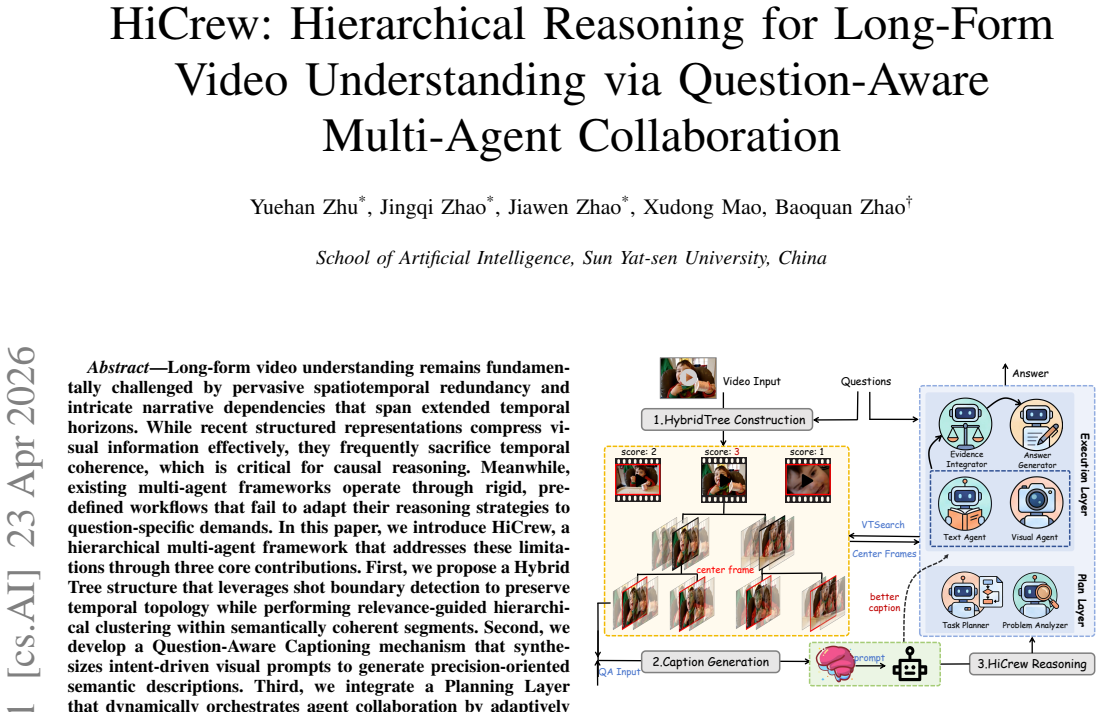
HiCrew introduces a Hybrid Tree that applies shot boundary detection to retain temporal topology and relevance-guided hierarchical clustering within coherent segments, combined with Question-Aware Captioning that creates intent-driven prompts for precise semantic descriptions and a Planning Layer that selects agent roles and execution paths according to question complexity, thereby enabling adaptive collaboration that improves handling of narrative dependencies in long videos.
What carries the argument
The Hybrid Tree structure, which preserves temporal topology via shot boundary detection while performing relevance-guided hierarchical clustering inside semantically coherent segments to support coherent reasoning.
If this is right
- Higher accuracy on temporal reasoning tasks through maintained event ordering across long sequences.
- Stronger causal reasoning by keeping narrative dependencies intact within the hierarchical structure.
- More effective agent collaboration because the planning layer adapts roles and paths to each question instead of using fixed workflows.
- Precision-oriented video descriptions generated from intent-driven prompts rather than generic captions.
Where Pith is reading between the lines
- The same hybrid tree construction might scale to videos much longer than the current benchmarks by increasing clustering depth at higher levels.
- Adaptive planning layers could transfer to multi-agent setups for other sequential domains like long documents or audio transcripts where order matters.
- Direct measurement of whether removing the relevance clustering step reduces performance exactly on questions that cross segment boundaries would test the topology-preservation claim.
Load-bearing premise
The hybrid tree structure built via shot boundary detection and relevance-guided hierarchical clustering preserves temporal topology and coherence better than prior structured representations.
What would settle it
An ablation experiment on EgoSchema or NExT-QA that replaces the hybrid tree with a flat shot segmentation and measures whether the accuracy gap on temporal and causal questions shrinks or vanishes.
Figures


read the original abstract
Long-form video understanding remains fundamentally challenged by pervasive spatiotemporal redundancy and intricate narrative dependencies that span extended temporal horizons. While recent structured representations compress visual information effectively, they frequently sacrifice temporal coherence, which is critical for causal reasoning. Meanwhile, existing multi-agent frameworks operate through rigid, pre-defined workflows that fail to adapt their reasoning strategies to question-specific demands. In this paper, we introduce HiCrew, a hierarchical multi-agent framework that addresses these limitations through three core contributions. First, we propose a Hybrid Tree structure that leverages shot boundary detection to preserve temporal topology while performing relevance-guided hierarchical clustering within semantically coherent segments. Second, we develop a Question-Aware Captioning mechanism that synthesizes intent-driven visual prompts to generate precision-oriented semantic descriptions. Third, we integrate a Planning Layer that dynamically orchestrates agent collaboration by adaptively selecting roles and execution paths based on question complexity. Extensive experiments on EgoSchema and NExT-QA validate the effectiveness of our approach, demonstrating strong performance across diverse question types with particularly pronounced gains in temporal and causal reasoning tasks that benefit from our hierarchical structure-preserving design.
Editorial analysis
A structured set of objections, weighed in public.
Referee Report
Summary. The manuscript introduces HiCrew, a hierarchical multi-agent framework for long-form video understanding. It proposes three main contributions: (1) a Hybrid Tree structure that combines shot boundary detection with relevance-guided hierarchical clustering within segments to preserve temporal topology and coherence; (2) a Question-Aware Captioning mechanism that generates intent-driven semantic descriptions; and (3) a Planning Layer that dynamically orchestrates agent roles and execution paths based on question complexity. The authors claim that extensive experiments on EgoSchema and NExT-QA demonstrate strong performance across question types, with particularly pronounced gains in temporal and causal reasoning tasks attributable to the structure-preserving design.
Significance. If the central claims regarding the Hybrid Tree's topology preservation and the resulting performance gains hold, this work could meaningfully advance long-form video understanding by mitigating the common trade-off between information compression and temporal/causal coherence in structured video representations. The question-adaptive multi-agent orchestration also offers a flexible alternative to rigid workflow-based systems, with potential applicability to other narrative-heavy domains.
major comments (1)
- [Hybrid Tree structure (method description)] The central claim that performance gains in temporal and causal reasoning stem from the 'hierarchical structure-preserving design' (abstract) depends on the Hybrid Tree actually maintaining shot ordering. The construction applies relevance-guided hierarchical clustering inside shot-boundary segments, but standard agglomerative clustering with feature similarity does not inherently respect original temporal sequence. No explicit order-preserving mechanism (e.g., sequential linkage, temporal-distance penalty, or post-clustering leaf sorting) is described in the available text. This is load-bearing for attributing gains to the topology-preserving aspect rather than other factors such as captioning or planning.
minor comments (1)
- [Abstract] The abstract asserts 'strong performance' and 'particularly pronounced gains' without any numerical results, metrics, or baselines; including at least the primary accuracy figures and key ablations would strengthen the summary.
Simulated Author's Rebuttal
We thank the referee for their careful reading and insightful feedback on the manuscript. The concern regarding explicit temporal order preservation in the Hybrid Tree is well-taken and directly impacts the attribution of gains to the structure-preserving design. We address this point below and outline the revisions we will make.
read point-by-point responses
-
Referee: [Hybrid Tree structure (method description)] The central claim that performance gains in temporal and causal reasoning stem from the 'hierarchical structure-preserving design' (abstract) depends on the Hybrid Tree actually maintaining shot ordering. The construction applies relevance-guided hierarchical clustering inside shot-boundary segments, but standard agglomerative clustering with feature similarity does not inherently respect original temporal sequence. No explicit order-preserving mechanism (e.g., sequential linkage, temporal-distance penalty, or post-clustering leaf sorting) is described in the available text. This is load-bearing for attributing gains to the topology-preserving aspect rather than other factors such as captioning or planning.
Authors: We appreciate the referee's identification of this critical detail. The Hybrid Tree begins with shot-boundary detection to produce temporally ordered segments, which establishes the primary topology preservation. Within each segment, relevance-guided hierarchical clustering builds the subtree structure for semantic coherence. To explicitly enforce original temporal sequence, we will revise the method description (Section 3.2) to specify two mechanisms: (1) a temporal-distance penalty term added to the similarity metric during agglomerative clustering, and (2) a post-clustering step that sorts leaf nodes by their original frame timestamps before tree construction. These additions will be accompanied by pseudocode and an ablation confirming their contribution to temporal/causal performance. We believe this clarification will strengthen the manuscript's claims without altering the core experimental results. revision: yes
Circularity Check
No circularity: framework description with no equations, derivations, or self-referential reductions
full rationale
The paper introduces HiCrew as a new hierarchical multi-agent framework with three explicit contributions: a Hybrid Tree via shot boundary detection plus relevance-guided clustering, Question-Aware Captioning, and a Planning Layer. No equations, fitted parameters, or derivation chains appear in the provided text. Claims rest on empirical results on EgoSchema and NExT-QA rather than any mathematical reduction to prior inputs or self-citations. The structure-preserving design is asserted as a design choice, not derived from or equivalent to its own outputs by construction. This is a standard non-circular systems paper.
Axiom & Free-Parameter Ledger
Reference graph
Works this paper leans on
-
[1]
Zongxin Yang, Guikun Chen, Xiaodi Li, Wenguan Wang, and Yi Yang, “Doraemongpt: Toward understanding dynamic scenes with large lan- guage models (exemplified as a video agent),”arXiv preprint arXiv:2401.08392, 2024
-
[2]
Videoagent: A memory-augmented multimodal agent for video understanding,
Yue Fan, Xiaojian Ma, Rujie Wu, Yuntao Du, Jiaqi Li, Zhi Gao, and Qing Li, “Videoagent: A memory-augmented multimodal agent for video understanding,” inECCV, 2024, pp. 75–92
2024
-
[3]
Omagent: A multi-modal agent framework for complex video understanding with task divide-and-conquer,
Lu Zhang, Tiancheng Zhao, Heting Ying, Yibo Ma, and Kyusong Lee, “Omagent: A multi-modal agent framework for complex video understanding with task divide-and-conquer,”arXiv preprint arXiv:2406.16620, 2024
-
[4]
Videotree: Adaptive tree- based video representation for llm reasoning on long videos,
Ziyang Wang, Shoubin Yu, Elias Stengel-Eskin, Jaehong Yoon, Feng Cheng, Gedas Bertasius, and Mohit Bansal, “Videotree: Adaptive tree- based video representation for llm reasoning on long videos,” inCVPR, 2025, pp. 3272–3283
2025
-
[5]
Bimba: Selective-scan compression for long-range video question answering,
Md Mohaiminul Islam, Tushar Nagarajan, Huiyu Wang, Gedas Berta- sius, and Lorenzo Torresani, “Bimba: Selective-scan compression for long-range video question answering,” inCVPR, 2025, pp. 29096– 29107
2025
-
[6]
Reagent-v: A reward- driven multi-agent framework for video understanding,
Yiyang Zhou, Yangfan He, Yaofeng Su, Siwei Han, Joel Jang, Gedas Bertasius, Mohit Bansal, and Huaxiu Yao, “Reagent-v: A reward- driven multi-agent framework for video understanding,”arXiv preprint arXiv:2506.01300, 2025
-
[7]
Long Context Transfer from Language to Vision
Peiyuan Zhang, Kaichen Zhang, Bo Li, Guangtao Zeng, Jingkang Yang, Yuanhan Zhang, Ziyue Wang, Haoran Tan, Chunyuan Li, and Ziwei Liu, “Long context transfer from language to vision,”arXiv preprint arXiv:2406.16852, 2024
work page internal anchor Pith review arXiv 2024
-
[8]
Hiervl: Learning hierarchical video-language embeddings,
Kumar Ashutosh, Rohit Girdhar, Lorenzo Torresani, and Kristen Grau- man, “Hiervl: Learning hierarchical video-language embeddings,” in CVPR, 2023, pp. 23066–23078
2023
-
[9]
arXiv preprint arXiv:2510.12422 , year=
Jialong Zuo, Yongtai Deng, Lingdong Kong, Jingkang Yang, Rui Jin, Yiwei Zhang, Nong Sang, Liang Pan, Ziwei Liu, and Changxin Gao, “Videolucy: Deep memory backtracking for long video understanding,” arXiv preprint arXiv:2510.12422, 2025
-
[10]
Bridging episodes and seman- tics: A novel framework for long-form video understanding,
Gueter Josmy Faure, Jia-Fong Yeh, Min-Hung Chen, Hung-Ting Su, Winston H Hsu, and Shang-Hong Lai, “Bridging episodes and seman- tics: A novel framework for long-form video understanding,”CoRR, 2024
2024
-
[11]
Videomamba: Spatio-temporal selective state space model,
Jinyoung Park, Hee-Seon Kim, Kangwook Ko, Minbeom Kim, and Changick Kim, “Videomamba: Spatio-temporal selective state space model,” inECCV, 2024, pp. 1–18
2024
-
[12]
Sharegpt4video: Improving video understanding and generation with better captions,
Lin Chen, Xilin Wei, Jinsong Li, Xiaoyi Dong, Pan Zhang, Yuhang Zang, Zehui Chen, Haodong Duan, Zhenyu Tang, Li Yuan, et al., “Sharegpt4video: Improving video understanding and generation with better captions,”NeurIPS, vol. 37, pp. 19472–19495, 2024
2024
-
[13]
Videoagent: Long-form video understanding with large language model as agent,
Xiaohan Wang, Yuhui Zhang, Orr Zohar, and Serena Yeung-Levy, “Videoagent: Long-form video understanding with large language model as agent,” inECCV, 2024, pp. 58–76
2024
-
[14]
Yongdong Luo, Xiawu Zheng, Xiao Yang, Guilin Li, Haojia Lin, Jinfa Huang, Jiayi Ji, Fei Chao, Jiebo Luo, and Rongrong Ji, “Video-rag: Visually-aligned retrieval-augmented long video comprehension,”arXiv preprint arXiv:2411.13093, 2024
-
[15]
Egoschema: A diagnostic benchmark for very long-form video lan- guage understanding,
Karttikeya Mangalam, Raiymbek Akshulakov, and Jitendra Malik, “Egoschema: A diagnostic benchmark for very long-form video lan- guage understanding,”NeurIPS, vol. 36, pp. 46212–46244, 2023
2023
-
[16]
Next-qa: Next phase of question-answering to explaining temporal actions,
Junbin Xiao, Xindi Shang, Angela Yao, and Tat-Seng Chua, “Next-qa: Next phase of question-answering to explaining temporal actions,” in CVPR, 2021, pp. 9777–9786
2021
-
[17]
Agentic keyframe search for video question answering,
Sunqi Fan, Meng-Hao Guo, and Shuojin Yang, “Agentic keyframe search for video question answering,”arXiv preprint arXiv:2503.16032, 2025
-
[18]
Ying Wang, Yanlai Yang, and Mengye Ren, “Lifelongmemory: Lever- aging llms for answering queries in long-form egocentric videos,”arXiv preprint arXiv:2312.05269, 2023
-
[19]
Mvbench: A comprehensive multi-modal video understanding benchmark,
Kunchang Li, Yali Wang, Yinan He, Yizhuo Li, Yi Wang, Yi Liu, Zun Wang, Jilan Xu, Guo Chen, Ping Luo, et al., “Mvbench: A comprehensive multi-modal video understanding benchmark,” inCVPR, 2024, pp. 22195–22206
2024
-
[20]
VideoLLaMA 3: Frontier Multimodal Foundation Models for Image and Video Understanding
Boqiang Zhang, Kehan Li, Zesen Cheng, Zhiqiang Hu, Yuqian Yuan, Guanzheng Chen, Sicong Leng, Yuming Jiang, Hang Zhang, Xin Li, et al., “Videollama 3: Frontier multimodal foundation models for image and video understanding,”arXiv preprint arXiv:2501.13106, 2025
work page internal anchor Pith review arXiv 2025
-
[21]
A simple llm framework for long- range video question-answering,
Ce Zhang, Taixi Lu, Md Mohaiminul Islam, Ziyang Wang, Shoubin Yu, Mohit Bansal, and Gedas Bertasius, “A simple llm framework for long- range video question-answering,” inEMNLP, 2024, pp. 21715–21737
2024
-
[22]
Llama-vid: An image is worth 2 tokens in large language models,
Yanwei Li, Chengyao Wang, and Jiaya Jia, “Llama-vid: An image is worth 2 tokens in large language models,” inECCV, 2024, pp. 323–340
2024
-
[23]
Mobile-videogpt: Fast and accurate video understanding language model,
Abdelrahman Shaker, Muhammad Maaz, Chenhui Gou, Hamid Rezatofighi, Salman Khan, and Fahad Shahbaz Khan, “Mobile-videogpt: Fast and accurate video understanding language model,”arXiv preprint arXiv:2503.21782, 2025
-
[24]
Intern- video2: Scaling foundation models for multimodal video understanding,
Yi Wang, Kunchang Li, Xinhao Li, Jiashuo Yu, Yinan He, Guo Chen, Baoqi Pei, Rongkun Zheng, Zun Wang, Yansong Shi, et al., “Intern- video2: Scaling foundation models for multimodal video understanding,” inECCV, 2024, pp. 396–416
2024
-
[25]
Too many frames, not all useful: Efficient strategies for long-form video qa,
Jongwoo Park, Kanchana Ranasinghe, Kumara Kahatapitiya, Wonjeong Ryu, Donghyun Kim, and Michael S Ryoo, “Too many frames, not all useful: Efficient strategies for long-form video qa,”arXiv preprint arXiv:2406.09396, 2024
-
[26]
Aaron Hurst, Adam Lerer, Adam P Goucher, Adam Perelman, Aditya Ramesh, Aidan Clark, AJ Ostrow, Akila Welihinda, Alan Hayes, Alec Radford, et al., “Gpt-4o system card,”arXiv preprint arXiv:2410.21276, 2024
work page internal anchor Pith review Pith/arXiv arXiv 2024
-
[27]
EVA-CLIP- 18B: Scaling clip to 18 billion parameters.arXiv:2402.04252, 2024
Quan Sun, Jinsheng Wang, Qiying Yu, Yufeng Cui, Fan Zhang, Xiaosong Zhang, and Xinlong Wang, “Eva-clip-18b: Scaling clip to 18 billion parameters,”arXiv preprint arXiv:2402.04252, 2024
-
[28]
Blip-2: Bootstrapping language-image pre-training with frozen image encoders and large language models,
Junnan Li, Dongxu Li, Silvio Savarese, and Steven Hoi, “Blip-2: Bootstrapping language-image pre-training with frozen image encoders and large language models,” inICML, 2023, pp. 19730–19742
2023
-
[29]
Learn- ing video representations from large language models,
Yue Zhao, Ishan Misra, Philipp Kr ¨ahenb¨uhl, and Rohit Girdhar, “Learn- ing video representations from large language models,” inCVPR, 2023, pp. 6586–6597
2023
discussion (0)
Sign in with ORCID, Apple, or X to comment. Anyone can read and Pith papers without signing in.