Catalytic quantum thermodynamics beyond additivity and reduced-state monotones
Pith reviewed 2026-05-09 22:18 UTC · model grok-4.3
The pith
Non-additive divergences produce second-law inequalities with explicit catalyst corrections for quantum thermal transformations.
A machine-rendered reading of the paper's core claim, the machinery that carries it, and where it could break.
Core claim
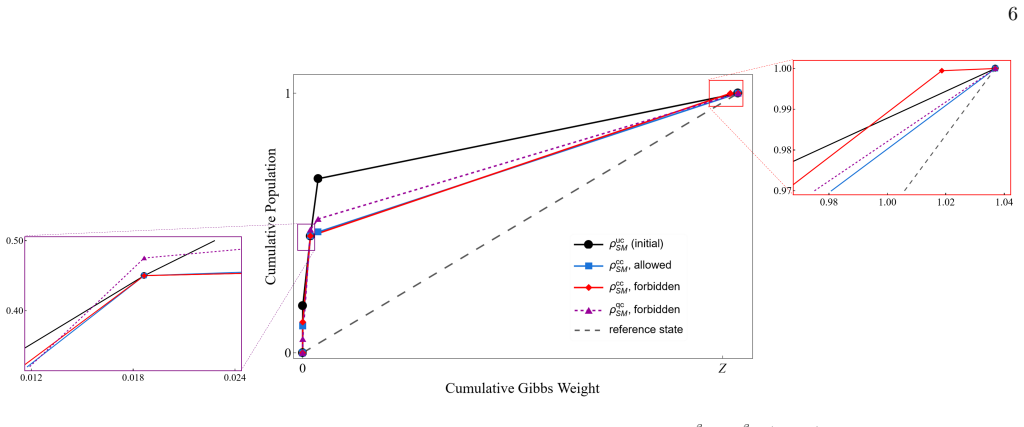
We develop a complementary formulation of generalized second laws based on non-additive divergences. Their pseudo-additive structure yields a family of generalized free energies containing an explicit catalyst-dependent correction term. For uncorrelated catalytic thermal transformations this produces non-additive second-law relations that make the catalytic contribution explicit and supply nontrivial constraints on admissible catalysts when the catalyst is returned only approximately. For correlated catalytic thermal transformations we show through explicit finite-dimensional examples that the thermo-majorization behavior of the joint transformation can change while the system and catalyst 1
What carries the argument
Non-additive divergences whose pseudo-additive structure generates generalized free energies that incorporate an explicit correction term depending on the catalyst.
If this is right
- Non-additive second-law relations supply explicit constraints on admissible catalysts returned only approximately in uncorrelated catalysis.
- Reduced-state data are generally insufficient to determine thermodynamic accessibility in correlated catalysis.
- Thermo-majorization accessibility of the joint state can change while system and catalyst marginals remain fixed.
- Joint states sharing the same marginals and mutual information can still differ in thermo-majorization accessibility.
Where Pith is reading between the lines
- Catalyst design in correlated settings may require accounting for joint-state features beyond mutual information.
- Experimental tests in small quantum systems could check whether non-additive inequalities better match observed accessibility than marginal-based predictions.
- The approach suggests that other resource theories might benefit from non-additive quantities to expose constraints invisible from reduced states.
Load-bearing premise
The pseudo-additive structure of the chosen non-additive divergences produces valid second-law inequalities containing explicit catalyst terms, and the finite-dimensional examples correctly illustrate changes in thermo-majorization accessibility with fixed marginals.
What would settle it
An explicit uncorrelated catalytic transformation that satisfies the usual additive second laws yet violates one of the new non-additive inequalities, or a pair of correlated joint states with identical marginals and mutual information that nevertheless exhibit identical thermo-majorization accessibility contrary to the given examples.
Figures
read the original abstract
The generalized second laws of quantum thermodynamics are usually formulated in terms of R\'enyi divergences and the associated family of generalized free energies. In catalytic thermal transformations, this framework typically certifies the existence of a suitable catalyst but does not make the catalytic contribution explicit in the resulting system-level inequalities. Here we develop a complementary formulation based on non-additive divergences, whose pseudo-additive structure yields a family of generalized free energies with an explicit catalyst-dependent correction term. For uncorrelated catalytic thermal transformations, we show that this leads to non-additive second-law relations that make the catalytic contribution explicit and provide nontrivial constraints on admissible catalysts when the catalyst is returned only approximately. We also analyze correlated catalytic thermal transformations and show, through explicit finite-dimensional examples, that reduced-state data are generally insufficient to characterize thermodynamic accessibility: the thermo-majorization behavior of the joint transformation can change while the system and catalyst marginals remain fixed, and even states with identical marginals and the same mutual information can exhibit different thermo-majorization accessibility. Our results show that non-additivity can be thermodynamically informative in uncorrelated catalysis, whereas correlated catalysis generally requires a genuinely joint-state-sensitive description beyond reduced-state monotones.
Editorial analysis
A structured set of objections, weighed in public.
Referee Report
Summary. The paper develops a complementary framework for catalytic quantum thermodynamics based on non-additive divergences rather than the standard Rényi family. The pseudo-additive structure of these divergences is used to construct generalized free energies that include an explicit catalyst-dependent correction term. For uncorrelated catalytic thermal operations the resulting inequalities make the catalyst's contribution visible and constrain admissible catalysts when return is only approximate. For correlated catalysis the paper presents finite-dimensional examples claiming that joint thermo-majorization accessibility can change even when system and catalyst marginals (and mutual information) are held fixed, implying that reduced-state monotones are generally insufficient.
Significance. If the derivations and examples are correct, the work supplies a useful alternative route to making catalytic contributions explicit in second-law statements and demonstrates a concrete limitation of marginal-only descriptions in correlated settings. The provision of explicit finite-dimensional examples is a positive feature that allows direct checking of the joint-state claim. The results would be of interest to researchers working on resource theories of thermodynamics and on the role of correlations in catalytic processes.
major comments (2)
- [derivation of generalized free energies] The central derivation that pseudo-additivity of the chosen non-additive divergences directly produces valid second-law inequalities with explicit catalyst corrections (abstract and the section introducing the generalized free energies) requires a clear monotonicity proof under thermal operations that include the catalyst correction; without it the explicit term may not function as a genuine constraint.
- [correlated catalysis examples] The finite-dimensional examples for correlated catalysis (the section presenting the explicit states) are load-bearing for the claim that reduced-state data are insufficient. The manuscript must supply the explicit density matrices, the computed thermo-majorization curves, and the verification that marginals and mutual information are identical while accessibility differs; otherwise the distinction between uncorrelated informativeness and the need for joint-state descriptions cannot be confirmed.
minor comments (1)
- [preliminaries] Notation for the non-additive divergence and the catalyst correction term should be introduced with a clear comparison table to the standard Rényi case to aid readability.
Simulated Author's Rebuttal
We thank the referee for the careful reading of our manuscript and the constructive comments. We address each major comment point by point below, indicating the revisions we will implement to improve clarity and verifiability.
read point-by-point responses
-
Referee: [derivation of generalized free energies] The central derivation that pseudo-additivity of the chosen non-additive divergences directly produces valid second-law inequalities with explicit catalyst corrections (abstract and the section introducing the generalized free energies) requires a clear monotonicity proof under thermal operations that include the catalyst correction; without it the explicit term may not function as a genuine constraint.
Authors: We appreciate the referee pointing out the need for an explicit monotonicity argument. The manuscript derives the generalized free energies from the pseudo-additivity property and applies them to catalytic thermal operations, but we agree that a self-contained proof of monotonicity (including how the catalyst correction is handled) would strengthen the presentation. In the revised manuscript we will add a dedicated lemma and proof in the section on generalized free energies, showing that the corrected quantities remain monotonic under the relevant operations and that the correction term therefore functions as a genuine constraint. revision: yes
-
Referee: [correlated catalysis examples] The finite-dimensional examples for correlated catalysis (the section presenting the explicit states) are load-bearing for the claim that reduced-state data are insufficient. The manuscript must supply the explicit density matrices, the computed thermo-majorization curves, and the verification that marginals and mutual information are identical while accessibility differs; otherwise the distinction between uncorrelated informativeness and the need for joint-state descriptions cannot be confirmed.
Authors: We agree that the examples must be fully explicit for the claim to be verifiable. The current version already states the finite-dimensional joint states and verifies that the marginals and mutual information are identical while thermo-majorization accessibility differs, but we acknowledge that the density matrices, curves, and step-by-step calculations could be presented more transparently. In the revision we will expand the relevant section to include the complete density matrices (in both ket and matrix form), the explicit thermo-majorization curves (as a figure or table), and the detailed verification that the marginals and mutual information remain fixed while accessibility changes. This will make the insufficiency of reduced-state monotones directly checkable. revision: yes
Circularity Check
No circularity: derivation follows directly from divergence properties
full rationale
The paper constructs generalized free energies and second-law inequalities by exploiting the pseudo-additive structure of non-additive divergences, yielding explicit catalyst correction terms without fitting parameters to the target results or reducing any load-bearing step to a self-citation. The uncorrelated catalysis results follow from the divergence axioms and the definition of thermal operations, while the correlated catalysis examples rely on explicit finite-dimensional thermo-majorization comparisons of joint states. No equation or claim is shown to be equivalent to its inputs by construction, and the central claims remain independent of any prior self-citation chain. The derivation is therefore self-contained.
Axiom & Free-Parameter Ledger
axioms (2)
- domain assumption Non-additive divergences possess a pseudo-additive structure that permits an explicit catalyst correction term in the resulting inequalities.
- domain assumption Thermo-majorization relations on the joint state determine thermodynamic accessibility even when marginals are fixed.
Reference graph
Works this paper leans on
-
[1]
1<α<+∞: fα(˜p)>f α(˜p′ ϵ)≡ln N ∑ i=1 (˜pi)α >ln N ∑ i=1 (˜p′ ϵ,i)α ⇐⇒ N ∑ i=1 (˜pi)α > N ∑ i=1 (˜p′ ϵ,i)α (C5) ⇐⇒Dα(˜p∥ηN)>D α(˜p′ ϵ∥ηN)(C6) 2.α=1: f1(˜p)>f 1(˜p′ ϵ)≡ N ∑ i=1 ˜pi ln ˜pi > N ∑ i=1 ˜pϵ,i ln ˜pϵ,i⇐⇒D1(˜p∥ηN)>D 1(˜p′ ϵ∥ηN)(C7)
-
[2]
0<α<1: fα(˜p)>f α(˜p′ ϵ)≡−ln N ∑ i=1 (˜pi)α >−ln N ∑ i=1 (˜pϵ,i)α ⇐⇒1 α−1 N ∑ i=1 (˜pi)α > 1 α−1 N ∑ i=1 (˜pϵ,i)α (C8) ⇐⇒Dα(˜p∥ηN)>D α(˜p′ ϵ∥ηN)(C9) 4.α=0: For ˜pϵ being of full rank, we have f0(˜p)>f 0(˜p′ ϵ)≡lim α→0+ fα(˜p)>lim α→0+ fα(˜p′ ϵ)(C10) ≡lim α→0+ (−log N ∑ i=1 (˜pi)α)>lim α→0+ (−log N ∑ i=1 (˜pϵ,i)α)(C11) ⇔−rank(˜p)>−rank(˜p ϵ)(C12) ≡−H 0(˜p)...
-
[3]
APPENDIX I: PSEUDO-ADDITIVITY AND FINITE-SIZE CATALYTIC CONSTRAINTS
provides a natural and sufficiently direct route to the non-additive characterization established above. APPENDIX I: PSEUDO-ADDITIVITY AND FINITE-SIZE CATALYTIC CONSTRAINTS
-
[4]
[13], in particular the characterization underlying Theorem 21
Exact uncorrelated catalysis For uncorrelated catalytic transformations of the form ρS⊗σM /leftfootl⫯ne→ρ′ S⊗σM ,(I1) the change in total non-additive free energy can be written as ∆Fα =∆F (S) α [1+sgn(α)(α−1)D α(σM∥γM)],(I2) 1 This technical assumption follows the order-theoretic framework for catalytic convertibility developed by Gour; see Ref. [13], in...
-
[5]
Approximate uncorrelated catalysis Assume now that the catalyst is returned only approximately. Denoting byσ M andσ ′ M the initial and final states ofM, respectively, we impose the trace-distance constraint 1 2∥σ′ M −σM∥1 ≤ε,equivalently∥ ⃗q−⃗p∥1 ≤2ε,(I8) whereσ ′ M =diag( ⃗q),σ M =diag( ⃗p), andε≥0 quantifies the degree of catalytic approximation. For u...
-
[6]
Simple finite-dimensional benchmark examples To make this finite-size mechanism explicit, let us consider the simplest benchmark in which the catalyst Hamiltonian is trivial, HM =0,(I23) so that the reference thermal state is uniform: γM =diag(1/d M , . . . ,1/dM).(I24) Instead of taking theinitialcatalyst to be uniform, it is often more natural in approx...
-
[7]
We take the thermal operations with respect 31 to a bath at inverse temperatureβ b
Common initial product state and thermal reference In all examples below, the initial state is taken to be a product of two local thermal states, ρ uc SM =ρ β2 S ⊗ρ β1 M ,(J3) where the subsystemSis initially in thermal equilibrium at inverse temperatureβ 2, while the subsystemM(the catalyst) is initially in thermal equilibrium at inverse temperatureβ 1. ...
-
[8]
Example 1: classical correlations with fixed marginals Our first family of final states is purely classically correlated: ρ cc SM(χ)= ⎛ ⎜⎜⎜ ⎝ pβ3 pβ1+χ0 0 0 0p β3(1−pβ1)−χ0 0 0 0(1−p β3)pβ1−χ0 0 0 0(1−p β3)(1−pβ1)+χ ⎞ ⎟⎟⎟ ⎠ ,(J10) where positivity requires −5.37×10⁻²<χ<6.55×10 −2 (J11) for the parameter values in Eq. (J8). By construction, trS[ρ cc SM(χ)]...
-
[9]
We now show that even the amount of correlation is not, by itself, sufficient
Example 2: same marginals, same mutual information, different correlation structure The previous example shows that theamountof correlation can matter even when the reduced states are fixed. We now show that even the amount of correlation is not, by itself, sufficient. Consider instead the discordant family ρ qc SM(λ)= ⎛ ⎜⎜⎜ ⎝ pβ3 pβ1 0 0 0 0p β3(1−pβ1)λ0...
-
[10]
D. Janzing, P. Wojcan, R. Zeier, R. Geiss, and T. Beth, International Journal of Theoretical Physics39, 2717–2753 (2000)
work page 2000
- [11]
-
[12]
F. G. S. L. Brand˜ ao, M. Horodecki, J. Oppenheim, J. M. Renes, and R. W. Spekkens, Physical Review Letters111, 250404 (2013)
work page 2013
-
[13]
J. M. Renes, The European Physical Journal Plus129, 153 (2014)
work page 2014
-
[14]
P. ´Cwikli´ nski, M. Studzi´ nski, M. Horodecki, and J. Oppenheim, Physical Review Letters115, 210403 (2015)
work page 2015
-
[15]
G. Gour, D. Jennings, F. Buscemi, R. Duan, and I. Marvian, Nature Communications9, 5352 (2018)
work page 2018
- [16]
- [17]
- [18]
- [19]
-
[20]
E. Ruch, R. Schranner, and T. H. Seligman, The Journal of Chemical Physics69, 386 (1978)
work page 1978
-
[21]
F. G. S. L. Brand˜ ao, M. Horodecki, N. Ng, J. Oppenheim, and S. Wehner, Proceedings of the National Academy of Sciences 112, 3275 (2015), the article contains supporting information online at the journal website
work page 2015
-
[22]
G. Gour and M. Tomamichel, IEEE Transactions on Information Theory67, 6313 (2021)
work page 2021
-
[23]
M. U. Farooq, T. Fritz, E. Haapasalo, and M. Tomamichel, IEEE Transactions on Information Theory70, 3118 (2024)
work page 2024
-
[24]
F. Verhagen, M. Tomamichel, and E. Haapasalo, IEEE Transactions on Information Theory71, 6517 (2025)
work page 2025
-
[25]
M. Lostaglio, M. P. M¨ uller, and M. Pastena, Physical Review Letters115, 150402 (2015)
work page 2015
- [26]
-
[27]
M. P. M¨ uller, Physical Review X8, 041051 (2018)
work page 2018
-
[28]
N. Shiraishi and T. Sagawa, Physical Review Letters126, 150502 (2021)
work page 2021
-
[29]
Shiraishi, Physical Review Letters134, 160402 (2025)
N. Shiraishi, Physical Review Letters134, 160402 (2025)
work page 2025
-
[30]
N. Shiraishi and R. Takagi, arXiv preprint arXiv:2510.05642 (2025)
-
[31]
Shiraishi, Europhysics Letters149, 18001 (2025)
N. Shiraishi, Europhysics Letters149, 18001 (2025)
work page 2025
-
[32]
P. Lipka-Bartosik, H. Wilming, and N. H. Y. Ng, Review of Modern Physics96, 025005 (2024)
work page 2024
-
[33]
N. H. Y. Ng, L. Manˇ cinska, C. Cirstoiu, J. Eisert, and S. Wehner, New Journal of Physics17, 085004 (2015)
work page 2015
-
[34]
P. Lipka-Bartosik and K. Korzekwa, Physical Review A111, 022440 (2025)
work page 2025
-
[35]
Tsallis, Journal of Statistical Physics52, 479 (1988)
C. Tsallis, Journal of Statistical Physics52, 479 (1988)
work page 1988
-
[36]
S. Furuichi, K. Yanagi, and K. Kuriyama, Journal of Mathematical Physics45, 4868 (2004)
work page 2004
-
[37]
A. C. G¨ unhan, O. Pusuluk, T. Oikonomou, and G. B. Ba˘ gcı (2026), in preparation
work page 2026
-
[38]
R. Horodecki, P. Horodecki, M. Horodecki, and K. Horodecki, Review of Modern Physics81, 865 (2009)
work page 2009
-
[39]
N. Brunner, D. Cavalcanti, S. Pironio, V. Scarani, and S. Wehner, Review of Modern Physics86, 419 (2014)
work page 2014
-
[40]
M. Lostaglio, D. Jennings, and T. Rudolph, Nature Communications6, 6383 (2015)
work page 2015
-
[41]
M. Lostaglio, K. Korzekwa, D. Jennings, and T. Rudolph, Physical Review X5, 021001 (2015)
work page 2015
- [42]
-
[43]
G. Gour, M. P. M¨ uller, V. Narasimhachar, R. W. Spekkens, and N. Yunger Halpern, Physics Reports583, 1 (2015)
work page 2015
- [44]
-
[45]
A. Streltsov, G. Adesso, and M. B. Plenio, Review of Modern Physics89, 041003 (2017)
work page 2017
- [46]
-
[47]
J. L. W. V. Jensen, Sur les fonctions convexes et les in´ egualit´ es entre les valeurs moyennes (1906)
work page 1906
-
[48]
A. R´ enyi, inProceedings of the Fourth Berkeley Symposium on Mathematical Statistics and Probability, 1960, Vol. 4.1 (University of California Press, 1961) pp. 547–561
work page 1960
-
[49]
M. Lostaglio and M. P. M¨ uller, Physical Review Letters123, 020403 (2019)
work page 2019
-
[50]
I. Marvian and R. W. Spekkens, Physical Review Letters123, 020404 (2019)
work page 2019
-
[51]
L. Borland, A. R. Plastino, and C. Tsallis, Journal of Mathematical Physics39, 6490 (1998)
work page 1998
-
[52]
L. Borland, A. R. Plastino, and C. Tsallis, Journal of Mathematical Physics40, 2196 (1999)
work page 1999
-
[53]
L. Henderson and V. Vedral, Journal of Physics A: Mathematical and Theoretical34, 6899 (2001)
work page 2001
-
[54]
K. Modi, T. Paterek, W. Son, V. Vedral, and M. Williamson, Physical Review Letters104, 080501 (2010)
work page 2010
-
[55]
K. Modi, A. Brodutch, H. Cable, T. Paterek, and V. Vedral, Review of Modern Physics84, 1655 (2012)
work page 2012
- [56]
-
[57]
A. Bera, T. Das, D. Sadhukhan, S. S. Roy, A. S. De, and U. Sen, Reports on Progress in Physics81, 024001 (2017)
work page 2017
- [58]
- [59]
- [60]
-
[61]
S. Kullback and R. A. Leibler, The Annals of Mathematical Statistics22, 79 (1951)
work page 1951
-
[62]
C. E. Shannon, The Bell System Technical Journal27, 379 (1948)
work page 1948
-
[63]
C. E. Shannon, The Bell System Technical Journal27, 623 (1948)
work page 1948
-
[64]
C. Shannon and W. Weaver,The Mathematical Theory of Communication, Illini books No. 1. c. (University of Illinois Press, 1949)
work page 1949
-
[65]
Klimesh, inInternational Symposium on Information Theory, 2004
M. Klimesh, inInternational Symposium on Information Theory, 2004. ISIT 2004. Proceedings.(2004) p. 357
work page 2004
-
[66]
Turgut, Journal of Physics A: Mathematical and Theoretical40, 12185 (2007)
S. Turgut, Journal of Physics A: Mathematical and Theoretical40, 12185 (2007)
work page 2007
-
[67]
Inequalities that Collectively Completely Characterize the Catalytic Majorization Relation
M. Klimesh, Inequalities that Collectively Completely Characterize the Catalytic Majorization Relation (2007), arXiv:0709.3680 [quant-ph]
work page Pith review arXiv 2007
discussion (0)
Sign in with ORCID, Apple, or X to comment. Anyone can read and Pith papers without signing in.