Speed-oriented quantum circuit backend
Pith reviewed 2026-05-09 21:52 UTC · model grok-4.3
The pith
A new quantum circuit backend generates circuits for up to 2000 qubits faster than Qiskit and Q#
A machine-rendered reading of the paper's core claim, the machinery that carries it, and where it could break.
Core claim
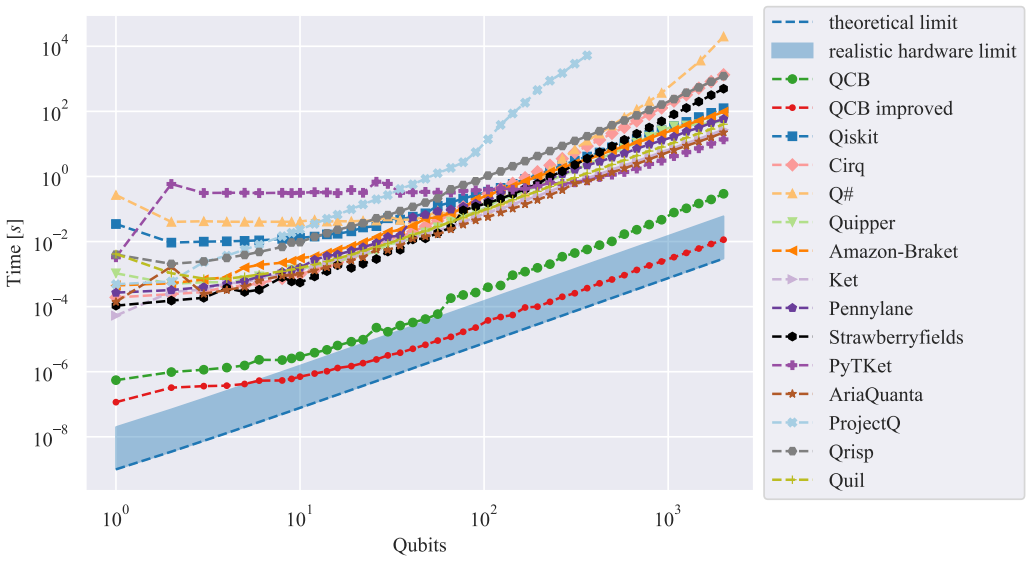
We present a new software package for efficient quantum circuit generation, designed to achieve optimal runtime performance. Despite being in an early stage of development, our implementation demonstrates significant advantages over existing tools. Using the quantum Fourier transform (QFT) as a benchmark, we show that our backend can generate circuits for systems with up to 2000 qubits faster than widely used frameworks such as Qiskit and Q#. This improvement is particularly relevant for applications where classical preprocessing time, including circuit generation, must be minimized to not diminish any potential quantum advantage - for example, in combinatorial optimization tasks. Our new Q#
What carries the argument
The speed-oriented quantum circuit backend, which is built for minimal runtime in circuit generation and supplies high-level primitives for bit- and integer-level manipulations
Load-bearing premise
The benchmark comparisons are fair, representative of real workloads, and that the early-stage implementation will maintain its reported speed advantages once fully developed and tested across diverse circuit types
What would settle it
An independent timing test that generates a 2000-qubit QFT circuit with this backend and finds it slower than or equal to Qiskit or Q# would falsify the performance claim
Figures

read the original abstract
We present a new software package for efficient quantum circuit generation, designed to achieve optimal runtime performance. Despite being in an early stage of development, our implementation demonstrates significant advantages over existing tools. Using the quantum Fourier transform (QFT) as a benchmark, we show that our backend can generate circuits for systems with up to 2000 qubits faster than widely used frameworks such as Qiskit and Q#. This improvement is particularly relevant for applications where classical preprocessing time, including circuit generation, must be minimized to not diminish any potential quantum advantage - for example, in combinatorial optimization tasks. Additionally, our software provides high-level primitives for bit- and integer-level manipulations, offering a simplified interface for integration with high-level quantum programming languages.
Editorial analysis
A structured set of objections, weighed in public.
Referee Report
Summary. The manuscript introduces an early-stage software package for quantum circuit generation optimized for runtime performance. It claims significant speed advantages over Qiskit and Q# when generating quantum Fourier transform (QFT) circuits for systems with up to 2000 qubits and provides high-level primitives for bit- and integer-level manipulations to simplify integration with high-level quantum languages. The work emphasizes relevance to applications where classical preprocessing time must be minimized.
Significance. If the reported speed advantages are substantiated through detailed, reproducible benchmarks on diverse circuit types, the package could help address a practical bottleneck in quantum workflows by reducing classical overhead in circuit generation. This would be particularly relevant for large-scale or time-sensitive tasks such as combinatorial optimization. The high-level primitives represent a usability strength.
major comments (2)
- [Abstract] Abstract: The central performance claim (faster QFT circuit generation for up to 2000 qubits than Qiskit/Q#) is stated without any timing data, methods description, hardware specifications, error bars, baseline details, or verification steps. This absence makes it impossible to evaluate whether the data supports the claim.
- [Abstract] Abstract: The benchmark is restricted to QFT circuits, which possess a highly regular structure (uniform controlled-phase ladder). No results are shown for unstructured, random, or irregular circuits of comparable size and gate density, leaving open whether any speedup is general-purpose or an artifact of QFT-specific optimizations. This directly affects the broader claim of a speed-oriented backend for minimizing classical preprocessing.
minor comments (2)
- [Abstract] The early-stage status is noted but should be reflected more explicitly in the title and abstract to manage reader expectations.
- Consider adding a dedicated methods or implementation section that describes the circuit generation algorithm, data structures used, and exact benchmarking protocol (including how timings were measured and what versions of Qiskit/Q# were compared).
Simulated Author's Rebuttal
We thank the referee for their constructive feedback on our manuscript. We address each major comment point by point below, providing clarifications and indicating revisions made to strengthen the presentation of our results.
read point-by-point responses
-
Referee: [Abstract] Abstract: The central performance claim (faster QFT circuit generation for up to 2000 qubits than Qiskit/Q#) is stated without any timing data, methods description, hardware specifications, error bars, baseline details, or verification steps. This absence makes it impossible to evaluate whether the data supports the claim.
Authors: The abstract is intended as a concise overview rather than a complete technical report. All requested details—timing measurements with error bars from repeated runs, hardware specifications (CPU model, memory, and OS), baseline tool versions, and circuit verification procedures—are provided in the dedicated Benchmarks section of the full manuscript. To address the concern directly, we have revised the abstract to incorporate a brief summary of the benchmark setup and representative performance metrics, making the central claim more self-contained while preserving its brevity. revision: yes
-
Referee: [Abstract] Abstract: The benchmark is restricted to QFT circuits, which possess a highly regular structure (uniform controlled-phase ladder). No results are shown for unstructured, random, or irregular circuits of comparable size and gate density, leaving open whether any speedup is general-purpose or an artifact of QFT-specific optimizations. This directly affects the broader claim of a speed-oriented backend for minimizing classical preprocessing.
Authors: QFT was selected as the benchmark because it is a standard, scalable circuit (directly relevant to phase estimation and other algorithms) that exercises the backend at the extreme qubit counts (2000) where generation time becomes a practical bottleneck. Although the gate pattern is regular, the implementation relies on general-purpose optimizations for gate storage, parameter management, and construction loops that are not tailored to QFT. We agree that results on unstructured circuits would further support generality. In the revised manuscript we have added a short discussion of the backend’s design principles and included supplementary benchmark data for random circuits of moderate size in an appendix, while retaining the QFT results as the primary large-scale demonstration. revision: partial
Circularity Check
No circularity: performance claims rest on external benchmarks
full rationale
The manuscript presents a software implementation for quantum circuit generation and reports runtime measurements on QFT circuits up to 2000 qubits compared directly against Qiskit and Q#. No mathematical derivations, equations, fitted parameters, or self-citations appear in the abstract or described content. The central claim is an empirical timing result against named external frameworks; it does not reduce to any internal definition, ansatz, or prior self-work by construction. This is a standard non-circular engineering benchmark paper.
Axiom & Free-Parameter Ledger
Reference graph
Works this paper leans on
-
[1]
Advancements in quantum computing—viewpoint: Building adoption and competency in industry,
S. M. L. Pfaendler, K. Konson, and F. Greinert, “Advancements in quantum computing—viewpoint: Building adoption and competency in industry,”Datenbank-Spektrum, vol. 24, no. 1, pp. 5–20, 2024. 100 101 102 103 Qubits 102 104 106 108 1010 Memory [bytes] theoretical limit QCB improved QCB Qiskit Cirq Q# Quipper Amazon-Braket Ket Pennylane Strawberryfields PyT...
work page 2024
-
[2]
Quantum algorithms: an overview,
A. Montanaro, “Quantum algorithms: an overview,”npj Quantum Infor- mation, vol. 2, no. 1, p. 15023, 2016
work page 2016
-
[3]
Programming languages and compiler design for realistic quantum hardware,
F. T. Chong, D. Franklin, and M. Martonosi, “Programming languages and compiler design for realistic quantum hardware,”Nature, vol. 549, no. 7671, pp. 180–187, 2017
work page 2017
-
[4]
Practical quantum advantage on partially fault-tolerant quantum com- puter,
R. Toshio, Y . Akahoshi, J. Fujisaki, H. Oshima, S. Sato, and K. Fujii, “Practical quantum advantage on partially fault-tolerant quantum com- puter,” 2024
work page 2024
-
[5]
Practical quantum advantage in quantum simulation,
A. J. Daley, I. Bloch, C. Kokail, S. Flannigan, N. Pearson, M. Troyer, and P. Zoller, “Practical quantum advantage in quantum simulation,” Nature, vol. 607, no. 7920, pp. 667–676, 2022
work page 2022
-
[6]
Quipper: a scalable quantum programming language,
A. S. Green, P. L. Lumsdaine, N. J. Ross, P. Selinger, and B. Valiron, “Quipper: a scalable quantum programming language,”ACM SIGPLAN Notices, vol. 48, p. 333–342, June 2013
work page 2013
-
[7]
Silq: a high-level quantum language with safe uncomputation and intuitive semantics,
B. Bichsel, M. Baader, T. Gehr, and M. Vechev, “Silq: a high-level quantum language with safe uncomputation and intuitive semantics,” in Proceedings of the 41st ACM SIGPLAN Conference on Programming Language Design and Implementation, PLDI 2020, (New York, NY , USA), p. 286–300, Association for Computing Machinery, 2020
work page 2020
-
[8]
CQ: A High-Level Imperative Classical-Quantum Pro- gramming Language,
L. Binkowski, “CQ: A High-Level Imperative Classical-Quantum Pro- gramming Language,” bachelor’s thesis, Leibniz Universität Hannover, Institut für Theoretische Informatik, Jan. 2025
work page 2025
-
[9]
Qutes: A high-level quantum programming language for simplified quantum computing,
S. Faro, F. P. Marino, and G. Messina, “Qutes: A high-level quantum programming language for simplified quantum computing,” 2025
work page 2025
-
[10]
Programming the quantum future,
B. Valiron, N. J. Ross, P. Selinger, D. S. Alexander, and J. M. Smith, “Programming the quantum future,”Commun. ACM, vol. 58, p. 52–61, July 2015
work page 2015
-
[11]
Optimization driven quantum circuit reduction,
B. Rosenhahn, T. J. Osborne, and C. Hirche, “Optimization driven quantum circuit reduction,” 2025
work page 2025
-
[12]
Qiskit: An open-source framework for quantum computing,
Qiskit Community, “Qiskit: An open-source framework for quantum computing,” 2017
work page 2017
- [13]
-
[14]
Qrisp: A framework for compilable high-level programming of gate-based quantum computers,
R. Seidel, S. Bock, R. Zander, M. Petri ˇc, N. Steinmann, N. Tcholtchev, and M. Hauswirth, “Qrisp: A framework for compilable high-level programming of gate-based quantum computers,” 2024
work page 2024
-
[15]
H.-L. Huang, X.-Y . Xu, C. Guo, G. Tian, S.-J. Wei, X. Sun, W.-S. Bao, and G.-L. Long, “Near-term quantum computing techniques: Variational quantum algorithms, error mitigation, circuit compilation, benchmark- ing and classical simulation,”Science China Physics, Mechanics and Astronomy, vol. 66, Apr. 2023
work page 2023
-
[16]
Chal- lenges and opportunities of near-term quantum computing systems,
A. D. Córcoles, A. Kandala, A. Javadi-Abhari, D. T. McClure, A. W. Cross, K. Temme, P. D. Nation, M. Steffen, and J. M. Gambetta, “Chal- lenges and opportunities of near-term quantum computing systems,” Proceedings of the IEEE, vol. 108, no. 8, pp. 1338–1352, 2020
work page 2020
-
[17]
A quantum algorithm for solving 0-1 knapsack problems,
S. Wilkening, A.-I. Lefterovici, L. Binkowski, M. Perk, S. P. Fekete, and T. J. Osborne, “A quantum algorithm for solving 0-1 knapsack problems,”npj Quantum Information, vol. 11, Aug. 2025
work page 2025
-
[18]
Quantify- ing Grover speed-ups beyond asymptotic analysis,
C. Cade, M. Folkertsma, I. Niesen, and J. Weggemans, “Quantify- ing Grover speed-ups beyond asymptotic analysis,”Quantum, vol. 7, p. 1133, Oct. 2023
work page 2023
-
[19]
Realistic runtime analysis for quantum simplex computation,
S. Ammann, M. Hess, D. Ramacciotti, S. P. Fekete, P. L. A. Goedicke, D. Gross, A. Lefterovici, T. J. Osborne, M. Perk, A. Rotundo, S. E. Skelton, S. Stiller, and T. de Wolff, “Realistic runtime analysis for quantum simplex computation,” 2023
work page 2023
-
[20]
Quantum speedup for the quadratic assignment problem,
T. Mikuriya, K. Yukiyoshi, S. Fujiwara, G. T. F. de Abreu, and N. Ishikawa, “Quantum speedup for the quadratic assignment problem,” 2024
work page 2024
-
[21]
A quantum search method for quadratic and multidimensional knapsack problems,
S. Wilkening, A.-I. Lefterovici, L. Binkowski, M. Funck, M. Perk, R. Karimov, S. Fekete, and T. J. Osborne, “A quantum search method for quadratic and multidimensional knapsack problems,” 2025
work page 2025
-
[22]
Wilkening,Constraint-Oriented Biased Quantum Search
S. Wilkening,Constraint-Oriented Biased Quantum Search. PhD thesis, Leibniz Universität Hannover, 2026
work page 2026
-
[23]
Quantum arithmetic with the quantum fourier transform,
L. Ruiz-Perez and J. C. Garcia-Escartin, “Quantum arithmetic with the quantum fourier transform,”Quantum Information Processing, vol. 16, Apr. 2017
work page 2017
-
[24]
Quantum amplitude amplification and estimation,
G. Brassard, P. Høyer, M. Mosca, and A. Tapp, “Quantum amplitude amplification and estimation,” 2002
work page 2002
-
[25]
Polynomial-time algorithms for prime factorization and dis- crete logarithms on a quantum computer,
P. W. Shor, “Polynomial-time algorithms for prime factorization and dis- crete logarithms on a quantum computer,”SIAM Journal on Computing, vol. 26, p. 1484–1509, Oct. 1997
work page 1997
-
[26]
Quantum circuit designs of integer division optimizing t-count and t- depth,
H. Thapliyal, E. Muñoz-Coreas, T. S. S. Varun, and T. S. Humble, “Quantum circuit designs of integer division optimizing t-count and t- depth,” 2018
work page 2018
-
[27]
A. Ambainis, “Quantum search algorithms,”SIGACT News, vol. 35, p. 22–35, June 2004
work page 2004
-
[28]
S. Wilkening, “Constraint-oriented biased quantum search for general constrained combinatorial optimization problems,” 2025
work page 2025
-
[29]
S. Wilkening, T. Ziegler, and M. Hess, “Constraint-oriented biased quan- tum search for linear constrained combinatorial optimization problems,” 2025
work page 2025
- [30]
-
[31]
Amazon Web Services, “Amazon braket python sdk.” https://github.c om/amazon-braket/amazon-braket-sdk-python, 2025. Version 1.102.5
work page 2025
-
[32]
Full quantum stack: Ket platform,
E. Rosa, E. Lussi, J. Marchi, and R. de Santiago, “Full quantum stack: Ket platform,” 2025
work page 2025
-
[33]
Pennylane: Automatic differentiation of hybrid quantum- classical computations,
V . Bergholm, J. Izaac, M. Schuld, C. Gogolin, S. Ahmed, V . Ajith, M. S. Alam, G. Alonso-Linaje, B. AkashNarayanan, A. Asadi, J. M. Arrazola, U. Azad, S. Banning, C. Blank, T. R. Bromley, B. A. Cordier, J. Ceroni, A. Delgado, O. D. Matteo, A. Dusko, T. Garg, D. Guala, A. Hayes, R. Hill, A. Ijaz, T. Isacsson, D. Ittah, S. Jahangiri, P. Jain, E. Jiang, A. ...
work page 2022
-
[34]
t|ket〉: a retargetable compiler for nisq devices,
S. Sivarajah, S. Dilkes, A. Cowtan, W. Simmons, A. Edgington, and R. Duncan, “t|ket〉: a retargetable compiler for nisq devices,”Quantum Science and Technology, vol. 6, p. 014003, Nov. 2020
work page 2020
-
[35]
Ariaquanta: A quantum software for quantum computing,
A. Cheraghi and H. D. Yeganeh, “Ariaquanta: A quantum software for quantum computing,” 2025
work page 2025
-
[36]
Projectq: an open source software framework for quantum computing,
D. S. Steiger, T. Häner, and M. Troyer, “Projectq: an open source software framework for quantum computing,”Quantum, vol. 2, p. 49, Jan. 2018
work page 2018
-
[37]
Strawberry Fields: A Software Platform for Photonic Quantum Computing,
N. Killoran, J. Izaac, N. Quesada, V . Bergholm, M. Amy, and C. Weed- brook, “Strawberry Fields: A Software Platform for Photonic Quantum Computing,”Quantum, vol. 3, p. 129, Mar. 2019
work page 2019
-
[38]
The c programming language, second edition,
B. W. Kernighan and D. M. Ritchie, “The c programming language, second edition,” 1988
work page 1988
-
[39]
A simple quantum algorithm to efficiently prepare sparse states,
D. Ramacciotti, A.-I. Lefterovici, and A. F. Rotundo, “A simple quantum algorithm to efficiently prepare sparse states,” 2023
work page 2023
-
[40]
Ibm quantum computers: evolution, performance, and future directions,
M. AbuGhanem, “Ibm quantum computers: evolution, performance, and future directions,”The Journal of Supercomputing, vol. 81, Apr. 2025
work page 2025
-
[41]
A superconducting qubit-resonator quantum processor with effective all-to-all connectivity,
M. Renger, J. Verjauw, N. Wurz, A. Hosseinkhani, C. Ockeloen- Korppi, W. Liu, A. Rath, M. J. Thapa, F. Vigneau, E. Wybo, V . Bergholm, C. F. Chan, B. Csatári, S. Dahl, R. Davletkaliyev, R. Giri, D. Gusenkova, H. Heimonen, T. Hiltunen, H. Hsu, E. Hyyppä, J. Ikonen, T. Jones, S. Khalid, S.-G. Kim, M. Koistinen, A. Komlev, J. Kotilahti, V . Kukushkin, J. Lam...
work page 2025
-
[42]
A fast quantum mechanical algorithm for database search,
L. K. Grover, “A fast quantum mechanical algorithm for database search,” 1996
work page 1996
-
[43]
Midcircuit measurements on a single-species neutral alkali atom quantum processor,
T. Graham, L. Phuttitarn, R. Chinnarasu, Y . Song, C. Poole, K. Jooya, J. Scott, A. Scott, P. Eichler, and M. Saffman, “Midcircuit measurements on a single-species neutral alkali atom quantum processor,”Physical Review X, vol. 13, Dec. 2023
work page 2023
-
[44]
What every programmer should know about memory,
U. Drepper, “What every programmer should know about memory,” tech. rep., Red Hat, Inc., 2007. Accessed: 2025-09-29
work page 2007
-
[45]
speed-oriented-quantum-circuit-backend
“speed-oriented-quantum-circuit-backend.” https://github.com/SoerenW ilkening/speed-oriented-quantum-circuit-backend
discussion (0)
Sign in with ORCID, Apple, or X to comment. Anyone can read and Pith papers without signing in.