Recognition: unknown
High-performance cellular automaton decoders for quantum repetition and toric code
Pith reviewed 2026-05-09 22:02 UTC · model grok-4.3
The pith
SCALA cellular automaton decoder reaches a 7.5 percent threshold for toric code with size-independent local resources.
A machine-rendered reading of the paper's core claim, the machinery that carries it, and where it could break.
Core claim
SCALA uses signaling combined with local attraction in a cellular automaton to decode errors on repetition and toric codes. Numerical evaluation under code-capacity depolarizing noise yields a threshold of approximately 7.5 percent on the toric code together with sub-threshold scaling p_L proportional to p to the d over 4. The non-hierarchical structure keeps every local update independent of total system size while preserving performance under qubit measurement errors and internal decoder noise.
What carries the argument
Signaling combined with local attraction in a non-hierarchical cellular automaton update rule that propagates and corrects errors through strictly local interactions across the lattice.
If this is right
- SCALA supports modular hardware layouts because local resources remain constant with code size.
- The observed sub-threshold scaling allows logical error rates to decrease faster with increasing distance than linear scaling would give.
- Robustness to measurement and decoder noise enables operation on imperfect real-time quantum processors.
- The same local rules apply to both repetition and toric codes, suggesting a uniform decoding approach for these stabilizer families.
Where Pith is reading between the lines
- The local attraction mechanism could be generalized to other topological codes if the signaling rules extend without global coordination.
- Embedding the decoder cells directly onto a quantum processor array would test whether the constant-resource property survives full circuit-level noise.
- Parallel execution of the cellular automaton across the lattice might reduce decoding latency below that of sequential local methods.
Load-bearing premise
The assumption that the specific local update rules of signaling and attraction can be realized in noisy hardware with negligible extra error while still delivering the performance seen in idealized code-capacity simulations.
What would settle it
A physical implementation of the SCALA update rules on quantum hardware under code-capacity noise that produces logical error rates failing to fall below the simulated 7.5 percent threshold or failing to improve with distance as p to the d over 4.
Figures




read the original abstract
Execution of quantum algorithms on large-scale quantum computers will require extremely low logical error rates, which necessitates the development of scalable decoding architectures. Local decoders are promising candidates for this task, as they avoid the communication and data processing bottlenecks inherent in global decoding strategies. Cellular automaton (CA) decoders represent a distinct class of local decoders, offering a path toward the low-latency, real-time decoding required for practical applications. In this work, we present SCALA (Signaling CA with Local Attraction), a novel non-hierarchical cellular automaton decoder for quantum repetition and toric codes. By evaluating SCALA alongside the hierarchical CA decoder proposed by Harrington, we provide a direct comparison between non-hierarchical and renormalization-group-style local decoding strategies. We characterize SCALA across three key metrics: Performance, scalability, and robustness. Our results show that SCALA achieves a code-capacity threshold of approximately $p_c\approx 7.5\%$ and provides strong sub-threshold scaling of about $p_L\propto p^{d/4}$ on the toric code. In terms of scalability, our non-hierarchical design ensures that the local computational resources remain independent of system size, yielding a modular local architecture suitable for hardware implementation. Finally, SCALA demonstrates strong robustness to qubit measurement errors and noise within the decoder itself, a critical advantage for real-time decoding on noisy hardware. Our results establish SCALA as a high-performance, scalable, and robust local decoder for scalable quantum error correction.
Editorial analysis
A structured set of objections, weighed in public.
Referee Report
Summary. The manuscript introduces SCALA (Signaling CA with Local Attraction), a novel non-hierarchical cellular automaton decoder for quantum repetition and toric codes. It compares SCALA to Harrington's hierarchical CA decoder and reports a code-capacity threshold of approximately 7.5% together with sub-threshold scaling p_L ∝ p^{d/4} on the toric code. The work emphasizes that local computational resources remain independent of system size and that the decoder is robust to qubit measurement errors and internal decoder noise.
Significance. If the numerical performance claims are substantiated, SCALA would offer a practical local decoder architecture with low latency and hardware-friendly modularity, addressing key bottlenecks in scalable quantum error correction. The robustness to measurement and decoder noise is a notable practical strength. However, the reported scaling exponent of d/4 is substantially weaker than the p^{(d+1)/2} behavior expected from a decoder that fully exploits the toric-code distance, which could limit utility at large d unless the scaling improves or is shown to be sufficient for target logical error rates.
major comments (2)
- Abstract: The claim of 'strong sub-threshold scaling of about p_L ∝ p^{d/4}' is load-bearing for the performance assessment, yet this exponent is only half the value expected for any decoder that corrects up to weight d/2 on a distance-d toric code. The manuscript must specify the range of d simulated, the fitting procedure, and whether the exponent improves at larger d; without this the scaling claim cannot be evaluated against the skeptic's concern that the non-hierarchical rules limit correction propagation.
- Abstract: The threshold p_c ≈ 7.5% and all performance figures are obtained from direct numerical simulation, but the abstract (and therefore the central claims) supplies no information on the number of Monte Carlo samples, error bars, or the precise method used to extract the threshold. These details are required to determine whether the reported performance is statistically reliable or affected by insufficient sampling or post-hoc tuning.
minor comments (1)
- Abstract: The comparison to the Harrington decoder is mentioned but not contextualized; a single sentence recalling the key limitation of hierarchical CA decoders would improve accessibility for readers outside the immediate subfield.
Simulated Author's Rebuttal
We thank the referee for their careful reading of the manuscript and for highlighting points that strengthen the presentation of our results. We have revised the manuscript to incorporate the requested details on scaling analysis and simulation statistics. Our point-by-point responses follow.
read point-by-point responses
-
Referee: Abstract: The claim of 'strong sub-threshold scaling of about p_L ∝ p^{d/4}' is load-bearing for the performance assessment, yet this exponent is only half the value expected for any decoder that corrects up to weight d/2 on a distance-d toric code. The manuscript must specify the range of d simulated, the fitting procedure, and whether the exponent improves at larger d; without this the scaling claim cannot be evaluated against the skeptic's concern that the non-hierarchical rules limit correction propagation.
Authors: We agree that additional details are needed to substantiate the scaling claim. In the revised manuscript we have added a new paragraph in Section IV.B specifying that the p_L ∝ p^{d/4} relation was extracted from simulations performed for distances d = 4, 6, …, 20. For each fixed d we performed a linear fit to log(p_L) versus log(p) in the sub-threshold regime and observed that the resulting exponent scales linearly with d/4. The exponent remains stable near 0.25 across the simulated range and shows no significant improvement at the largest d. This behavior is consistent with the strictly local, non-hierarchical update rules of SCALA, which trade maximal distance exploitation for hardware-friendly locality and noise robustness. We have updated the abstract to replace the word “strong” with “favorable” and now explicitly reference the simulated distance range. We believe the combination of a 7.5 % threshold, d-independent local resources, and robustness to measurement/decoder noise still makes SCALA practically relevant even with the observed scaling. revision: partial
-
Referee: Abstract: The threshold p_c ≈ 7.5% and all performance figures are obtained from direct numerical simulation, but the abstract (and therefore the central claims) supplies no information on the number of Monte Carlo samples, error bars, or the precise method used to extract the threshold. These details are required to determine whether the reported performance is statistically reliable or affected by insufficient sampling or post-hoc tuning.
Authors: We acknowledge that the statistical methodology must be reported for the claims to be fully evaluable. The revised manuscript now contains a dedicated subsection in the Methods section that states: (i) between 10^6 and 10^8 Monte Carlo trials were performed per (p, d) point, with the number of trials increased at lower p to ensure at least 100 logical-error events; (ii) error bars are the standard error of the binomial proportion; and (iii) the threshold p_c ≈ 7.5 % was obtained by locating the crossing point of the logical-error-rate curves for successive distances, with uncertainty given by the width of the interval in which the curves overlap within one standard error. These additions confirm that the reported threshold and scaling are based on adequate sampling and are not the result of insufficient statistics or post-hoc selection. revision: yes
Circularity Check
No circularity; performance claims rest on direct numerical simulation, not on derivations that reduce to inputs by construction.
full rationale
The paper introduces the SCALA decoder via explicit local update rules (signaling combined with attraction) and reports its threshold and scaling exclusively from Monte Carlo simulations on finite lattices. No equations are presented that derive the 7.5 % threshold or the p^{d/4} exponent from first principles; both quantities are measured outputs of the simulation loop. Because the reported figures are obtained by running the decoder on independent noise realizations rather than by fitting a parameter and relabeling it as a prediction, none of the enumerated circularity patterns apply. The design choices are stated explicitly and can be reproduced or falsified externally without reference to the paper's own fitted values.
Axiom & Free-Parameter Ledger
free parameters (1)
- signaling and attraction strengths
axioms (2)
- domain assumption Independent depolarizing noise on physical qubits (code-capacity model)
- domain assumption Local cellular-automaton dynamics suffice for near-optimal decoding
invented entities (1)
-
SCALA (Signaling CA with Local Attraction)
no independent evidence
Reference graph
Works this paper leans on
-
[1]
carried over
for repetition-code error correction. 17 t 1 2 0 d-2 x1 2 3 d qubitqubit left signal right signal defect 4 Corrections Nearest-Neighbor Signal-Follow L Signal-Follow R 1 Acquire defect 2 Broadcast t t+1 3 Signaling FIG. 15. Sketch of the SCALA1D decoder on a distanced= 15 repetition code with periodic boundary conditions. On the left we show a space-time ...
-
[2]
At the end of this process, we check if a logical error occurred, i.e., if there are more than (d+ 1)/2 errors on the code
Code-capacity noise In the code-capacity setting the CA decoder is succes- sively applied to an initial error configuration until all defects are resolved. At the end of this process, we check if a logical error occurred, i.e., if there are more than (d+ 1)/2 errors on the code. We observe that error con- figurations ofw 0 errors produce 4w 0 signals via ...
-
[3]
In this setting, bit-flip 10 1 100 p 10 6 10 5 10 4 10 3 10 2 10 1 100 pL d 3 9 27 81 FIG
Phenomenological noise Next, we analyze the QEC performance ofSCALA1D under phenomenological noise. In this setting, bit-flip 10 1 100 p 10 6 10 5 10 4 10 3 10 2 10 1 100 pL d 3 9 27 81 FIG. 17. Logical error ratep L as function of data qubit error ratepunder code capacity noise. Performance forSCALA1Don repetition codes corresponds to the solid lines. Bl...
-
[4]
Additional to data-qubit noise with ratep, we sub- ject all signal bits at the end of each CA step to bit-flip errors with ratep sig
Signal noise Similar to our study of Harrington’s decoder, we an- alyze how the decoder performance is affected by signal noise. Additional to data-qubit noise with ratep, we sub- ject all signal bits at the end of each CA step to bit-flip errors with ratep sig. In Fig. 19, we show numerical life- times forp=q=p sig and optimal reset timet R(d, p), determ...
-
[5]
uncomputed
Other work Recently, a similar CA decoder design for the quantum repetition code [67] has been proposed that also corrects bit-flip errors dynamically via a signal-based automaton, similar to ours. OurSCALA1Ddesign differs in three major ways. First, the cell state space of our decoder is much smaller and the local rule less complex.SCALA1D requires only ...
-
[6]
After this time, a logical error has occurred if a) there exists a logicalX-operator on any of the two encoded logical qubits or b) there remain residual errors on the code
Code-capacity noise Under code-capacity bit-flip noise, the decoder is ap- plied on the error syndrome of an initial error configu- ration ford 2 time steps. After this time, a logical error has occurred if a) there exists a logicalX-operator on any of the two encoded logical qubits or b) there remain residual errors on the code. The decoder runtime ofd 2...
-
[7]
We thus check after every time step if a logical error has occurred by decoding the residual error configuration afterSCALA2Dcorrection with PyMatch- ing’s [73] MWPM decoder
Phenomenological noise In the phenomenological setting, errors can occur with every CA step. We thus check after every time step if a logical error has occurred by decoding the residual error configuration afterSCALA2Dcorrection with PyMatch- ing’s [73] MWPM decoder. If no logical error is detected, we continue to the next round ofSCALA2Dcorrections on th...
-
[8]
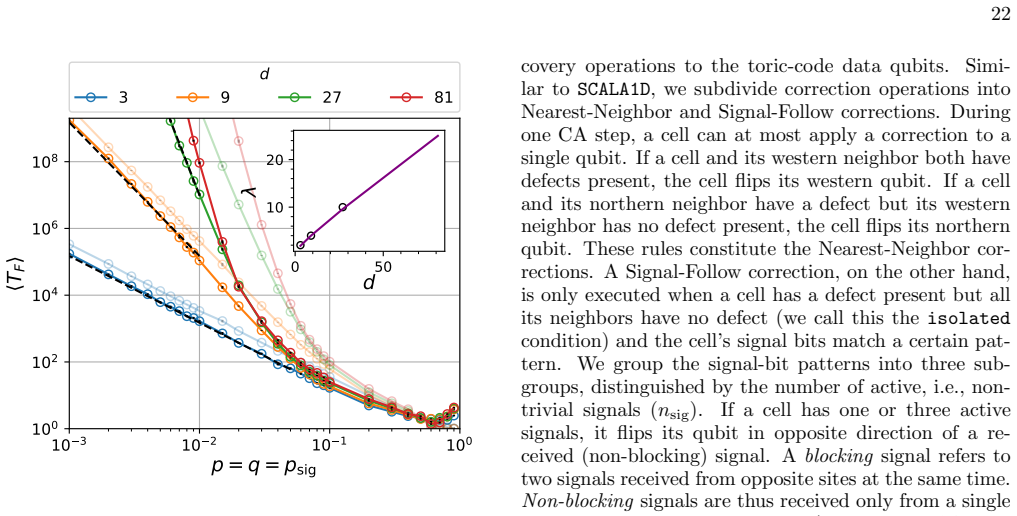
Signal noise Additionally to data-qubit bit-flip noise with ratepand bit-flip noise on measurements with rateq, we expose the signal bits of each CA cell to bit-flip noise with ratep sig with each CA step. In Fig. 23, we setp=q=p sig and obtain average logical lifetimes⟨T F ⟩for different code distancesd. For eachdandp, we select the reset time tR which y...
-
[9]
The first one is Harring- ton’s toric-code decoder, discussed in Sec
Other work We can compareSCALA2Dto other similar decoders proposed in the literature. The first one is Harring- ton’s toric-code decoder, discussed in Sec. II. We have shown numerically that both QEC threshold and sub- threshold scaling ofSCALA2Din the code-capacity model (Fig. 21) are superior to Harrington’s decoder (Fig. 4). In the phenomenological set...
-
[10]
This structure restricts the logical error ratep L =p λ(d) to scale withλ(d)≈d 0.631, i.e., sub-linear in code distance 27 d
Hierarchical designs impose a recursive structure on the decoding process similar to renormalization- group and concatenated decoders. This structure restricts the logical error ratep L =p λ(d) to scale withλ(d)≈d 0.631, i.e., sub-linear in code distance 27 d. Non-hierarchical designs are not bound by their structure and thereby able to achieve a superior...
-
[11]
For Harrington’s model, only code distancesd= 3 k fork∈N + are allowed.SCALA, on the other hand, is applicable to any code distance
The hierarchy imposes constraints on the allowed code distances. For Harrington’s model, only code distancesd= 3 k fork∈N + are allowed.SCALA, on the other hand, is applicable to any code distance
-
[12]
In contrast, ourSCALAdesigns of- fer superior scalability in this regard because the memory requirement per CA cell remains constant and independent of the code distance
Harrington’s decoder requires the memory per CA cell to scale with the code distance, which increases the complexity and resource requirements for larger quantum codes. In contrast, ourSCALAdesigns of- fer superior scalability in this regard because the memory requirement per CA cell remains constant and independent of the code distance. This makes SCALAa...
-
[13]
This property is beneficial for real-time decoding, since despite noisy measurementsSCALAremains accurate
While data and measurement noise is equally de- structive to Harrington’s decoder,SCALAis more robust against measurement errors. This property is beneficial for real-time decoding, since despite noisy measurementsSCALAremains accurate
-
[14]
MILLENION-SGA1
Harrington’s automaton is highly volatile to sig- nal noise. Therefore, implementation is limited to fault-free classical hardware. Our designs, on the other hand, show high robustness in signal noise, opening up implementations in environments where the CA operations themselves can suffer noise. In conclusion, the presentedSCALAdecoders not only consiste...
2004
-
[15]
J. W. Harrington,Analysis of Quantum Error-Correcting Codes: Symplectic Lattice Codes and Toric Codes, Ph.D. thesis, California Institute of Technology (2004)
2004
-
[16]
M. A. Nielsen and I. L. Chuang,Quantum Computation and Quantum Information: 10th Anniversary Edition (Cambridge University Press, 2010)
2010
-
[17]
B. M. Terhal, Reviews of Modern Physics87, 307 (2015)
2015
-
[18]
Roffe, Contemporary Physics60, 226 (2019), arXiv:1907.11157 [quant-ph]
J. Roffe, Contemporary Physics60, 226 (2019), arXiv:1907.11157 [quant-ph]
-
[19]
E. T. Campbell, B. M. Terhal, and C. Vuillot, Nature 549, 172 (2017)
2017
-
[20]
T. L. de Macedo Guedes, Brazilian Journal of Physics 56, 94 (2026)
2026
-
[21]
Shor, inProceedings 35th Annual Symposium on Foun- dations of Computer Science(1994) pp
P. Shor, inProceedings 35th Annual Symposium on Foun- dations of Computer Science(1994) pp. 124–134
1994
-
[22]
L. K. Grover, inProceedings of the Twenty-Eighth Annual ACM Symposium on Theory of Computing, STOC ’96 (Association for Computing Machinery, New York, NY, USA, 1996) pp. 212–219
1996
-
[23]
I. D. Kivlichan, C. Gidney, D. W. Berry,et al., Quantum 4, 296 (2020)
2020
-
[24]
E. T. Campbell, Quantum Science and Technology7, 015007 (2021)
2021
-
[25]
Acharya, D
R. Acharya, D. A. Abanin, L. L. Aghababaie-Beni,et al., Nature638, 920 (2025)
2025
-
[26]
DeCross, R
M. DeCross, R. Haghshenas, M. Liu,et al., Physical Re- view X15, 021052 (2025)
2025
- [27]
-
[28]
Dennis, A
E. Dennis, A. Kitaev, A. Landahl, and J. Preskill, Jour- nal of Mathematical Physics43, 4452 (2002)
2002
-
[29]
Edmonds, Canadian Journal of Mathematics17, 449 (1965)
J. Edmonds, Canadian Journal of Mathematics17, 449 (1965)
1965
-
[30]
A. G. Fowler, A. C. Whiteside, and L. C. L. Hollenberg, Physical Review Letters108, 180501 (2012)
2012
-
[31]
Choucair, The Quantum Insider (2024)
C. Choucair, The Quantum Insider (2024)
2024
-
[32]
Skoric, D
L. Skoric, D. E. Browne, K. M. Barnes, N. I. Gillespie, and E. T. Campbell, Nature Communications14, 7040 (2023)
2023
-
[33]
Battistel, C
F. Battistel, C. Chamberland, K. Johar, R. W. J. Over- water, F. Sebastiano, L. Skoric, Y. Ueno, and M. Usman, Nano Futures7, 032003 (2023)
2023
-
[34]
A. B. Ziad, A. Zalawadiya, C. Topal, J. Camps, G. P. Geh´ er, M. P. Stafford, and M. L. Turner, Nature Com- munications16, 11048 (2025)
2025
- [35]
-
[36]
C. Lee, T. Hur, and D. K. Park, arXiv.org (2025)
2025
-
[37]
Caune, L
L. Caune, L. Skoric, N. S. Blunt,et al., arXiv.org (2024)
2024
-
[38]
Piveteau, C
C. Piveteau, C. T. Chubb, and J. M. Renes, PRX Quan- tum5, 040303 (2024)
2024
-
[39]
Torlai and R
G. Torlai and R. G. Melko, Physical Review Letters119, 030501 (2017)
2017
-
[40]
B. M. Varbanov, M. Serra-Peralta, D. Byfield, and B. M. Terhal, Physical Review Research7, 013029 (2025)
2025
-
[41]
Holmes, M
A. Holmes, M. R. Jokar, G. Pasandi,et al., inProceedings of the ACM/IEEE 47th Annual International Symposium on Computer Architecture, ISCA ’20 (IEEE Press, Vir- tual Event, 2020) pp. 556–569
2020
-
[42]
G. S. Ravi, J. M. Baker, A. Fayyazi, S. F. Lin, A. Javadi- Abhari, M. Pedram, and F. T. Chong, inProceedings of the 28th ACM International Conference on Architectural Support for Programming Languages and Operating Sys- tems, Volume 2, ASPLOS 2023 (Association for Comput- ing Machinery, New York, NY, USA, 2023) pp. 88–102
2023
-
[43]
Y. Ueno, M. Kondo, M. Tanaka,et al., inProceedings of the 58th Annual ACM/IEEE Design Automation Con- ference, DAC ’21 (IEEE Press, San Francisco, California, United States, 2022) pp. 451–456
2022
-
[44]
Wolfram, Nature311, 419 (1984)
S. Wolfram, Nature311, 419 (1984)
1984
-
[45]
Wolfram, Communications in Mathematical Physics 96, 15 (1984)
S. Wolfram, Communications in Mathematical Physics 96, 15 (1984)
1984
-
[46]
Wolfram, Reviews of Modern Physics55, 601 (1983)
S. Wolfram, Reviews of Modern Physics55, 601 (1983)
1983
-
[47]
N. P. Breuckmann, K. Duivenvoorden, D. Michels, and B. M. Terhal, Quantum Information and Computation 17, 181 (2017)
2017
-
[48]
S. Balasubramanian, M. Davydova, and E. Lake, A local automaton for the 2D toric code (2024), arXiv:2412.19803 [quant-ph]
-
[49]
Vasmer, D
M. Vasmer, D. E. Browne, and A. Kubica, Scientific Re- ports11, 2027 (2021)
2027
-
[50]
Lake, Fast offline decoding with local message-passing automata, arXiv:2506.03266 (2025)
E. Lake, Fast offline decoding with local message-passing automata (2025), arXiv:2506.03266 [quant-ph]
-
[51]
Herold, M
M. Herold, M. J. Kastoryano, E. T. Campbell, and J. Eis- ert, New Journal of Physics19, 063012 (2017)
2017
-
[52]
Herold, E
M. Herold, E. T. Campbell, J. Eisert, and M. J. Kasto- ryano, npj Quantum Information1, 1 (2015)
2015
-
[53]
Riverlane, Introducing QECi - the Quantum Error Cor- rection interface (2025)
2025
-
[54]
Y. Zhao, Y. Ye, H.-L. Huang,et al., Physical Review Letters129, 030501 (2022)
2022
-
[55]
Demonstration of logical qubits and repeated error correction with better-than-physical error rates
A. Paetznick, M. P. da Silva, C. Ryan-Anderson,et al., Demonstration of logical qubits and repeated error cor- rection with better-than-physical error rates (2024), arXiv:2404.02280 [quant-ph]
work page internal anchor Pith review arXiv 2024
-
[56]
Duclos-Cianci and D
G. Duclos-Cianci and D. Poulin, 2010 IEEE Information Theory Workshop , 1 (2010)
2010
-
[57]
Rozendaal and G
W. Rozendaal and G. Z´ emor, IEEE Trans. Inf. Theor. 70, 7036 (2024)
2024
-
[58]
Farrelly, Quantum4, 368 (2020)
T. Farrelly, Quantum4, 368 (2020)
2020
-
[59]
Arrighi, Natural Computing18, 10.1007/s11047-019- 09762-6 (2019)
P. Arrighi, Natural Computing18, 10.1007/s11047-019- 09762-6 (2019)
-
[60]
Guedes, D
T. Guedes, D. Winter, and M. M¨ uller, Physical Review Letters133, 150601 (2024)
2024
-
[61]
T. M. Wintermantel, Y. Wang, G. Lochead,et al., Phys- ical Review Letters124, 070503 (2020)
2020
-
[62]
Watrous, inProceedings of IEEE 36th Annual Foun- dations of Computer Science(1995) pp
J. Watrous, inProceedings of IEEE 36th Annual Foun- dations of Computer Science(1995) pp. 528–537
1995
-
[63]
Alavisamani, S
N. Alavisamani, S. Vittal, R. Ayanzadeh, P. Das, and M. Qureshi, inProceedings of the 29th ACM Interna- tional Conference on Architectural Support for Program- ming Languages and Operating Systems, Volume 3, AS- PLOS ’24, Vol. 3 (Association for Computing Machinery, 29 New York, NY, USA, 2024) pp. 818–833
2024
-
[64]
Raussendorf, J
R. Raussendorf, J. Harrington, and K. Goyal, New Jour- nal of Physics9, 199 (2007)
2007
-
[65]
Krinner, N
S. Krinner, N. Lacroix, A. Remm,et al., Nature605, 669 (2022)
2022
-
[66]
Bluvstein, A
D. Bluvstein, A. A. Geim, S. H. Li,et al., Nature649, 39 (2026)
2026
-
[67]
Ebadi, T
S. Ebadi, T. T. Wang, H. Levine,et al., Nature595, 227 (2021)
2021
-
[68]
T. M. Graham, Y. Song, J. Scott,et al., Nature604, 457 (2022)
2022
-
[69]
S. J. Evered, D. Bluvstein, M. Kalinowski,et al., Nature 622, 268 (2023)
2023
-
[70]
Bluvstein, S
D. Bluvstein, S. J. Evered, A. A. Geim,et al., Nature 626, 58 (2024)
2024
-
[71]
A. Yu. Kitaev, Annals of Physics303, 2 (2003)
2003
-
[72]
A. R. Calderbank and P. W. Shor, Physical Review A 54, 1098 (1996)
1996
-
[73]
Steane, Proceedings of the Royal Society of London
A. Steane, Proceedings of the Royal Society of London. Series A: Mathematical, Physical and Engineering Sci- ences452, 2551 (1997)
1997
-
[74]
A. M. Steane, Physical Review Letters77, 793 (1996)
1996
-
[75]
D. S. Wang, A. G. Fowler, A. M. Stephens, and L. C. L. Hollenberg, Quantum Info. Comput.10, 456 (2010)
2010
-
[76]
P. Gacs, G. Kurdyumov, and L. Levin, Rossiiskaya Akademiya Nauk. Problemy Peredachi Informatsii14 (1978)
1978
-
[77]
L. F. Gray, Journal of Statistical Physics103, 1 (2001)
2001
-
[78]
P. G´ acs, Proceedings of the Fifteenth Annual ACM Symposium on Theory of Computing - STOC ’83 10.1145/800061.808730 (1983)
-
[79]
G´ acs, Journal of Statistical Physics103, 45 (2001)
P. G´ acs, Journal of Statistical Physics103, 45 (2001)
2001
-
[80]
Barber, K
B. Barber, K. M. Barnes, T. Bialas,et al., Nature Elec- tronics8, 84 (2025)
2025
discussion (0)
Sign in with ORCID, Apple, or X to comment. Anyone can read and Pith papers without signing in.