Taste for Privacy: How Context, Identity, and Lived-Experience Shape Information Sharing Preferences
Pith reviewed 2026-05-08 13:44 UTC · model grok-4.3
The pith
Privacy preferences depend on institutional context and personal lived experience rather than being fixed traits.
A machine-rendered reading of the paper's core claim, the machinery that carries it, and where it could break.
Core claim
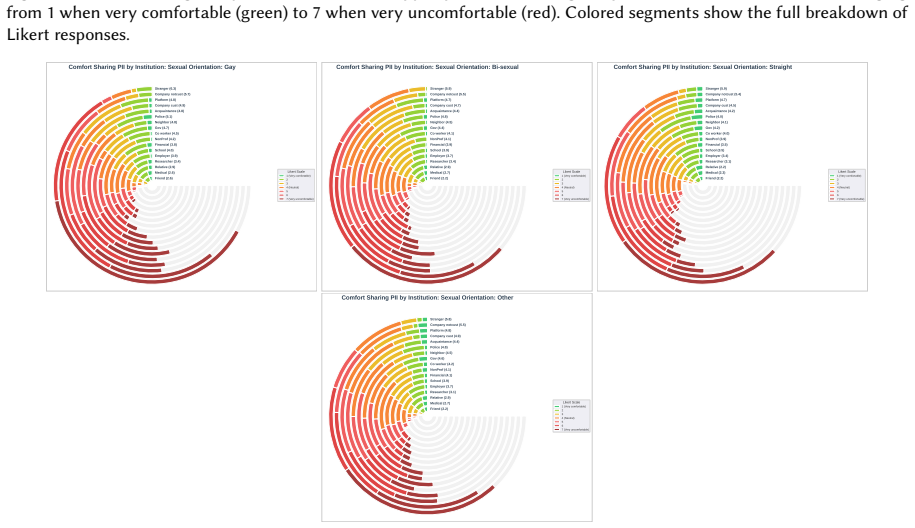
Privacy preferences are not fixed individual traits but depend on context and lived experiences. Analysis of 2,912 survey responses reveals a large shift toward private social media accounts from one-third in 2007 to two-thirds in 2024, with discomfort sharing PII with social media platforms strongly predicting privacy settings. A stable ranking of institutional trust emerges, though institutions such as police show high variability tied to divergent lived experiences. Traditionally marginalized groups and participants with adverse childhood experiences report more discomfort with institutions of power, especially where they face greater vulnerability.
What carries the argument
The survey instrument that measures participants' comfort sharing PII across 17 institutional contexts and correlates those comfort scores with self-reported social media account privacy settings.
If this is right
- Discomfort with social media platforms directly shapes whether users choose private accounts.
- Institutional trust rankings remain stable across the sample except for high-variability cases such as police.
- Marginalized identity and adverse childhood experiences increase discomfort toward institutions of power.
- Uniform consent frameworks fail to account for these context-specific and demographic differences.
Where Pith is reading between the lines
- Expanding the same survey to non-student adult populations could test whether the observed institutional ranking and demographic patterns hold outside campus settings.
- Platform design that surfaces context-specific privacy options based on user-reported institutional comfort might increase actual usage of protective settings.
- Longitudinal tracking of the same individuals could reveal whether major life events alter PII comfort scores and corresponding account choices over time.
Load-bearing premise
Self-reported survey answers from a college-student sample accurately capture real privacy behaviors and can be generalized beyond that group without major selection or reporting biases.
What would settle it
A field study that directly observes actual social media account settings and data-sharing logs while collecting the same PII-comfort responses from the same individuals and compares them for consistency.
Figures


read the original abstract
Privacy preferences are not fixed individual traits, they depend on context and lived experiences. In this study, we analyze 2,912 survey responses from 782 college students collected over seven survey periods during 2023 and 2024. We ask about their usage of social media, the security settings of their accounts, and measure their comfort in sharing personally identifiable information (PII) across 17 different institutional contexts. Compared to past research, we observe a large shift towards private accounts, going from 1/3rd private in 2007 to 2/3rds in 2024, and find that participants' discomfort sharing PII with social media platforms strongly predicts their privacy settings. Beyond social media, we identify a stable ranking of institutional trust, though some institutions, like the police, show high variability reflecting divergent lived experiences. Traditionally marginalized groups and participants having faced adverse childhood experiences show more discomfort with institutions of power, especially in areas where they face greater vulnerability. We argue for context-adaptive privacy settings that recognize institutional relationships and demographic vulnerabilities, moving beyond one-size-fits-all consent frameworks toward contextually appropriate data governance.
Editorial analysis
A structured set of objections, weighed in public.
Referee Report
Summary. The manuscript reports findings from a multi-wave survey of 782 college students yielding 2,912 responses across seven periods in 2023–2024. It claims a large increase in private social media accounts relative to prior work (from roughly one-third in 2007 to two-thirds in 2024), that discomfort sharing PII with social media platforms strongly predicts current privacy settings, a stable institutional trust ranking with high variability for police, and greater discomfort among traditionally marginalized groups and those reporting adverse childhood experiences. The authors conclude that privacy preferences are context- and identity-dependent and advocate context-adaptive privacy settings over one-size-fits-all consent models.
Significance. If the descriptive patterns hold, the work supplies timely evidence on evolving privacy norms among young adults and the role of lived experience in shaping institutional trust. The multi-period design and sizable sample strengthen the reliability of the cross-sectional associations reported. The emphasis on demographic vulnerabilities and the call for context-sensitive governance could inform both platform design and regulatory approaches to data sharing.
major comments (1)
- [Abstract] Abstract and introduction: The central claim of a shift from 1/3 private accounts in 2007 to 2/3 in 2024 is load-bearing for the temporal-change narrative that frames the rest of the results. The comparison is made to an unspecified 'past research' baseline without any description of that study's population, platform(s), exact definition of 'private' (e.g., friends-only vs. custom lists), or measurement protocol. Because the current sample is restricted to college students, any mismatch in demographics or UI options could explain the apparent doubling without reflecting genuine preference evolution.
minor comments (2)
- [Abstract] Abstract: The statement that discomfort 'strongly predicts' privacy settings is presented without any indication of the statistical model, controls, effect size, or robustness checks used to support the claim.
- The manuscript should clarify how self-reported privacy settings were elicited and whether any validation against actual account data or behavioral measures was performed.
Simulated Author's Rebuttal
We thank the referee for their constructive feedback on our manuscript. The single major comment raises a valid concern about the specificity of our temporal comparison, which we address below by committing to revisions that improve transparency and allow readers to evaluate the claim more rigorously.
read point-by-point responses
-
Referee: [Abstract] Abstract and introduction: The central claim of a shift from 1/3 private accounts in 2007 to 2/3 in 2024 is load-bearing for the temporal-change narrative that frames the rest of the results. The comparison is made to an unspecified 'past research' baseline without any description of that study's population, platform(s), exact definition of 'private' (e.g., friends-only vs. custom lists), or measurement protocol. Because the current sample is restricted to college students, any mismatch in demographics or UI options could explain the apparent doubling without reflecting genuine preference evolution.
Authors: We agree that the current phrasing in the abstract and introduction is insufficiently detailed and could lead readers to question the validity of the comparison. The manuscript references prior work on social media privacy settings from that era, but we did not include the necessary descriptors of the baseline study. We will revise both the abstract and introduction to explicitly identify the referenced study, summarize its sample characteristics (college students), platform focus, operational definition of private accounts, and data collection approach. We will also add a brief discussion of potential differences in platform defaults and user interface options between 2007 and 2024. This revision will strengthen rather than weaken the temporal narrative by making the basis for the comparison transparent and allowing readers to assess demographic and contextual alignment directly. revision: yes
Circularity Check
No circularity: purely observational survey reporting direct data associations
full rationale
The paper is an empirical survey study collecting 2,912 responses from 782 students and reporting descriptive statistics (e.g., proportion of private accounts) plus associations (e.g., discomfort with PII sharing predicting settings). No mathematical derivations, fitted models whose outputs are renamed as predictions, or self-citations that bear the load of any central claim exist. The reference to a 2007 baseline is an external comparison and does not reduce any result to the paper's own inputs by construction. All findings remain independent observations from the collected data.
Axiom & Free-Parameter Ledger
axioms (1)
- domain assumption Self-reported survey responses accurately capture participants' privacy preferences, institutional trust, and the influence of lived experiences.
Reference graph
Works this paper leans on
-
[1]
Alessandro Acquisti and Jens Grossklags. 2005. Privacy and rationality in individual decision making.IEEE Security & Privacy3, 1 (2005), 26–33. doi:10.1109/MSP.2005.22
-
[2]
2010.Analysis of ordinal categorical data
Alan Agresti. 2010.Analysis of ordinal categorical data. John Wiley & Sons, United Kingdom
work page 2010
-
[3]
2012.Categorical data analysis
Alan Agresti. 2012.Categorical data analysis. Vol. 792. John Wiley & Sons, New Jersey, USA
work page 2012
-
[4]
Jebreel Alamari and Aziz Alshehri. 2025. Adaptive privacy permissions for social media web.Multimedia Tools and Applications84, 20 (2025), 23065–23084. doi:10.1007/s11042-024-20423-4
-
[5]
Irwin Altman. 1975.The environment and social behavior: privacy, personal space, territory, and crowding.ERIC, Monterey, California
work page 1975
-
[6]
Adam Barth, Anupam Datta, John C Mitchell, and Helen Nissenbaum. 2006. Privacy and contextual integrity: Framework and applications. In2006 IEEE Symposium on Security and Privacy (S&P’06). IEEE, Berkeley/Oakland, CA, 15–pp. doi:10.1109/SP.2006.32
-
[7]
Jošt Bartol, Vasja Vehovar, and Andraž Petrovčič. 2026. Cross-Contextual Analysis of the Effects of Vertical and Horizontal Privacy Perceptions on Willingness to Disclose Personal Information on the Internet.International Journal of Human–Computer Interaction42, 1 (2026), 478–491. doi:10.1080/10447318.2025.2508310
-
[8]
Ruha Benjamin. 2023. Race after technology. InSocial Theory Re-Wired. Routledge, London, UK, 405–415
work page 2023
-
[9]
2015.Dark matters: On the surveillance of blackness
Simone Browne. 2015.Dark matters: On the surveillance of blackness. Duke University Press, Durham, North Carolina
work page 2015
-
[10]
Taina Bucher. 2019. The algorithmic imaginary: Exploring the ordinary affects of Facebook algorithms. InThe social power of algorithms. Routledge, London, UK, 30–44
work page 2019
-
[11]
Tamara Dinev and Paul Hart. 2006. An extended privacy calculus model for e-commerce transactions.Information Systems Research17, 1 (2006), 61–80. doi:10.1287/isre.1060.0080
-
[12]
Nora A Draper and Joseph Turow. 2019. The corporate cultivation of digital resignation.New Media & Society21, 8 (2019), 1824–1839. doi:10.1177/1461444819833331
-
[13]
2018.Automating inequality: How high-tech tools profile, police, and punish the poor
Virginia Eubanks. 2018.Automating inequality: How high-tech tools profile, police, and punish the poor. Macmillan, New York, NY
work page 2018
-
[14]
2001.Overseers of the poor: Surveillance, resistance, and the limits of privacy
John Gilliom. 2001.Overseers of the poor: Surveillance, resistance, and the limits of privacy. University of Chicago Press, Chicago, IL
work page 2001
-
[15]
Ralph Gross and Alessandro Acquisti. 2005. Information revelation and privacy in online social networks. InProceedings of the 2005 ACM Workshop on Privacy in the Electronic Society(Alexandria, VA, USA)(WPES ’05). Association for Computing Machinery, New York, NY, USA, 71–80. doi:10.1145/1102199.1102214
-
[16]
Eszter Hargittai and Alice Marwick. 2016. “What can I really do?” Explaining the privacy paradox with online apathy.International Journal of Communication10 (2016), 21
work page 2016
-
[17]
Munene Kanampiu and Mohd Anwar. 2019. Privacy Preferences vs. Privacy Settings: An Exploratory Facebook Study. InAdvances in Human Factors in Cybersecurity, Tareq Z. Ahram and Denise Nicholson (Eds.). Springer International Publishing, Cham, Switzerland, 116–126. doi:10.1007/978-3-319-94782-2_12
-
[18]
Canan Karatekin, Susan M. Mason, Amy Riegelman, Caitlin Bakker, Shanda Hunt, Bria Gresham, Frederique Corcoran, and Andrew Barnes. 2023.Adverse Childhood Experiences (ACEs): An Overview of Definitions, Measures, and Methods. Springer International Publishing, Cham. 31–45 pages. doi:10.1007/978-3-031-32597-7_3
-
[19]
Iman Kassam, Daria Ilkina, Jessica Kemp, Heba Roble, Abigail Carter-Langford, and Nelson Shen. 2023. Patient perspectives and preferences for consent in the digital health context: state-of-the-art literature review.Journal of medical Internet research25 (2023), e42507
work page 2023
-
[20]
Spyros Kokolakis. 2017. Privacy attitudes and privacy behaviour: A review of current research on the privacy paradox phenomenon. Computers & Security64 (2017), 122–134. doi:10.1016/j.cose.2015.07.002
-
[21]
Kevin Lewis, Jason Kaufman, and Nicholas Christakis. 2008. The taste for privacy: An analysis of college student privacy settings in an online social network.Journal of Computer-Mediated Communication14, 1 (2008), 79–100. doi:10.1111/j.1083-6101.2008.01432.x
-
[22]
Juniper Lovato, Jonathan St-Onge, Randall Harp, Gabriela Salazar Lopez, Sean P Rogers, Ijaz Ul Haq, Laurent Hébert-Dufresne, and Jeremiah Onaolapo. 2024. Diverse misinformation: impacts of human biases on detection of deepfakes on networks.npj Complexity1, 1 (2024), 5. doi:10.1038/s44260-024-00006-y
-
[23]
Juniper Lovato, Julia Witte Zimmerman, Isabelle Smith, Peter Dodds, and Jennifer L Karson. 2024. Foregrounding artist opinions: A survey study on transparency, ownership, and fairness in AI generative art. InProceedings of the AAAI/ACM Conference on AI, Ethics, Taste for Privacy in Context FAccT ’26, June 25–28, 2026, Montreal, Canada and Society, Vol. 7....
-
[24]
Lovato, Antoine Allard, Randall Harp, Jeremiah Onaolapo, and Laurent Hébert-Dufresne
Juniper L. Lovato, Antoine Allard, Randall Harp, Jeremiah Onaolapo, and Laurent Hébert-Dufresne. 2022. Limits of Individual Consent and Models of Distributed Consent in Online Social Networks. InProceedings of the 2022 ACM Conference on Fairness, Accountability, and Transparency(Seoul, Republic of Korea)(FAccT ’22). Association for Computing Machinery, Ne...
-
[25]
Stephen T Margulis. 2003. On the status and contribution of Westin’s and Altman’s theories of privacy.Journal of Social issues59, 2 (2003), 411–429. doi:10.1111/1540-4560.00071
-
[26]
Kirsten Martin. 2016. Understanding privacy online: Development of a social contract approach to privacy.Journal of Business Ethics 137, 3 (2016), 551–569. doi:10.1007/s10551-015-2565-9
-
[27]
2018.Situational privacy and self-disclosure: Communication processes in online environments
Philipp K Masur. 2018.Situational privacy and self-disclosure: Communication processes in online environments. Springer, Berlin, Germany
work page 2018
-
[28]
Roger C Mayer, James H Davis, and F David Schoorman. 1995. An integrative model of organizational trust.Academy of Management Review20, 3 (1995), 709–734. doi:10.5465/amr.1995.9508080335
-
[29]
Helen Nissenbaum. 2004. Privacy as contextual integrity.Washington Law Review79 (2004), 119
work page 2004
-
[30]
Helen Nissenbaum. 2011. A contextual approach to privacy online.Daedalus140, 4 (2011), 32–48. doi:10.1162/DAED_a_00113
-
[31]
Patricia A Norberg, Daniel R Horne, and David A Horne. 2007. The privacy paradox: Personal information disclosure intentions versus behaviors.Journal of Consumer Affairs41, 1 (2007), 100–126. doi:10.1111/j.1745-6606.2006.00070.x
-
[32]
Gautham Pallapa, Mario Di Francescoy, and Sajal K. Das. 2012. Adaptive and context-aware privacy preservation schemes exploiting user interactions in pervasive environments. In2012 IEEE International Symposium on a World of Wireless, Mobile and Multimedia Networks (WoWMoM). IEEE, San Francisco, CA„ 1–6. doi:10.1109/WoWMoM.2012.6263765
-
[33]
Darhl M Pedersen. 1987. Sex differences in privacy preferences.Perceptual and Motor Skills64, 3_suppl (1987), 1239–1242. doi:10.2466/ pms.1987.64.3c.12
work page 1987
-
[34]
Darhl M Pedersen. 1997. Psychological functions of privacy.Journal of Environmental Psychology17, 2 (1997), 147–156. doi:10.1006/jevp. 1997.0049
-
[35]
2002.Boundaries of privacy: Dialectics of disclosure
Sandra Petronio. 2002.Boundaries of privacy: Dialectics of disclosure. Suny Press, Albany, NY
work page 2002
-
[36]
Matthew Price, Johanna E Hidalgo, Yoshi M Bird, Laura SP Bloomfield, Casey Buck, Janine Cerutti, Peter Sheridan Dodds, Mikaela Irene Fudolig, Rachel Gehman, Marc Hickok, et al. 2023. A large clinical trial to improve well-being during the transition to college using wearables: The lived experiences measured using rings study.Contemporary clinical trials13...
work page 2023
-
[37]
Ari Schlesinger, W. Keith Edwards, and Rebecca E. Grinter. 2017. Intersectional HCI: Engaging Identity through Gender, Race, and Class. InProceedings of the 2017 CHI Conference on Human Factors in Computing Systems(Denver, Colorado, USA)(CHI ’17). Association for Computing Machinery, New York, NY, USA, 5412–5427. doi:10.1145/3025453.3025766
-
[38]
Gwen Shaffer. 2021. Applying a contextual integrity framework to privacy policies for smart technologies.Journal of Information Policy 11 (2021), 222–265. doi:10.5325/jinfopoli.11.2021.0222
-
[39]
Christina Shane-Simpson, Adriana Manago, Naomi Gaggi, and Kristen Gillespie-Lynch. 2018. Why do college students prefer Facebook, Twitter, or Instagram? Site affordances, tensions between privacy and self-expression, and implications for social capital.Computers in Human Behavior86 (2018), 276–288. doi:10.1016/j.chb.2018.04.041
-
[40]
Paul Smaldino. 2015.The evolution of the social self: Multidimensionality of social identity solves the coordination problems of a society. University of Minnesota Press, Minneapolis, MN. 45–469 pages
work page 2015
-
[41]
Fred Stutzman and Jacob Kramer-Duffield. 2010. Friends only: examining a privacy-enhancing behavior in facebook. InProceedings of the SIGCHI Conference on Human Factors in Computing Systems(Atlanta, Georgia, USA)(CHI ’10). Association for Computing Machinery, New York, NY, USA, 1553–1562. doi:10.1145/1753326.1753559
-
[42]
Are your social media profiles typically public or private?
Yaqing Yang, Tony W Li, and Haojian Jin. 2024. On the Feasibility of Predicting Users’ Privacy Concerns using Contextual Labels and Personal Preferences. InProceedings of the 2024 CHI Conference on Human Factors in Computing Systems(Honolulu, HI, USA)(CHI ’24). Association for Computing Machinery, New York, NY, USA, Article 792, 20 pages. doi:10.1145/3613...
discussion (0)
Sign in with ORCID, Apple, or X to comment. Anyone can read and Pith papers without signing in.