Optical Lineshape Models and the Generalized Einstein Relation between Absorption and Stimulated Emission
Pith reviewed 2026-05-08 09:39 UTC · model grok-4.3
The pith
The quantum Brownian oscillator model for optical lineshapes obeys the generalized Einstein relation between absorption and stimulated emission spectra in all tested damping and energy regimes.
A machine-rendered reading of the paper's core claim, the machinery that carries it, and where it could break.
Core claim
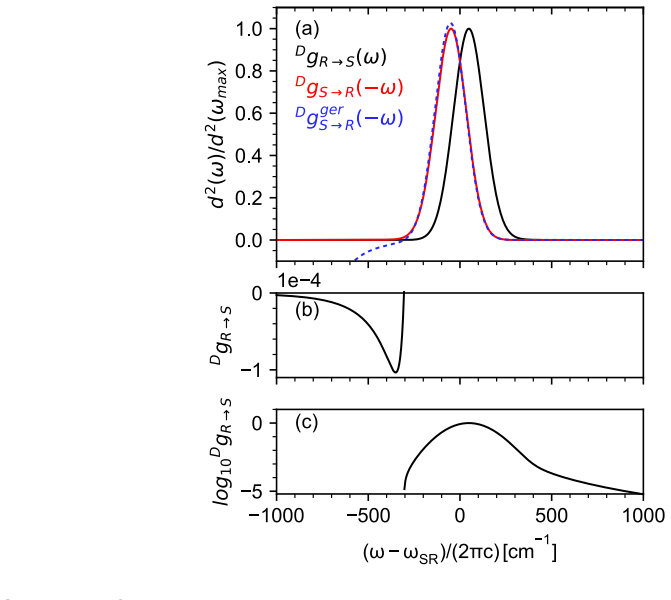
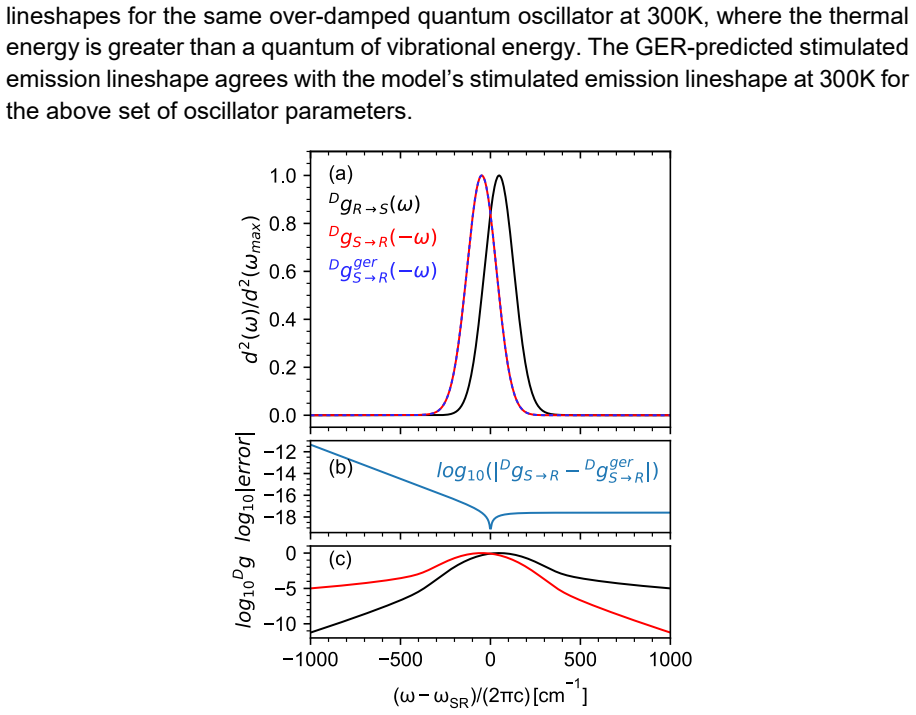
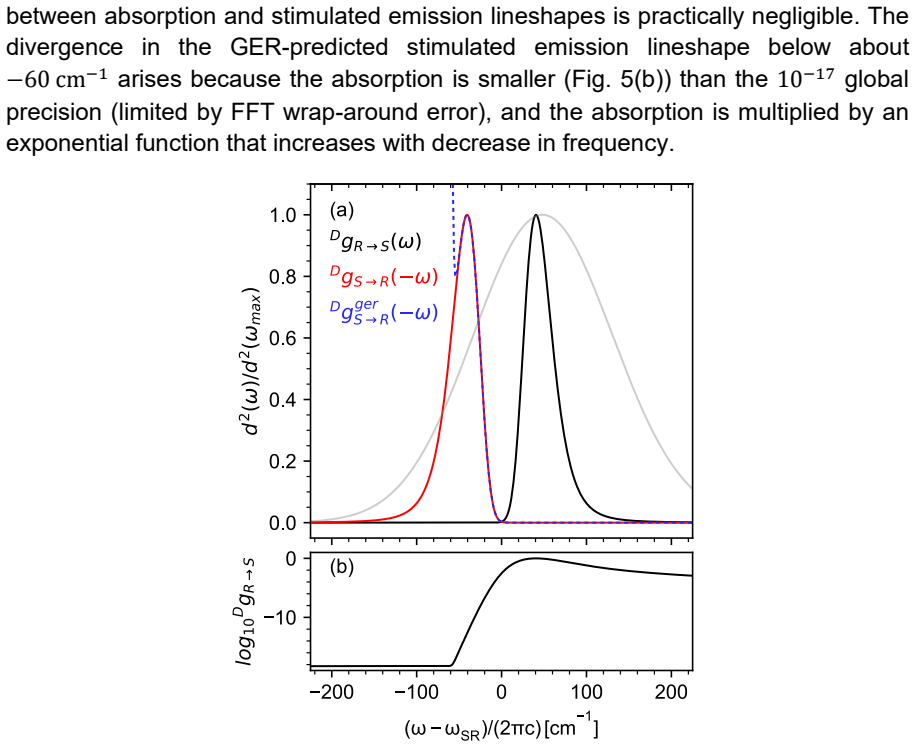
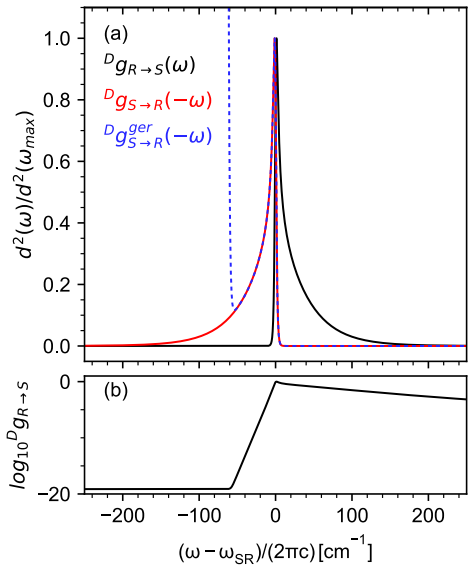
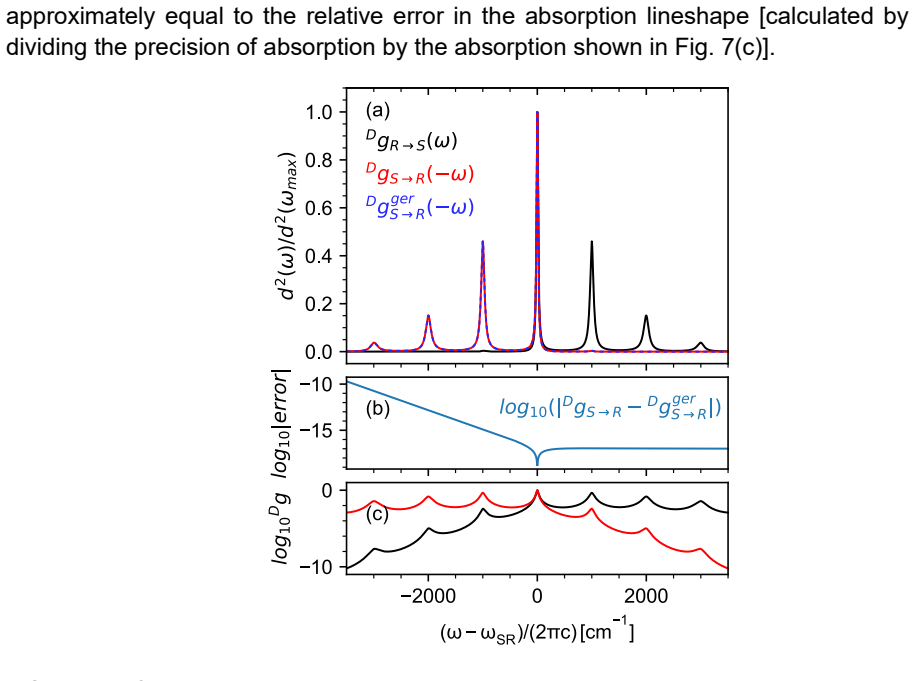
The absorption and stimulated emission dipole-strength spectra from the two-state quantum Brownian oscillator lineshape model satisfy the generalized Einstein relation to within the numerical precision of the calculation for transitions between two displaced but otherwise identical harmonic potential energy surfaces coupled to the same thermal bath. The relation holds in the under-damped, critically damped, and over-damped regimes when both thermal energy and reorganization energy are varied from much less than to greater than the vibrational quantum. The Bloch, stochastic, and semiclassical Brownian oscillator models do not obey the relation.
What carries the argument
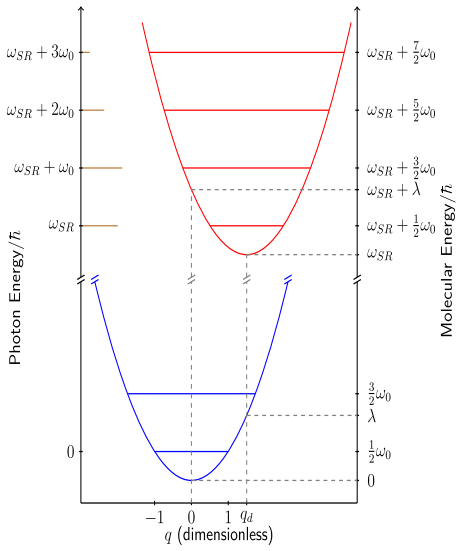
The quantum Brownian oscillator model, which treats a harmonic quantum vibration bilinearly coupled to a thermal bath of quantum harmonic oscillators that generate damping and a random force, applied to two displaced but identical harmonic surfaces sharing the same bath.
If this is right
- Absorption and stimulated emission spectra can be interconverted directly using the generalized relation without additional assumptions.
- The model remains consistent with thermal equilibrium for any combination of damping regime and energy scale tested.
- Lineshapes generated by this approach can be inserted into calculations of light-matter interactions that require detailed balance.
- The same bath coupling applies to both ground and excited surfaces, simplifying the treatment of condensed-phase spectra.
Where Pith is reading between the lines
- The model's obedience suggests it could serve as a reference for developing new lineshape theories that automatically preserve thermal consistency.
- Analytical proofs of the relation for this specific model might be derivable from the underlying quantum oscillator algebra.
- Extensions to anharmonic surfaces or multi-mode baths could be checked numerically to test whether the property survives beyond the harmonic case.
Load-bearing premise
The two-state quantum Brownian oscillator accurately represents transitions between displaced but otherwise identical harmonic potential energy surfaces coupled to the same thermal bath of quantum harmonic oscillators.
What would settle it
A numerical evaluation of absorption and stimulated emission spectra for the quantum Brownian oscillator parameters that shows a violation of the generalized Einstein relation larger than the reported numerical precision of 14 to 30 digits.
Figures
read the original abstract
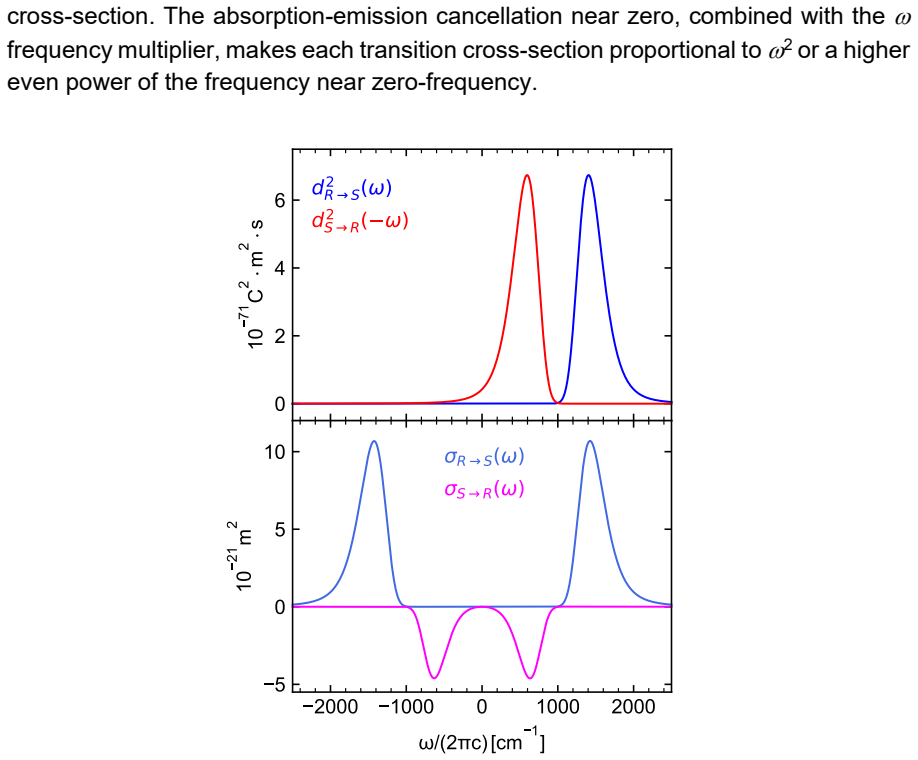
Recently, Ryu et al. generalized Einstein's three coefficients for absorption, stimulated emission, and spontaneous emission between two quantum levels to a set of four spectra between two broadened bands. The spectra obey generalized Einstein relationships at thermal equilibrium; Einstein's relations are obtained as an approximation for line spectra. Here, the generalized Einstein relation between absorption and stimulated emission dipole-strength spectra is applied to investigate optical lineshape models. Lineshapes for the Bloch model, the stochastic model, and the semi-classical Brownian oscillator model do not obey the generalized Einstein relation and therefore fail to satisfy detailed balance with Planck blackbody radiation. The quantum Brownian oscillator model treats a harmonic quantum vibration that is bi-linearly coupled to a thermal bath of quantum harmonic oscillators which generate damping and a random force. The two-state quantum Brownian oscillator lineshape model provides lineshapes for transitions between two displaced, but otherwise identical, harmonic potential energy surfaces on which the same quantum vibration is coupled to the same thermal bath of quantum harmonic oscillators. The absorption and stimulated emission lineshapes were calculated using the quantum Brownian oscillator model in under-damped, critically damped, and over-damped cases. The thermal and reorganization energy were each varied from much less to greater than the vibrational quantum of energy. All quantum Brownian oscillator lineshapes obey the generalized Einstein relation within the numerical precision of the calculation (14 to 30 digits), suggesting this lineshape model is compatible with detailed balance. The formula giving the electric-dipole transition cross-section in terms of these lineshapes is presented.
Editorial analysis
A structured set of objections, weighed in public.
Referee Report
Summary. The paper claims that common optical lineshape models (Bloch, stochastic, and semi-classical Brownian oscillator) violate the generalized Einstein relation between absorption and stimulated-emission dipole-strength spectra introduced by Ryu et al., while the quantum Brownian oscillator (QBO) model obeys it to high numerical precision (14–30 digits). The QBO is applied to transitions between two displaced but otherwise identical harmonic potential energy surfaces coupled to the same quantum harmonic bath; calculations span under-, critical-, and over-damped regimes with thermal and reorganization energies ranging from ≪ ħω to ≫ ħω. The manuscript concludes that the QBO lineshapes are compatible with detailed balance and presents the formula relating these lineshapes to the electric-dipole transition cross-section.
Significance. If the numerical result holds, the work identifies a lineshape model that is consistent with thermal equilibrium and the generalized Einstein relation, offering a physically grounded alternative for modeling condensed-phase optical spectra involving quantum vibrations. The high-precision verification across damping regimes and energy scales provides concrete support for using the QBO construction when detailed balance with Planck radiation is required. The explicit cross-section formula adds practical value for applications in molecular spectroscopy.
minor comments (3)
- The abstract asserts obedience 'within the numerical precision of the calculation (14 to 30 digits)' without reporting error estimates, convergence tests, or implementation details; the main text should include these to substantiate the precision claim.
- The manuscript would benefit from a table or supplementary figure quantifying the maximum deviation from the generalized Einstein relation as a function of damping regime and energy ratios, rather than stating the range of digits only in the abstract and conclusion.
- Notation for the absorption and stimulated-emission dipole-strength spectra (e.g., how they are normalized and extracted from the QBO correlation functions) should be defined more explicitly in the section introducing the QBO model to facilitate reproduction.
Simulated Author's Rebuttal
We thank the referee for the careful reading of the manuscript and the positive evaluation of its significance. The referee's summary accurately reflects the central claims regarding the generalized Einstein relation and the performance of the quantum Brownian oscillator model. We note the recommendation for minor revision and will address any editorial or minor points in the revised version.
Circularity Check
No significant circularity; numerical verification is independent
full rationale
The paper cites Ryu et al. (overlapping authors) only to define the generalized Einstein relation used as an external benchmark for testing lineshape models. The central result is an explicit numerical computation of absorption and stimulated-emission spectra from the quantum Brownian oscillator Hamiltonian in multiple damping regimes and energy scales, followed by a direct check that the computed spectra satisfy the relation to 14–30 digits. This check is not forced by construction or by any fitted parameter; the model's symmetric construction (identical surfaces and bath) makes obedience physically expected, but the paper reports the outcome of independent calculation rather than assuming or deriving it from the cited relation. No derivation step reduces a claimed prediction to an input by definition, and the self-citation supplies the test criterion without substituting for the numerical evidence.
Axiom & Free-Parameter Ledger
axioms (2)
- standard math Quantum harmonic oscillators and bilinear coupling to a thermal bath of oscillators generate the damping and random force in the lineshape model
- domain assumption The generalized Einstein relation between absorption and stimulated emission dipole-strength spectra holds at thermal equilibrium
Reference graph
Works this paper leans on
-
[1]
Agrawal, Ryu & Jonas Page 11 of 11 References: 1 Y.J. Yan, and S. Mukamel, “Electronic dephasing, vibrational relaxation, and solvent friction in molecular nonlinear optical line shapes,” J. Chem. Phys. 89(8), 5160– 5176 (1988). 2 Y. Gu, A. Widom, and P.M. Champion, “Spectral line shapes of damped quantum oscillators: Applications to biomolecules,” J. Che...
work page 1988
discussion (0)
Sign in with ORCID, Apple, or X to comment. Anyone can read and Pith papers without signing in.