The circumstellar environment of the young, low-mass dipper star JH 223. Accretion and large-scale magnetic field topology
Pith reviewed 2026-05-08 10:06 UTC · model grok-4.3
The pith
Observations confirm that the magnetospheric accretion model applies to fully convective very-low-mass T Tauri stars like JH 223.
A machine-rendered reading of the paper's core claim, the machinery that carries it, and where it could break.
Core claim
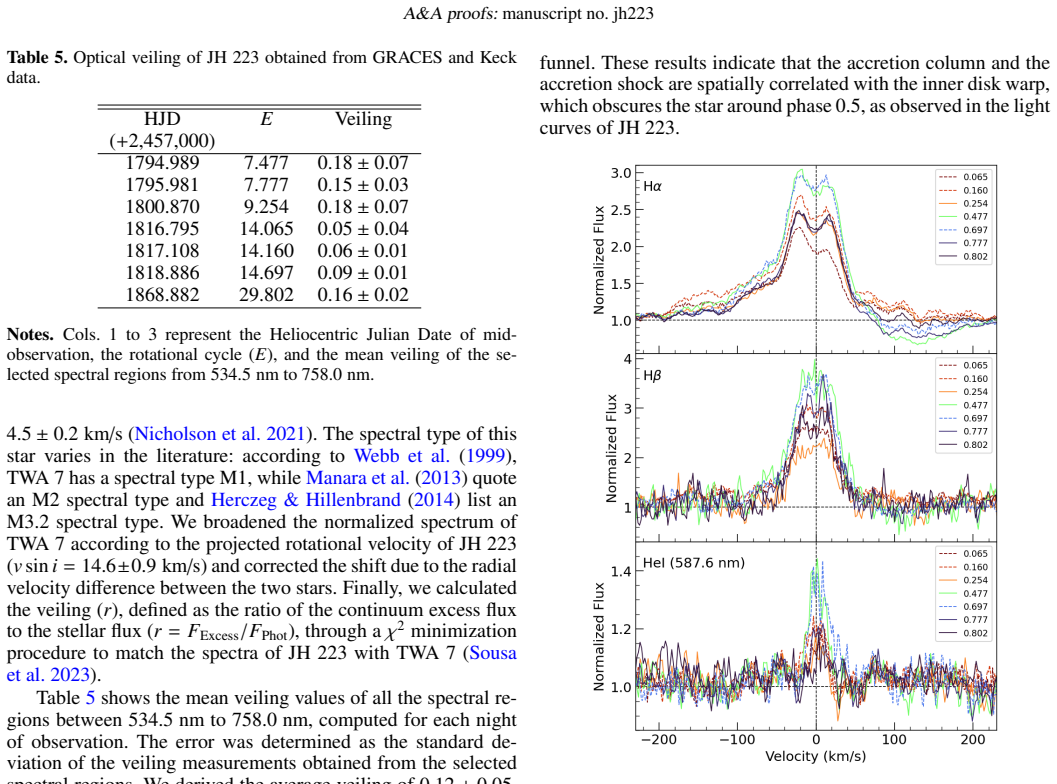
The large-scale surface magnetic field of JH 223 is predominantly poloidal with a 250 G dipolar component. The dipole strength and mass accretion rate place the disk truncation radius near corotation. The inclined dipole and star-disk interaction generate accretion columns that warp the inner disk, which periodically obscures the star every 3.31 days to produce the dipper light curves. Redshifted absorption features in H alpha and He I trace these columns at matching phases. The process transitions from unstable to stable accretion over weeks.
What carries the argument
The inclined dipolar component of the large-scale stellar magnetic field, which interacts with the disk to truncate it near corotation and form accretion columns that create a warp causing periodic dips.
If this is right
- The 3.31-day rotational period is consistently detected across photometry, radial velocity, and longitudinal magnetic field data.
- The accretion columns are linked to the inner disk warp at the same rotational phase.
- The accretion regime changes from unstable to stable over a few weeks, aligning with MHD simulations.
- The magnetospheric accretion framework explains the observations without invoking other variability sources.
Where Pith is reading between the lines
- If similar magnetic topologies are found in other dipper stars, it would suggest this mechanism is widespread among low-mass young stars.
- Long-term monitoring could test whether the warp persists or evolves with changes in the magnetic field.
- Extending Zeeman-Doppler imaging to more very-low-mass T Tauri stars would check if dipole dominance is typical in fully convective regimes.
Load-bearing premise
The measured dipole field strength and mass accretion rate directly determine that the truncation radius is near corotation, with the inclined columns causing the warp that dominates the observed dips.
What would settle it
Finding that the disk truncation radius is substantially different from the corotation radius through independent measurements, or observing no correlation between the accretion tracers and the 3.31-day period.
Figures




read the original abstract
Studies of magnetospheric accretion and magnetic field topology in T Tauri stars have advanced over the years, but their applications to fully convective, very-low-mass T Tauri stars remain relatively unexplored. We aim to analyze the circumstellar environment of the very-low-mass dipper-like star JH 223 by investigating the accretion process and characterizing its large-scale magnetic field topology. We analyzed the photometric variability of JH 223 using observations from multiple telescopes, including K2, TESS, and LCOGT. Additionally, we used Gemini/GRACES spectroscopic and CFHT/SPIRou spectropolarimetric data to investigate the star-disk interaction and characterize the large-scale stellar magnetic field using Zeeman-Doppler imaging. JH 223 is a fully convective classical T Tauri star with an age of about 3 Myr and a mass of 0.4 M$_{\odot}$. The large-scale surface magnetic field is predominantly poloidal, with a 250 G dipolar component. The dipole field strength and mass accretion rate indicate that the disk truncation radius is near the corotation radius. The star-disk interaction, combined with the inclined dipole, generates accretion columns that warp the inner disk. As the star rotates, this warp periodically obscures the stellar surface every 3.31 days, producing dipper light curves. The same period is also detected in radial velocity and longitudinal magnetic field variability. The accretion columns, traced by redshifted absorption in H$\alpha$ and He I 1083 nm, are associated with the inner disk warp at the same rotational phase. The accretion process in JH 223 is dynamic, transitioning from an unstable to a stable regime over a few weeks, consistent with magnetohydrodynamic simulations of star-disk interaction. Results from multi-technique observations suggest that the magnetospheric accretion model remains valid for fully convective very-low-mass young stars.
Editorial analysis
A structured set of objections, weighed in public.
Referee Report
Summary. The paper presents a multi-technique observational study of the young, fully convective, very-low-mass T Tauri star JH 223 (0.4 M⊙, ~3 Myr). Photometry from K2, TESS, and LCOGT reveals periodic 3.31-day dips; Gemini/GRACES spectroscopy and CFHT/SPIRou spectropolarimetry are used to map the large-scale magnetic field via Zeeman-Doppler imaging (predominantly poloidal with a 250 G dipole) and to trace accretion columns through redshifted absorption in Hα and He I 1083 nm. The authors conclude that the measured dipole strength and mass-accretion rate place the disk truncation radius near corotation, producing an inclined inner-disk warp that explains the photometric, radial-velocity, and longitudinal-field periodicities, with the accretion regime transitioning from unstable to stable over weeks.
Significance. If the central claim holds, the work provides one of the first detailed observational tests of the magnetospheric accretion model in the fully convective, very-low-mass regime. The combination of time-series photometry, spectroscopy, and magnetic mapping demonstrates consistency between the observed 3.31-day signals and an inclined accretion-column warp, offering empirical support for extending the paradigm below 0.5 M⊙ and aligning with existing MHD simulations of star-disk interaction.
major comments (1)
- [Abstract and the section presenting the dipole strength, accretion-rate derivation, and truncation-radius comparison] The central claim that the disk truncation radius lies near corotation (and thereby generates the observed warp) rests on the 250 G dipole and the adopted mass-accretion rate, yet the manuscript reports neither the explicit truncation-radius formula employed, nor propagated uncertainties, nor any Monte-Carlo or sensitivity analysis on B_dipole or Ṁ. Because r_trunc scales approximately as (B_dip^{2} R_*^{6} / (Ṁ √(GM_*)))^{1/7}, even factor-of-two variations in either input shift r_trunc/r_co by 30-50 %, directly affecting whether the warp interpretation is required or whether alternative variability mechanisms remain viable.
minor comments (2)
- [Abstract] The abstract states the stellar age as 'about 3 Myr' and mass as 0.4 M⊙ without citing the evolutionary tracks, isochrones, or spectroscopic indicators used to obtain these values.
- [Discussion of accretion dynamics] The transition between unstable and stable accretion regimes is described qualitatively; a quantitative metric (e.g., the ratio of observed to expected accretion-column filling factor or a time-series measure of veiling variability) would strengthen the comparison to MHD simulations.
Simulated Author's Rebuttal
We thank the referee for their positive assessment of the significance of our study and for the constructive major comment. We address the concern regarding the truncation radius calculation below and will revise the manuscript to incorporate the requested details.
read point-by-point responses
-
Referee: The central claim that the disk truncation radius lies near corotation (and thereby generates the observed warp) rests on the 250 G dipole and the adopted mass-accretion rate, yet the manuscript reports neither the explicit truncation-radius formula employed, nor propagated uncertainties, nor any Monte-Carlo or sensitivity analysis on B_dipole or Ṁ. Because r_trunc scales approximately as (B_dip^{2} R_*^{6} / (Ṁ √(GM_*)))^{1/7}, even factor-of-two variations in either input shift r_trunc/r_co by 30-50 %, directly affecting whether the warp interpretation is required or whether alternative variability mechanisms remain viable.
Authors: We agree that the manuscript did not explicitly present the truncation-radius formula, propagate uncertainties, or include a sensitivity analysis. In the revised version we will add the standard magnetospheric truncation radius expression (with reference), report the computed r_trunc/r_co value together with uncertainties derived from the ZDI dipole strength, the adopted Ṁ, and stellar parameters, and include a Monte-Carlo or sensitivity test showing the effect of factor-of-two variations in B_dipole and Ṁ. This will demonstrate that the ratio remains near unity within the explored range, thereby supporting the warp interpretation. revision: yes
Circularity Check
No significant circularity; observational measurements interpreted with standard formulas
full rationale
The paper reports independent datasets (K2/TESS/LCOGT photometry for the 3.31 d period, Gemini/GRACES spectroscopy for accretion tracers and Ṁ, CFHT/SPIRou spectropolarimetry for ZDI-derived 250 G dipole). The truncation-radius comparison uses the standard magnetospheric-accretion scaling r_trunc ∝ (B_dip² R_*⁶ / (Ṁ √(G M_*)))^{1/7} applied to these measured inputs; the result is then checked against the independently observed corotation radius. No step redefines a fitted quantity as a prediction, imports a uniqueness theorem from the authors' prior work, or renames an empirical pattern. The central claim is an interpretive consistency check between observed quantities and the magnetospheric model, not a closed loop.
Axiom & Free-Parameter Ledger
axioms (2)
- domain assumption Zeeman-Doppler imaging can reliably reconstruct the large-scale magnetic field topology from spectropolarimetric data.
- domain assumption The disk truncation radius can be estimated from the balance of magnetic and accretion ram pressure using the dipole strength and mass accretion rate.
Reference graph
Works this paper leans on
-
[1]
, " * write output.state after.block = add.period write newline
ENTRY address archiveprefix author booktitle chapter edition editor howpublished institution eprint journal key month note number organization pages publisher school series title type volume year label extra.label sort.label short.list INTEGERS output.state before.all mid.sentence after.sentence after.block FUNCTION init.state.consts #0 'before.all := #1 ...
-
[2]
" write newline "" before.all 'output.state := FUNCTION n.dashify 't := "" t empty not t #1 #1 substring "-" = t #1 #2 substring "--" = not "--" * t #2 global.max substring 't := t #1 #1 substring "-" = "-" * t #2 global.max substring 't := while if t #1 #1 substring * t #2 global.max substring 't := if while FUNCTION word.in bbl.in " " * FUNCTION format....
-
[3]
Akeson , R. L., Jensen , E. L. N., Carpenter , J., et al. 2019, , 872, 158
work page 2019
-
[4]
Alcal \'a , J. M., Manara , C. F., Natta , A., et al. 2017, , 600, A20
work page 2017
-
[5]
Alencar , S. H. P., Bouvier , J., Donati , J. F., et al. 2018, , 620, A195
work page 2018
-
[6]
Alencar , S. H. P., Teixeira , P. S., Guimar \ a es , M. M., et al. 2010, , 519, A88
work page 2010
- [7]
- [8]
- [9]
-
[10]
Baraffe , I., Homeier , D., Allard , F., & Chabrier , G. 2015, , 577, A42
work page 2015
- [11]
- [12]
-
[13]
Bessell , M. S., Castelli , F., & Plez , B. 1998, , 333, 231
work page 1998
-
[14]
Bessolaz , N., Zanni , C., Ferreira , J., Keppens , R., & Bouvier , J. 2008, , 478, 155
work page 2008
-
[15]
Betti , S. K., Follette , K. B., Ward-Duong , K., et al. 2023, , 166, 262
work page 2023
-
[16]
Blinova , A. A., Romanova , M. M., & Lovelace , R. V. E. 2016, , 459, 2354
work page 2016
-
[17]
Bodman , E. H. L., Quillen , A. C., Ansdell , M., et al. 2017, , 470, 202
work page 2017
-
[18]
2002, Bollinger on Bollinger bands (McGraw-Hill New York)
Bollinger, J. 2002, Bollinger on Bollinger bands (McGraw-Hill New York)
work page 2002
-
[19]
Bouvier , J., Alencar , S. H. P., Boutelier , T., et al. 2007 a , , 463, 1017
work page 2007
-
[20]
Bouvier , J., Alencar , S. H. P., Harries , T. J., Johns-Krull , C. M., & Romanova , M. M. 2007 b , in Protostars and Planets V, ed. B. Reipurth , D. Jewitt , & K. Keil , 479
work page 2007
- [21]
-
[22]
Bouvier , J., Grankin , K. N., Alencar , S. H. P., et al. 2003, , 409, 169
work page 2003
-
[23]
Brown , T. M., Baliber , N., Bianco , F. B., et al. 2013, , 125, 1031
work page 2013
-
[24]
Cang , T. Q., Petit , P., Donati , J. F., et al. 2020, , 643, A39
work page 2020
- [25]
-
[26]
2014, in Society of Photo-Optical Instrumentation Engineers (SPIE) Conference Series, Vol
Chene , A.-N., Padzer , J., Barrick , G., et al. 2014, in Society of Photo-Optical Instrumentation Engineers (SPIE) Conference Series, Vol. 9151, Advances in Optical and Mechanical Technologies for Telescopes and Instrumentation, ed. R. Navarro , C. R. Cunningham , & A. A. Barto , 915147
work page 2014
-
[27]
Chiang , E. I. & Goldreich , P. 1997, , 490, 368
work page 1997
- [28]
-
[29]
Cody , A. M. & Hillenbrand , L. A. 2018, , 156, 71
work page 2018
-
[30]
Cody , A. M., Hillenbrand , L. A., & Rebull , L. M. 2022, , 163, 212
work page 2022
-
[31]
M., Stauffer , J., Baglin , A., et al
Cody , A. M., Stauffer , J., Baglin , A., et al. 2014, , 147, 82
work page 2014
-
[32]
J., Artigau , \'E ., Doyon , R., et al
Cook , N. J., Artigau , \'E ., Doyon , R., et al. 2022, , 134, 114509
work page 2022
-
[33]
Donati , J. F. 2003, in Astronomical Society of the Pacific Conference Series, Vol. 307, Solar Polarization, ed. J. Trujillo-Bueno & J. Sanchez Almeida , 41
work page 2003
-
[34]
Donati , J. F., Bouvier , J., Alencar , S. H., et al. 2019, , 483, L1
work page 2019
-
[35]
Donati , J. F., Bouvier , J., Alencar , S. H., et al. 2020 a , , 491, 5660
work page 2020
-
[36]
Donati , J.-F., Cristofari , P. I., Carmona , A., et al. 2026, arXiv e-prints, arXiv:2602.24078
-
[37]
Donati , J. F., Gregory , S. G., Alencar , S. H. P., et al. 2011 a , , 417, 472
work page 2011
-
[38]
Donati , J. F., Gregory , S. G., Alencar , S. H. P., et al. 2012, , 425, 2948
work page 2012
-
[39]
Donati , J. F., Gregory , S. G., Alencar , S. H. P., et al. 2013, , 436, 881
work page 2013
-
[40]
Donati , J. F., Gregory , S. G., Montmerle , T., et al. 2011 b , , 417, 1747
work page 2011
-
[41]
F., H \'e brard , E., Hussain , G., et al
Donati , J. F., H \'e brard , E., Hussain , G., et al. 2014, , 444, 3220
work page 2014
-
[42]
F., H \'e brard , E., Hussain , G
Donati , J. F., H \'e brard , E., Hussain , G. A. J., et al. 2015, , 453, 3706
work page 2015
-
[43]
Donati , J. F., Howarth , I. D., Jardine , M. M., et al. 2006, , 370, 629
work page 2006
-
[44]
Donati , J. F., Jardine , M. M., Gregory , S. G., et al. 2007, , 380, 1297
work page 2007
-
[45]
Donati , J. F., Jardine , M. M., Gregory , S. G., et al. 2008, , 386, 1234
work page 2008
-
[46]
F., Kouach , D., Moutou , C., et al
Donati , J. F., Kouach , D., Moutou , C., et al. 2020 b , , 498, 5684
work page 2020
-
[47]
Donati , J. F., Semel , M., Carter , B. D., Rees , D. E., & Collier Cameron , A. 1997, , 291, 658
work page 1997
-
[48]
Donati , J. F., Skelly , M. B., Bouvier , J., et al. 2010 a , , 409, 1347
work page 2010
-
[49]
Donati , J. F., Skelly , M. B., Bouvier , J., et al. 2010 b , , 402, 1426
work page 2010
-
[50]
F., Yu , L., Moutou , C., et al
Donati , J. F., Yu , L., Moutou , C., et al. 2017, , 465, 3343
work page 2017
-
[51]
Edwards , S., Fischer , W., Hillenbrand , L., & Kwan , J. 2006, , 646, 319
work page 2006
-
[52]
Erkal , J., Manara , C. F., Schneider , P. C., et al. 2022, , 666, A188
work page 2022
-
[53]
Fischer , W., Kwan , J., Edwards , S., & Hillenbrand , L. 2008, , 687, 1117
work page 2008
-
[54]
Flock , M., Fromang , S., Turner , N. J., & Benisty , M. 2017, , 835, 230
work page 2017
-
[55]
S., Reipurth , B., & Duch \^e ne , G
Flores , C., Connelley , M. S., Reipurth , B., & Duch \^e ne , G. 2022, , 925, 21
work page 2022
-
[56]
P., Bouvier , J., Petit , P., et al
Folsom , C. P., Bouvier , J., Petit , P., et al. 2018, , 474, 4956
work page 2018
-
[57]
P., Petit , P., Bouvier , J., et al
Folsom , C. P., Petit , P., Bouvier , J., et al. 2016, , 457, 580
work page 2016
-
[58]
M., Klutsch , A., & Guillout , P
Frasca , A., Montes , D., Alcal \`a , J. M., Klutsch , A., & Guillout , P. 2018, , 68, 403
work page 2018
-
[59]
Gaia Collaboration , Brown , A. G. A., Vallenari , A., et al. 2021, , 649, A1
work page 2021
-
[60]
Gaidos , E., Thanathibodee , T., Hoffman , A., et al. 2024, , 966, 167
work page 2024
-
[61]
Gullbring , E., Hartmann , L., Brice \ n o , C., & Calvet , N. 1998, , 492, 323
work page 1998
-
[62]
Gustafsson , B., Edvardsson , B., Eriksson , K., et al. 2008, , 486, 951
work page 2008
- [63]
-
[64]
Hartmann , L., Jones , B. F., Stauffer , J. R., & Kenyon , S. J. 1991, , 101, 1050
work page 1991
-
[65]
Hartmann , L., Megeath , S. T., Allen , L., et al. 2005, , 629, 881
work page 2005
-
[66]
Herczeg , G. J. & Hillenbrand , L. A. 2014, , 786, 97
work page 2014
-
[67]
Hill , C. A., Carmona , A., Donati , J. F., et al. 2017, , 472, 1716
work page 2017
-
[68]
Hill , C. A., Folsom , C. P., Donati , J. F., et al. 2019, , 484, 5810
work page 2019
- [69]
-
[70]
Jenkins , J. M., Twicken , J. D., McCauliff , S., et al. 2016, in Society of Photo-Optical Instrumentation Engineers (SPIE) Conference Series, Vol. 9913, Software and Cyberinfrastructure for Astronomy IV, ed. G. Chiozzi & J. C. Guzman , 99133E
work page 2016
-
[71]
Johns-Krull , C. M. 2007, , 664, 975
work page 2007
-
[72]
Jones , B. F. & Herbig , G. H. 1979, , 84, 1872
work page 1979
-
[73]
A., Allende Prieto , C., et al
J \"o nsson , H., Holtzman , J. A., Allende Prieto , C., et al. 2020, , 160, 120
work page 2020
-
[74]
Kenyon , S. J. & Hartmann , L. 1995, , 101, 117
work page 1995
-
[75]
G., Blinov , D., Ramaprakash , A
King , O. G., Blinov , D., Ramaprakash , A. N., et al. 2014, , 442, 1706
work page 2014
- [76]
- [77]
-
[78]
Kraus , A. L. & Hillenbrand , L. A. 2007, , 662, 413
work page 2007
- [79]
-
[80]
Landolt , A. U. 1983, , 88, 439
work page 1983
discussion (0)
Sign in with ORCID, Apple, or X to comment. Anyone can read and Pith papers without signing in.