Resource-Aware Layered Intrusion Detection Allocation Model
Pith reviewed 2026-05-08 11:32 UTC · model grok-4.3
The pith
An integer linear program assigns monitoring depths to devices to optimize layered intrusion detection while respecting budgets and device limits.
A machine-rendered reading of the paper's core claim, the machinery that carries it, and where it could break.
Core claim
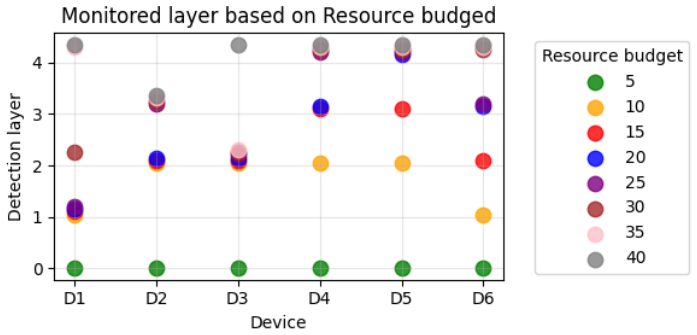
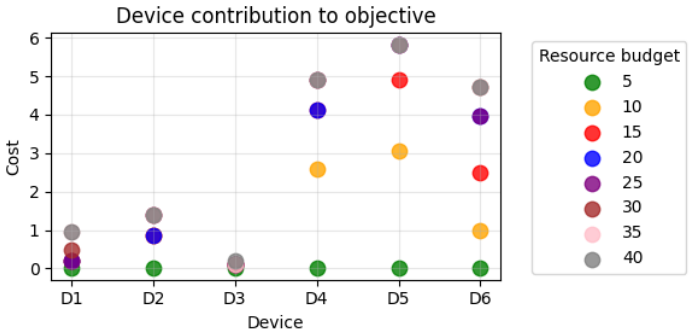
The central claim is that the layered intrusion detection allocation problem can be formulated as an integer linear program that assigns a single monitoring depth to each device. This formulation accounts for device importance, attack probability, layer-dependent detection rates, and per-layer monitoring costs. It further incorporates a global resource budget, minimum monitoring requirements for critical devices, and maximum feasibility limits for constrained devices. The resulting allocation on a small heterogeneous network concentrates monitoring on important and high-risk devices while satisfying all constraints.
What carries the argument
The integer linear program that assigns exactly one monitoring depth per device while enforcing a global budget, minimum levels for critical devices, and feasibility caps for limited devices.
If this is right
- The solved allocation concentrates monitoring effort on important and high-risk devices.
- The global resource budget is respected in the produced allocation.
- Critical devices receive at least the required minimum monitoring level.
- Constrained devices such as simple IoT sensors are assigned only feasible monitoring depths.
Where Pith is reading between the lines
- If the input values can be estimated reliably from network data, the model could guide administrators in trimming monitoring costs across larger systems.
- The same structure might adapt to settings where attack probabilities or device importance shift over time.
- Scaling the formulation to networks with dozens or hundreds of devices would test whether the focus on high-value targets remains effective.
Load-bearing premise
Accurate numerical values exist for device importance, attack probabilities, layer-dependent detection rates, and per-layer monitoring costs that can be supplied as fixed inputs without significant uncertainty.
What would settle it
Measuring actual attack detection rates on a test network using the model's assigned depths versus a uniform or random allocation would show whether the optimized choices improve security outcomes.
Figures
read the original abstract
This paper proposes a resource-aware allocation model for layered intrusion detection in het erogeneous networks. Monitoring traffic at higher protocol layers improves the ability to detect sophisticated attacks, but it also increases computational and storage costs. The problem is formu lated as an integer linear program that assigns a single monitoring depth, ranging from Ethernet to the application layer, to each device, while accounting for device importance, attack probability, layer-dependent detection rates, and per-layer monitoring costs. The model further enforces a global resource budget, a minimum monitoring level for critical devices, and maximum-feasibility limits for constrained devices such as simple IoT sensors. The formulation is solved with the SCIP optimization framework on a small heterogeneous network of six devices, and the resulting allocation illustrates how the model concentrates monitoring effort on important and high-risk devices while respecting feasibility and budget constraints.
Editorial analysis
A structured set of objections, weighed in public.
Referee Report
Summary. The paper proposes a resource-aware allocation model for layered intrusion detection in heterogeneous networks. It formulates the problem as an integer linear program (ILP) that assigns a single monitoring depth (ranging from Ethernet to application layer) to each device, incorporating device importance, attack probability, layer-dependent detection rates, and per-layer monitoring costs. The model enforces a global resource budget, minimum monitoring levels for critical devices, and maximum feasibility limits for constrained devices. The ILP is solved using the SCIP optimization framework on a small heterogeneous network of six devices, with the resulting allocation claimed to concentrate monitoring effort on important and high-risk devices while respecting constraints.
Significance. If validated with sensitivity analysis and larger instances, the ILP formulation could offer a systematic approach to optimizing limited IDS resources across heterogeneous devices with varying risks and capabilities. The integration of multiple factors (importance, probabilities, rates, costs) into a single optimization program is a conceptual strength, and the use of a standard solver like SCIP is appropriate for the presented scale.
major comments (2)
- [Abstract] Abstract: The claim that the allocation 'concentrates monitoring effort on important and high-risk devices' is demonstrated solely via the SCIP solution on one six-device instance. No sensitivity analysis or uncertainty quantification is provided for the externally supplied parameters (device importance weights, attack probabilities, layer-dependent detection rates, per-layer monitoring costs), which are free inputs; small perturbations typical in intrusion-detection settings can alter the optimal assignment, so the concentration result is not a general property of the model.
- [Numerical evaluation] Numerical evaluation: The manuscript reports no error analysis, no comparison to baselines (e.g., uniform allocation, greedy heuristics, or cost-agnostic prioritization), and no scalability tests beyond the toy six-device network. These omissions are load-bearing for assessing whether the ILP produces practically useful allocations.
minor comments (2)
- [Abstract] Abstract contains typographical errors: 'het erogeneous' should read 'heterogeneous' and 'formu lated' should read 'formulated'.
- [Abstract] The abstract describes the resulting allocation but does not include or reference a table/figure listing the per-device monitoring depths chosen by the solver, hindering direct verification of the concentration claim.
Simulated Author's Rebuttal
We thank the referee for the constructive comments on our manuscript. We address each major comment point by point below, indicating where revisions will be made to the next version.
read point-by-point responses
-
Referee: [Abstract] Abstract: The claim that the allocation 'concentrates monitoring effort on important and high-risk devices' is demonstrated solely via the SCIP solution on one six-device instance. No sensitivity analysis or uncertainty quantification is provided for the externally supplied parameters (device importance weights, attack probabilities, layer-dependent detection rates, per-layer monitoring costs), which are free inputs; small perturbations typical in intrusion-detection settings can alter the optimal assignment, so the concentration result is not a general property of the model.
Authors: We agree that the demonstration relies on a single illustrative instance. The abstract uses the phrasing 'illustrates how the model concentrates...' to describe the outcome for the specific six-device case and chosen parameters rather than asserting a general property. We acknowledge that without sensitivity analysis on the input parameters, robustness to typical perturbations cannot be shown. In the revised manuscript we will update the abstract and add a limitations paragraph in the conclusion to explicitly state that the observed concentration is instance-specific and that sensitivity analysis is required to establish generality. revision: yes
-
Referee: [Numerical evaluation] Numerical evaluation: The manuscript reports no error analysis, no comparison to baselines (e.g., uniform allocation, greedy heuristics, or cost-agnostic prioritization), and no scalability tests beyond the toy six-device network. These omissions are load-bearing for assessing whether the ILP produces practically useful allocations.
Authors: We concur that the evaluation section is limited to a feasibility demonstration on one small network without baselines, error analysis, or scalability experiments. The manuscript's primary contribution is the ILP formulation and constraint modeling; the numerical example serves only to show that a feasible solution can be obtained with SCIP. We will revise the manuscript to more clearly frame the numerical results as an illustrative case study, to state the absence of comparative and scalability results as a limitation, and to outline these as directions for future work. revision: yes
Circularity Check
No circularity: standard ILP solved on external parameters
full rationale
The paper defines an integer linear program that assigns monitoring depths subject to a budget and feasibility constraints, with the objective incorporating externally supplied numerical values for device importance, attack probabilities, layer-specific detection rates, and per-layer costs. The central result is the SCIP solver output on a six-device instance. This allocation is produced by the optimizer from the given inputs; it is not obtained by substituting the objective back into itself, by fitting parameters to the same data used for prediction, or by any self-citation chain. No load-bearing step reduces to a tautology or to a prior result authored by the same team. The formulation is therefore self-contained against external benchmarks.
Axiom & Free-Parameter Ledger
free parameters (4)
- device importance weights
- attack probabilities
- layer-dependent detection rates
- per-layer monitoring costs
axioms (2)
- domain assumption The allocation problem can be expressed as a pure integer linear program with linear objective and constraints
- standard math SCIP solver returns a globally optimal solution for the six-device instance
Reference graph
Works this paper leans on
-
[1]
Arp spoofing detection using machine learning classifiers: an experimental study,
S. Majumder, M. K. Deb Barma, and A. Saha, “Arp spoofing detection using machine learning classifiers: an experimental study,”Knowledge and Information Systems, vol. 67, no. 1, pp. 727– 766, 2025
work page 2025
-
[2]
V. Hnamte and J. Hussain, “Enhancing security in software-defined networks: An approach to efficient arp spoofing attacks detection and mitigation,”Telematics and Informatics Reports, vol. 14, p. 100129, 2024
work page 2024
-
[3]
S. Ennaji, F. De Gaspari, D. Hitaj, A. Kbidi, and L. V. Mancini, “Adversarial challenges in network intrusion detection systems: Research insights and future prospects,”IEEE Access, 2025
work page 2025
-
[4]
Energy consumption of on-device machine learning models for iot intrusion detection,
N. Tekin, A. Acar, A. Aris, A. S. Uluagac, and V. C. Gungor, “Energy consumption of on-device machine learning models for iot intrusion detection,”Internet of Things, vol. 21, p. 100670, 2023
work page 2023
-
[5]
Insights into modern intrusion detection strategies for internet of things ecosystems,
B. Isong, O. Kgote, and A. Abu-Mahfouz, “Insights into modern intrusion detection strategies for internet of things ecosystems,”Electronics, vol. 13, no. 12, p. 2370, 2024
work page 2024
-
[6]
S. Liu, Y. Yu, Y. Zong, P. L. Yeoh, L. Guo, B. Vucetic, T. Q. Duong, and Y. Li, “Delay and energy-efficient asynchronous federated learning for intrusion detection in heterogeneous industrial internet of things,”IEEE Internet of Things Journal, vol. 11, no. 8, pp. 14739–14754, 2023
work page 2023
-
[7]
Optimal network intrusion detection assignment in multi- level iot systems,
T.-N. Dao, D. Van Le, and X. N. Tran, “Optimal network intrusion detection assignment in multi- level iot systems,”Computer Networks, vol. 232, p. 109846, 2023
work page 2023
-
[8]
L. Yang and A. Shami, “Toward autonomous and efficient cybersecurity: A multi-objective automl- based intrusion detection system,”IEEE Transactions on Machine Learning in Communications and Networking, vol. 3, pp. 1244–1264, 2025
work page 2025
-
[9]
H. E. Ibrahim, S. M. Badr, and M. A. Shaheen, “Adaptive layered approach using machine learning techniques with gain ratio for intrusion detection systems,”arXiv preprint arXiv:1210.7650, 2012
-
[10]
Scip: Solving constraint integer programs,
T. Achterberg, “Scip: Solving constraint integer programs,”Mathematical Programming Computa- tion, vol. 1, pp. 1–41, 07 2009. 6
work page 2009
discussion (0)
Sign in with ORCID, Apple, or X to comment. Anyone can read and Pith papers without signing in.