One Shot Learning for Edge Detection on Point Clouds
Pith reviewed 2026-05-08 12:29 UTC · model grok-4.3
The pith
A one-shot network learns a point cloud's scanner-specific errors to extract its edges more accurately than general models.
A machine-rendered reading of the paper's core claim, the machinery that carries it, and where it could break.
Core claim
By training OSFENet on a single point cloud with a filtered-KNN-based surface patch representation and an RBF_DoS module, the network learns the target scan's unique data distribution and extracts edges more effectively than networks trained on general data distributions from multiple scanners.
What carries the argument
The filtered-KNN surface patch representation combined with the RBF_DoS module, which together allow the lightweight OSFENet to model scanner-specific sampling errors from only one point cloud.
If this is right
- Edge extraction improves on data from any particular scanner without requiring a large mixed training set.
- The lightweight network supports practical use on real indoor and outdoor point clouds such as S3DIS, Semantic3D, and UrbanBIS.
- Comparative results on the ABC dataset establish superiority over seven existing baselines.
- The filtered-KNN and RBF_DoS components enable one-shot adaptation that captures local geometry for edge detection.
Where Pith is reading between the lines
- The one-shot approach may reduce the data collection burden for other point-cloud tasks such as segmentation or normal estimation when scanner-specific adaptation is needed.
- If the modules prove stable across varying densities, the same filtered-KNN plus RBF_DoS pattern could be tested for quick adaptation on new sensors without retraining from scratch.
- Combining one-shot training with a small set of similar-scanner examples might further improve robustness while still avoiding full multi-scanner datasets.
Load-bearing premise
A single point cloud contains enough information about the scanner's error distribution for the network to learn useful edge features without overfitting to noise or scan-specific artifacts.
What would settle it
If training OSFENet on one scan from a given scanner produces edge detection accuracy on held-out scans from the same scanner that is no higher than a network trained on mixed scanner data, the claimed benefit of one-shot scanner-specific adaptation would be falsified.
Figures






read the original abstract
Each scanner possesses its unique characteristics and exhibits its distinct sampling error distribution. Training a network on a dataset that includes data collected from different scanners is less effective than training it on data specific to a single scanner. Therefore, we present a novel one-shot learning method allowing for edge extraction on point clouds, by learning the specific data distribution of the target point cloud, and thus achieve superior results compared to networks that were trained on general data distributions. More specifically, we present how to train a lightweight network named OSFENet (One-Shot edge Feature Extraction Network), by designing a filtered-KNN-based surface patch representation that supports a one-shot learning framework. Additionally, we introduce an RBF_DoS module, which integrates Radial Basis Function-based Descriptor of the Surface patch, highly beneficial for the edge extraction on point clouds. The advantage of the proposed OSFENet is demonstrated through comparative analyses against 7 baselines on the ABC dataset, and its practical utility is validated by results across diverse real-scanned datasets, including indoor scenes like S3DIS dataset, and outdoor scenes such as the Semantic3D dataset and UrbanBIS dataset.
Editorial analysis
A structured set of objections, weighed in public.
Referee Report
Summary. The paper proposes a novel one-shot learning method for edge extraction on point clouds. It introduces OSFENet, a lightweight network trained on a single target point cloud using a filtered-KNN-based surface patch representation and an RBF_DoS module to learn the scanner-specific sampling error distribution, claiming to outperform networks trained on general data distributions. The method is evaluated on the ABC dataset against 7 baselines and validated on real-scanned datasets including S3DIS, Semantic3D, and UrbanBIS.
Significance. If the one-shot training successfully captures scanner-specific error distributions without overfitting to scene geometry, this could meaningfully advance practical point cloud edge detection by enabling adaptation to individual scanners with minimal data, reducing the need for large multi-scanner training sets in indoor and outdoor applications.
major comments (2)
- Abstract: The central claim that OSFENet 'learn[s] the specific data distribution of the target point cloud' (scanner error) rather than its geometric structures is load-bearing for the reported superiority over general-distribution baselines, but no analysis, ablation, or cross-cloud test from the same scanner is described to show that filtered-KNN patches and the RBF_DoS module separate noise distribution from geometry; this leaves the method open to the overfitting risk noted in the stress-test.
- Abstract (comparative analyses): The claim of superior results against 7 baselines on ABC and across S3DIS/Semantic3D/UrbanBIS is presented without any quantitative metrics, loss function, training details, or description of how one-shot training is applied per target cloud, making it impossible to assess whether the advantage is due to the specific-distribution hypothesis or other factors.
minor comments (1)
- Abstract: The abstract introduces 'filtered-KNN-based surface patch representation' and 'RBF_DoS module' without a one-sentence definition or pointer to the relevant method subsection, which reduces immediate clarity for readers.
Simulated Author's Rebuttal
We thank the referee for the thoughtful and detailed comments, which help clarify the presentation of our one-shot learning approach for point cloud edge detection. We address each major comment below and have revised the manuscript to strengthen the supporting evidence and details.
read point-by-point responses
-
Referee: Abstract: The central claim that OSFENet 'learn[s] the specific data distribution of the target point cloud' (scanner error) rather than its geometric structures is load-bearing for the reported superiority over general-distribution baselines, but no analysis, ablation, or cross-cloud test from the same scanner is described to show that filtered-KNN patches and the RBF_DoS module separate noise distribution from geometry; this leaves the method open to the overfitting risk noted in the stress-test.
Authors: We agree that the manuscript would be strengthened by explicit analysis demonstrating that the learned features capture scanner-specific sampling distributions rather than scene-specific geometry. The filtered-KNN representation and RBF_DoS module were designed precisely to emphasize local surface descriptor distributions while attenuating geometric idiosyncrasies through filtering and radial basis modeling. To directly address the concern, we have added a new ablation subsection that reports performance on multiple point clouds acquired by the same scanner but containing distinct geometries; the consistent edge-detection accuracy across these clouds supports the distribution-learning interpretation. We have also included a brief discussion of the stress-test results and how the one-shot protocol mitigates overfitting. revision: yes
-
Referee: Abstract (comparative analyses): The claim of superior results against 7 baselines on ABC and across S3DIS/Semantic3D/UrbanBIS is presented without any quantitative metrics, loss function, training details, or description of how one-shot training is applied per target cloud, making it impossible to assess whether the advantage is due to the specific-distribution hypothesis or other factors.
Authors: The abstract was written as a concise overview, but we acknowledge that the absence of key quantitative indicators and procedural details limits immediate assessment. The full manuscript reports F1, precision, and recall metrics on the ABC dataset showing consistent gains over the seven baselines, describes the loss as a combination of binary cross-entropy with an edge-aware weighting term, and details the one-shot protocol in Section 3: the network is randomly initialized and trained for a fixed number of epochs solely on filtered-KNN patches extracted from the single target cloud. We have expanded the abstract to include representative quantitative results and a short statement of the training procedure. revision: yes
Circularity Check
No significant circularity detected
full rationale
The paper's central contribution is a new one-shot training procedure for OSFENet that uses a filtered-KNN surface-patch representation and an RBF_DoS descriptor module. These are presented as explicit architectural inventions rather than quantities derived from or fitted to the target result. No equations reduce a claimed prediction to a fitted parameter by construction, no uniqueness theorem is imported from prior self-citations, and no ansatz is smuggled via citation. The superiority claims rest on comparative experiments against seven baselines on ABC, S3DIS, Semantic3D and UrbanBIS; the derivation chain therefore remains self-contained and does not collapse to its own inputs.
Axiom & Free-Parameter Ledger
free parameters (2)
- filtered-KNN parameters
- RBF_DoS hyperparameters
axioms (1)
- domain assumption One-shot learning on a single point cloud can capture the scanner's unique sampling error distribution effectively.
invented entities (2)
-
OSFENet
no independent evidence
-
RBF_DoS module
no independent evidence
Reference graph
Works this paper leans on
-
[1]
Ec-net: An edge- aware point set consolidation network,
L. Yu, X. Li, C.-W. Fu, D. Cohen-Or, and P.-A. Heng, “Ec-net: An edge- aware point set consolidation network,” inComputer Vision – ECCV 2018: 15th European Conference, Munich, Germany, September 8–14, 2018, Proceedings, Part VII. Berlin, Heidelberg: Springer-Verlag, 2018, pp. 398–414
2018
-
[2]
Def: Deep estimation of sharp geometric features in 3d shapes,
A. Matveev, R. Rakhimov, A. Artemov, G. Bobrovskikh, V . Egiazarian, E. Bogomolov, D. Panozzo, D. Zorin, and E. Burnaev, “Def: Deep estimation of sharp geometric features in 3d shapes,”ACM Trans. Graph., vol. 41, no. 4, Jul. 2022
2022
-
[3]
Nerve: Neural volumetric edges for parametric curve extraction from point cloud,
X. Zhu, D. Du, W. Chen, Z. Zhao, Y . Nie, and X. Han, “Nerve: Neural volumetric edges for parametric curve extraction from point cloud,” in 2023 IEEE Conference on Computer Vision and Pattern Recognition (CVPR). Piscataway, NJ, USA: IEEE, 2023, pp. 13 601–13 610
2023
-
[4]
Urban- bis: a large-scale benchmark for fine-grained urban building instance segmentation,
G. Yang, F. Xue, Q. Zhang, K. Xie, C.-W. Fu, and H. Huang, “Urban- bis: a large-scale benchmark for fine-grained urban building instance segmentation,” inACM SIGGRAPH 2023 Conference Proceedings, ser. SIGGRAPH ’23. New York, NY , USA: Association for Computing Machinery, 2023
2023
-
[5]
Semantic3D.net: A new Large-scale Point Cloud Classification Benchmark
T. Hackel, N. Savinov, L. Ladicky, J. D. Wegner, K. Schindler, and M. Pollefeys, “Semantic3d.net: A new large-scale point cloud classifi- cation benchmark,”ArXiv, vol. abs/1704.03847, pp. 837–841, 2017
work page Pith review arXiv 2017
-
[6]
The orthogonal gradients method: A radial basis functions method for solving partial differential equations on arbitrary surfaces,
C. Piret, “The orthogonal gradients method: A radial basis functions method for solving partial differential equations on arbitrary surfaces,” Journal of Computational Physics, vol. 231, no. 14, pp. 4662–4675, Mar. 2012
2012
-
[7]
Generalized moving least squares vs. radial basis function finite difference methods for approximating surface derivatives,
A. M. Jones, P. A. Bosler, P. A. Kuberry, and G. B. Wright, “Generalized moving least squares vs. radial basis function finite difference methods for approximating surface derivatives,”Computers & Mathematics with Applications, vol. 147, pp. 1–13, Jul. 2023
2023
-
[8]
Abc: A big cad model dataset for geometric deep learning,
S. Koch, A. Matveev, Z. Jiang, F. Williams, A. Artemov, E. Burnaev, M. Alexa, D. Zorin, and D. Panozzo, “Abc: A big cad model dataset for geometric deep learning,” inProceedings of the IEEE/CVF Conference on Computer Vision and Pattern Recognition (CVPR). Piscataway, NJ, USA: IEEE, Jun. 2019, pp. 9593–9603
2019
-
[9]
Feature extraction from point clouds,
S. Gumhold, X. Wang, and R. MacLeod, “Feature extraction from point clouds,” inProceedings of the 10th international meshing roundtable, 2001, pp. 293–305
2001
-
[10]
Detection of closed sharp edges in point clouds using normal estimation and graph theory,
K. Demarsin, D. Vanderstraeten, T. V olodine, and D. Roose, “Detection of closed sharp edges in point clouds using normal estimation and graph theory,”Comput. Aided Des., vol. 39, no. 4, pp. 276–283, Apr. 2007
2007
-
[11]
Fast and robust edge ex- traction in unorganized point clouds,
D. Bazazian, J. R. Casas, and J. Ruiz-Hidalgo, “Fast and robust edge ex- traction in unorganized point clouds,” in2015 International Conference on Digital Image Computing: Techniques and Applications (DICTA). Piscataway, NJ, USA: IEEE, Nov. 2015, pp. 1–8
2015
-
[12]
Multi-scale feature extraction on point-sampled surfaces,
M. Pauly, R. Keiser, and M. Gross, “Multi-scale feature extraction on point-sampled surfaces,”Computer Graphics Forum, vol. 22, no. 3, pp. 281–289, Nov. 2003
2003
-
[13]
A statistical approach for extraction of feature lines from point clouds,
Y . Zhang, G. Geng, X. Wei, S. Zhang, and S. Li, “A statistical approach for extraction of feature lines from point clouds,”Computers & Graphics, vol. 56, pp. 31–45, May 2016
2016
-
[14]
Sharp feature detection in point clouds,
C. Weber, S. Hahmann, and H. Hagen, “Sharp feature detection in point clouds,” inProceedings of the 2010 Shape Modeling International Conference, ser. SMI ’10. USA: IEEE Computer Society, 2010, pp. 175–186
2010
-
[15]
Multiscale feature line extraction from raw point clouds based on local surface variation and anisotropic contraction,
H. Chen, Y . Huang, Q. Xie, Y . Liu, Y . Zhang, M. Wei, and J. Wang, “Multiscale feature line extraction from raw point clouds based on local surface variation and anisotropic contraction,”IEEE Transactions on Automation Science and Engineering, vol. 19, no. 2, pp. 1003–1016, Apr. 2022
2022
-
[16]
Sglbp: Subgraph-based local binary patterns for feature extraction on point clouds,
B. Guo, Y . Zhang, J. Gao, C. Li, and Y . Hu, “Sglbp: Subgraph-based local binary patterns for feature extraction on point clouds,”Computer Graphics Forum, vol. 41, no. 6, pp. 51–66, Apr. 2022
2022
-
[17]
Line segment extraction for large scale unorganized point clouds,
Y . Lin, C. Wang, J. Cheng, B. Chen, F. Jia, Z. Chen, and J. Li, “Line segment extraction for large scale unorganized point clouds,”ISPRS Journal of Photogrammetry and Remote Sensing, vol. 102, pp. 172– 183, Apr. 2015
2015
-
[18]
Pie-net: Parametric inference of point cloud edges,
X. Wang, Y . Xu, K. Xu, A. Tagliasacchi, B. Zhou, A. Mahdavi-Amiri, and H. Zhang, “Pie-net: Parametric inference of point cloud edges,” in Proceedings of the 34th International Conference on Neural Information Processing Systems, ser. NIPS’20. Red Hook, NY , USA: Curran Associates Inc., 2020
2020
-
[19]
Learning part boundaries from 3d point clouds,
M. Loizou, M. Averkiou, and E. Kalogerakis, “Learning part boundaries from 3d point clouds,”Computer Graphics Forum, vol. 39, no. 5, pp. 183–195, Aug. 2020. IEEE TRANSACTIONS ON VISUALIZATION AND COMPUTER GRAPHICS 12
2020
-
[20]
Jsenet: Joint semantic segmentation and edge detection network for 3d point clouds,
Z. Hu, M. Zhen, X. Bai, H. Fu, and C.-l. Tai, “Jsenet: Joint semantic segmentation and edge detection network for 3d point clouds,” inCom- puter Vision – ECCV 2020. Cham: Springer International Publishing, 2020, pp. 222–239
2020
-
[21]
Edc-net: Edge detection capsule network for 3d point clouds,
D. Bazazian and M. E. Par ´es, “Edc-net: Edge detection capsule network for 3d point clouds,”Applied Sciences, vol. 11, no. 4, p. 1833, Feb. 2021
2021
-
[22]
Surface and edge detection for primitive fitting of point clouds,
Y . Li, S. Liu, X. Yang, J. Guo, J. Guo, and Y . Guo, “Surface and edge detection for primitive fitting of point clouds,” inProceedings of the 18th Meeting of the ACM SIGGRAPH, ser. SIGGRAPH ’23. New York, NY , USA: ACM, 2023, pp. 8486–8495
2023
-
[23]
Pcednet: A lightweight neural network for fast and interactive edge detection in 3d point clouds,
C.-E. Himeur, T. Lejemble, T. Pellegrini, M. Paulin, L. Barthe, and N. Mellado, “Pcednet: A lightweight neural network for fast and interactive edge detection in 3d point clouds,”ACM Trans. Graph., vol. 41, no. 1, Nov. 2021
2021
-
[24]
Bounded: Neural boundary and edge detection in 3d point clouds via local neighborhood statistics,
L. Bode, M. Weinmann, and R. Klein, “Bounded: Neural boundary and edge detection in 3d point clouds via local neighborhood statistics,” ISPRS Journal of Photogrammetry and Remote Sensing, vol. 205, pp. 334–351, 2022
2022
-
[25]
Deep shape represen- tation with sharp feature preservation,
Y .-F. Feng, L.-Y . Shen, C.-M. Yuan, and X. Li, “Deep shape represen- tation with sharp feature preservation,”Comput. Aided Des., vol. 157, p. 103468, Apr. 2023
2023
-
[26]
Nef: Neural edge fields for 3d parametric curve reconstruction from multi-view images,
Y . Ye, R. Yi, Z. Gao, C. Zhu, Z. Cai, and K. Xu, “Nef: Neural edge fields for 3d parametric curve reconstruction from multi-view images,” in2023 IEEE Conference on Computer Vision and Pattern Recognition (CVPR). Piscataway, NJ, USA: IEEE, 2023, pp. 8486–8495
2023
-
[27]
Msl-net: Sharp feature detection network for 3d point clouds,
X. Jiao, C. Lv, R. Yi, J. Zhao, Z. Pan, Z. Wu, and Y . Liu, “Msl-net: Sharp feature detection network for 3d point clouds,”IEEE Transactions on Visualization and Computer Graphics, pp. 1–15, Dec. 2023
2023
-
[28]
Variational progressive-iterative approximation for rbf-based surface reconstruc- tion,
L. Shengjun, L. Tao, H. Ling, S. Yuanyuan, and X. Liu, “Variational progressive-iterative approximation for rbf-based surface reconstruc- tion,”The Visual Computer, vol. 37, pp. 2485–2497, Sep. 2021
2021
-
[29]
Rps-net: Indoor scene point cloud completion using rbf-point sparse convolution,
T. Wang, J. Wu, Z. Ji, and Y .-K. Lai, “Rps-net: Indoor scene point cloud completion using rbf-point sparse convolution,” inComputer Graphics and Visual Computing (CGVC). Geneva, Switzerland: The Eurographics Association, 2023
2023
-
[30]
The perfect match: 3d point cloud matching with smoothed densities,
Z. Gojcic, C. Zhou, J. D. Wegner, and A. Wieser, “The perfect match: 3d point cloud matching with smoothed densities,” in2019 IEEE/CVF Conference on Computer Vision and Pattern Recognition (CVPR). Pis- cataway, NJ, USA: IEEE, 2019, pp. 5540–5549
2019
-
[31]
The perfect match: 3d point cloud matching with smoothed densities,
——, “The perfect match: 3d point cloud matching with smoothed densities,” in2019 IEEE/CVF Conference on Computer Vision and Pattern Recognition (CVPR), 2019, pp. 5540–5549
2019
-
[32]
Learning compact geometric features,
M. Khoury, Q.-Y . Zhou, and V . Koltun, “Learning compact geometric features,” in2017 IEEE International Conference on Computer Vision (ICCV), 2017, pp. 153–161
2017
-
[33]
Attention is all you need,
A. Vaswani, N. Shazeer, N. Parmar, J. Uszkoreit, L. Jones, A. N. Gomez, L. u. Kaiser, and I. Polosukhin, “Attention is all you need,” in Proceedings of the 31st International Conference on Neural Information Processing Systems, ser. NIPS’17. Marshfield, MA, USA: Curran Associates, Inc., 2017, p. 6000–6010
2017
-
[34]
Feature Curve Extraction on Triangle Meshes,
E. Moscoso Thompson, G. Arvanitis, S. Biasotti, B. FALCIDIENO, K. Moustakas, N. Hoang-Xuan, E. R. Nguyen, M. Tran, T. Lejemble, L. Barthe, N. Mellado, and C. Romanengo, “Feature Curve Extraction on Triangle Meshes,” inEurographics Workshop on 3D Object Retrieval, S. Biasotti, G. Lavou ´e, and R. Veltkamp, Eds. The Eurographics Association, 2019
2019
-
[35]
3d semantic parsing of large-scale indoor spaces,
I. Armeni, O. Sener, A. Zamir, H. Jiang, I. K. Brilakis, M. Fischer, and S. Savarese, “3d semantic parsing of large-scale indoor spaces,” in2016 IEEE Conference on Computer Vision and Pattern Recognition (CVPR). Piscataway, NJ, USA: IEEE, 2016, pp. 1534–1543
2016
-
[36]
The pipeline from cad to virtual reality in visionair project,
S. Gagliardo, F. Giannini, M. Monti, S. Mottura, and M. Pitikakis, “The pipeline from cad to virtual reality in visionair project,” inInformatik
-
[37]
1985–1988
Bonn: Gesellschaft f ¨ur Informatik e.V ., 2014, pp. 1985–1988
2014
-
[38]
Turbosquid: 3d models for professionals,
M. Wisdom, “Turbosquid: 3d models for professionals,” TurboSquid, accessed Aug. 4, 2024. [Online]. Available: https://www.turbosquid. com/
2024
-
[39]
3d is here: Point cloud library (pcl),
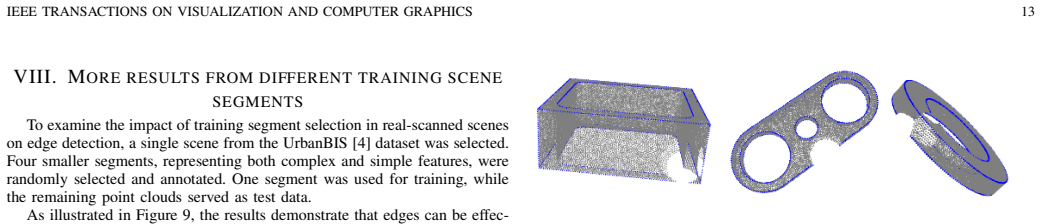
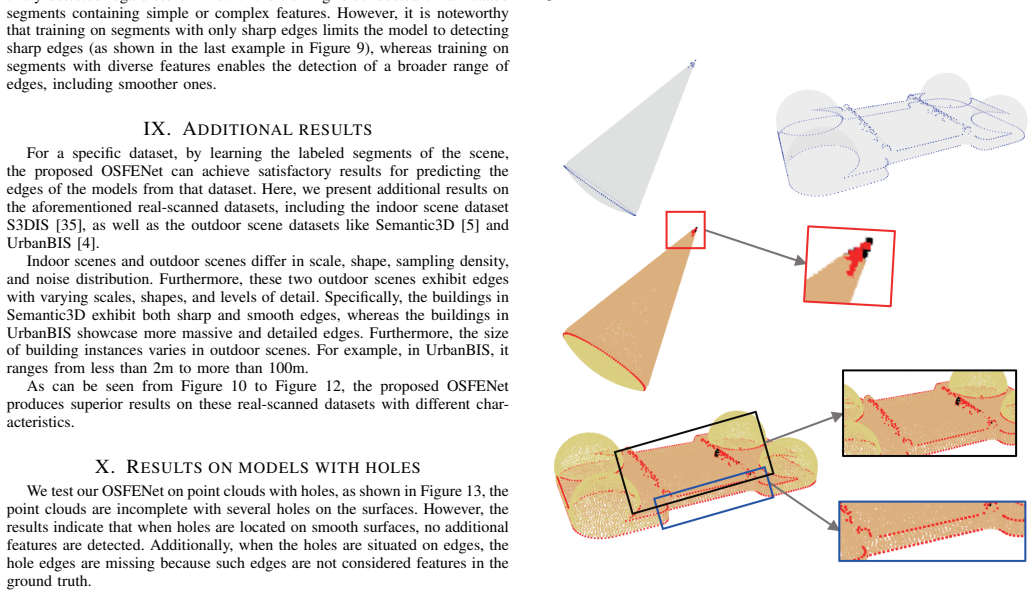
R. B. Rusu and S. Cousins, “3d is here: Point cloud library (pcl),” in2011 IEEE International Conference on Robotics and Automation. Piscataway, NJ, USA: IEEE, 2011, pp. 1–4. IEEE TRANSACTIONS ON VISUALIZATION AND COMPUTER GRAPHICS 13 VIII. MORE RESULTS FROM DIFFERENT TRAINING SCENE SEGMENTS To examine the impact of training segment selection in real-scan...
2011
discussion (0)
Sign in with ORCID, Apple, or X to comment. Anyone can read and Pith papers without signing in.