Covariant Onsager and Onsager-Machlup principles for active and inertial dynamics
Pith reviewed 2026-05-08 09:29 UTC · model grok-4.3
The pith
Covariant Onsager-Machlup principle ensures thermodynamic consistency for active inertial dynamics.
A machine-rendered reading of the paper's core claim, the machinery that carries it, and where it could break.
Core claim
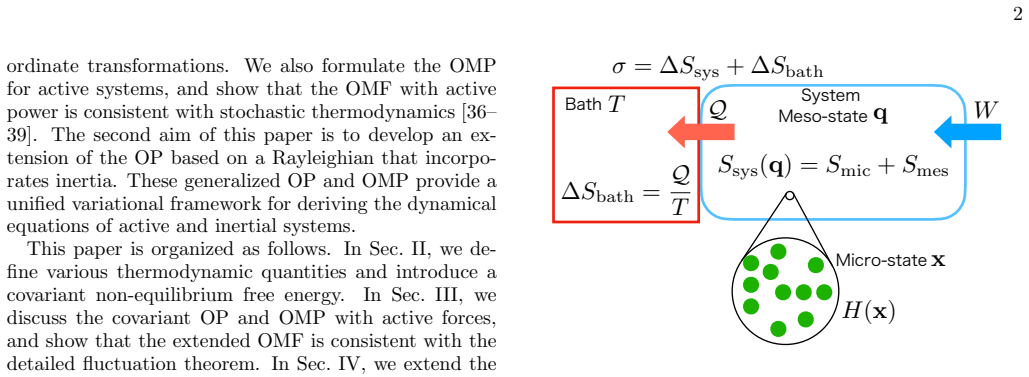
Requiring that the path probability obeys the detailed fluctuation theorem, we show that the extended Onsager-Machlup theory is consistent with stochastic thermodynamics. Moreover, we incorporate inertia into the variational framework and show that the proper covariant equations follow when the covariant acceleration is held fixed during the variation.
What carries the argument
The covariant Onsager-Machlup functional, whose minimization subject to the detailed fluctuation theorem and fixed covariant acceleration produces the governing equations.
If this is right
- Phenomenological equations for active dissipative systems are obtained by minimizing a covariant Rayleighian.
- Fluctuating path probabilities automatically satisfy thermodynamic relations such as the detailed fluctuation theorem.
- Inertial terms enter the dynamics while geometric covariance under coordinate transformations is preserved.
- The same variational structure unifies deterministic active dynamics, fluctuations, and inertia.
Where Pith is reading between the lines
- The same covariance requirement could be applied to derive consistent equations in other dissipative systems that live on manifolds.
- Path-sampling algorithms built on this functional might generate trajectories that automatically obey both activity and inertia constraints.
- The approach suggests a route to variational formulations for active particles in curved geometries or under external flows.
Load-bearing premise
The path probability for stochastic trajectories is required to obey the detailed fluctuation theorem in order to establish consistency with stochastic thermodynamics.
What would settle it
Direct numerical sampling of trajectory probabilities from the underlying active inertial stochastic differential equations and explicit verification that they satisfy the detailed fluctuation theorem predicted by the variational principle.
Figures
read the original abstract
The Onsager principle provides a variational route to the phenomenological equations of dissipative dynamics through the minimization of the Rayleighian. We develop a covariant formulation of the Onsager principle for active systems, ensuring geometric consistency under coordinate transformations. To further incorporate thermal fluctuations, we formulate the Onsager-Machlup principle for active systems by considering the Onsager-Machlup functional and the corresponding path probability for stochastic trajectories. Requiring that the path probability obeys the detailed fluctuation theorem, we show that the extended Onsager-Machlup theory is consistent with stochastic thermodynamics. Moreover, we incorporate inertia into the variational framework and show that the proper covariant equations follow when the covariant acceleration is held fixed during the variation.
Editorial analysis
A structured set of objections, weighed in public.
Referee Report
Summary. The manuscript develops a covariant formulation of the Onsager principle for active systems via minimization of a Rayleighian, extends this to an Onsager-Machlup functional whose associated path measure encodes thermal fluctuations, and asserts consistency with stochastic thermodynamics by requiring that the path probability satisfy the detailed fluctuation theorem. It further incorporates inertia by performing variations while holding the covariant acceleration fixed, claiming that this yields the correct covariant inertial equations.
Significance. A self-consistent covariant variational framework that unifies active, fluctuating, and inertial dynamics would be valuable for geometric treatments of stochastic thermodynamics in soft matter. The work's potential impact is reduced by the fact that consistency is obtained through an imposed external constraint (the fluctuation theorem) rather than derived from the variational principle itself; if this imposition is not tautological, the result could provide a useful route to fluctuation theorems in active systems.
major comments (2)
- [Abstract / Onsager-Machlup derivation] Abstract and the section deriving consistency with stochastic thermodynamics: the central claim that 'requiring that the path probability obeys the detailed fluctuation theorem' establishes consistency is load-bearing, yet the manuscript does not demonstrate that the Onsager-Machlup functional is selected independently of this requirement. If the functional is constructed so that P[forward]/P[reverse] = exp(ΔS) holds identically, the consistency follows by construction rather than from covariance or the variational principle; an explicit check that the functional emerges first and then satisfies the theorem (or a counter-example where it fails) is needed.
- [Inertial dynamics section] The inertial extension (section on incorporation of inertia): holding the covariant acceleration fixed during the variation is presented as yielding the 'proper covariant equations,' but no explicit comparison is given to the standard covariant Langevin equation or to the known form of inertial active Brownian motion. Without this verification, it is unclear whether additional geometric terms are omitted or introduced by the fixed-acceleration constraint.
minor comments (1)
- [Notation and definitions] Notation for the covariant acceleration and the precise definition of the Rayleighian under coordinate transformations should be stated explicitly in the main text rather than deferred to appendices, to allow immediate verification of covariance.
Simulated Author's Rebuttal
We thank the referee for the careful reading of our manuscript and the constructive comments. We address the major comments point by point below and outline the revisions we will make to strengthen the paper.
read point-by-point responses
-
Referee: [Abstract / Onsager-Machlup derivation] Abstract and the section deriving consistency with stochastic thermodynamics: the central claim that 'requiring that the path probability obeys the detailed fluctuation theorem' establishes consistency is load-bearing, yet the manuscript does not demonstrate that the Onsager-Machlup functional is selected independently of this requirement. If the functional is constructed so that P[forward]/P[reverse] = exp(ΔS) holds identically, the consistency follows by construction rather than from covariance or the variational principle; an explicit check that the functional emerges first and then satisfies the theorem (or a counter-example where it fails) is needed.
Authors: We agree that the independence of the functional derivation from the fluctuation theorem requirement needs to be clarified. The Onsager-Machlup functional is obtained by extending the covariant Rayleighian minimization to include stochastic paths, based solely on the geometric and variational principles for active dynamics. The detailed fluctuation theorem is then imposed as a consistency condition with stochastic thermodynamics, which selects the appropriate noise correlator or confirms the form. This is not by construction in the sense that the variational principle could in principle yield other functionals, but the theorem ensures thermodynamic consistency. We will revise the manuscript to include an explicit step-by-step derivation showing the functional prior to the theorem application, and provide a brief discussion of what would happen if the theorem were not satisfied. This addresses the concern directly. revision: yes
-
Referee: [Inertial dynamics section] The inertial extension (section on incorporation of inertia): holding the covariant acceleration fixed during the variation is presented as yielding the 'proper covariant equations,' but no explicit comparison is given to the standard covariant Langevin equation or to the known form of inertial active Brownian motion. Without this verification, it is unclear whether additional geometric terms are omitted or introduced by the fixed-acceleration constraint.
Authors: The referee correctly identifies that an explicit verification against known equations is necessary. In our approach, fixing the covariant acceleration during the variation ensures that the inertial terms transform correctly as a tensor, avoiding non-covariant artifacts. To demonstrate this, we will add a new subsection comparing our derived equations to the standard covariant inertial Langevin equation for active particles (e.g., the one with covariant derivatives and appropriate noise terms for active Brownian motion with inertia). We show that they coincide, with the fixed-acceleration constraint preventing the introduction of spurious geometric terms that would arise from naive variations. This verification will be included in the revised version. revision: yes
Circularity Check
No circularity: external fluctuation theorem used to validate consistency, independent of variational construction.
full rationale
The derivation begins from the standard Onsager variational principle, extends it covariantly for active systems, and formulates the Onsager-Machlup functional for path probabilities. Consistency with stochastic thermodynamics is established by imposing the detailed fluctuation theorem as an external requirement on the path probability, rather than deriving the theorem from the functional or fitting parameters to force it. The inertial extension follows from holding covariant acceleration fixed in the variation. No self-definitional loops, fitted inputs renamed as predictions, or load-bearing self-citations appear in the chain; the DFT is a standard external benchmark from stochastic thermodynamics, not constructed within the paper's ansatz.
Axiom & Free-Parameter Ledger
axioms (3)
- domain assumption The Onsager principle applies to active dissipative systems via minimization of a suitably defined Rayleighian.
- domain assumption Path probabilities for stochastic trajectories must obey the detailed fluctuation theorem.
- domain assumption Covariant acceleration is the appropriate quantity to hold fixed during variation when including inertia.
Reference graph
Works this paper leans on
-
[1]
Onsager, Reciprocal relations in irreversible processes
L. Onsager, Reciprocal relations in irreversible processes. I.,Phys. Rev.37, 405 (1931)
1931
-
[2]
Onsager, Reciprocal relations in irreversible processes
L. Onsager, Reciprocal relations in irreversible processes. II.,Phys. Rev.38, 2265 (1931)
1931
-
[3]
Doi,Soft Matter Physics(Oxford University Press, Oxford, 2013)
M. Doi,Soft Matter Physics(Oxford University Press, Oxford, 2013)
2013
-
[4]
Kubo, Statistical-Mechanical Theory of Irreversible Processes
R. Kubo, Statistical-Mechanical Theory of Irreversible Processes. I. General Theory and Simple Applications to Magnetic and Conduction Problems,J. Phys. Soc. Jpn. 12, 570 (1957)
1957
-
[5]
Kubo and M
R. Kubo and M. Yokota, Statistical-Mechanical Theory of Irreversible Processes. II. Response to Thermal Dis- turbance,J. Phys. Soc. Jpn.12, 1203 (1957)
1957
-
[6]
Doi, Onsager’s variational principle in soft matter,J
M. Doi, Onsager’s variational principle in soft matter,J. Phys.: Cond. Mat.23, 284118 (2011)
2011
-
[7]
Zhou and M
J. Zhou and M. Doi, Dynamics of viscoelastic filaments based on Onsager principle,Phys. Rev. Fluids3, 084004 (2018)
2018
-
[8]
Doi, Onsager principle in polymer dynamics,Prog
M. Doi, Onsager principle in polymer dynamics,Prog. Polym. Sci.112, 101339 (2021)
2021
-
[9]
X. Xu, U. Thiele, and T. Qian, A Variational approach to thin film hydrodynamics of binary mixtures,J. Phys.: Cond. Mat.27, 085005 (2015)
2015
-
[10]
Fournier, On the hydrodynamics of bilayer mem- branes,Int
J.-B. Fournier, On the hydrodynamics of bilayer mem- branes,Int. J. Non-Linear Mech.75, 67 (2015)
2015
-
[11]
Okamoto, Y
R. Okamoto, Y. Kanemori, S. Komura, and J.-B. Fournier, Relaxation dynamics of two-component fluid bilayer membranes,Eur. Phys. J. E39, 52 (2016)
2016
-
[12]
Oya and T
Y. Oya and T. Kawakatsu, Onsager’s variational princi- ple for the dynamics of a vesicle in a Poiseuille flow,J. Chem. Phys.148, 114905 (2018)
2018
-
[13]
Man and M
X. Man and M. Doi, Vapor-induced motion of liquid droplets on an inert substrate,Phys. Rev. Lett.119, 044502 (2017)
2017
-
[14]
S. Hu, Y. Wang, X. Man, and M. Doi, Deposition pat- terns of two neighboring droplets: Onsager variational principle studies,Langmuir33, 5965 (2017)
2017
-
[15]
Zhang, M
Y.-H. Zhang, M. Deserno, and Z.-C. Tu, Dynamics of active nematic defects on the surface of a sphere,Phys. Rev. E102, 012607 (2020)
2020
-
[16]
H. Wang, T. Qian, and X. Xu, Onsager’s variational prin- ciple in active soft matter,Soft Matter17, 3634 (2021)
2021
-
[17]
Ackermann and M
J. Ackermann and M. B. Amar, Onsager’s variational principle in proliferating biological tissues, in the pres- ence of activity and anisotropy,Eur. Phys. J. Plus138, 1103 (2023)
2023
-
[18]
Onsager and S
L. Onsager and S. Machlup, Fluctuations and irreversible processes,Phys. Rev.91, 1505 (1953)
1953
-
[19]
Machlup and L
S. Machlup and L. Onsager, Fluctuations and irreversible processes. II. Systems with kinetic energy,Phys. Rev.91, 1512 (1953)
1953
-
[20]
M. Doi, J. Zhou, Y. Di, and X. Xu, Application of the Onsager-Machlup integral in solving dynamic equations in nonequilibrium systems,Phys. Rev. E99, 063303 (2019)
2019
-
[21]
Taniguchi and E
T. Taniguchi and E. G. D. Cohen, Onsager-Machlup the- ory for nonequilibrium steady states and fluctuation the- orems,J. Stat. Phys.126, 1 (2007)
2007
-
[22]
Taniguchi and E
T. Taniguchi and E. G. D. Cohen, Inertial Effects in Nonequilibrium Work Fluctuations by a Path Integral Approach,J. Stat. Phys.130, 1 (2008)
2008
-
[23]
Zuckerman,Statistical Physics of Biomolecules: An Introduction(CRC Press, Boca Raton, FL, 2010)
D. Zuckerman,Statistical Physics of Biomolecules: An Introduction(CRC Press, Boca Raton, FL, 2010)
2010
-
[24]
J. Wang, K. Zhang, and E. Wang, Kinetic paths, time scale, and underlying landscapes: A path integral frame- work to study global natures of nonequilibrium systems and networks,J. Chem. Phys.133, 125103 (2010)
2010
- [25]
-
[26]
Yasuda, K
K. Yasuda, K. Ishimoto, and S. Komura, Statistical for- mulation of Onsager-Machlup variational principle,Phys. Rev. E110, 044104 (2024)
2024
-
[27]
Yasuda, A
K. Yasuda, A. Kobayashi, L.-S. Lin, Y. Hosaka, I. Sou, and S. Komura, The Onsager-Machlup integral for non- reciprocal systems with odd elasticity,J. Phys. Soc. Jpn. 91, 015001 (2022)
2022
-
[28]
Yasuda, Irreversibility of stochastic state transitions in Langevin systems with odd elasticity,Phys
K. Yasuda, Irreversibility of stochastic state transitions in Langevin systems with odd elasticity,Phys. Rev. E 109, 064116 (2024)
2024
-
[29]
Yasuda and K
K. Yasuda and K. Ishimoto, Most probable path of an ac- tive Brownian particle,Phys. Rev. E106, 064120 (2022)
2022
- [30]
-
[31]
Demon's variational principle for informational active matter
K. Yasuda, K. Ishimoto, and S. Komura, Demon’s vari- ational principle for informational active matter, unpub- lished, arXiv:2510.13145 (2025)
work page internal anchor Pith review Pith/arXiv arXiv 2025
-
[32]
Uneyama, Dissipation in Langevin Equation and Con- struction of Mobility Tensor from Dissipative Heat Flow, Nihon Reoroji Gakkaishi48, 65 (2020)
T. Uneyama, Dissipation in Langevin Equation and Con- struction of Mobility Tensor from Dissipative Heat Flow, Nihon Reoroji Gakkaishi48, 65 (2020)
2020
-
[33]
Nakamura, Derivation of the Invariant Free-Energy Landscape Based on Langevin Dynamics,Phys
T. Nakamura, Derivation of the Invariant Free-Energy Landscape Based on Langevin Dynamics,Phys. Rev. Lett.132, 137101 (2024)
2024
-
[34]
Wang, Generalized Onsager Principle and Its Appli- cations, inFrontiers and Progress of Current Soft Matter Research, ed
Q. Wang, Generalized Onsager Principle and Its Appli- cations, inFrontiers and Progress of Current Soft Matter Research, ed. X.-Y. Liu, pp. 101 (Springer, Singapore, 2020). 9
2020
-
[35]
Xiao and C.-X
K. Xiao and C.-X. Wu, Time-dependent invasion laws for a liquid-liquid displacement system,Phys. Fluids36, 072105 (2024)
2024
-
[36]
Sekimoto,Stochastic EnergeticsLecture Notes in Physics (Springer, Berlin & Heidelberg, 2010)
K. Sekimoto,Stochastic EnergeticsLecture Notes in Physics (Springer, Berlin & Heidelberg, 2010)
2010
-
[37]
Peliti and S
L. Peliti and S. Pigolotti,Stochastic Thermodynamics: An Introduction(Princeton University Press, Princeton, NJ, 2021)
2021
-
[38]
Shiraishi,An Introduction to Stochastic Thermody- namics: From Basic to AdvancedFundamental Theories of Physics (Springer-Nature, Singapore, 2023)
N. Shiraishi,An Introduction to Stochastic Thermody- namics: From Basic to AdvancedFundamental Theories of Physics (Springer-Nature, Singapore, 2023)
2023
-
[39]
Seifert,Stochastic Thermodynamics(Cambridge Uni- versity Press, Cambridge, 2025)
U. Seifert,Stochastic Thermodynamics(Cambridge Uni- versity Press, Cambridge, 2025)
2025
-
[40]
Esposito, Stochastic thermodynamics under coarse graining,Phys
M. Esposito, Stochastic thermodynamics under coarse graining,Phys. Rev. E85, 041125 (2012)
2012
-
[41]
Maruyama, F
K. Maruyama, F. Nori, and V. Vedral, Colloquium: The physics of Maxwell’s demon and information,Rev. Mod. Phys.81, 1 (2009)
2009
-
[42]
J. M. R. Parrondo, J. M. Horowitz, and T. Sagawa, Ther- modynamics of information,Nature Phys.11, 131 (2015)
2015
-
[43]
Goldstein, C
H. Goldstein, C. P. Poole, and J. L. Safko,Classical Me- chanics, 3rd ed. (Addison-Wesley, San Francisco, 2001)
2001
-
[44]
Graham, Covariant formulation of non-equilibrium statistical thermodynamics,Z
R. Graham, Covariant formulation of non-equilibrium statistical thermodynamics,Z. Phys. B26, 397 (1977)
1977
-
[45]
Graham, Path integral formulation of general diffusion processes,Z
R. Graham, Path integral formulation of general diffusion processes,Z. Phys. B26, 281 (1977)
1977
-
[46]
Dekker, On the path integral for diffusion in curved spaces,Physica A103, 586 (1980)
H. Dekker, On the path integral for diffusion in curved spaces,Physica A103, 586 (1980)
1980
-
[47]
van Saarloos, V
W. van Saarloos, V. Vitelli, and Z. Zeravcic,Soft Mat- ter: Concepts, Phenomena, and Applications(Princeton University Press, Princeton, NJ, 2024)
2024
-
[48]
Seifert, Stochastic thermodynamics, fluctuation the- orems and molecular machines,Rep
U. Seifert, Stochastic thermodynamics, fluctuation the- orems and molecular machines,Rep. Prog. Phys.75, 126001 (2012)
2012
-
[49]
R. M. Wald,General Relativity(University of Chicago Press, Chicago, 1984)
1984
-
[50]
Romanczuk, M
P. Romanczuk, M. B¨ ar, W. Ebeling, B. Lindner, and L. Schimansky-Geier, Active Brownian particles,Eur. Phys. J. Spec. Top.202, 1 (2012)
2012
-
[51]
L.-S. Lin, K. Yasuda, K. Ishimoto, Y. Hosaka, and S. Komura, Onsager’s variational principle for nonrecipro- cal systems with odd elasticity,J. Phys. Soc. Jpn.92, 033001 (2023)
2023
-
[52]
Ohta, Brownian Motion on a Fluctuating Random Geometry,J
T. Ohta, Brownian Motion on a Fluctuating Random Geometry,J. Phys. Soc. Jpn.89, 074001 (2020)
2020
-
[53]
Ohta and S
T. Ohta and S. Komura, Lateral diffusion on a frozen random surface,EPL132, 50007 (2020)
2020
-
[54]
Nardini, ´E Fodor, E
C. Nardini, ´E Fodor, E. Tjhung, F. van Wijland, J. Tailleur, and M. E. Cates, Entropy Production in Field Theories without Time-Reversal Symmetry: Quantifying the Non-Equilibrium Character of Active Matter,Phys. Rev. X7, 021007(2017)
2017
-
[55]
VanSaders, M
B. VanSaders, M. Fruchart, and V. Vitelli, Measurement- induced phase transitions in informational active matter, PNAS Nexus5, pgag077 (2026)
2026
discussion (0)
Sign in with ORCID, Apple, or X to comment. Anyone can read and Pith papers without signing in.