Odd pathways speed up self-assembly
Pith reviewed 2026-05-08 09:21 UTC · model grok-4.3
The pith
Non-reciprocal odd interactions accelerate self-assembly by enhancing barrier crossing rates while preserving the equilibrium Boltzmann distribution.
A machine-rendered reading of the paper's core claim, the machinery that carries it, and where it could break.
Core claim
Non-reciprocal odd interactions induce probability currents that reshape activated barrier crossing, soft-mode relaxation, and transitions between metastable states. These currents enhance Arrhenius rates by driving particles across otherwise inaccessible free-energy barriers. The acceleration arises from an effective increase in the mobility of the reaction coordinate, mediated by non-reciprocal coupling between mechanical modes. A trade-off exists between this kinetic acceleration and the power dissipation incurred when the active forces are engaged.
What carries the argument
Probability currents from odd non-reciprocal interactions, which increase the effective mobility of the reaction coordinate through non-reciprocal coupling between mechanical modes.
Load-bearing premise
Non-reciprocal odd interactions can be engineered so that the induced currents accelerate barrier crossing while exactly preserving the equilibrium Boltzmann distribution and leaving the target structures undistorted.
What would settle it
An experiment or simulation in which odd interactions are introduced, the final structures remain identical to the equilibrium case, yet the measured assembly or relaxation time shows no reduction compared to the passive system.
Figures


read the original abstract
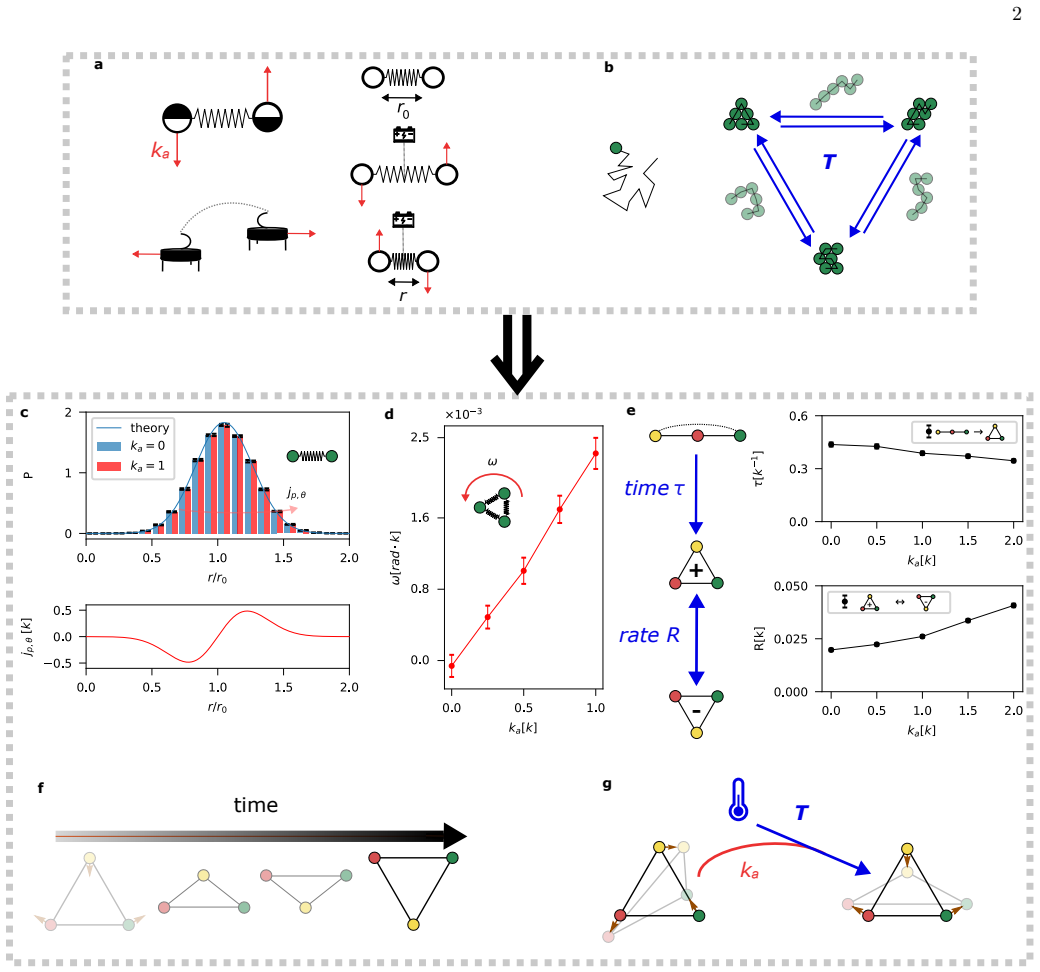
Active self-assembly can bypass equilibrium bottlenecks through external energy injection. However, generic driving typically distorts target structures and requires sustained energy input even after assembly is complete. Here, we investigate a class of non-reciprocal interactions that accelerates assembly while preserving the equilibrium Boltzmann distribution. The probability currents induced by these odd interactions reshape fundamental processes, including activated barrier crossing, soft-mode relaxation, and transitions between metastable states. In particular, these currents enhance Arrhenius rates by driving particles across otherwise inaccessible free-energy barriers. We show that this acceleration arises from an effective increase in the mobility of the reaction coordinate, mediated by non-reciprocal coupling between mechanical modes. In turn, we discover a trade-off between kinetic acceleration and power dissipation when active forces are engaged. Our results suggest a route to energy-efficient, high-fidelity self-assembly via active catalysts that transiently accelerate relaxation toward equilibrium targets and deactivate upon reaching the desired state.
Editorial analysis
A structured set of objections, weighed in public.
Referee Report
Summary. The paper proposes a class of non-reciprocal odd interactions in active self-assembly that induce probability currents to accelerate processes such as activated barrier crossing, soft-mode relaxation, and metastable transitions, while exactly preserving the equilibrium Boltzmann distribution. The acceleration is attributed to an effective increase in the mobility of the reaction coordinate through non-reciprocal coupling between mechanical modes, with an accompanying trade-off in power dissipation. The approach is positioned as enabling transient, energy-efficient catalysis of assembly toward equilibrium targets.
Significance. If the mechanism is robust, the result offers a route to high-fidelity active self-assembly that avoids structural distortion and continuous energy input after completion. This could be relevant for colloidal and soft-matter systems where equilibrium bottlenecks limit practical assembly. The work is credited for identifying the mobility-enhancement pathway and the dissipation trade-off as concrete, testable consequences of the odd couplings.
major comments (2)
- [Model section / Fokker-Planck derivation] The central claim that odd non-reciprocal terms generate non-zero circulatory currents while leaving the stationary density exactly equal to the Boltzmann measure exp(−βU) is load-bearing. The manuscript must explicitly demonstrate that the antisymmetric contribution to the probability current is divergence-free at ρ_eq for the many-body Langevin/Fokker-Planck dynamics, including the required integrability condition on the mobility matrix for arbitrary particle numbers and interaction topologies (see the skeptic note on this point).
- [Results on barrier crossing] The effective-mobility increase for the reaction coordinate (abstract and results) is derived from non-reciprocal mode coupling. The derivation should be shown to remain valid when the odd terms are many-body and not reducible to a single effective coordinate; otherwise the Arrhenius-rate enhancement claim may not generalize beyond the two-particle or low-dimensional cases.
minor comments (2)
- [Abstract] The abstract states both the currents and exact Boltzmann preservation but does not indicate where in the text the integrability proof appears; a brief forward reference would improve readability.
- [Methods / Results] Simulation details, error bars, and parameter ranges for the reported acceleration factors are not summarized in the provided excerpt; these should be added to the main text or SI for reproducibility.
Simulated Author's Rebuttal
We thank the referee for their thorough review and constructive comments on our manuscript. We address the major points raised below and have revised the manuscript to incorporate explicit demonstrations and clarifications where appropriate.
read point-by-point responses
-
Referee: [Model section / Fokker-Planck derivation] The central claim that odd non-reciprocal terms generate non-zero circulatory currents while leaving the stationary density exactly equal to the Boltzmann measure exp(−βU) is load-bearing. The manuscript must explicitly demonstrate that the antisymmetric contribution to the probability current is divergence-free at ρ_eq for the many-body Langevin/Fokker-Planck dynamics, including the required integrability condition on the mobility matrix for arbitrary particle numbers and interaction topologies (see the skeptic note on this point).
Authors: We agree that an explicit demonstration is necessary to fully support the central claim. In the revised manuscript, we will add a new subsection to the Model section together with an appendix that derives the Fokker-Planck operator for the general many-body Langevin dynamics with a position-dependent, antisymmetric mobility matrix. We explicitly show that the divergence of the odd (antisymmetric) contribution to the probability current vanishes identically when evaluated at ρ_eq = exp(−βU). This follows directly from the antisymmetry M_odd^T = −M_odd together with the equilibrium force balance; the resulting current is purely circulatory and divergence-free. The proof is algebraic and holds for arbitrary particle number N and arbitrary interaction topologies. We will also state the required integrability condition on the mobility matrix (ensuring a consistent stochastic calculus, e.g., Stratonovich interpretation) and verify that it is satisfied by the odd couplings employed in the work. revision: yes
-
Referee: [Results on barrier crossing] The effective-mobility increase for the reaction coordinate (abstract and results) is derived from non-reciprocal mode coupling. The derivation should be shown to remain valid when the odd terms are many-body and not reducible to a single effective coordinate; otherwise the Arrhenius-rate enhancement claim may not generalize beyond the two-particle or low-dimensional cases.
Authors: The effective-mobility enhancement is obtained by projecting the full many-body dynamics onto the reaction coordinate. Because the projection integrates out the orthogonal modes, the contribution of the odd couplings to the effective mobility along the reaction coordinate remains valid even when the odd terms are genuinely many-body and cannot be reduced to a single effective coordinate. We will expand the Results section with a general mode-decomposition argument (using the committor or the slowest eigenmode of the linearized dynamics) that demonstrates the Arrhenius-rate increase for arbitrary dimensionality. We will also add numerical illustrations for systems with more than two particles to confirm that the enhancement persists beyond the low-dimensional cases already presented. revision: yes
Circularity Check
No significant circularity in the derivation of accelerated self-assembly
full rationale
The paper constructs non-reciprocal odd interactions within a many-body Langevin or Fokker-Planck framework such that the induced probability currents are divergence-free at the equilibrium Boltzmann measure, thereby preserving exp(−βU) exactly while accelerating barrier crossing and relaxation via effective mobility enhancement. This follows directly from the antisymmetric structure of the mobility matrix and the resulting steady-state condition, without reducing any claimed prediction to a fitted parameter, self-citation loop, or ansatz smuggled from prior work. The trade-off with power dissipation is likewise obtained from the same equations of motion. The central result is therefore self-contained against the model assumptions and does not rely on load-bearing external uniqueness theorems or renaming of known patterns.
Axiom & Free-Parameter Ledger
axioms (2)
- domain assumption Overdamped Langevin dynamics with additive non-reciprocal forces
- ad hoc to paper Non-reciprocal interactions preserve the equilibrium Boltzmann distribution
Reference graph
Works this paper leans on
-
[1]
Self- assembly: from crystals to cells
Bartosz A Grzybowski, Christopher E Wilmer, Jiwon Kim, Kevin P Browne, and Kyle JM Bishop. Self- assembly: from crystals to cells. Soft Matter, 5(6):1110– 1128, 2009
2009
-
[2]
Equilibrium mechanisms of self-limiting assembly
Michael F Hagan and Gregory M Grason. Equilibrium mechanisms of self-limiting assembly. Reviews of modern 7 physics, 93(2):025008, 2021
2021
-
[3]
Reaction-rate theory: fifty years after kramers
Peter H¨ anggi, Peter Talkner, and Michal Borkovec. Reaction-rate theory: fifty years after kramers. Reviews of modern physics, 62(2):251, 1990
1990
-
[4]
The statistical mechanics of dynamic pathways to self-assembly.Annual review of physical chemistry, 66(1):143–163, 2015
Stephen Whitelam and Robert L Jack. The statistical mechanics of dynamic pathways to self-assembly.Annual review of physical chemistry, 66(1):143–163, 2015
2015
-
[5]
An active approach to colloidal self-assembly
Stewart A Mallory, Chantal Valeriani, and Angelo Cac- ciuto. An active approach to colloidal self-assembly. Annual review of physical chemistry, 69:59–79, 2018
2018
-
[6]
Self-assembly and time-dependent control of ac- tive and passive triblock janus colloids
Juri Franz Schubert, Salman Fariz Navas, and Sabine HL Klapp. Self-assembly and time-dependent control of ac- tive and passive triblock janus colloids. The Journal of Chemical Physics, 163(4), 2025
2025
-
[7]
Activity-controlled annealing of colloidal mono- layers
Sophie Ramananarivo, Etienne Ducrot, and Jeremie Palacci. Activity-controlled annealing of colloidal mono- layers. Nature communications, 10(1):3380, 2019
2019
-
[8]
Statistical mechanics of ac- tive ornstein-uhlenbeck particles
David Martin, J´ er´ emy O’Byrne, Michael E Cates, ´Etienne Fodor, Cesare Nardini, Julien Tailleur, and Fr´ ed´ eric Van Wijland. Statistical mechanics of ac- tive ornstein-uhlenbeck particles. Physical Review E, 103(3):032607, 2021
2021
-
[9]
Non-reciprocal phase transitions
Michel Fruchart, Ryo Hanai, Peter B Littlewood, and Vincenzo Vitelli. Non-reciprocal phase transitions. Nature, 592(7854):363–369, 2021
2021
-
[10]
Self-assembly of catalytically active colloidal molecules: tailoring activ- ity through surface chemistry
Rodrigo Soto and Ramin Golestanian. Self-assembly of catalytically active colloidal molecules: tailoring activ- ity through surface chemistry. Physical review letters, 112(6):068301, 2014
2014
-
[11]
Accelerating diffusions
Chii-Ruey Hwang, Shu-Yin Hwang-Ma, and Shuenn-Jyi Sheu. Accelerating diffusions. The Annals of Applied Probability, 15(2), 2005
2005
-
[12]
Acceleration of convergence to equilibrium in markov chains by breaking detailed balance.Journal of statistical physics, 168(2):259–287, 2017
Marcus Kaiser, Robert L Jack, and Johannes Zimmer. Acceleration of convergence to equilibrium in markov chains by breaking detailed balance.Journal of statistical physics, 168(2):259–287, 2017
2017
-
[13]
Sampling efficiency of trans- verse forces in dense liquids
Federico Ghimenti, Ludovic Berthier, Grzegorz Szamel, and Fr´ ed´ eric van Wijland. Sampling efficiency of trans- verse forces in dense liquids. Physical Review Letters, 131(25):257101, 2023
2023
-
[14]
Transverse forces and glassy liquids in infinite dimensions
Federico Ghimenti, Ludovic Berthier, Grzegorz Sza- mel, and Fr´ ed´ eric van Wijland. Transverse forces and glassy liquids in infinite dimensions. Physical Review E, 109(6):064133, 2024
2024
-
[15]
Non-reciprocal multifarious self-organization
Saeed Osat and Ramin Golestanian. Non-reciprocal multifarious self-organization. Nature Nanotechnology, 18(1):79–85, 2023
2023
-
[16]
Escaping kinetic traps using nonrecipro- cal interactions
Saeed Osat, Jakob Metson, Mehran Kardar, and Ramin Golestanian. Escaping kinetic traps using nonrecipro- cal interactions. Physical Review Letters, 133(2):028301, 2024
2024
-
[17]
Continuous-time multifarious systems
Jakob Metson, Saeed Osat, and Ramin Golestanian. Continuous-time multifarious systems. ii. non-reciprocal multifarious self-organization. The Journal of Chemical Physics, 163(12), 2025
2025
-
[18]
Spinning janus doublets driven in uniform ac electric fields
Alicia Boymelgreen, Gilad Yossifon, Sinwook Park, and Touvia Miloh. Spinning janus doublets driven in uniform ac electric fields. Physical Review E, 89(1):011003, 2014
2014
-
[19]
Kilobot: A low cost robot with scalable operations designed for collective behaviors
Michael Rubenstein, Christian Ahler, Nick Hoff, Adrian Cabrera, and Radhika Nagpal. Kilobot: A low cost robot with scalable operations designed for collective behaviors. Robotics and Autonomous Systems, 62(7):966–975, 2014
2014
-
[20]
Self-assembly of emul- sion droplets through programmable folding
Angus McMullen, Maitane Mu˜ noz Basagoiti, Zorana Zeravcic, and Jasna Brujic. Self-assembly of emul- sion droplets through programmable folding. Nature, 610(7932):502–506, 2022
2022
-
[21]
Odd elasticity
Colin Scheibner, Anton Souslov, Debarghya Banerjee, Pi- otr Sur´ owka, William TM Irvine, and Vincenzo Vitelli. Odd elasticity. Nature Physics, 16(4):475–480, 2020
2020
-
[22]
Odd microswimmer
Kento Yasuda, Yuto Hosaka, Isamu Sou, and Shigeyuki Komura. Odd microswimmer. Journal of the Physical Society of Japan, 90(7):075001, 2021
2021
-
[23]
Odd viscosity and odd elasticity
Michel Fruchart, Colin Scheibner, and Vincenzo Vitelli. Odd viscosity and odd elasticity. Annual Review of Condensed Matter Physics, 14(1):471–510, 2023
2023
-
[24]
Direct measurement of the nonconservative force field generated by optical tweezers
Pinyu Wu, Rongxin Huang, Christian Tischer, Alexandr Jonas, and Ernst-Ludwig Florin. Direct measurement of the nonconservative force field generated by optical tweezers. Physical review letters, 103(10):108101, 2009
2009
-
[25]
Brownian vortexes
Bo Sun, Jiayi Lin, Ellis Darby, Alexander Y Grosberg, and David G Grier. Brownian vortexes. Physical Review E—Statistical, Nonlinear, and Soft Matter Physics, 80(1):010401, 2009
2009
-
[26]
Hamiltonian curl forces
MV Berry and Pragya Shukla. Hamiltonian curl forces. Proceedings of the Royal Society A: Mathematical, Physical and Engineering Sciences, 471(2176), 2015
2015
-
[27]
Odd dynam- ics of living chiral crystals
Tzer Han Tan, Alexander Mietke, Junang Li, Yuchao Chen, Hugh Higinbotham, Peter J Foster, Shreyas Gokhale, J¨ orn Dunkel, and Nikta Fakhri. Odd dynam- ics of living chiral crystals. Nature, 607(7918):287–293, 2022
2022
-
[28]
Motile dislocations knead odd crys- tals into whorls
Ephraim S Bililign, Florencio Balboa Usabiaga, Yehuda A Ganan, Alexis Poncet, Vishal Soni, Sofia Magkiriadou, Michael J Shelley, Denis Bartolo, and William TM Irvine. Motile dislocations knead odd crys- tals into whorls. Nature Physics, 18(2):212–218, 2022
2022
-
[29]
Non-reciprocal robotic metamate- rials
Martin Brandenbourger, Xander Locsin, Edan Lerner, and Corentin Coulais. Non-reciprocal robotic metamate- rials. Nature communications, 10(1):4608, 2019
2019
-
[30]
More is less in unpercolated active solids
Jack Binysh, Guido Baardink, Jonas Veenstra, Corentin Coulais, and Anton Souslov. More is less in unpercolated active solids. Physical Review X, 16(2):021012, 2026
2026
-
[31]
Geometric the- ory of (extended) time-reversal symmetries in stochas- tic processes: I
J´ er´ emy O’Byrne and Michael E Cates. Geometric the- ory of (extended) time-reversal symmetries in stochas- tic processes: I. finite dimension. Journal of Statistical Mechanics: Theory and Experiment, 2024(11):113207, 2024
2024
-
[32]
Cluster phases and bubbly phase separation in active flu- ids: Reversal of the ostwald process
Elsen Tjhung, Cesare Nardini, and Michael E Cates. Cluster phases and bubbly phase separation in active flu- ids: Reversal of the ostwald process. Physical Review X, 8(3):031080, 2018
2018
-
[33]
Fold- ing mechanisms at finite temperature
D Rocklin, Vincenzo Vitelli, and Xiaoming Mao. Fold- ing mechanisms at finite temperature. arXiv preprint arXiv:1802.02704, 2018
-
[34]
Theory of protein folding: the en- ergy landscape perspective
Jos´ e Nelson Onuchic, Zaida Luthey-Schulten, and Pe- ter G Wolynes. Theory of protein folding: the en- ergy landscape perspective. Annual review of physical chemistry, 48(1):545–600, 1997
1997
-
[35]
The protein- folding problem, 50 years on
Ken A Dill and Justin L MacCallum. The protein- folding problem, 50 years on. science, 338(6110):1042– 1046, 2012
2012
-
[36]
Dynamic path- ways for viral capsid assembly
Michael F Hagan and David Chandler. Dynamic path- ways for viral capsid assembly. Biophysical journal, 91(1):42–54, 2006
2006
-
[37]
Mechanisms of virus assembly
Jason D Perlmutter and Michael F Hagan. Mechanisms of virus assembly. Annual review of physical chemistry, 8 66(1):217–239, 2015
2015
-
[38]
Anisotropy of building blocks and their assembly into complex struc- tures
Sharon C Glotzer and Michael J Solomon. Anisotropy of building blocks and their assembly into complex struc- tures. Nature materials, 6(8):557–562, 2007
2007
-
[39]
Janus particles
Andreas Walther and Axel HE M¨ uller. Janus particles. Soft matter, 4(4):663–668, 2008
2008
-
[40]
Lock and key colloids
Stefano Sacanna, William TM Irvine, Paul M Chaikin, and David J Pine. Lock and key colloids. Nature, 464(7288):575–578, 2010
2010
-
[41]
Folding dna to create nanoscale shapes and patterns
Paul WK Rothemund. Folding dna to create nanoscale shapes and patterns. Nature, 440(7082):297–302, 2006
2006
-
[42]
Dna origami nano-mechanics
Jiahao Ji, Deepak Karna, and Hanbin Mao. Dna origami nano-mechanics. Chemical Society Reviews, 50(21):11966–11978, 2021
2021
-
[43]
Bioinspired micro- robots
Stefano Palagi and Peer Fischer. Bioinspired micro- robots. Nature Reviews Materials, 3(6):113–124, 2018
2018
-
[44]
Micro/nanorobotic swarms: from fundamentals to functionalities
Junhui Law, Jiangfan Yu, Wentian Tang, Zheyuan Gong, Xian Wang, and Yu Sun. Micro/nanorobotic swarms: from fundamentals to functionalities. ACS nano, 17(14):12971–12999, 2023
2023
-
[45]
Stochastic thermodynamics, fluctuation the- orems and molecular machines
Udo Seifert. Stochastic thermodynamics, fluctuation the- orems and molecular machines. Reports on progress in physics, 75(12):126001, 2012
2012
-
[46]
The Fokker-PlanckEquation Methods of Solution and Applications
Hannes Risken. The Fokker-PlanckEquation Methods of Solution and Applications. Springer, 1989
1989
-
[47]
Multiscale methods: averaging and homogenization
Grigoris Pavliotis and Andrew Stuart. Multiscale methods: averaging and homogenization. Springer Sci- ence & Business Media, 2008. 9 Appendix A: Methods
2008
-
[48]
Langevin dynamics and steady-state probability distribution invariance We consider a minimal stochastic model that isolates non-reciprocal mechanical response. Each particle ex- periences a force composed of three contributions: (i) a reciprocal part derived from a potentialE, (ii) a trans- verse, non-reciprocal odd-elastic component, and (iii) ad- ditive...
-
[49]
Model definitions We consider several models which are all consistent with Eqs. (A2,A3). The number of particles isM. In 10 some cases it is useful to consider the particles as vertices of a polygon whose signed area is A= MX i=1 xiyi+1 −y ixi+1 2 .(A11) in which indices are added moduloM, so (xM+1 , yM+1) = (x1, y1). a. Two particle model.The model of Fi...
-
[50]
A 2, the two-particle model is de- scribed in polar co-ordinates (detailed calculations are given in Supplementary Information)
Analysis of two-particle model As explained in Sec. A 2, the two-particle model is de- scribed in polar co-ordinates (detailed calculations are given in Supplementary Information). The dynamics of the particle separation decouples from the centre of mass; converting the associated Langevin dynamics for (r(t), θ(t)) to a Fokker-Planck equation for the prob...
-
[51]
as ⟨ ˙θ⟩ ≈k a s 2T πkr 2 0 exp − kr2 0 2T .(A17)
-
[52]
Dynamics of the odd square For the odd square model, we explain in the main text that the low-temperature dynamics of the internal an- gleβis described by Eq. (2). We outline the derivation of this result, with details in Supplementary Information. The central assumption is that the configuration remains always close to a rhombus shape, with small deviati...
-
[53]
Equations of motion.All stochastic dynamics were integrated using an Euler-Maruyama scheme
Numerical simulations a. Equations of motion.All stochastic dynamics were integrated using an Euler-Maruyama scheme. The particle positions were updated according to: ri(t+ ∆t) =r i(t) +F i(t)∆t+ √ 2T∆tξ i(t),(A26) withF i(t) as in Eq. (A3), the time step is ∆tand the components of the noise vectorsξ i were sampled as inde- pendent standard normal variate...
-
[54]
Flip ratesRand first-passage timesτestimation Flip rates and first-passage times are defined in terms of basins arounds target states, defined using thresholds on suitable order parameters, as appropriate for each model (see below). For any given initial condition, the mean first passage time is obtained by measuring first time at which the system enters ...
-
[55]
Supplementary Video Supplementary Movies 1 and 2 provide representa- tive stochastic trajectories illustrating the dynamics dis- cussed in the main text. Movie 1 (based on Fig.2b) shows folding of the four-particle square network from a square to a line state under passive (k a = 0) and non-reciprocal (ka = 1) dynamics, together with the time evolution of...
-
[56]
= (−0.5,0),x 0 2 = (x 0 2, y0
-
[57]
= (0, √ 3 2 ),x 0 3 = (x 0 3, y0
-
[58]
= (0.5,0) andX 0 = (x0 1,x 0 2,x 0 3). Considering small deformations of the (passive) spring network about this configuration, the (normalised) eigenmodes are ξx = 1√ 3 (1,0,1,0,1,0), ξy = 1√ 3 (0,1,0,1,0,1), z1 = 1 2 √ 3 1,− √ 3,−2,0,1, √ 3 , z2 = 1 2 √ 3 √ 3,1,0,−2,− √ 3,1 , z3 = 1 2 √ 3 √ 3,1,− √ 3,1,0,−2 , z4 = 1 2 √ 3 −1, √ 3,−1,− √ 3,2,0 . (A40) wh...
-
[59]
= cos β 2 ,0 , (x0 2, y0
-
[60]
= 0,sin β 2 , (x0 3, y0
-
[61]
= −cos β 2 ,0 , (x0 4, y0
-
[62]
= 0,−sin β 2 . (A45) and we write s0 = x0 1, y0 1, x0 2, y0 2, x0 3, y0 3, x0 4, y0 4 (A46) Considering small deformations about this state, the eigenmodes of the square spring network are ξx = 1 2 (1,0,1,0,1,0,1,0), ξy = 1 2 (0,1,0,1,0,1,0,1), za = 1√ 2 0,cos β 2 ,−sin β 2 ,0,0,−cos β 2 ,sin β 2 ,0 , zb = 1√ 2 sin β 2 ,0,0,−cos β 2 ,−sin β 2 ,0,0,cos β 2...
-
[63]
Initialize the assembly in the rectangular configuration (a special case of the ladder state) and measure the time required to reach the chevron configuration, as defined in MethodsA.6
-
[64]
Repeat forNstatistically independent realizations
-
[65]
This protocol assumes that once the chevron configuration is reached, the double-square is immediately stabilized by a bound cargo and does not revert to the ladder state
Collect and sort the transition times to construct the density plot in Fig.3e, representing the distribution of first-passage times from ladder to chevron. This protocol assumes that once the chevron configuration is reached, the double-square is immediately stabilized by a bound cargo and does not revert to the ladder state. The density plot therefore qu...
discussion (0)
Sign in with ORCID, Apple, or X to comment. Anyone can read and Pith papers without signing in.