Recognition: unknown
On the Hybrid Nature of ABPMS Process Frames and its Implications on Automated Process Discovery
Pith reviewed 2026-05-08 11:51 UTC · model grok-4.3
The pith
An ABPMS process frame is a hybrid of semi-concurrently executed procedural and declarative models that supports framed autonomy through constraint-like interpretations.
A machine-rendered reading of the paper's core claim, the machinery that carries it, and where it could break.
Core claim
We conceptualize the notion of an ABPMS process frame as a hybrid business process representation, consisting of semi-concurrently executed procedural and declarative process models. We rely on our earlier works to outline the execution semantics of this type of process frame, arguing in favor of adopting the open-world assumption of the declarative paradigm also for procedural process models. The latter leads to a constraint-like interpretation, where each procedural model is considered to constrain the activities within that model, without imposing explicit execution requirements nor limitations on activities that may be present in other models. This is analogous to existing declarative 1s
What carries the argument
The hybrid process frame of semi-concurrently executed procedural and declarative models, with the open-world assumption applied to procedural models to yield constraint-like interpretations.
If this is right
- The process frame becomes more permissive than traditional models, enabling framed autonomy to emerge in ABPMS.
- Procedural models receive a constraint-like interpretation that affects only their own activities, without global execution mandates.
- Subsets of discovered declarative constraints can be mapped to equivalent semi-concurrently executed procedural fragments.
- This mapping lays the groundwork for automated discovery approaches that handle hybrid process frames.
Where Pith is reading between the lines
- The hybrid representation could allow ABPMS to integrate predefined procedures directly with commonsense rules and best practices in a single frame.
- Automated discovery might handle mixed procedural and declarative knowledge more flexibly than approaches limited to one formalism.
- This view suggests process discovery tools could alternate between constraint extraction and fragment assembly depending on input data.
Load-bearing premise
Adopting the open-world assumption for procedural process models preserves their core characteristics while enabling a constraint-like interpretation without explicit execution requirements.
What would settle it
A set of execution traces where applying the open-world assumption to a procedural model produces activity sequences that violate the original model's intended ordering or completeness semantics.
Figures





read the original abstract
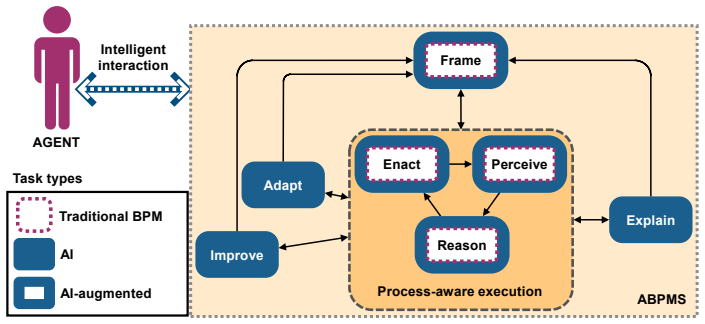
A core component of any AI-Augmented Business Process Management System (ABPMS) is the process frame, which gives the system process-awareness and defines the boundaries in which the system must operate. Compared to traditional process models, the process frame should, in principle, provide a somewhat more permissive representation of the managed processes, such that the (semi) autonomous behavior of an ABPMS, referred to as framed autonomy, could emerge. At the same time, it is not limited to a single linguistic or symbolic formalism and may incorporate heterogeneous knowledge ranging from predefined procedures to commonsense rules and best practices. In this paper, we conceptualize the notion of an ABPMS process frame as a hybrid business process representation, consisting of semi-concurrently executed procedural and declarative process models. We rely on our earlier works to outline the execution semantics of this type of process frame, arguing in favor of adopting the open-world assumption of the declarative paradigm also for procedural process models. The latter leads to a constraint-like interpretation, where each procedural model is considered to constrain the activities within that model, without imposing explicit execution requirements nor limitations on activities that may be present in other models. This is analogous to existing declarative languages, such as Declare, where each constraint has a direct effect only on the specific activities being constrained. Given this similarity, we propose mapping subsets of discovered declarative constraints into equivalent semi-concurrently executed procedural fragments, thus laying the foundation for a corresponding process (frame) discovery approach.
Editorial analysis
A structured set of objections, weighed in public.
Referee Report
Summary. The manuscript conceptualizes ABPMS process frames as hybrid business process representations consisting of semi-concurrently executed procedural and declarative process models. It argues for adopting the open-world assumption for procedural models to enable a constraint-like interpretation without explicit execution requirements, and proposes mapping subsets of discovered declarative constraints into equivalent procedural fragments as a foundation for automated process (frame) discovery.
Significance. If the central claims hold, the work could provide a conceptual bridge between procedural and declarative paradigms in AI-augmented BPM, supporting more permissive 'framed autonomy' in ABPMS. The mapping proposal offers a potential direction for hybrid discovery techniques that integrate both model types.
major comments (1)
- The argument for reinterpreting procedural models under the open-world assumption (detailed in the abstract and the section on execution semantics) is load-bearing for the hybrid claim but provides no formal preservation proof or detailed semantics showing that core prescriptive control-flow properties are retained while remaining distinct from declarative models. Without this, the semi-concurrent hybrid execution risks reducing to an effectively declarative representation, undermining the stated distinction and the proposed mapping.
minor comments (2)
- The manuscript relies heavily on 'our earlier works' for execution semantics; including a self-contained summary or explicit cross-references to specific prior results would improve accessibility.
- The proposal for mapping declarative constraints to procedural fragments is outlined at a high level; adding a concrete example or pseudocode sketch would clarify the implications for automated discovery.
Simulated Author's Rebuttal
We thank the referee for the constructive feedback and the opportunity to clarify the conceptual foundations of ABPMS process frames. We address the major comment point by point below, with a commitment to strengthen the manuscript through targeted revisions.
read point-by-point responses
-
Referee: The argument for reinterpreting procedural models under the open-world assumption (detailed in the abstract and the section on execution semantics) is load-bearing for the hybrid claim but provides no formal preservation proof or detailed semantics showing that core prescriptive control-flow properties are retained while remaining distinct from declarative models. Without this, the semi-concurrent hybrid execution risks reducing to an effectively declarative representation, undermining the stated distinction and the proposed mapping.
Authors: We agree that the manuscript, being primarily conceptual, outlines the execution semantics by reference to our prior works without providing a self-contained formal preservation proof in this submission. The intended distinction rests on procedural models retaining intra-model control-flow prescriptions (e.g., ordering or concurrency relations among their own activities) even under open-world semantics, while declarative components impose cross-model constraints without such structure; semi-concurrent execution then interleaves the two without collapsing the procedural fragments into pure constraints. To address the concern directly, the revised manuscript will expand the execution semantics section with a proof sketch that formally shows preservation of these prescriptive properties within each procedural fragment, demonstrates non-equivalence to a fully declarative model, and illustrates how this supports the proposed mapping of declarative constraints to procedural fragments. This addition will also include a small illustrative example of the hybrid execution trace. revision: yes
Circularity Check
Core hybrid execution semantics and mapping proposal reduce to self-cited prior works
specific steps
-
self citation load bearing
[Abstract]
"We rely on our earlier works to outline the execution semantics of this type of process frame, arguing in favor of adopting the open-world assumption of the declarative paradigm also for procedural process models. The latter leads to a constraint-like interpretation, where each procedural model is considered to constrain the activities within that model, without imposing explicit execution requirements nor limitations on activities that may be present in other models. ... Given this similarity, we propose mapping subsets of discovered declarative constraints into equivalent semi-concurrently 0"
The execution semantics enabling the open-world constraint-like view of procedural models (and thus the hybrid semi-concurrent execution and the mapping proposal) are justified solely by citation to the authors' prior works. This semantics is load-bearing: without it, the claimed hybrid nature (distinct from pure declarative) and the foundation for automated discovery do not follow from the paper's own arguments.
full rationale
The paper's derivation of the ABPMS process frame as a hybrid representation and the proposed mapping of declarative constraints to procedural fragments both rest on execution semantics that are explicitly outlined only via reference to the authors' earlier works. The open-world reinterpretation of procedural models (constraint-like without explicit execution requirements) is presented as enabling the semi-concurrent hybrid and the mapping, yet no independent formal preservation argument or external benchmark is supplied here. This constitutes self-citation load-bearing for the central claim, as the hybrid distinction and discovery implications collapse without the prior self-defined semantics. The paper remains self-contained on the high-level conceptualization but the load-bearing steps are not independently verified within this manuscript.
Axiom & Free-Parameter Ledger
axioms (1)
- domain assumption Open-world assumption applies to procedural process models, treating them as constraints without explicit execution requirements
invented entities (1)
-
Hybrid ABPMS process frame
no independent evidence
Reference graph
Works this paper leans on
-
[1]
Dumas, F
M. Dumas, F. Fournier, L. Limonad, A. Marrella, M. Montali, J. Rehse, R. Accorsi, D. Calvanese, G. De Giacomo, D. Fahland, A. Gal, M. La Rosa, H. Völzer, I. Weber, AI-augmented business process management systems: A research manifesto, ACM Trans. Manag. Inf. Syst. 14 (1) (2023) 11:1–11:19
2023
-
[2]
A. A. Andaloussi, A. Burattin, T. Slaats, E. Kindler, B. Weber, On the declarative paradigm in hybrid business process representations: A conceptual framework and a systematic literature study, Inf. Syst. 91 (2020) 101505
2020
-
[3]
Bandara, A
W. Bandara, A. Van Looy, M. Rosemann, L. Meyers, A call for ’holistic’ business process management, in: Problems@BPM, Vol. 2938 of CEUR Workshop Proceedings, CEUR-WS.org, 2021, pp. 6–10
2021
-
[4]
Alman, F
A. Alman, F. M. Maggi, M. Montali, F. Patrizi, A. Rivkin, Monitoring hybrid process specifications with conflict management: An automata- theoretic approach, Artificial Intelligence in Medicine 139 (2023) 102512
2023
-
[5]
Alman, F
A. Alman, F. M. Maggi, M. Montali, F. Patrizi, A. Rivkin, A framework for modeling, executing, and monitoring hybrid multi-process specifi- cations with bounded global–local memory, Information Systems 119 (2023) 102271. 34
2023
-
[6]
Acitelli, A
G. Acitelli, A. Alman, F. M. Maggi, A. Marrella, Achieving framed au- tonomy in AI-augmented business process management systems through automated planning, Inf. Syst. 133 (2025) 102573
2025
-
[7]
P.H.Wittlinger, G.Acitelli, A.Alman, F.M.Maggi, A.Marrella, Fraim: A what-if analysis tool enabling framed autonomy via automated plan- ning, in: BPM (Demos / Resources Forum), CEUR Workshop Proceed- ings, CEUR-WS.org, 2025, pp. 192–199
2025
-
[8]
Alman, F
A. Alman, F. M. Maggi, S. Rinderle-Ma, A. Rivkin, K. Winter, Towards a multi-model paradigm for business process management, in: CAiSE, Vol. 14663 of Lecture Notes in Computer Science, Springer, 2024, pp. 178–194
2024
-
[9]
F. M. Maggi, A. Alman, P. H. Wittlinger, From constraint-based pro- cess modeling to framed autonomy: A historical excursus, in: Mining a Scientist’s Process: Essays Dedicated to Wil van der Aalst on the Oc- casion of His 60th Birthday, Springer Nature Switzerland, Cham, 2026, pp. 199–211
2026
-
[10]
Murata, Petri nets: Properties, analysis and applications, Proc
T. Murata, Petri nets: Properties, analysis and applications, Proc. IEEE 77 (4) (1989) 541–580
1989
-
[11]
K. M. van Hee, N. Sidorova, J. M. E. M. van der Werf, Business process modeling using Petri nets, Trans. Petri Nets Other Model. Concurr. 7 (2013) 116–161
2013
-
[12]
Pesic, H
M. Pesic, H. Schonenberg, W. M. P. van der Aalst, DECLARE: Full support for loosely-structured processes, in: EDOC, IEEE Computer Society, 2007, pp. 287–300
2007
-
[13]
Alman, I
A. Alman, I. Cohen, A. Gal, F. M. Maggi, M. Montali, Discovering pro- cess framing for AI-augmented BPM systems in a multi-process setting, in: PMAI@ECAI, Vol. 3779 of CEUR Workshop Proceedings, CEUR- WS.org, 2024, pp. 47–58
2024
-
[14]
Sadiq, W
S. Sadiq, W. Sadiq, M. E. Orlowska, Pockets of flexibility in workflow specification, in: ER, Lecture Notes in Computer Science, Springer, 2001, pp. 513–526. 35
2001
-
[15]
Pesic, Constraint-based workflow management systems : shifting control to users, PhD thesis, Technische Universiteit Eindhoven (2008)
M. Pesic, Constraint-based workflow management systems : shifting control to users, PhD thesis, Technische Universiteit Eindhoven (2008)
2008
-
[16]
Alman, C
A. Alman, C. Di Ciccio, F. M. Maggi, M. Montali, H. van der Aa, RuM: Declarative process mining, distilled, in: BPM, Vol. 12875 of Lecture Notes in Computer Science, Springer, 2021, pp. 23–29
2021
-
[17]
P. Bär, M. T. Wynn, S. J. J. Leemans, A full picture in conformance checking: Efficiently summarizing all optimal alignments, in: BPM, Lec- ture Notes in Computer Science, Springer, 2025, pp. 69–87
2025
-
[18]
URLhttps://www.omg.org/spec/BPMN/2.0.2/PDF
OMG, Business process model and notation (BPMN), Technical report, Object Management Group, version 2.0.2 (2014). URLhttps://www.omg.org/spec/BPMN/2.0.2/PDF
2014
-
[19]
Debois, T
S. Debois, T. T. Hildebrandt, T. Slaats, Hierarchical declarative mod- elling with refinement and sub-processes, in: BPM, Vol. 8659, Springer, 2014, pp. 18–33
2014
-
[20]
T. T. Hildebrandt, R. R. Mukkamala, Declarative event-based workflow as distributed dynamic condition response graphs, in: PLACES, Vol. 69 of EPTCS, 2010, pp. 59–73
2010
-
[21]
URLhttps://www.omg.org/spec/SBVR/1.5/
OMG, Semantics of business vocabulary and business rules (SBVR), Technical report, Object Management Group, (accessed 22.01.26) (2019). URLhttps://www.omg.org/spec/SBVR/1.5/
2019
-
[22]
Boley, S
H. Boley, S. Tabet, G. Wagner, Design rationale for RuleML: A markup language for semantic web rules, in: SWWS, 2001, pp. 381–401
2001
-
[23]
D. L. McGuinness, F. Van Harmelen, OWL web ontology language overview, W3C recommendation(accessed 22.01.26) (2004). URLhttp://www.w3.org/TR/2004/REC-owl-features-20040210/
2004
-
[24]
A. B. Benevides, G. Guizzardi, A model-based tool for conceptual mod- eling and domain ontology engineering in ontouml, in: ICEIS, Vol. 24 of Lecture Notes in Business Information Processing, Springer, 2009, pp. 528–538. 36
2009
-
[25]
Sterling, K
L. Sterling, K. Taveter, The art of agent-oriented modeling, MIT Press, 2009
2009
-
[26]
Dumas, M
M. Dumas, M. La Rosa, J. Mendling, H. A. Reijers, Fundamentals of Business Process Management, Second Edition, Springer, 2018
2018
-
[27]
A. J. M. M. Weijters, W. M. P. van der Aalst, Rediscovering workflow models from event-based data using little thumb, Integr. Comput. Aided Eng. 10 (2) (2003) 151–162
2003
-
[28]
S. J. J. Leemans, D. Fahland, W. M. P. van der Aalst, Discovering block-structured process models from event logs containing infrequent behaviour, in: Business Process Management Workshops, Lecture Notes in Business Information Processing, Springer, 2013, pp. 66–78
2013
-
[29]
Augusto, R
A. Augusto, R. Conforti, M. Dumas, M. La Rosa, A. Polyvyanyy, Split miner: Automated discovery of accurate and simple business process models from event logs, Knowl. Inf. Syst. 59 (2) (2019) 251–284
2019
-
[30]
Support Syst
J.DeSmedt, J.DeWeerdt, J.Vanthienen, Fusionminer: Processdiscov- ery for mixed-paradigm models, Decis. Support Syst. 77 (2015) 123–136
2015
-
[31]
8659 of Lecture Notes in Computer Science, Springer, 2014, pp
F.M.Maggi, T.Slaats, H.A.Reijers, Theautomateddiscoveryofhybrid processes, in: BPM, Vol. 8659 of Lecture Notes in Computer Science, Springer, 2014, pp. 392–399
2014
-
[32]
W. M. P. van der Aalst, Object-centric process mining: Dealing with divergence and convergence in event data, in: SEFM, Lecture Notes in Computer Science, Springer, 2019, pp. 3–25
2019
-
[33]
W. M. P. van der Aalst, A. Berti, Discovering object-centric Petri nets, Fundam. Informaticae 175 (1-4) (2020) 1–40
2020
-
[34]
J. N. van Detten, P. Schumacher, S. J. J. Leemans, Discovering compact, live and identifier-sound object-centric process models, in: ICPM, IEEE, 2024, pp. 113–120
2024
-
[35]
Küsters, W
A. Küsters, W. M. P. van der Aalst, OC-DECLARE: Discovering object- centric declarative patterns with synchronization, in: BPM, Lecture Notes in Computer Science, Springer, 2025, pp. 162–179. 37
2025
-
[36]
Haisjackl, S
C. Haisjackl, S. Zugal, P. Soffer, I. Hadar, M. Reichert, J. Pinggera, B. Weber, Making sense of declarative process models: Common strate- gies and typical pitfalls, in: BMMDS/EMMSAD, Lecture Notes in Busi- ness Information Processing, Springer, 2013, pp. 2–17
2013
-
[37]
De Smedt, J
J. De Smedt, J. De Weerdt, E. Serral, J. Vanthienen, Discovering hidden dependencies in constraint-based declarative process models for improv- ing understandability, Inf. Syst. 74 (Part) (2018) 40–52
2018
-
[38]
C. W. Günther, A. Rozinat, W. M. P. van der Aalst, Activity mining by global trace segmentation, in: Business Process Management Work- shops, LectureNotesinBusinessInformationProcessing, Springer, 2009, pp. 128–139
2009
-
[39]
F. M. Maggi, C. Di Ciccio, C. Di Francescomarino, T. Kala, Parallel algorithms for the automated discovery of declarative process models, Inf. Syst. 74 (Part) (2018) 136–152
2018
-
[40]
C. D. Ciccio, M. Mecella, On the discovery of declarative control flows for artful processes, ACM Trans. Manag. Inf. Syst. 5 (4) (2015) 24:1– 24:37
2015
-
[41]
Westergaard, Better algorithms for analyzing and enacting declar- ative workflow languages using LTL, in: BPM, Vol
M. Westergaard, Better algorithms for analyzing and enacting declar- ative workflow languages using LTL, in: BPM, Vol. 6896 of LNCS, Springer, 2011, pp. 83–98
2011
-
[42]
M. B. Dwyer, G. S. Avrunin, J. C. Corbett, Patterns in property speci- fications for finite-state verification, in: ICSE, ACM, 1999, pp. 411–420
1999
-
[43]
Montali, Specification and Verification of Declarative Open Inter- action Models - A Logic-Based Approach, Vol
M. Montali, Specification and Verification of Declarative Open Inter- action Models - A Logic-Based Approach, Vol. 56 of Lecture Notes in Business Information Processing, Springer, 2010
2010
-
[44]
W. M. P. van der Aalst, Process Mining - Discovery, Conformance and Enhancement of Business Processes, Springer, 2011
2011
-
[45]
Alman, F
A. Alman, F. M. Maggi, M. Montali, A. Rivkin, Generating event logs from hybrid process models, in: Business Process Management Work- shops, Vol. 492 of Lecture Notes in Business Information Processing, Springer, 2023, pp. 289–301. 38
2023
-
[46]
Kupferman, M
O. Kupferman, M. Y. Vardi, Vacuity detection in temporal model check- ing, Int. J. Softw. Tools Technol. Transf. 4 (2) (2003) 224–233
2003
-
[47]
F. M. Maggi, R. P. J. C. Bose, W. M. P. van der Aalst, A knowledge- based integrated approach for discovering and repairing declare maps, in: CAiSE, Vol. 7908 of Lecture Notes in Computer Science, Springer, 2013, pp. 433–448
2013
-
[48]
M. L. Bernardi, A. Casciani, M. Cimitile, A. Marrella, A preliminary study on business process-aware large language models, in: Ital-IA, Vol. 3762 of CEUR Workshop Proceedings, CEUR-WS.org, 2024, pp. 441– 446
2024
-
[49]
Casciani, Conversational AI for framed autonomy in AI-augmented business process management, in: BPM (Demos / Resources Forum), Vol
A. Casciani, Conversational AI for framed autonomy in AI-augmented business process management, in: BPM (Demos / Resources Forum), Vol. 3758 of CEUR Workshop Proceedings, CEUR-WS.org, 2024, pp. 53–60
2024
-
[50]
Casciani, Integrating LLMs and symbolic reasoning for framed auton- omy in AI-augmented business process management, in: CAiSE Forum, Vol
A. Casciani, Integrating LLMs and symbolic reasoning for framed auton- omy in AI-augmented business process management, in: CAiSE Forum, Vol. 557 of Lecture Notes in Business Information Processing, Springer, 2025, pp. 277–285
2025
-
[51]
Casciani, M
A. Casciani, M. L. Bernardi, M. Cimitile, A. Marrella, Conversational systems for AI-augmented business process management, in: RCIS (1), Vol. 513 of Lecture Notes in Business Information Processing, Springer, 2024, pp. 183–200
2024
-
[52]
Conversational Process Model Redesign
N. Klievtsova, T. Kampik, J. Mangler, S. Rinderle-Ma, Conversational process model redesign, CoRR abs/2505.05453 (2025)
work page internal anchor Pith review Pith/arXiv arXiv 2025
- [53]
-
[54]
L. Limonad, F. Fournier, H. Mulian, G. Manias, S. Borotis, D. Kyrkou, Selecting the right LLM for eGov explanations, CoRR abs/2504.21032 (2025). 39
-
[55]
Fournier, L
F. Fournier, L. Limonad, I. Skarbovsky, Towards a benchmark for causal business process reasoning with LLMs, in: Business Process Manage- ment Workshops, Vol. 534 of Lecture Notes in Business Information Processing, Springer, 2024, pp. 233–246
2024
-
[56]
M. L. Bernardi, A. Casciani, M. Cimitile, A. Marrella, Conversing with business process-aware large language models: the BPLLM framework, J. Intell. Inf. Syst. 62 (6) (2024) 1607–1629
2024
-
[57]
A. Buss, W. Kratsch, S. J. Schmid, H. Wang, ProcessLLM: A large lan- guage model specialized in the interpretation, analysis, and optimization ofbusinessprocesses, in: BusinessProcessManagementWorkshops, Vol. 534 of Lecture Notes in Business Information Processing, Springer, 2024, pp. 221–232
2024
-
[58]
Kampik, C
T. Kampik, C. Warmuth, A. Rebmann, R. Agam, L. N. P. Egger, A. Gerber, J. Hoffart, J. Kolk, P. Herzig, G. Decker, H. van der Aa, A. Polyvyanyy, S. Rinderle-Ma, I. Weber, M. Weidlich, Large process models: A vision for business process management in the age of gener- ative AI, Künstliche Intell. 39 (2) (2025) 81–95
2025
-
[59]
Chapela-Campa, M
D. Chapela-Campa, M. Dumas, From process mining to augmented pro- cess execution, Softw. Syst. Model. 22 (6) (2023) 1977–1986
2023
-
[60]
Elyasaf, A
A. Elyasaf, A. Metzger, S. Sardina, A. Senderovich, E. S. Asensio, N. Tax, Toward self-modifying autonomous business process systems, in: PMAI, CEUR Workshop Proceedings, CEUR-WS.org, 2025
2025
-
[61]
Acitelli, S
G. Acitelli, S. Agostinelli, A. Casciani, A. Marrella, An end-to-end ex- ecution of a logistic process in an AI-augmented business process man- agement system, in: PMAI@ECAI, Vol. 3779 of CEUR Workshop Pro- ceedings, CEUR-WS.org, 2024, pp. 5–10
2024
-
[62]
Agentic Business Process Management: A Research Manifesto
D. Calvanese, A. Casciani, G. D. Giacomo, M. Dumas, F. Fournier, T. Kampik, E. L. Malfa, L. Limonad, A. Marrella, A. Metzger, M. Mon- tali, D. Amyot, P. Fettke, A. Polyvyanyy, S. Rinderle-Ma, S. Sardiña, N. Tax, B. Weber, Agentic business process management: A research manifesto (2026). arXiv:2603.18916. 40
work page internal anchor Pith review Pith/arXiv arXiv 2026
-
[63]
Montali, AI for declarative processes: Representation, mining, syn- thesis, in: ECAI, Vol
M. Montali, AI for declarative processes: Representation, mining, syn- thesis, in: ECAI, Vol. 392 of Frontiers in Artificial Intelligence and Ap- plications, IOS Press, 2024, pp. 17–24
2024
-
[64]
S. W. Sadiq, M. E. Orlowska, W. Sadiq, Specification and validation of process constraints for flexible workflows, Inf. Syst. 30 (5) (2005) 349– 378
2005
-
[65]
A. H. M. ter Hofstede, W. M. P. van der Aalst, M. Adams, N. Russell (Eds.), Modern Business Process Automation - YAWL and its Support Environment, Springer, 2010
2010
-
[66]
Slaats, D
T. Slaats, D. M. M. Schunselaar, F. M. Maggi, H. A. Reijers, The se- mantics of hybrid process models, in: OTM Conferences, Vol. 10033, 2016, pp. 531–551
2016
-
[67]
D. M. M. Schunselaar, T. Slaats, F. M. Maggi, H. A. Reijers, W. M. P. vanderAalst, Mining hybrid business process models: A quest for better precision, in: BIS, Vol. 320 of Lecture Notes in Business Information Processing, Springer, 2018, pp. 190–205
2018
-
[68]
S. J. J. Leemans, D. Fahland, W. M. P. van der Aalst, Discovering block- structured process models from event logs - A constructive approach, in: Petri Nets, Vol. 7927 of Lecture Notes in Computer Science, Springer, 2013, pp. 311–329
2013
-
[69]
De Smedt, J
J. De Smedt, J. De Weerdt, J. Vanthienen, G. Poels, Mixed-paradigm process modeling with intertwined state spaces, Bus. Inf. Syst. Eng. 58 (1) (2016) 19–29
2016
-
[70]
B. F. van Dongen, J. De Smedt, C. Di Ciccio, J. Mendling, Conformance checking of mixed-paradigm process models, Inf. Syst. 102 (2021)
2021
-
[71]
N. Tax, N. Sidorova, R. Haakma, W. M. P. van der Aalst, Mining local process models, J. Innov. Digit. Ecosyst. 3 (2) (2016) 183–196
2016
-
[72]
Brunings, D
M. Brunings, D. Fahland, B. F. van Dongen, Defining meaningful local process models, Trans. Petri Nets Other Model. Concurr. 16 (2022) 24– 48. 41
2022
-
[73]
Carmona, Projection approaches to process mining using region-based techniques, Data Mining and Knowledge Discovery 24 (2012) 218–246
J. Carmona, Projection approaches to process mining using region-based techniques, Data Mining and Knowledge Discovery 24 (2012) 218–246
2012
-
[74]
M. Solé, J. Carmona, Region-based foldings in process discovery, IEEE Transactions on Knowledge and Data Engineering 25 (1) (2011) 192– 205
2011
-
[75]
R. H. Bemthuis, M. Koot, M. R. K. Mes, F. A. Bukhsh, M. Iacob, N. Meratnia, An agent-based process mining architecture for emergent behavior analysis, in: EDOC Workshops, IEEE, 2019, pp. 54–64
2019
-
[76]
W. M. P. van der Aalst, Object-centric process mining: Unraveling the fabric of real processes, Mathematics 11 (12) (2023)
2023
-
[77]
A. K. F. Christfort, A. Rivkin, D. Fahland, T. T. Hildebrandt, T. Slaats, Discovery of object-centric declarative models, in: ICPM, IEEE, 2024, pp. 121–128
2024
-
[78]
Fahland, Process mining over multiple behavioral dimensions with event knowledge graphs, in: Process Mining Handbook, Vol
D. Fahland, Process mining over multiple behavioral dimensions with event knowledge graphs, in: Process Mining Handbook, Vol. 448 of Lec- ture Notes in Business Information Processing, Springer, 2022, pp. 274– 319
2022
-
[79]
De Smedt, S
J. De Smedt, S. vanden Broucke, J. Weerdt, J. Vanthienen, A full R/I- net construct lexicon for declare constraints, Tech. rep., KU Leuven (02 2015)
2015
-
[80]
A. K. A. De Medeiros, Genetic process mining, Ph.D. thesis, Technical University of Eindhoven (2006). 42
2006
discussion (0)
Sign in with ORCID, Apple, or X to comment. Anyone can read and Pith papers without signing in.