Mean-Field Theory for the Three-State Active Lattice Gas Model
Pith reviewed 2026-05-08 09:27 UTC · model grok-4.3
The pith
A mean-field theory on a triangular lattice identifies stable high-density ordered structures in the density-noise plane for a simplified three-state active lattice gas.
A machine-rendered reading of the paper's core claim, the machinery that carries it, and where it could break.
Core claim
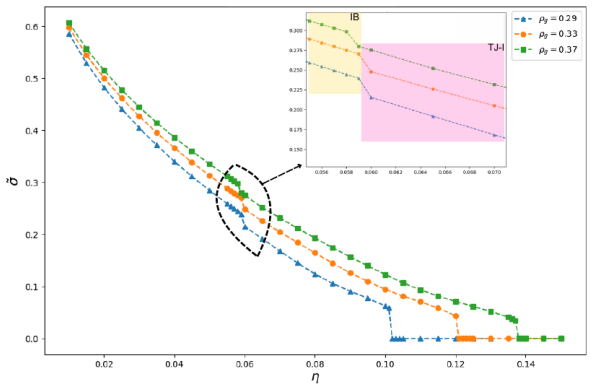
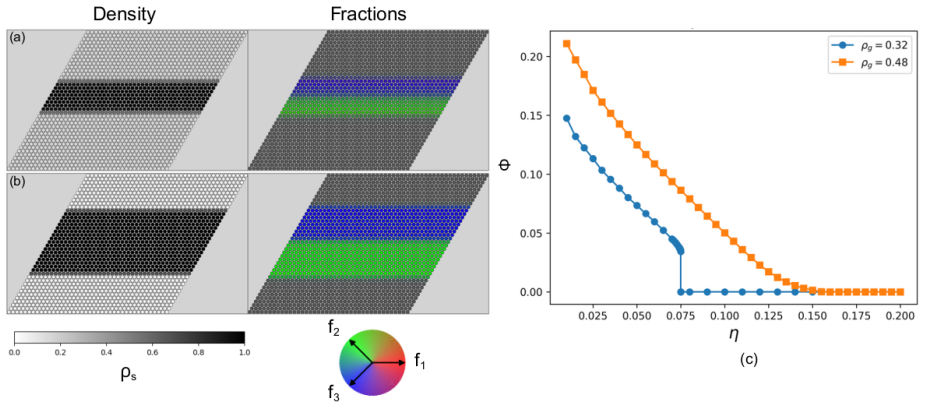
Starting from various ordered initial configurations, the mean-field equations on the triangular lattice are integrated to determine the stability of stationary states. This mapping in the density-noise plane uncovers multiple high-density ordered structures. Comparison with Monte Carlo simulations confirms many of these but indicates unexpected transitions between ordered configuration types in certain parameter regimes.
What carries the argument
The mean-field closure on the triangular lattice, which approximates local densities by products of neighboring site averages in the evolution equations for the three states.
If this is right
- High-density ordered structures persist in specific areas of the density-noise plane.
- Some ordered configurations undergo transitions to other types as density or noise varies.
- The mean-field predictions match Monte Carlo results except in cases of unexpected transitions.
- The stability of each stationary state depends on the initial ordered configuration.
Where Pith is reading between the lines
- Mean-field methods may still capture qualitative active-matter phase behavior despite ignoring fluctuations.
- Fluctuations neglected near phase boundaries could shift the locations of the observed transitions.
- Adding higher-order correlation terms would provide a direct test of where the current closure breaks down.
Load-bearing premise
Local particle correlations can be accurately replaced by the product of average densities on neighboring lattice sites across the entire density-noise plane.
What would settle it
Observing in Monte Carlo simulations that the ordered structures predicted by the mean-field equations do not appear or that the transitions occur at different parameter values would indicate the mean-field approximation fails.
Figures






read the original abstract
We develop a mean-field description including spatial structure for a simplified version of the three-state active matter model studied by Venzel et al. (Phys. Rev. E 110, 014109 (2024)). The resulting triangular lattice of coupled nonlinear differential equations are integrated numerically using a fourth-order Runge-Kutta scheme. Starting from various ordered initial configurations, we probe the stability of the corresponding stationary states, revealing the presence of various high-density ordered structures in the density(\r{ho})-noise({\eta}) plane. The results are compared with Monte Carlo simulations of the simplified model, yielding, in certain cases, unexpected transitions between ordered configuration types.
Editorial analysis
A structured set of objections, weighed in public.
Referee Report
Summary. The paper develops a mean-field description for a simplified three-state active lattice gas model on a triangular lattice. It derives a system of coupled nonlinear ODEs for the densities of the three particle states at each lattice site by applying a closure that replaces local correlations with products of average densities. These ODEs are integrated forward in time using a fourth-order Runge-Kutta scheme starting from various ordered initial configurations. The resulting stable stationary states are mapped in the density-noise (ρ, η) plane, revealing multiple high-density ordered structures; these mean-field predictions are then compared against Monte Carlo simulations of the underlying stochastic model, which in some parameter regions exhibit unexpected transitions between ordered configuration types.
Significance. If the mean-field closure holds in the relevant regimes, the work supplies a deterministic, computationally tractable route to scan the stability of ordered phases and locate transitions in an active lattice gas, thereby complementing direct stochastic sampling. The explicit comparison to Monte Carlo runs provides a concrete test of the approximation and highlights potentially interesting discrepancies that could guide further study of correlation effects in active matter.
major comments (3)
- [Numerical integration] Numerical integration section: the fourth-order Runge-Kutta scheme is stated, yet no lattice size, time-step value, convergence tests, or quantitative criteria (e.g., tolerance on order-parameter drift or density fluctuations) are supplied for declaring a configuration stable or for locating transitions. These details are required to reproduce and validate the reported structures in the (ρ, η) plane.
- [Mean-field derivation] Mean-field closure (derivation of the ODEs): the replacement of pair correlations by products of site densities is the central approximation. In the high-density ordered phases where the paper identifies multiple structures, exclusion and directed motion are expected to generate strong short-range correlations that violate this ansatz. The manuscript should supply direct diagnostics (e.g., measured g(r) from MC versus the product assumption, or order-parameter mismatch across the reported transition lines) to establish that the closure remains accurate in the regimes that matter.
- [Comparison with Monte Carlo] Comparison with Monte Carlo simulations: while MC runs are performed, no quantitative measures of agreement (order-parameter differences, transition-point shifts, or correlation-function residuals) are reported. Without these, it is impossible to determine whether the “unexpected transitions” survive beyond the mean-field level or are artifacts of the closure.
minor comments (2)
- [Abstract] Abstract: the notation “density(ρ)” is rendered as “density(ρ)” with a LaTeX artifact; correct to standard ρ.
- [Model and equations] Notation: ensure consistent use of symbols for density and noise throughout; the triangular-lattice coordination number should be stated explicitly when the mean-field equations are written.
Simulated Author's Rebuttal
We thank the referee for the thorough review and valuable suggestions. We address each of the major comments below and have made revisions to the manuscript to improve clarity and reproducibility.
read point-by-point responses
-
Referee: [Numerical integration] Numerical integration section: the fourth-order Runge-Kutta scheme is stated, yet no lattice size, time-step value, convergence tests, or quantitative criteria (e.g., tolerance on order-parameter drift or density fluctuations) are supplied for declaring a configuration stable or for locating transitions. These details are required to reproduce and validate the reported structures in the (ρ, η) plane.
Authors: We agree with the referee that these numerical details are essential for reproducibility. In the revised manuscript, we have added the following information to the Numerical integration section: All simulations were performed on a triangular lattice of size 100 × 100 sites with periodic boundary conditions. The time step used in the fourth-order Runge-Kutta integrator is Δt = 0.01. A configuration is considered stable when the maximum change in any density over 1000 time steps is less than 10^{-6}. We have also performed convergence tests by varying the lattice size from 50×50 to 200×200 and time steps from 0.001 to 0.05, confirming that the reported phase boundaries are insensitive to these choices within the stated precision. These additions are now included in the main text and a new supplementary figure shows the convergence data. revision: yes
-
Referee: [Mean-field derivation] Mean-field closure (derivation of the ODEs): the replacement of pair correlations by products of site densities is the central approximation. In the high-density ordered phases where the paper identifies multiple structures, exclusion and directed motion are expected to generate strong short-range correlations that violate this ansatz. The manuscript should supply direct diagnostics (e.g., measured g(r) from MC versus the product assumption, or order-parameter mismatch across the reported transition lines) to establish that the closure remains accurate in the regimes that matter.
Authors: The referee raises an important point regarding the validity of the mean-field closure in dense regimes. While we acknowledge that strong correlations may exist, the mean-field approach is intended as an approximation to efficiently explore the phase space. To address this, we have added a new subsection in the revised manuscript that compares the mean-field predicted order parameters with those obtained from Monte Carlo simulations at representative points in the (ρ, η) plane. Although direct pair correlation functions g(r) were not computed in the original study, the qualitative agreement in the stability regions of the ordered phases suggests that the closure captures the main features. We note that quantitative discrepancies, such as the unexpected transitions mentioned, may indeed arise from neglected correlations, and we discuss this as a limitation in the revised text. A full computation of g(r) would require significant additional computational effort but could be pursued in future work. revision: partial
-
Referee: [Comparison with Monte Carlo] Comparison with Monte Carlo simulations: while MC runs are performed, no quantitative measures of agreement (order-parameter differences, transition-point shifts, or correlation-function residuals) are reported. Without these, it is impossible to determine whether the “unexpected transitions” survive beyond the mean-field level or are artifacts of the closure.
Authors: We thank the referee for this observation. In the original manuscript, the comparison was primarily qualitative. In the revised version, we have included quantitative measures: specifically, we report the differences in the critical noise values η_c for transitions between ordered states, with mean-field and MC values listed in a new table. Additionally, we provide the root-mean-square deviation of the order parameters between the two methods at selected densities. These metrics indicate that while the mean-field captures the overall structure, there are shifts in transition points of up to 15%, highlighting the role of correlations. This strengthens the discussion of the unexpected transitions. revision: yes
Circularity Check
Mean-field derivation is self-contained; no reductions to inputs by construction
full rationale
The paper derives the closed system of nonlinear ODEs on the triangular lattice directly from the transition rules of the simplified three-state active lattice gas model by replacing pair correlations with products of local densities (standard mean-field closure). These ODEs are then integrated forward in time from chosen ordered initial conditions using Runge-Kutta to locate stationary states in the (ρ, η) plane. The resulting structures are compared against independent Monte Carlo trajectories of the identical stochastic model. No parameter is fitted to a data subset and then relabeled as a prediction, no uniqueness theorem is imported from prior self-work, and the model definition itself is taken as external input rather than derived from the mean-field output. The derivation chain therefore remains non-circular.
Axiom & Free-Parameter Ledger
axioms (1)
- domain assumption Local particle densities on neighboring sites can be replaced by products of average densities (mean-field closure)
Reference graph
Works this paper leans on
-
[1]
Escaping this state requires the introduction of fluctuations in the local fractions and/or in the density, thereby driving the system away from the homogeneous disordered state. Consequently, it is not possible to construct, within the mean-field approach, a random initial condition equivalent to that used in simulations, which may account for the differ...
-
[2]
M. Ballerini, N. Cabibbo, R. Candelier, A. Cavagna, E. Cisbani, I. Giardina, V. Lecomte, A. Orlandi, G. Parisi, M. Procaccini, M. Viale, and V. Zdravkovic, Interaction ruling animal collective behavior depends on topological rather than metric distance: Evidence from a field study, Proceedings of the National Academy of Sciences105, 1232 (2008)
work page 2008
-
[3]
F. Ginelli, F. Peruani, M.-H. Pillot, H. Chat´ e, G. Theraulaz, and R. Bon, Intermittent collec- tive dynamics emerge from conflicting imperatives in sheep herds, Proceedings of the National Academy of Sciences112, 12729 (2015)
work page 2015
- [4]
-
[5]
H. P. Zhang, A. Be’er, E.-L. Florin, and H. L. Swinney, Collective motion and density fluc- tuations in bacterial colonies, Proceedings of the National Academy of Sciences107, 13626 (2010). 32
work page 2010
- [6]
-
[7]
G. Gr´ egoire and H. Chat´ e, Onset of collective and cohesive motion, Phys. Rev. Lett.92, 025702 (2004)
work page 2004
-
[8]
A. P. Solon and J. Tailleur, Revisiting the flocking transition using active spins, Phys. Rev. Lett.111, 07810 (2013)
work page 2013
-
[9]
A. P. Solon and J. Tailleur, Flocking with discrete symmetry: The two-dimensional active Ising model, Phys. Rev. E92, 042119 (2015)
work page 2015
-
[10]
S. Chatterjee, M. Mangeat, R. Paul, and H. Rieger, Flocking and reorientation transition in the 4-state active Potts model, Europhys. Lett.130, 66001 (2020)
work page 2020
-
[11]
M. Mangeat, S. Chatterjee, R. Paul, and H. Rieger, Flocking with a q-fold discrete symmetry: Band-to-lane transition in the active Potts model, Phys. Rev. E102, 042601 (2020)
work page 2020
-
[12]
A. P. Solon, H. Chat´ e, and J. Tailleur, From phase to microphase separation in flocking models: The essential role of nonequilibrium fluctuations, Phys. Rev. Lett.114, 068101 (2015)
work page 2015
-
[13]
M. Karmakar, S. Chatterjee, R. Paul, and H. Rieger, Consequence of anisotropy on flocking: the discretized Vicsek model, New Journal of Physics26, 043023 (2024)
work page 2024
-
[14]
S. Chatterjee, M. Mangeat, and H. Rieger, Polar flocks with discretized directions: The active clock model approaching the Vicsek model, Europhys. Lett.138, 41001 (2022)
work page 2022
- [15]
-
[16]
M. Karmakar, S. Chatterjee, M. Mangeat, H. Rieger, and R. Paul, Jamming and flocking in the restricted active Potts model, Phys. Rev. E108, 014604 (2023)
work page 2023
-
[17]
F. Peruani, T. Klauss, A. Deutsch, and A. Voss-Boehme, Traffic jams, gliders, and bands in the quest for collective motion of self-propelled particles, Phys. Rev. Lett.106, 128101 (2011)
work page 2011
-
[18]
T. V. Rosembach, A. L. N. Dias, and R. Dickman, Three-state active lattice gas: A discrete Vicsek-like model with excluded volume, Phys. Rev. E110, 014109 (2024)
work page 2024
-
[19]
M. Plischke and B. Bergersen, Equilibrium Statistical Physics (World Scientific Publishing Co. Pte. Ltd., 2006)
work page 2006
-
[20]
See Supplemental Material [URL will be inserted by publisher] for videos of the time evolution for different initial conditions and for a discussion on density fluctuations and full occupancy
-
[21]
We have not studied collisions between MBs, but this remains an interesting question for 33 future work
-
[22]
A. L. N. Dias, Mean Field Theory for a Vicsek-like Model on a Lattice, Master’s thesis, Uni- versidade Federal de Minas Gerais, Belo Horizonte, Brazil (2022)
work page 2022
-
[23]
A. L. N. Dias, T. V. Rosembach, and R. Dickman, Supplementary videos for: Mean-field theory for the three-state active lattice gas model (2026). 34
work page 2026
discussion (0)
Sign in with ORCID, Apple, or X to comment. Anyone can read and Pith papers without signing in.