Accurate calculation of Wannier centers, position matrix, and composite operators using translationally equivariant and higher-order finite differences
Pith reviewed 2026-05-08 11:17 UTC · model grok-4.3
The pith
A translationally equivariant finite-difference scheme combined with higher-order stencils improves accuracy of Wannier centers, polarization, and related quantities while preserving crystal symmetries.
A machine-rendered reading of the paper's core claim, the machinery that carries it, and where it could break.
Core claim
The central claim is that a translationally equivariant formulation of the finite-difference approximation for position and composite operators, together with higher-order difference stencils, supplies a more accurate and symmetry-preserving route to the k-space derivatives required by Wannier interpolation, thereby reducing errors and improving convergence for Wannier centers and spreads, electric polarization, off-diagonal position matrix elements, orbital magnetization, and spin Hall conductivity.
What carries the argument
The translationally equivariant finite-difference scheme for position matrix elements, which constructs the stencil so that the approximation commutes with lattice translations and therefore preserves the underlying crystal symmetries.
If this is right
- Wannier centers and spreads converge faster with k-point density.
- Electric polarization and orbital magnetization calculations become more reliable on modest k-grids.
- Spin Hall conductivity and other response functions inherit the same accuracy gain.
- The generalization that reduces the number of finite-difference points can lower computational cost while retaining accuracy.
- The methods integrate into existing Wannier codes with only small additional coding effort.
Where Pith is reading between the lines
- The equivariant property could simplify error analysis in low-symmetry or defective systems where symmetry violations were previously difficult to isolate.
- Coarser initial k-grids may become sufficient for target accuracy in large-unit-cell or high-throughput studies.
- The same stencil construction might be adapted to other Berry-phase or quantum-geometric quantities that rely on k-derivatives of Bloch states.
Load-bearing premise
That the dominant source of inaccuracy in practical Wannier interpolation is the finite-difference step on the coarse grid rather than other interpolation ingredients or basis-set limitations.
What would settle it
A direct comparison on a simple crystal such as silicon or GaAs in which the new scheme produces polarization or orbital-magnetization values that differ from the standard finite-difference result by an amount larger than the claimed error reduction, or in which symmetry-violating components remain visible.
Figures




read the original abstract
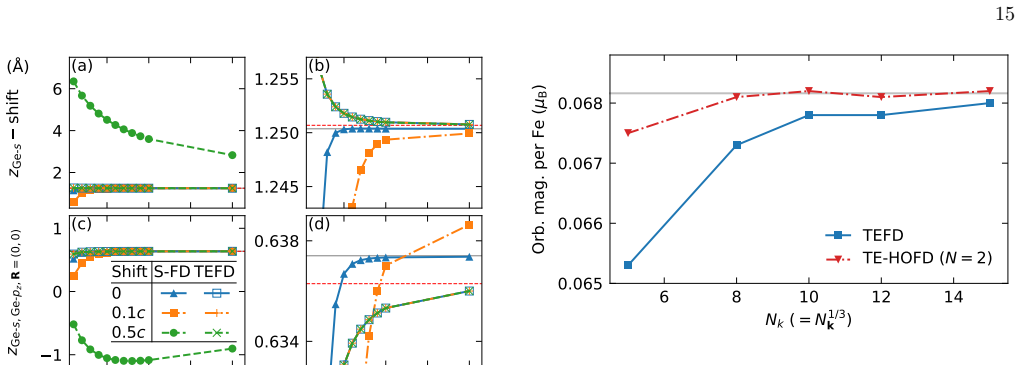
The momentum-space derivatives of Bloch wavefunctions are essential for studying quantum geometry and the equilibrium and response properties of solids. In practical first-principles calculations, these derivatives are obtained via Wannier interpolation of position and related composite matrices. These matrices are initially evaluated on a coarse k-point grid using finite-difference approximations and then interpolated to a dense grid. The accuracy of the finite-difference approximation directly impacts the convergence and reliability of the result. In this work, we present two key improvements to the finite-difference calculation of position and composite operators for Wannier interpolation. First, we formulate a translationally equivariant scheme that preserves the underlying symmetries of the system and significantly reduces finite-difference errors. Second, we introduce a higher-order finite-difference approach that yields a more accurate approximation of the k-space derivatives by systematically increasing the convergence rate. From a real-space perspective, these improvements correspond to better approximations of the position operator at the locations of the Wannier functions. We also present a generalization of the finite-difference scheme, which may reduce the number of finite-difference points while maintaining accuracy. We demonstrate the effectiveness of our methods by applying them to the calculation of Wannier centers and spreads, electric polarization, off-diagonal position matrix elements, orbital magnetization, and spin Hall conductivity. Our results demonstrate significant reductions in finite-difference errors, elimination of symmetry-violating errors, and improved convergence with respect to k-point sampling. These methods have been implemented in the open-source packages and can be readily adopted in other Wannier-based codes with minimal computational overhead.
Editorial analysis
A structured set of objections, weighed in public.
Referee Report
Summary. The manuscript introduces a translationally equivariant finite-difference scheme and a higher-order stencil approach for computing position and composite operator matrices on coarse k-grids in Wannier interpolation. These modifications are claimed to preserve underlying symmetries, reduce finite-difference errors, and improve k-point convergence for quantities including Wannier centers and spreads, electric polarization, off-diagonal position elements, orbital magnetization, and spin Hall conductivity. The methods are presented as direct, parameter-free enhancements with a real-space interpretation as improved position-operator approximations at Wannier-function locations, and they are implemented in open-source packages.
Significance. If the reported error reductions and symmetry preservation are confirmed, the work provides a low-overhead, readily adoptable improvement to standard Wannier-based calculations of quantum-geometric and response properties. The explicit parameter-free character, open-source implementation, and applicability across multiple observables constitute clear strengths that could enhance reproducibility and reliability in first-principles studies without altering existing codebases.
major comments (2)
- [Abstract and §3] Abstract and §3: the claim that the equivariant scheme 'eliminates symmetry-violating errors' requires a direct side-by-side comparison (e.g., a table of symmetry-breaking residuals for a non-centrosymmetric test case) against the conventional finite-difference construction; without such quantitative evidence the elimination statement remains unverified.
- [§4.2] §4.2, Eq. (higher-order stencil): the generalization that reduces the number of finite-difference points while preserving accuracy is introduced, yet its effect on composite operators entering the spin-Hall conductivity is not accompanied by explicit error-vs-k-grid curves; this leaves open whether the reduced-point variant retains the higher-order convergence rate for all demonstrated quantities.
minor comments (2)
- Figure captions and §5 should explicitly state the k-grid densities and the reference 'exact' values used to compute the reported error reductions.
- A short paragraph on the additional floating-point operations per matrix element would help readers assess the 'minimal overhead' claim.
Simulated Author's Rebuttal
We thank the referee for the careful review and positive recommendation. We address the two major comments below and will incorporate the suggested additions in the revised manuscript.
read point-by-point responses
-
Referee: [Abstract and §3] Abstract and §3: the claim that the equivariant scheme 'eliminates symmetry-violating errors' requires a direct side-by-side comparison (e.g., a table of symmetry-breaking residuals for a non-centrosymmetric test case) against the conventional finite-difference construction; without such quantitative evidence the elimination statement remains unverified.
Authors: We agree that a direct quantitative comparison strengthens the claim. The equivariant scheme is constructed to preserve translational equivariance and thus the underlying crystal symmetries by design, which eliminates the symmetry-breaking residuals that arise from the conventional centered-difference approximation on a discrete k-grid. In the revised manuscript we will add a table in §3 that reports the symmetry-breaking residuals (e.g., the magnitude of the imaginary part of the position-matrix elements for a non-centrosymmetric test case such as GaAs) for both the conventional and equivariant schemes on identical coarse k-grids. This will provide explicit numerical confirmation that the residuals drop to machine precision with the equivariant construction while remaining finite with the standard approach. revision: yes
-
Referee: [§4.2] §4.2, Eq. (higher-order stencil): the generalization that reduces the number of finite-difference points while preserving accuracy is introduced, yet its effect on composite operators entering the spin-Hall conductivity is not accompanied by explicit error-vs-k-grid curves; this leaves open whether the reduced-point variant retains the higher-order convergence rate for all demonstrated quantities.
Authors: We thank the referee for this observation. The higher-order stencil and its reduced-point generalization are formulated in a manner that preserves the formal order of accuracy for any composite operator constructed from the position matrix, including those entering the spin Hall conductivity. Nevertheless, we acknowledge that explicit convergence curves for the spin Hall conductivity with the reduced-point variant were not shown. In the revision we will add error-versus-k-grid plots for the spin Hall conductivity (both intrinsic and extrinsic contributions) using the full higher-order stencil and the reduced-point variant, confirming that the higher-order convergence rate is retained for this observable as well. revision: yes
Circularity Check
No significant circularity detected
full rationale
The paper introduces two algorithmic enhancements to standard finite-difference evaluation of position and composite operator matrices on coarse k-grids for Wannier interpolation: a translationally equivariant scheme that preserves crystal symmetries and a higher-order stencil that raises the convergence order. These are presented as direct, parameter-free modifications to the existing finite-difference construction, with the accuracy improvements for Wannier centers, polarization, orbital magnetization, and spin Hall conductivity arising from the improved numerical approximation itself rather than from any fitted parameter, self-definition, or load-bearing self-citation. No step in the derivation reduces by construction to a quantity defined inside the paper; the central claims remain independent numerical results that can be verified against external benchmarks or exact limits without circularity.
Axiom & Free-Parameter Ledger
axioms (1)
- domain assumption Bloch wavefunctions are periodic in reciprocal space and can be represented on a discrete k-grid for finite-difference operations.
Forward citations
Cited by 1 Pith paper
-
Self-consistent evaluation of the Berry connection for Wannier functions
A matrix-logarithm self-consistent interpolation for the Berry connection improves accuracy over prior schemes by respecting the full overlap matrix structure and relating basis incompleteness to the invariant spread ...
Reference graph
Works this paper leans on
-
[1]
or the proposed method [Eqs. (D21)–(D24)]. We used the first-order TEFD method on a 20×20×20 coarsek-point grid in both cases. 5 10 15 20 Nk ( = N1/3 k ) 0 50 100 150 cumul xyz (S eV2/cm e) (a) Ryoo et al. This work 0.00 0.02 0.04 1/N2 k (b) FIG. 13. Cumulative spin Hall conductivity [Eq. (70)] of GaAs as a function of the (a) coarse grid size and (b) its...
-
[2]
HOFD conditions and the error We derive the HOFD condition in Eq. (71). First, we begin by reviewing the first-order case. For a set ofb vectors that connectkto neighboring grid points, we approximate thek-gradient with the ansatz ∇αf(k)≈ ∇ FD α f(k) = X b c|b|bαf(k+b).(F1) Now, let us Taylor expandf(k+b) aroundkas f(k+b) = X n=0 f(n) α1α2···αn n! bα1 bα2...
-
[3]
Multiples method In this subsection, we derive thec |b| coefficients for the HOFD multiples method. We first review the one- dimensional case and then discuss how this can be com- bined with the first-order FD method to obtain HOFD methods in higher dimensions. In the one-dimensionalNth-order HOFD method, bvectors are taken from the set{−N b,−(N− 1)b,· · ...
-
[4]
D. Xiao, M.-C. Chang, and Q. Niu, Berry phase effects on electronic properties, Rev. Mod. Phys.82, 1959 (2010)
work page 1959
- [5]
-
[6]
J. Yu, B. A. Bernevig, R. Queiroz, E. Rossi, P. T¨ orm¨ a, and B.-J. Yang, Quantum geometry in quantum materi- als, npj Quantum Materials10, 101 (2025)
work page 2025
-
[7]
R. D. King-Smith and D. Vanderbilt, Theory of polariza- tion of crystalline solids, Phys. Rev. B47, 1651 (1993)
work page 1993
-
[8]
R. Resta, Macroscopic electric polarization as a geomet- ric quantum phase, Europhysics Letters22, 133 (1993)
work page 1993
-
[9]
D. Vanderbilt and R. D. King-Smith, Electric polariza- tion as a bulk quantity and its relation to surface charge, 27 Phys. Rev. B48, 4442 (1993)
work page 1993
-
[10]
G. Ortiz and R. M. Martin, Macroscopic polarization as a geometric quantum phase: Many-body formulation, Phys. Rev. B49, 14202 (1994)
work page 1994
-
[11]
Resta, Macroscopic polarization in crystalline di- electrics: the geometric phase approach, Rev
R. Resta, Macroscopic polarization in crystalline di- electrics: the geometric phase approach, Rev. Mod. Phys. 66, 899 (1994)
work page 1994
-
[12]
T. Thonhauser, D. Ceresoli, D. Vanderbilt, and R. Resta, Orbital magnetization in periodic insulators, Phys. Rev. Lett.95, 137205 (2005)
work page 2005
-
[13]
D. Xiao, J. Shi, and Q. Niu, Berry phase correction to electron density of states in solids, Phys. Rev. Lett.95, 137204 (2005)
work page 2005
-
[14]
D. Ceresoli, T. Thonhauser, D. Vanderbilt, and R. Resta, Orbital magnetization in crystalline solids: Multi-band insulators, chern insulators, and metals, Phys. Rev. B 74, 024408 (2006)
work page 2006
-
[15]
J. Shi, G. Vignale, D. Xiao, and Q. Niu, Quantum theory of orbital magnetization and its generalization to inter- acting systems, Phys. Rev. Lett.99, 197202 (2007)
work page 2007
-
[16]
M.-C. Chang and Q. Niu, Berry phase, hyperorbits, and the hofstadter spectrum: Semiclassical dynamics in mag- netic bloch bands, Phys. Rev. B53, 7010 (1996)
work page 1996
-
[17]
G. Sundaram and Q. Niu, Wave-packet dynamics in slowly perturbed crystals: Gradient corrections and berry-phase effects, Phys. Rev. B59, 14915 (1999)
work page 1999
-
[18]
M. Onoda and N. Nagaosa, Topological nature of anoma- lous hall effect in ferromagnets, Journal of the Physical Society of Japan71, 19 (2002)
work page 2002
-
[19]
T. Jungwirth, Q. Niu, and A. H. MacDonald, Anomalous hall effect in ferromagnetic semiconductors, Phys. Rev. Lett.88, 207208 (2002)
work page 2002
-
[20]
J. E. Sipe and A. I. Shkrebtii, Second-order optical re- sponse in semiconductors, Phys. Rev. B61, 5337 (2000)
work page 2000
-
[21]
G. Y. Guo, Y. Yao, and Q. Niu, Ab initio calculation of the intrinsic spin Hall effect in semiconductors, Phys. Rev. Lett.94, 226601 (2005)
work page 2005
- [22]
-
[23]
G. H. Wannier, The structure of electronic excitation lev- els in insulating crystals, Phys. Rev.52, 191 (1937)
work page 1937
-
[24]
Kohn, Analytic properties of Bloch waves and wan- nier functions, Phys
W. Kohn, Analytic properties of Bloch waves and wan- nier functions, Phys. Rev.115, 809 (1959)
work page 1959
-
[25]
N. Marzari and D. Vanderbilt, Maximally-localized gen- eralized Wannier functions for composite energy bands, Phys. Rev. B56, 12847 (1997)
work page 1997
- [26]
-
[27]
N. Marzari, A. A. Mostofi, J. R. Yates, I. Souza, and D. Vanderbilt, Maximally localized Wannier functions: Theory and applications, Rev. Mod. Phys.84, 1419 (2012)
work page 2012
-
[28]
A. A. Mostofi, J. R. Yates, Y.-S. Lee, I. Souza, D. Van- derbilt, and N. Marzari, Wannier90: A tool for obtaining maximally-localised Wannier functions, Comput. Phys. Commun.178, 685 (2008)
work page 2008
-
[29]
G. Pizzi, V. Vitale, R. Arita, S. Bl¨ ugel, F. Freimuth, G. G´ eranton, M. Gibertini, D. Gresch, C. Johnson, T. Koretsune, J. Iba˜ nez-Azpiroz, H. Lee, J.-M. Lihm, D. Marchand, A. Marrazzo, Y. Mokrousov, J. I. Mustafa, Y. Nohara, Y. Nomura, L. Paulatto, S. Ponc´ e, T. Pon- weiser, J. Qiao, F. Th¨ ole, S. S. Tsirkin, M. Wierzbowska, N. Marzari, D. Vanderbi...
work page 2020
-
[30]
S. Ponc´ e, E. Margine, C. Verdi, and F. Giustino, EPW: Electron-phonon coupling, transport and superconduct- ing properties using maximally localized Wannier func- tions, Comput. Phys. Commun.209, 116 (2016)
work page 2016
-
[31]
Q. Wu, S. Zhang, H.-F. Song, M. Troyer, and A. A. Soluyanov, WannierTools: An open-source software pack- age for novel topological materials, Comput. Phys. Com- mun.224, 405 (2018)
work page 2018
-
[32]
S. S. Tsirkin, High performance Wannier interpolation of Berry curvature and related quantities with Wannier- Berri code, npj Comput. Mater.7, 1 (2021)
work page 2021
-
[33]
H. Lee, S. Ponc´ e, K. Bushick, S. Hajinazar, J. Lafuente- Bartolome, J. Leveillee, C. Lian, J.-M. Lihm, F. Macheda, H. Mori, H. Paudyal, W. H. Sio, S. Tiwari, M. Zacharias, X. Zhang, N. Bonini, E. Kioupakis, E. R. Margine, and F. Giustino, Electron–phonon physics from first principles using the EPW code, npj Comput. Mater.9, 156 (2023)
work page 2023
-
[34]
A. Marrazzo, S. Beck, E. R. Margine, N. Marzari, A. A. Mostofi, J. Qiao, I. Souza, S. S. Tsirkin, J. R. Yates, and G. Pizzi, Wannier-function software ecosystem for mate- rials simulations, Rev. Mod. Phys.96, 045008 (2024)
work page 2024
-
[35]
D. S´ anchez-Portal, I. Souza, and R. M. Martin, LCAO calculation of dynamical charges and ferroelectricity, AIP Conf. Proc.535, 111 (2000)
work page 2000
-
[36]
J. M. Soler, E. Artacho, J. D. Gale, A. Garc´ ıa, J. Jun- quera, P. Ordej´ on, and D. S´ anchez-Portal, The SIESTA method for ab initio order-Nmaterials simulation, J. Phys. Condens. Matter14, 2745 (2002)
work page 2002
-
[37]
M. Stengel and N. A. Spaldin, Accurate polarization within a unified Wannier function formalism, Phys. Rev. B73, 075121 (2006)
work page 2006
-
[38]
M. G. Lopez, D. Vanderbilt, T. Thonhauser, and I. Souza, Wannier-based calculation of the orbital magnetization in crystals, Phys. Rev. B85, 014435 (2012)
work page 2012
-
[39]
J. Qiao, J. Zhou, Z. Yuan, and W. Zhao, Calculation of intrinsic spin hall conductivity by Wannier interpolation, Phys. Rev. B98, 214402 (2018)
work page 2018
-
[40]
J. H. Ryoo, C.-H. Park, and I. Souza, Computation of intrinsic spin hall conductivities from first principles us- ing maximally localized Wannier functions, Phys. Rev. B 99, 235113 (2019)
work page 2019
-
[41]
Blount, Formalisms of band theory (Academic Press,
E. Blount, Formalisms of band theory (Academic Press,
-
[42]
X. Wang, J. R. Yates, I. Souza, and D. Vanderbilt, Ab initio calculation of the anomalous hall conductivity by Wannier interpolation, Phys. Rev. B74, 195118 (2006)
work page 2006
-
[43]
Sakuma, Symmetry-adapted Wannier functions in the maximal localization procedure, Phys
R. Sakuma, Symmetry-adapted Wannier functions in the maximal localization procedure, Phys. Rev. B87, 235109 (2013)
work page 2013
-
[44]
T. Koretsune, Construction of maximally-localized wan- nier functions using crystal symmetry, Computer Physics Communications285, 108645 (2023)
work page 2023
-
[45]
R. Oiwa, A. Inda, S. Hayami, T. Nomoto, R. Arita, and H. Kusunose, Symmetry-adapted closest wannier model- ing based on complete multipole basis set, Phys. Rev. B 112, 035116 (2025)
work page 2025
-
[46]
G. Cistaro, M. Malakhov, J. J. Esteve-Paredes, A. J. Ur´ ıa-´Alvarez, R. E. F. Silva, F. Mart´ ın, J. J. Palacios, 28 and A. Pic´ on, Theoretical approach for electron dynam- ics and ultrafast spectroscopy (EDUS), J. Chem. Theory Comput.19, 333 (2023)
work page 2023
-
[47]
P. L. Silvestrelli, Maximally localized Wannier func- tions for simulations with supercells of general symmetry, Phys. Rev. B59, 9703 (1999)
work page 1999
-
[48]
M. Posternak, A. Baldereschi, S. Massidda, and N. Marzari, Maximally localized Wannier functions in antiferromagnetic MnO within the FLAPW formalism, Phys. Rev. B65, 184422 (2002)
work page 2002
-
[49]
The method of Ref. [34], which uses a sawtooth wave to calculate the Wannier centers, can be regarded as an infinite-order HOFD
-
[50]
J.-M. Lihm, Accurate calculation of Wannier centers and position matrix elements I: Translationally-invariant for- mula,https://indico.ictp.it/event/9851/session/ 27/contribution/105/material/video/(2022), talk at the Wannier 2022 Developers Meeting
work page 2022
-
[51]
M. Ghim, Accurate calculation of Wannier centers and position matrix elements II: Higher-order finite differ- ence,https://indico.ictp.it/event/9851/session/ 27/contribution/106/material/video/(2022), talk at the Wannier 2022 Developers Meeting
work page 2022
-
[52]
S. Ponc´ e, M. Royo, M. Stengel, N. Marzari, and M. Gib- ertini, Long-range electrostatic contribution to electron- phonon couplings and mobilities of two-dimensional and bulk materials, Phys. Rev. B107, 155424 (2023)
work page 2023
-
[53]
A. Urru, I. Souza, O. P. Oca˜ na, S. S. Tsirkin, and D. Van- derbilt, Optical spatial dispersion via wannier interpola- tion, Phys. Rev. B112, 045201 (2025)
work page 2025
-
[54]
16-vikrant and W.-B. Contributors, Discrepancy in shift current results: postw90 vs wannierberri (issue #477), GitHub Issue (2026), issue #477, wannier-berri/wannier- berri repository
work page 2026
-
[55]
Self-consistent evaluation of the Berry connection for Wannier functions
M. Th¨ ummler, A. Croy, T. Lettau, U. Peschel, and S. Gr¨ afe, Self-consistent evaluation of the Berry con- nection for Wannier functions (2026), arXiv:2604.21660 [cond-mat.mtrl-sci]
work page internal anchor Pith review Pith/arXiv arXiv 2026
-
[56]
P. Giannozzi, S. Baroni, N. Bonini, M. Calandra, R. Car, C. Cavazzoni, D. Ceresoli, G. L. Chiarotti, M. Cococ- cioni, I. Dabo,et al., Quantum ESPRESSO: a modular and open-source software project for quantum simula- tions of materials, J. Phys. Condens. Matter21, 395502 (2009)
work page 2009
-
[57]
P. Giannozzi, O. Andreussi, T. Brumme, O. Bunau, M. B. Nardelli, M. Calandra, R. Car, C. Cavazzoni, D. Ceresoli, M. Cococcioni,et al., Advanced capabilities for materials modelling with Quantum ESPRESSO, J. Phys. Condens. Matter29, 465901 (2017)
work page 2017
-
[58]
J. Qiao, G. Pizzi, and N. Marzari, Automated mixing of maximally localized Wannier functions into target man- ifolds, Npj Comput. Mater.9, 206 (2023)
work page 2023
-
[59]
M. van Setten, M. Giantomassi, E. Bousquet, M. Ver- straete, D. Hamann, X. Gonze, and G.-M. Rignanese, The PseudoDojo: Training and grading a 85 element op- timized norm-conserving pseudopotential table, Comput. Phys. Commun.226, 39 (2018)
work page 2018
-
[60]
J. P. Perdew, K. Burke, and M. Ernzerhof, Generalized gradient approximation made simple, Phys. Rev. Lett. 77, 3865 (1996)
work page 1996
- [61]
discussion (0)
Sign in with ORCID, Apple, or X to comment. Anyone can read and Pith papers without signing in.